Phuket is a large island, and “where to buy” matters more than “what to buy”: the same budget in different areas delivers different yield, liquidity and audience. The west coast with its top beaches traditionally leads on demand, but each area has its own logic. Here are the key locations for investment — from premium Layan to the affordable south — and how to choose for your goal.
Contents
- How to choose an area
- Island map: west, south, east
- Layan — quiet and growth
- Bang Tao — mature hub
- Surin — premium
- Kamala — family growth
- Rawai and Nai Harn — south
- Kata and Karon — footfall
- Nai Thon and Nai Yang — north
- Area comparison
- Three investor profiles
- Area-choice pitfalls
- How to vet an area before buying
- Case: area for your goal
1. How to choose an area
The area drives yield and liquidity more than the unit itself. Selection criteria:
- Rental demand — tourist footfall and year-round occupancy.
- Infrastructure — restaurants, schools, healthcare, transport.
- Audience — families, couples, long-stay, tourists.
- Price and growth potential — mature area (stability) or growing (capital growth).
- Liquidity — how easily you can resell.
The important part: these criteria almost never align all at once. A mature area with maximum infrastructure is already expensive — growth headroom is limited. A growing area offers a low entry and potential, but some infrastructure will only arrive in a few years. A cheap area with weak tourist flow may never reach decent occupancy. Choosing an area is therefore always a deliberate trade-off for a specific goal, not a hunt for a universal “best place.”
A practical sequence — five steps:
- Define the goal: income now, capital growth toward handover, or living with partial rental.
- Fix the budget and payment form — lump sum or developer installments.
- Filter areas by audience: who will you rent to — families, premium guests, long-stay expats?
- Check the logistics: distance to the airport, schools, shops and clinics.
- Compare 2–3 specific projects in the finalist areas with a yield calculation, not “by feel.”
🔗 Strategy basics: Phuket investment guide →
2. Island map: west, south, east
Before comparing individual beaches, it helps to see the whole picture. The island roughly splits into three investment belts:
- West — the sunset side with the main sandy beaches: from quiet Nai Thon and Layan in the north through mature Bang Tao, Surin and Kamala down to touristy Patong. This is where the main tourist flow, premium projects and peak rental demand are concentrated.
- South — Rawai, Nai Harn, partly Kata: the expat community, long-term rental, more affordable prices and life “for yourself.”
- East and Phuket Town — marinas, business life and the local market: a different audience, less tourist flow, but steady long-term demand. More in our east coast overview.
The general pattern of the west coast: the further north, the quieter and more premium; the closer to Patong, the denser and more mass-market. For an investor this means different income models: the north works on a premium and family audience with a high ticket, the southwest on mass short-term flow.
🔗 Full location map: Phuket districts →
3. Layan — quiet and growth
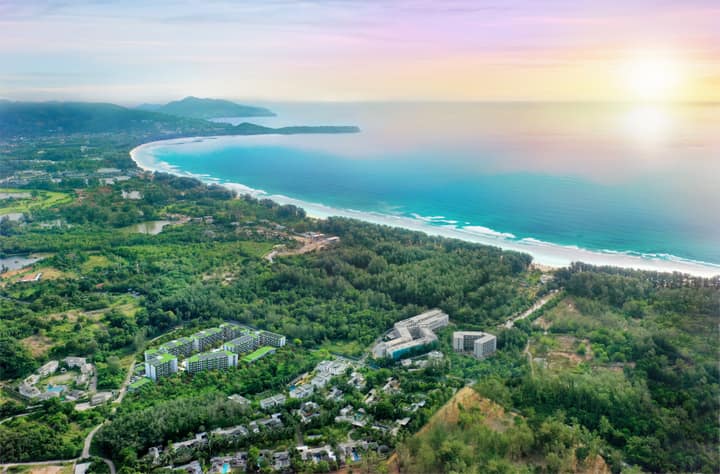
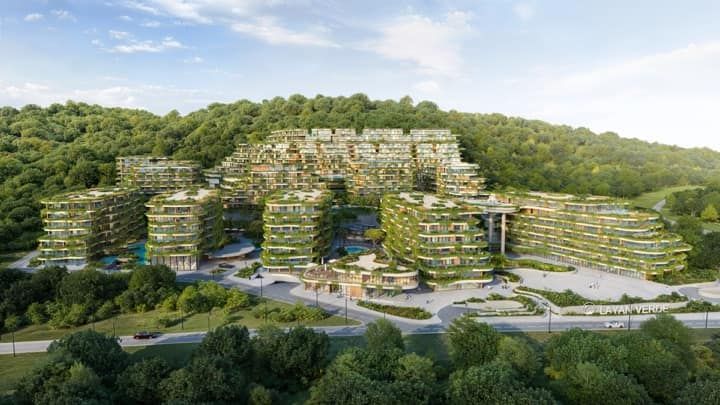
Layan is a calm, green area with one of the island’s cleanest beaches. Less dense development, premium privacy, new beachfront projects — for example Layan Verde, 700 m from the beach. Investor pros: growth potential of new projects and a statement location. Con: infrastructure is still developing.
Layan’s key mechanic is scarcity. Almost no free land remains by this bay, while demand for a clean, quiet shore keeps growing. Layan Verde is 774 residences on 7.5 ha with handover in 2028, entry from $235,995 with installments over the construction period; the developer forecasts capitalization of around +45% over the construction period (a forecast, not a guarantee). Nearby, Layan Green Park is already operating — Phuket’s first condo-hotel with the EDGE eco-certificate (up to 40% savings on utilities): phase 1 with 248 units is fully sold out and has hosted guests since 2024 — ready proof of demand for the area, unpacked in the phase 1 case study.
Layan’s “undeveloped infrastructure” is also relative: the full Bang Tao service set (Boat Avenue, schools, clinics) is 5–10 minutes away, and the airport is about 20 minutes — closer than from most western resort areas. The area’s villas and apartments are gathered in the Layan villas collection.
4. Bang Tao — mature hub
Bang Tao is the west coast’s largest resort hub: the Laguna complex, Boat Avenue, restaurants, international schools, clinics. Mature infrastructure drives steady year-round rental demand. The Layan Green Park condo-hotel with its completed phase 1 operates here. Pro: predictable income. Con: higher price for completed.
The area’s scale impresses even by Phuket standards: Bang Tao beach is about 8 km of sand, one of the longest on the island. Inside — the Laguna Phuket resort cluster with a golf course, the Boat Avenue dining hub and Porto de Phuket with supermarkets and restaurants, plus statement beach clubs. The UWC Thailand and HeadStart international schools are 15–20 minutes away, Bangkok Hospital Phuket about 25 minutes, the airport around 30 minutes.
The flip side of maturity is entry economics: almost no free land remains near the beachfront, so large new projects with launch prices come out not in Bang Tao itself but in neighbouring Layan, 5–10 minutes away. In Bang Tao an investor more often buys completed stock or a resale — pricier, but earning from the first month. A detailed breakdown is in the Bang Tao guide and the Laguna cluster overview; villas are in the Bang Tao collection.
🔗 Direct comparison: Layan vs Bang Tao →
5. Surin — premium
Surin is one of Phuket’s most prestigious beaches, “Millionaire’s Row.” Premium villas and residences, a high rental rate, an affluent audience. Pro: status and a high absolute price. Con: a high entry point and more niche resale demand.
Surin’s economics are built on scarcity and status: a compact bay, little land, dense and expensive development. In our selection practice, a villa in Surin can cost nearly double a comparable-class unit in a project under construction in Layan, 20 minutes north — that difference is what the buyer pays for the address itself. For a “yield per dollar invested” strategy this is not always optimal, but for preserving capital in a status asset and living in a prestigious location it works well. When reselling a premium property, budget a longer exposure period: the buyer pool at high price points is narrower.
🔗 More: Surin guide → · Surin vs Layan →
6. Kamala — family growth
Kamala is a calm family area between Surin and Patong, with growing infrastructure (including large entertainment projects). A balance of price and potential: cheaper than Surin but with rising demand. Suits families and long-stay.
Kamala beach is about 2 km of soft sand with a gentle slope into the water; to the north lies the quiet Laem Singh cove. The area’s unique advantage is its terrain: the hills around the bay give sea-view units with panoramas that flat Bang Tao mostly cannot offer. The second trump card is Patong next door: about 10 minutes to nightlife, malls and hospitals, while Kamala itself stays calm and family-oriented. The logistics downside is the airport: around 40 minutes, noticeably further than from the northern areas. The area’s view projects are easy to browse in the sea-view condos collection.
🔗 More: Kamala guide → · Kamala vs Bang Tao →
7. Rawai and Nai Harn — south
The south — Rawai and Nai Harn — is valued for its expat community, calm and more affordable prices. A great option for living and long-term rental, with less mass tourism. Con: further from the airport and the western “premium beaches.”
The south’s economics differ from the resort west: less short-term tourist flow, but steady long-term rental demand from expats, winterers and remote professionals. Yield is lower (a 5–7% guide), but entry is more affordable and occupancy depends less on the tourist season. It is an area more “for living with income” than “for income with occasional visits”: its own atmosphere, markets, yoga studios, surfing and one of the island’s most beautiful bays — Nai Harn.
🔗 More: Rawai and Nai Harn guide →
8. Kata and Karon — footfall
Kata and Karon are popular tourist beaches with heavy guest flow and established short-term rental. Good occupancy, a mid-range rate. Suits a rental strategy, but with denser development and more competition.
The mass-market model rules here: many guests, plenty of supply, mid-segment rates. For a unit to earn, management quality, reviews and positioning are critical — “just a flat near the beach” gets lost among hundreds of similar listings. When choosing between short- and long-term letting in these areas, run both models: short-term has higher gross income but also higher management costs and low-season gaps.
🔗 Comparing the models: Short-term vs long-term rental →
9. Nai Thon and Nai Yang — north
The very north of the west coast holds the small coves of Nai Thon and Nai Yang by Sirinat National Park. Almost no beachfront development, minimal infrastructure — but nature, seclusion and record logistics: the airport is 5–15 minutes away. These are niche locations for those who seek quiet and fly often; the rental audience here is limited, so investors who want both the “quiet north” and a clear yield more often look at neighbouring Layan, 20–30 minutes south — the same nature and calm, but with operating managed projects.
🔗 More: Nai Thon and Nai Yang guide →
10. Area comparison
| Area | Audience | Yield | Entry price | Growth potential |
|---|---|---|---|---|
| Layan | Privacy, premium | 8–10% | Medium (launch) | High |
| Bang Tao | Families, long-stay | 8–10% | Higher (completed) | Moderate |
| Surin | Premium | High rate | High | Moderate |
| Kamala | Families | 6–7% | Medium | Growing |
| Rawai/Nai Harn | Expats, long-stay | 5–7% | Affordable | Moderate |
| Kata/Karon | Tourists | 8–10% | Medium | Limited |
| Nai Thon/Nai Yang | Seclusion, airport | Niche | Medium | Moderate |
Reading the table, remember: an “area yield” is a guide for quality managed projects, not a guarantee for any unit. Within one area the spread between a good and a poor property is bigger than between the areas themselves. Managed condo-hotels on the west run the rental pool model: the owner takes 60% of the pool’s net profit, the guide figure is ~8–10% net, payback about 12 years. Seasonality and real month-by-month occupancy are covered separately in our article on rental seasons.
11. Three investor profiles
Typing the request helps turn area choice into a decision. Most enquiries fit three profiles:
| Profile | Goal | Areas | Format |
|---|---|---|---|
| “Rentier” | Income from month one | Bang Tao, completed Layan units | Completed/resale, managed rental |
| “Capital growth” | Earn on construction | Layan, growing zones | Off-plan at launch |
| “Lifestyle + income” | Live and partly rent out | Kamala, Surin, the south | Villa or sea-view apartments |
The “rentier” buys completed stock: for example, a phase 1 resale at Layan Green Park (studios from $142,602 on the resale price list) — a unit already inside a working rental pool. “Capital growth” enters off-plan at launch: lower entry, installments over construction, betting on appreciation toward handover — the Layan Verde model. The “lifestyle” buyer first chooses where they want to live and only then optimizes income — rental logic is secondary; the beach, the views and the setting decide.
🔗 How to run each scenario: Calculating ROI in Phuket → · Calculator
12. Area-choice pitfalls
- Chasing the cheapest. A low price often means weak rental demand. A cheap entry without occupancy is not an investment but frozen money.
- Ignoring the audience. Patong and Layan are different rental models and guests: a “party” unit will not let to families, and vice versa.
- Pricing at peak occupancy. Look at the annual average, not the season: December rates do not work in September.
- Forgetting liquidity. Niche premium takes longer to sell; budget the exposure period for your exit.
- Overlooking logistics. Distance from the airport affects demand: a guest with two kids books a 20-minute transfer far more readily than a 60-minute one.
- Buying in a “growing area” without checking the construction. Growth potential is real only if the surrounding projects are actually being built and delivered — verify status, not renders.
- Ignoring the ownership form. In the same area units sell both freehold and leasehold — this affects price, foreign demand and resale.
13. How to vet an area before buying
A short pre-decision checklist — the same one we use when selecting:
- Visit (or request a review) in the low season — an area you like in December should also be seen in September.
- Check the real occupancy of similar units using management company data, not brochure promises.
- Measure the distances to the airport, beach, schools and clinics in minutes in traffic, not as the crow flies.
- Vet the developer: track record of delivered projects, construction pace, contract terms — the method is in how to choose a developer.
- Order a legal check of the property and land — standard due diligence before signing.
- Clarify the ownership form and quota: is the unit available in the freehold foreign quota, or offered as leasehold.
- Unpack the management model: who operates it, how income is split, what falls into the owner’s costs.
A skipped item on this list costs more than a week of waiting for answers. An area can be excellent while a specific property in it is not — check both levels.
14. Case: area for your goal
Consider two investors. The first wants steady income and simple rental — choosing Bang Tao with ready infrastructure and predictable occupancy. The second bets on capital growth — entering a new project in Layan at launch, counting on appreciation toward handover and the premium location.
Add a third scenario: a family with children looking for a home to live in with partial letting. The west suits them, but not Patong (noise) and not Surin (the budget goes on the address alone). The finalists are Kamala with its view units and Patong schools within reach, and the Layan—Bang Tao pairing with the Cherng Talay schools. Airport distance and the choice of a specific managed project decided it — the family took apartments near Layan: quiet living, rental between visits, schools 15 minutes away.
Takeaway: the “best” area isn’t an absolute but a function of your goal. Income now — the west with mature infrastructure; growth — new beachfront projects; lifestyle — Surin, Kamala or the south.
I’ll select an area and specific units for your goal, budget and rental strategy.
Find an area and unit
By submitting this form you agree to the privacy policy.