Buying off-plan or completed is a key fork for a Phuket investor. Off-plan gives a lower price, instalments and capital growth toward handover; completed gives income here and now plus the chance to see the unit. Here’s what’s smarter in 2026 for your goal — and what to look at in the contract, the payment schedule and the rental statements so the choice is deliberate rather than emotional.
Contents
- Off-plan: pros
- Completed: pros
- Comparison
- Price, instalments, growth
- How an off-plan payment schedule works
- Construction risk and how to reduce it
- What to check on a completed unit
- Yield: now or at handover
- Exit: assignment, resale and taxes
- Hybrid strategy: completed + off-plan
- Pitfalls
- Case: by goal
- Decision checklist
1. Off-plan: pros
- Lower entry price — launch is cheaper than completed.
- Milestone instalments — e.g. 35% start + 5×13% every 6 months in Layan Verde.
- Capital growth toward handover — the main driver of total ROI on an early entry.
- Pick the best units — at launch the best views and floors (and freehold quota) are available.
There is a less obvious advantage too: at the foundation stage the buyer gets a new asset built to today’s standards — layouts, engineering, finishes and the management company are all chosen for current demand, not for the market of a decade ago. That matters for letting: a guest chooses between fresh complexes with pools and service, and older stock loses that contest.
Finally, off-plan offers a wider choice of ownership format: while the foreign quota is still open you can take freehold; in a completed complex with active sales the quota is often already used up, leaving only leasehold.
2. Completed: pros
- Income now — rental works without waiting (example: phase 1 of Layan Green Park, completed 2024).
- You see the unit — real quality, views, occupancy.
- No timing risk — construction is already done.
- Easier to assess yield — there’s real rental data.
A completed complex also comes with a verifiable management history: how fast residents’ requests get closed, what the pools and lobby look like after a year or two of operation, whether the CAM fee is creeping up, whether owners are in conflict with the management company. In off-plan all of this remains a promise; in a completed building it is a fact you can see with your own eyes and read in the statements.
🔗 Every completed condo and apart-hotel in the catalog in one list, with prices and rental status: Completed Condos in Phuket →
3. Comparison
| Parameter | Off-plan | Completed |
|---|---|---|
| Price | Lower | Higher |
| Payment | Milestone instalments | More often full sum |
| Income | At handover | Now |
| Capital growth | High | Limited |
| Timing risk | Yes | No |
| Unit choice | Wide | From remainders |
| Freehold quota | Usually available | Often used up |
| Verification | Documents and the site | Facts and rental statements |
| Horizon | 2–4 years to income | Income from the first season |
The table shows not “which is better” but which variables you are buying. Off-plan is price and growth in exchange for time and trust in the developer. Completed is certainty and cash flow in exchange for a higher price and no “discount for waiting”.
4. Price, instalments, growth
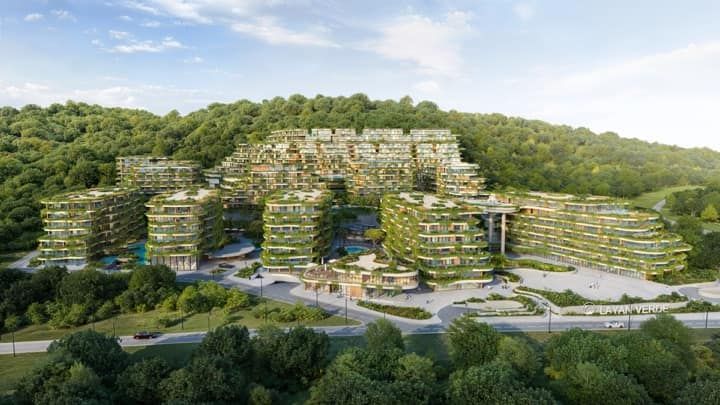
The developer sells lower at launch and raises the price as it nears completion. Instalments cut the start payment: in Layan Verde a 35% plan starts at around $86,000, the rest by milestones to the 2028 handover. Thanks to instalments, return on actually invested capital is higher, and capital growth toward handover adds the bulk of ROI.
What the price ladder looks like
The developer’s logic is simple: early money funds construction, so it earns a discount. As buildings rise out of the ground the buyer’s risk falls — and the price rises. Roughly, the stages look like this:
| Stage | What the buyer sees | Price vs launch |
|---|---|---|
| Sales launch (foundation) | Renders, contract, developer reputation | Base |
| Mid-construction | Frame, structure, first facades | Higher — part of the growth is already “used up” |
| Handover and rental launch | A working complex, real occupancy | Maximum for primary stock |
| Resale 1–3 years later | An asset with an income history | Market level, growth slows |
A concrete example: in Layan Verde studios have risen from $224,776 to $235 over recent months while construction is only gathering pace. The developer forecasts capital growth over the construction period of around +45% — that is a forecast, not a guarantee, and it is worth setting against a completed case: according to the developer, phase 1 of Layan Green Park rose roughly 100% from sales launch to a working complex.
🔗 How to calculate ROI: Investment guide → · Calculator · LGP phase 1 sell-out case →
5. How an off-plan payment schedule works
Construction-stage instalments are neither a loan nor a mortgage. They are a payment schedule to the developer, tied either to the calendar or to construction milestones. A typical structure, using Layan Verde as the example:
- Reservation — 200,000 THB to take the unit off the market while the contract is prepared.
- First payment on signing the sale and purchase agreement — 35% or 50% depending on the chosen scheme.
- Interim payments — 5 payments of 13% (on the 35% scheme) or 10% (on the 50% scheme) every 6 months.
- Handover of the unit — registration of title at the Land Office, payment of the transfer fee for freehold (~2%) or leasehold registration (1.1%), the one-off sinking fund and the first CAM contributions.
There is also a 100% payment within 14 days option — usually with an extra discount, but it forfeits the main financial effect of instalments: the money you have not handed over today keeps working in other assets until handover.
What to look at in the schedule:
- What the payments are tied to. Calendar dates are easier to plan; construction milestones are safer — if the site stops, so do the payments.
- What happens if the buyer is late — the penalty rate and the period after which the contract is terminated.
- What happens if the developer is late — the late-handover penalty and the buyer’s right to exit the deal.
- Where the money goes. A full escrow is rare in Phuket, so the real protection is the developer’s reputation and portfolio of delivered projects.
🔗 Projects with payment plans: Instalment-plan catalog → · Reservation and deposit →
6. Construction risk and how to reduce it
- Schedule. Choose a developer with a delivery track record; check the construction stage.
- Documents. Verify land title, permits, the contract and late-handover penalties.
- Payment. Pay by milestones tied to construction, not the whole sum upfront.
- Design. Fix the unit’s specs in the contract.
VillaCarte Group is a developer with a Phuket portfolio (Layan Green Park phase 1 completed 2024), which lowers timing risk.
What a proper developer check looks like
The practical minimum before the first payment:
- Portfolio. What has already been delivered, how the timing compared with what was promised, what the buildings look like after 2–3 years of operation.
- Land. The Chanote for the plot is held by the developer company or its affiliate, with no charges that would block transfer of units.
- Permits. The construction permit and, for large projects, the EIA approval — without them the site can be halted.
- Progress. Regular site reports: Layan Verde publishes them building by building, which is normal practice for a diligent developer.
- Contract. Late-delivery penalties, exit rights, fixed area and finish specification, the title-registration procedure.
🔗 How to choose a developer → · Developer red flags → · Construction timelines in Thailand →
7. What to check on a completed unit
Completed removes construction risk but brings its own set of questions. Here you are buying not a promise but a working business — and it is the business you need to check.
- Rental statements for past seasons. Not “expected yield” but the actual payouts to owners for high and low season. In projects with a rental pool this is a standard document.
- Occupancy by month. Phuket is seasonal: what matters is how the property gets through May–October, not just December–February.
- CAM and sinking fund. The current rate (in Layan Green Park — 75 THB/m² per month), whether the seller has arrears, what state the repair fund is in.
- The condominium juristic person. Who manages the building, whether owners are in conflict, whether the management company has changed.
- Title and quota. On a resale — a Chanote check and availability of foreign quota if you need freehold.
- Unit condition and furnishing. What is included in the price and what will need refreshing before letting.
If the seller is unwilling to show rental statements, that is an answer in itself. The detailed procedure is in our piece on due diligence.
8. Yield: now or at handover
Completed gives cash flow immediately — an owner net yield benchmark of ~8–10% via the rental pool. Off-plan gives capital growth toward handover plus rental afterward. Over a 3–5 year horizon, “early entry + growth + later rental” often delivers a higher total ROI; for income “now,” completed is more practical.
Two income profiles on the same horizon
Take a notional 5-year horizon and the same pool logic (owner receives 60% of net profit, a benchmark of ~8–10% net per year).
- Completed unit. Rental runs for all 5 years. Capital growth is at market pace — after handover it usually slows to moderate levels. Result: a predictable flow, modest appreciation.
- Off-plan with handover in ~2 years. No income for the first 2 years, but the capital is only partly deployed — according to the instalment schedule. The main growth is realised by handover (in Layan Verde the developer forecasts +45%; in the completed LGP phase 1 case growth was ~100%). Then 3 years of rental from a new, higher base.
The key effect is return on capital actually deployed: while only 35–60% has been paid under the schedule, the rest of the money is not frozen. That is why, at equal rental rates, the total off-plan result on a mid-term horizon is often higher — provided the building is delivered on time and reaches planned occupancy.
🔗 How to calculate ROI in Phuket → · Rental management programme →
9. Exit: assignment, resale and taxes
The “buy at foundation, sell by handover” strategy only works if the exit mechanism is clear in advance.
Before handover — assignment. You transfer your contract rights to a new buyer, who pays the developer the remaining balance under the schedule. What to check:
- whether the contract allows assignment and whether the developer charges a fee for it;
- from what point it is permitted (often — after a certain share has been paid);
- who pays the registration fees on transfer.
After handover — a classic resale. Here government fees appear that need to be built into the model:
| Fee | When | Benchmark |
|---|---|---|
| Transfer fee | On freehold registration | ~2% of the appraised value |
| Leasehold registration | On registration / re-registration | 1.1% |
| Specific business tax | Sale within the first 5 years of ownership | 3.3% |
| Stamp duty | Sale after 5 years of ownership (instead of SBT) | 0.5% |
| Withholding tax | On sale | Sliding scale on appraised value |
The 5-year threshold is a practical argument for holding: a sale 2–3 years after handover attracts SBT; after the fifth year only stamp duty applies. A 2.8% difference on the unit price is a noticeable sum that often outweighs the benefit of “selling a little earlier”.
🔗 How to resell property in Phuket → · Capital gains tax in Thailand →
10. Hybrid strategy: completed + off-plan
The “off-plan or completed” question does not have to be an either/or. Many investors with a budget for two units split it:
- A completed unit — delivers cash flow from the first season and “insures” the waiting period.
- An off-plan unit — delivers growth and instalments, part of which is effectively covered by income from the first unit.
Within a single district this is especially convenient: in Layan, the completed phase 1 of Layan Green Park (resale only, full payment, studios from $142,602) and the under-construction Layan Verde (774 residences managed by Dusit, handover 2028, entry from $235,995 with construction-period instalments) — one location, one management ecosystem, two different income profiles.
An important caveat on LGP: phase 1 is completed and fully sold out by the developer; there are no instalments on it in any form — only resale from an owner with full payment. So “completed with instalments” does not exist in this pairing; instalments are an attribute of construction.
🔗 Layan Verde vs Layan Green Park → · New condos 2026–2028 →
11. Pitfalls
- Ignoring the developer. The main off-plan risk is developer reliability.
- Full payment upfront. Use milestone payments tied to construction.
- Treating growth as a guarantee. Capital growth is an expectation, not a promise.
- Completed “blind.” Even for completed, check real occupancy and costs.
- Comparing price per sqm without the stage. A completed unit costs more than off-plan not because it is “overpriced” but because construction risk is gone and the growth has already happened. Compare the total result over the horizon, not the price tag.
- Skipping the assignment clause. If the plan is to sell before handover and the contract forbids assignment or charges a high fee, the strategy will not work.
- Forgetting the tax calendar. A sale within the first 5 years — SBT 3.3%; build it into the exit model.
- Buying completed without rental statements. “Expected 10%” on a completed unit is a red flag: a working complex has facts, not expectations.
12. Case: by goal
Consider two investors. The first wants capital growth and is happy to wait — entering Layan Verde at the construction stage on a 35% plan, counting on appreciation toward the 2028 handover. The second wants income now — a completed unit in Layan Green Park phase 1, where rental already works and occupancy is visible.
Let’s look at them 5 years on — in 2031.
The first investor. Until the end of 2028 he paid by schedule: 35% at the start and 13% every six months. There was no income, but the capital was deployed in parts too. After handover the unit joined the pool under Dusit management, and for the last 2–3 years of the horizon he received rental from a new, higher value base. If the developer’s growth forecast came true even partially, the bulk of his result is appreciation; rental is the add-on. His risk was timing and build quality; his protection was the developer’s portfolio of delivered projects and a contract with late-handover penalties.
The second investor. He paid the full sum for a resale in a completed complex — more per sqm, but with no waiting. For all 5 years he received pool payouts, saw month-by-month occupancy and could exit into a resale at any moment. His capital growth was moderate, at market pace — the construction effect had already been priced in by the seller. His risk was not timing but management quality and seasonality; his protection was the rental statements before the deal.
Takeaway: off-plan is about capital growth and instalments; completed about immediate flow and predictability. Both work — it’s a question of goal and horizon. If the goal is the maximum total result over 3–5 years and you have patience, early entry wins. If the goal is a clear flow from month one and minimum uncertainty, completed wins.
13. Decision checklist
Five questions that usually settle the choice in one conversation:
- When do you need income? Right away — completed. In 2–3 years is acceptable — off-plan.
- How much capital do you have now? If the full sum is a stretch, construction-stage instalments are the only realistic entry into a new project; completed requires 100% payment.
- What is your horizon? Under 2 years — completed; 3–5 years and longer — off-plan or a hybrid.
- Are you ready to vet the developer? If there is no time or appetite to dig into the portfolio and contract, take completed, where you verify a fact rather than a promise.
- Do you need freehold? At sales launch the quota is usually open; in a completed complex it may be gone.
I’ll select both off-plan and completed units for your strategy, with a yield calculation and a walk-through of the payment schedule.
Find off-plan or completed
By submitting this form you agree to the privacy policy.