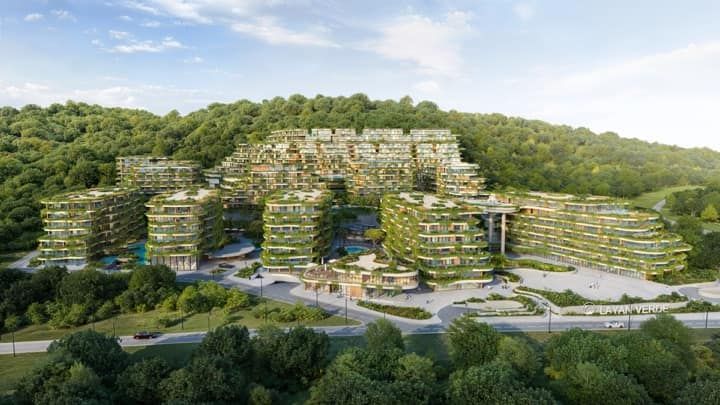
Nice renders and aggressive marketing exist for every project — reliable and troubled alike. The difference shows up not in the pitch deck but in the details: land, permits, the contract, delivery history. Let’s cover concrete red flags that signal risk, and how to check them before you put down a reservation.
Contents
1. Land and the right to build
The most fundamental risk is a problem with the land under the project:
- Land title — the plot should carry a clean Chanote with no disputes or encumbrances.
- Mortgaged land — if the plot is mortgaged to a bank, that creates risk for unit buyers.
- Construction permit and EIA — an environmental impact assessment is mandatory for large projects; its absence is a serious red flag.
Without a clear right to the land, every other attractive feature of the project stops mattering.
An important nuance on mortgages: a bank mortgage on the plot is not, by itself, a verdict. Project financing secured on land is normal practice worldwide, and having a lending bank is sometimes even a plus — the bank has done its own checks on the developer. The mortgage becomes a flag in two cases. First, the developer keeps quiet about it and the buyer learns of the mortgage from a Land Office extract rather than from the seller. Second, the contract contains no mechanism for releasing the mortgage from the specific unit at handover: without it you risk paying for a unit that legally remains security for someone else’s loan.
On the EIA the rule is simple: a developer with its paperwork in order gives you the approval number and date the same day, without “we’ll check with the lawyers.” Phuket’s history includes projects halted by regulators mid-construction precisely over environmental-assessment problems — for buyers that meant years of uncertainty.
🔗 How to verify a title: Verifying a Chanote →
2. Delivery history and portfolio
A developer’s reliability is proven by track record, not promises:
- Delivered projects — properties that genuinely operate, not just “in development”.
- Reviews from current owners — independent sources, not just the developer’s own materials.
- Time in the market — several years of history is more reliable than a company set up for a single project.
- Real property condition — on-site photos and video, not just renders.
A red flag: a developer with zero delivered projects, selling purely on marketing reputation.
Two techniques make the history check concrete. First, the DBD registry: searching the legal entity’s name shows its registration date, registered capital and directors. The typical picture of a troubled project is a company registered a few months before the sales launch, with minimal capital and directors with no traceable construction history. Second, date reconciliation: take old brochures or an archived version of the developer’s website and compare the promised handover dates of past projects with the actual ones. Systematic slippage by years is a pattern that will repeat with your unit.
Also account for the ownership structure: in Phuket each project is often built by a separate legal entity (SPV). That is normal, but it means the “brand portfolio” and the obligations of the specific developer company are not the same thing — both levels need checking.
🔗 How to choose a developer → · Best Phuket developers 2026 →
3. The project’s financial model
- The developer’s own capital — real money at stake, not just relying on future buyer payments.
- Phasing transparency — a clear construction schedule and what happens to buyers’ money at each stage.
- Independence from ongoing sales — risk is higher if construction is funded entirely by current buyers’ money with no financial buffer.
A red flag: a developer whose financial model depends entirely on a continuous stream of new sales.
Why this is critical in Thailand specifically: there is no mandatory escrow for all construction here, and buyers’ money usually goes straight to the developer. In a “build on sales” model, any drop in demand — seasonal, currency-driven, geopolitical — shows up immediately in the pace of work. Indirect signs of resilience you can judge without access to the accounts: the site does not go quiet in low season; previous phases closed without prolonged pauses; the project has a partner bank; discounts for 100% prepayment are reasonable rather than desperate (a 20%+ discount for full prepayment often signals a cash squeeze).
A separate flag is aggressive collection of full prepayment at an early stage: the more money the developer asks for before the foundation pit, the more construction risk is shifted onto you.
4. The contract and terms
A troubled project often shows up in the contract text itself:
- Vague handover dates — no specific dates or penalties for delay.
- No refund conditions — what happens if the project isn’t completed.
- A vague unit description — area, finishing, and what’s included in the price should be precise.
- No right to convert leasehold to freehold (if marketing claims it but the contract doesn’t guarantee it).
A red flag: a developer unwilling to discuss or amend unfavourable contract clauses.
In practice, three more points of the SPA deserve a check. Asymmetric penalties: if late payment by the buyer accrues a penalty but late handover by the developer does not, the contract’s balance is skewed — and that is a negotiating point. The area-recalculation rule: the unit’s actual area after survey almost always differs from the design figure; the contract should state at what deviation the price is recalculated, and whether in both directions. Payment details: the payee is the developer’s legal entity named in the contract; requests to pay into personal accounts or “group companies” not listed in the SPA are a stop-the-deal-level flag. More on the first payment and its refundability — deposit and reservation →.
5. Yield promises
- Yield notably above market (e.g. a “15–20% guarantee”) with no clear basis — a typical marketing tactic.
- An opaque payout source — if it’s unclear what funds the guarantee, that’s a risk.
- Blurring gross and net yield in presentations — a figure can look more attractive than the owner’s real income.
A realistic guide for a Phuket pool model is an owner net yield of ~8–10% a year. Figures well above that range with no transparent basis warrant extra scrutiny.
How to tell a working guarantee from a marketing one: an honest program has a clear payout source (the operating income of the hotel/pool, not new buyers’ money), the period and calculation base are fixed in the contract, and it spells out what happens after the guarantee period ends. Ask directly: “is the guarantee a percentage of the unit price with or without the furniture package? before or after CAM and taxes?” The gap between gross and net yield on these details easily reaches several percentage points.
6. Sales tactics and pressure
- Artificial urgency — “today only”, “last unit” with no way to verify the facts.
- Refusing to share documents before payment — the title, permits and contract should be available for review in advance.
- Pressure for a quick decision with no time for due diligence — a reliable developer wants an informed buyer.
Add the flags that are visible before you even speak to the sales team. An anonymous team: the website shows no legal entity, no founders’ names, no sales-office address — just an enquiry form. Hard selling through social media with a discount promised for a transfer “by the end of today.” Double pricing: the price list in the agent’s presentation differs noticeably from the developer’s — a sign of an uncontrolled chain of intermediaries. Finally, check that you are dealing with an authorised seller of the specific project and not a look-alike: popular Phuket projects attract clone websites collecting enquiries under someone else’s brand. Typical fraud schemes are covered in the article on property scams in Thailand →.
7. Flags on the construction site
If the project is already under construction, the most honest source of information is the site itself. What should raise concern on a visit (or on a fresh video walkthrough if you are buying remotely):
- An empty site during working hours. A single quiet day happens, but if machinery and workers are absent for weeks, the pace does not match the stated schedule.
- Progress does not match the reports. The presentation says “40% complete” while on site there is a foundation. Ask for dated photo reports and compare the trend over several months.
- No information board with the construction permit details, contractor and timelines — on a legal site it is mandatory.
- A change of main contractor mid-build with no clear explanation — a frequent companion of financial trouble.
- Neighbouring phases by the same developer are frozen. If phase 1 is unfinished while phase 3 is already selling, new buyers’ money is probably plugging holes in old obligations.
A useful habit is to tie your payments to milestones you can verify visually: foundation poured, structure enclosed, finishing started. How a normal construction schedule looks — in the article on new-build construction timelines →.
8. Flags in the rental program
For investment units the rental program is part of the product, and it has its own risk markers:
- The management company is not named. “There will be an international operator” without a signed management agreement is a promise, not a fact. Serious projects know their operator before the sales launch: at Layan Verde, for example, the residences are managed by the Dusit hotel brand.
- No hotel licence or plan to obtain one — short-term letting without a licence is illegal in Phuket, and “grey” rental schemes can be shut down at any moment.
- Rental pool terms not fixed in writing: the income-distribution model, who pays CAM, utilities and OTA commission, how many days the owner may stay.
- A rental guarantee from a shell company. Look at who is legally obliged to pay: if the guarantee comes from a freshly registered entity with no assets, its value is zero.
Projects with rental programs that already operate rather than merely promise are gathered in the guaranteed-rental property shortlist.
9. Red-flag checklist
| Category | Red flag |
|---|---|
| Land | Mortgaged plot with no release mechanism, disputed title, no EIA |
| History | Zero delivered projects, a fly-by-night entity, no independent reviews |
| Finances | Construction funded entirely by sales, desperate discounts for 100% prepayment |
| Contract | Vague dates, no refund conditions, asymmetric penalties |
| Yield | A guarantee well above market with no basis and no payout source |
| Sales | Pressure, refusing to show documents before payment, payment to personal accounts |
| Site | Empty site, progress not matching reports, frozen phases |
| Rental | Operator not named, no hotel licence, guarantee from a shell |
The more flags from this list that coincide, the higher the risk.
10. What to do if you find a flag
A flag you have found is not always a command to run. The course of action depends on the stage:
- Before reservation. Ask the developer a direct question and judge the reaction: a documented answer within a day or two is a workable situation; evasiveness confirms the flag. In parallel, order due diligence — the check costs a fraction of a percent of the deal.
- After reservation, before the SPA. If the deposit is refundable, put your questions in writing and do not sign the contract until they are answered. If it is non-refundable, weigh with a lawyer which is more expensive: losing the deposit or entering a troubled project. Experience shows the deposit is almost always cheaper.
- After signing the SPA. Do not make the next instalments until the matter is resolved. A lawyer will assess the grounds for termination: missing promised permits or a material departure from what was declared are arguments in refund negotiations.
- At any point. Keep the correspondence in writing (e-mail, not phone promises) — in a dispute it is the only evidence.
And the mirror rule: one yellow flag with transparent answers from the developer is a reason to negotiate, not to walk away. Several red ones at once are a reason to look for another project: the Phuket market in 2026 is wide enough that you need not cling to a risky option. The full verification process — in the article on property due diligence →.
11. Case: a flag caught in time
Consider a typical scenario. An investor was considering a project with attractive marketing and an 18% yield guarantee for the first three years. On checking, it turned out the developer had zero delivered properties, the company had been registered less than a year, and the guarantee had no transparent basis — the presentation didn’t explain what funded it. The land, meanwhile, turned out to be mortgaged to a bank with unresolved terms.
The investor walked away before putting down a reservation and chose a project with a transparent history instead: several years in the market, a completed phase 1, a clean land title, and a realistic yield model of ~8–10% net via the pool. The extra check took a few days but removed the risk of losing the entire investment.
Takeaway: red flags rarely appear alone — usually several signs coincide. Checking the land, delivery history, contract and yield realism before paying removes most off-plan purchase risk.
I’ll run a developer and document check on a specific project before you put down a reservation.
Developer check before a deal
By submitting this form you agree to the privacy policy.