“A fixed 7% for 5 years” is a common line in Phuket resort-project decks. It sounds like a risk-free deposit, but it works differently. A contracted yield is a commitment by the developer or management company, and its value depends directly on who backs it and how. Here’s how a fixed payment under contract works, how it differs from profit-share and a rental pool, what’s hidden in the headline number, how much is left after tax, and what to check in the contract so the commitment protects you rather than sells to you.
Contents
- What a contracted yield is
- How the developer funds it
- Three models: fixed payment, profit-share, rental pool
- What the payment covers and the term
- The hidden price of a fixed rate
- What happens after the term ends
- Tax and net yield
- Mini-case with numbers: 6% for 3 years vs the pool
- Legality of the programme: the hotel licence
- Seasonality and timing: when payments start
- What to check in the contract
- Pre-deal checklist
- Pitfalls
- Case: a commitment with no operator
1. What a contracted yield is
A contracted yield (brochures also call it a fixed yield) is a commitment to pay the owner a fixed percentage of the unit value for an agreed term, regardless of whether the unit was rented and at what occupancy. Typical Phuket parameters are 5–7% a year for 3–5 years, with quarterly or annual payouts.
The point for an investor is predictability at the start: you know income in advance and don’t depend on seasonality or operations. That’s convenient when cash-flow forecasting matters, especially in the first years after handover, while the complex is still building recognition, booking-platform ratings and repeat guests.
Legally it is neither a deposit nor an insurance policy. It is an obligation of a specific legal entity under a contract — the same kind as the obligation to deliver the building on time. If that entity ceases to exist or runs out of money, there is nobody to collect from. So the rest of this article is really about telling a funded commitment apart from a marketing line.
2. How the developer funds it
A fixed payment isn’t “magic” — it’s a financial model. The operator covers payouts from several sources:
- Actual rental — the main source: the management programme really rents units to guests.
- A reserve from the sale price — part of the unit value can be set aside for future payouts.
- Complex operating profit — the hotel/condo-hotel earns from services (restaurants, spa, amenities).
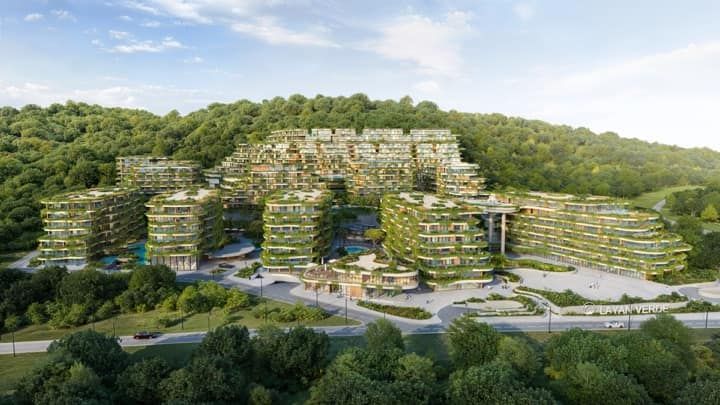
The conclusion: a commitment is as reliable as the operator is stable. A strong developer with operating projects (e.g. the completed phase 1 of Layan Green Park, 248 units, 2024) backs the payments with real occupancy. A weak operator promises a percentage “on paper”.
There is a simple way to see which source is paying you. Ask the operator for the average occupancy and average nightly rate in the buildings already running, and compare them with the promised rate. If the unit’s rental income at the stated occupancy covers the fixed payment with room for the operator’s costs, the model lives on rental. If it doesn’t, you are being paid from the reserve or from the next buyers’ money — and that model ends when sales end.
🔗 How to vet a developer before paying a deposit: Developer red flags in Phuket →
3. Three models: fixed payment, profit-share, rental pool
A contracted yield is just one model. In Phuket you meet three, pure or hybrid:
| Parameter | Fixed payment | Profit-share (own unit) | Rental pool |
|---|---|---|---|
| Owner income | Fixed % of price | Share of your own unit’s income | Share of the whole pool’s net profit |
| Occupancy dependence | None (during the term) | Yes — your unit’s own occupancy | Yes, but averaged across the complex |
| In-season upside | Capped by the rate | Maximum | High, smoothed |
| Predictability | High | Low | Medium |
| Low-season risk | On the operator | Entirely on the owner | Spread across owners |
| Example formula | 6% a year for 3 years | 70/30 of the unit’s revenue | 60% of net profit to owners, 40% to the operator |
A fixed rate suits those who want a forecast; profit-share suits those comfortable with swings for more upside; the pool is the compromise, where the owner of a second-floor studio and the owner of a corner penthouse earn in proportion to their share of the pool rather than depending on luck with a particular guest. The Layan Verde and Layan Green Park programmes use exactly the pool: owners receive 60% of net profit, 40% stays with the management company, and the owner net-yield benchmark is ~8–10% a year.
Often the developer offers a choice or a hybrid: a fixed payment for the first years, then a move to profit-share or the pool. That is a sensible structure if the transition is written into the contract as a formula, not as “on the terms applicable at that time”.
🔗 How rental models work: Rental management programme → · Yield calculator
4. What the payment covers and the term
The devil is in the contract detail. Key parameters:
- Rate and base — the percentage and what it’s calculated on: unit price with or without furniture, with or without VAT, contract price or an “appraised value”.
- Term — how many years the payments run (3, 5, 7) and from when: signing, key handover or the hotel’s opening.
- Payout frequency — quarterly/annually, and in which currency.
- Owner-stay right — how many nights a year you can use yourself (often this reduces the payout or is limited to the low season).
- Who bears costs — common area fee, utilities, furniture depreciation, building insurance.
Pay special attention to when the clock starts. “5 years from the contract date” in a project due for handover in two years means effectively three years of payments after opening. “5 years from the hotel’s opening” is the honest wording — but then ask what happens between key handover and opening: is anything paid for that period at all?
5. The hidden price of a fixed rate
A high fixed percentage isn’t always a “gift”. Sometimes it’s partly built into the purchase price: you overpay per metre and the developer returns part of that overpayment as payouts. So compare projects on two axes at once:
- The payout percentage — how realistic it is versus the market (in a pool model the owner’s net yield typically runs ~8–10% — compare the fixed rate against that benchmark; across our catalogue the median developer forecast is 6% a year).
- Price per metre — whether it’s higher than comparables because of a “baked-in” payout. District medians are published in the price index.
A quick test: if the unit costs 15% more than neighbouring projects of the same class and the fixed payment is 7% for 3 years, you get back 21% of the price over three years — 15% of which you overpaid yourself. The developer’s real “top-up” is 6% over three years, roughly 2% a year. That is very different arithmetic.
“Fair price + moderate rate from a strong operator” usually beats “inflated price + record percentage”.
6. What happens after the term ends
The fixed period is finite. When it ends, the unit moves to a standard model — usually profit-share or pool, where income depends on real occupancy. In a pool model like the Layan Verde and Layan Green Park programme, owner net yield typically runs ~8–10% (the owner receives 60% of the pool’s net profit). So plan the investment over two periods:
- The fixed period — predictable income under contract.
- After it — actual market yield.
An investor who looks only at the fixed figure risks disappointment in year four. The reverse also happens: in a strong complex the pool after the fixed period can pay more than the rate did — in which case the fixed years were the price of predictability, not a gift.
Check three things about the transition in the contract: which model exactly the unit moves to, whether the owner has a choice between models, and whether you can leave the management programme altogether (for example to live in the unit or let it long-term). More on exits in our guide to exit strategies for Phuket property.
7. Tax and net yield
The fixed percentage is usually a gross benchmark. In hand it’s less:
Net ≈ Fixed payment − income tax − (sometimes) part of the servicing costs.
The tax mechanics for an individual owner in Thailand look like this:
- Rental income from property is Thai-sourced income, category 40(5) of the Revenue Code, taxed on the progressive 0–35% scale regardless of the owner’s nationality or residency.
- When computing the base you may apply the standard 30% deduction from gross rent without supporting documents, or deduct actual documented expenses.
- If a legal entity (the developer or operator) makes the payment, it withholds 5% withholding tax at source and remits it to the Revenue Department. This is not a separate tax but an advance: it is credited when you file the annual PND.90 return, and any overpayment is refunded.
Confirm in the contract whether it’s net or gross and who bears which costs. A “7% net in hand” payment and a “7% gross before tax” one are different money. A separate question is tax in your country of residence: where a double-tax treaty with Thailand exists, tax withheld in Thailand is usually credited at home.
🔗 Rental income tax in detail: Tax on rental income in Thailand → · The full cost picture: Phuket taxes & fees →
8. Mini-case with numbers: 6% for 3 years vs the pool
Take a real price anchor — a 36.7 sqm phase-2 studio at Layan Green Park at the price list of 1 September 2026: 7,424,784 THB ($224,043). Suppose the developer offered a fixed 6% a year on it for 3 years (an illustration: the live Layan Green Park programme runs a pool, not a fixed rate). Let’s count one year.
| Line | Amount, THB | Comment |
|---|---|---|
| Fixed payment 6% | 445,487 | gross, on the contract price |
| CAM fee 75 THB/sqm × 36.7 sqm × 12 months | −33,030 | if the contract puts it on the owner |
| Income before tax | 412,457 | |
| Withheld at source, 5% of 445,487 | −22,274 | advance on income tax |
| PIT base: 445,487 − 30% deduction | 311,841 | standard deduction, no documents |
| Estimated income tax | ≈8,700 | first 150,000 THB of base at 0%, next 150,000 at 5%, remainder at 10% |
| Overpayment refunded via PND.90 | ≈13,600 | 22,274 − 8,700 |
| Net in hand for the year | ≈403,800 | about 5.4% of the price |
Result: the “6%” in the brochure became ~5.4% net, and that’s before personal allowances that would lower the tax further, and before insurance, utilities for empty nights and other small items that may be shifted to the owner. The calculation is simplified and ignores your personal circumstances — it’s there to show the order of magnitude.
Now compare with the same project’s pool: the ~8–10% owner net-yield benchmark means 594,000–742,000 THB a year on the same unit — but that is a share of actual profit, which in a weak year can come in lower. In this example the fixed rate costs the owner the difference of 150,000–300,000 THB a year — that is the price of predictability. Whether it’s worth paying depends on how much you trust the complex’s occupancy in its first years.
🔗 The full method: How to calculate ROI on Phuket property →
9. Legality of the programme: the hotel licence
The source of the payments is short tourist stays. In Thailand, accommodating paying guests for less than 30 days is hotel business under the Hotel Act B.E. 2547 (2004), and the operator needs a licence. The authorities regularly repeat that daily condo rentals without a licence are illegal, and inspections that close unlicensed properties are recent news, not theory.
For the owner this means: if a project pays a contracted yield while earning on daily rentals without a licence, the source of the payments is legally exposed. A fine or a suspension of the operator’s business — and the commitment to you is left without money. Ask for a copy of the valid licence, the licensee’s name and the expiry date, and check that it covers exactly the building and phase where your unit is, not the building next door. In condo-hotels like Layan Green Park the licence is held by the operator of the whole complex — that is the correct structure.
🔗 What a hotel licence is and how to verify it: The Hotel Act and licensing in Phuket → · What’s legal in short-term rental →
10. Seasonality and timing: when payments start
A fixed rate hides seasonality from the owner, but not from the operator. Phuket’s high season is the dry period, roughly November to March/April with a peak in December–February; the low season runs May to October. This matters for three reasons:
- Start date. A complex that opens in October enters its first high season with no reviews or rating — in the first months the fixed payments are almost certainly subsidised from the reserve, not from rental. That’s fine, as long as the reserve exists.
- Owner nights. Most programmes allow owner stays in the low season. If you want to live in Phuket in January, ask how that reduces the payout.
- Transition to the pool. If the fixed period ends in May, the first months on the market model fall in the low season — income drops more sharply than the annual average suggests. It’s more comfortable when the transition coincides with the start of the high season.
🔗 How occupancy is spread across the year: Rental seasons and occupancy in Phuket →
11. What to check in the contract
- Who gives the commitment — developer, operator or a separate entity; its stability, assets, track record.
- Net or gross and what’s deducted.
- Term and payout mechanism, penalties for late payment in your favour.
- Yield after the fixed period — which model the unit moves to and by what formula.
- Exit right — whether you can sell the unit during the term and whether the commitment passes to the new owner.
- Security — whether there is bank security, an escrow deposit or other collateral behind the payments (most projects have none, which is normal, but you need to know).
- The operator’s termination right — under what conditions it can stop payments unilaterally.
12. Pre-deal checklist
Let’s put the checks in one table. Left column — what should be there; right column — what should worry you.
| Check | Good sign | Red flag |
|---|---|---|
| Operator’s delivered projects | A running building with public occupancy data | First project; payments promised by a new entity |
| Rate vs the market | Within 5–7%, in line with the 6% median forecast | Well above market with no explanation of the source |
| Price per metre | In line with district comparables | 10–20% higher alongside a “record” rate |
| Calculation base | Contract price, stated in the text | “Appraised value” or not specified |
| Tax wording | Gross/net stated explicitly, withholding payer named | A percentage with no qualifiers |
| Hotel licence | Copy provided, licensee is the building’s operator | “Being arranged”, or covers a different building |
| Transition after the term | Pool or profit-share formula in the contract | “On the terms applicable at the time of transition” |
| Sale during the payment period | Commitment passes to the buyer | Sale prohibited or payments lost on sale |
| Start of the clock | From the hotel’s opening | From the contract date with handover in 2 years |
If you land in the right-hand column on three or more rows, that is not a reason to walk away — but it is a reason to recalculate the deal with no fixed payment at all: is the purchase worthwhile on its own, on price and location?
13. Pitfalls
- Looking only at the percentage. 9% from a weak operator is worse than 6% from a strong one.
- Ignoring price per metre. The payout may be “baked into” an overpayment.
- Not counting “after the term”. In year four income drops to market — or rises, if the complex is strong; either way it’s a different number.
- Confusing net and gross. Tax and costs eat into it: in the example above 6% became ~5.4%.
- Not vetting the operator. The payout is its financial obligation, nothing more.
- Forgetting the licence. A programme built on daily rentals without a Hotel Act licence puts the source of payments at risk.
- Counting the term from the contract. Two years of construction can “eat” nearly half the promised period.
- Skipping the termination clause. The operator’s unilateral right to stop payments devalues everything else.
- Relying on the sales manager’s verbal promises. Only what is written in the contract and signed by the paying entity counts.
14. Case: a commitment with no operator
Consider a typical scenario. An investor chose a project with a record “9% for 5 years” rate — above market. During checks it emerged the developer had no delivered projects, and the commitment was given by a new entity with no assets or operating history. That is, the 9% was effectively to be paid from new buyers’ money, not real rental.
The investor compared this with a project where a moderate 6% was paid by an operator with a completed, operating phase and a fair price per metre. They chose the second: a lower percentage but real protection and a clear yield after the fixed period. A year later a third difference emerged: sales in the first project slowed, and the developer asked buyers to “voluntarily” switch to profit-share ahead of schedule — exactly what you would expect from a model that lives on the next buyers’ money.
Takeaway: a contracted yield is about the operator’s reliability, not the size of the percentage. A number with no stable business behind it is marketing, not a commitment.
I’ll assess how realistic a fixed rate is for a specific project, compare it with profit-share and the pool, and calculate the “after the term” income. If you’re looking at the VillaCarte Group flagships, see the pool terms on the Layan Verde and Layan Green Park pages — each has a per-unit yield calculator. How our agency works, and why we select for your brief rather than for our own developments, is explained separately.
Contracted-yield review
By submitting this form you agree to the privacy policy.