A foreigner can legally buy property in Phuket — it’s only a question of the ownership form, which depends on the property type. An apartment in a condominium can be registered in full ownership (freehold) in your name — or you enter via leasehold, which is often better as an entry point and usually converts to freehold later. A villa with land is taken via long-term lease or a company. By 2026 the schemes are settled, but the cost of a mistake is high: the wrong structure or a lost currency-inflow certificate can block title registration at the deal stage.
This guide is a practical breakdown of all working ownership methods, current for 2026: from the 49% foreign quota to transferring money, the step-by-step deal sequence, documents and typical pitfalls.
Contents
- The main answer: what a foreigner can really do in 2026
- Condo apartment: the 49% freehold foreign quota
- Leasehold: a flexible entry with the right to convert to freehold
- Villas and land: lease vs a Thai company
- Money and FET: how to transfer payment correctly
- Step-by-step deal sequence for a foreign buyer
- Documents, timelines and registration costs
- Foreign-buyer pitfalls
- Case: how a buyer nearly lost freehold
- Comparing ownership forms
For the country-wide picture beyond Phuket — regions, budgets and the full deal walkthrough — see how foreigners buy a home in Thailand.
1. The main answer: what a foreigner can really do in 2026
Thai law directly allows foreigners to own condominium apartments in full ownership. Land is a separate story: it can’t be registered directly, so villas are bought via land lease or a company. Three working formats:
- Freehold (full ownership) — for apartments within the 49% foreign quota.
- Leasehold (long-term lease) — a flexible entry for apartments (cheaper, fewer formalities, converts to freehold later) and the form for land under villas.
- Thai company — owns the land, the foreigner controls the company.
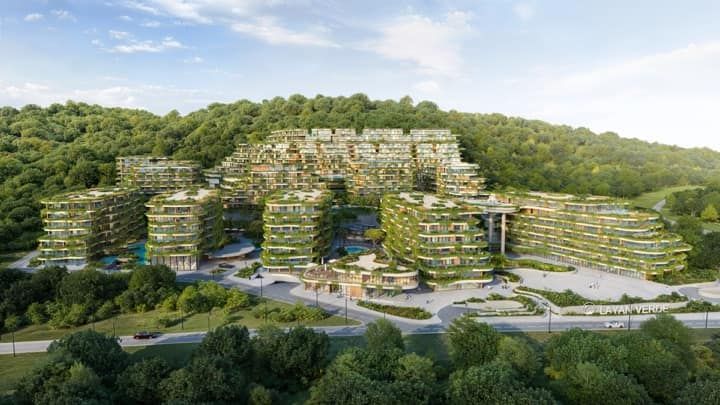
For the vast majority of investors in projects like Layan Verde and Layan Green Park, the first two options are relevant: both projects sell in freehold (within quota) and in leasehold. The buyer’s nationality is irrelevant to Thai law — the rules are identical for citizens of the EU, the UK, India, China or the CIS; only the banking logistics of the payment differ.
🔗 One-page overview of Thailand’s regions with $/sqm by segment, ownership forms and the deal process: Thailand property: regions and prices →
2. Condo apartment: the 49% freehold foreign quota
A foreigner’s main tool is the Condominium Act. It allows foreigners to own up to 49% of a building’s total saleable area in full ownership. You get a chanote (ownership certificate) in your name, with no term and no restrictions on sale and inheritance.
Why the quota matters early. The best units in the freehold quota are taken first. The earlier the entry at the sales stage, the higher the chance of getting freehold rather than leasehold. So at reservation the first question to the developer is the remaining foreign quota in the specific building. The quota is counted by floor area, not by number of units, and is tracked per building: one block in a project may be full while the neighbouring block still has room. On the resale market the remaining quota is confirmed by the condominium’s management body (juristic person) in a letter the Land Department requires at registration — how to request it is covered in how to check a condo’s foreign quota.
🔗 More on the difference: Freehold vs leasehold in Thailand →
🔗 Browse condos in the freehold quota in the catalog: Freehold Condos for Foreigners in Phuket →
🔗 Buying from India: how the $250,000 LRS remittance limit shapes the budget and what fits under it → Can Indians Buy Property in Thailand? →
3. Leasehold: a flexible entry with the right to convert to freehold
Leasehold isn’t a “backup option” but often a more favourable entry point. Standard is 30 years with renewal (a 30+30+30 structure); the lease right is registered at the Land Department, can be assigned (sold) and inherited. Why it appeals to a foreigner:
- A lower entry price and higher yield on invested capital.
- More payment options: no mandatory currency inflow with FET — payment can be made via a wider set of methods.
- Fewer formalities and more private (on the Thai side): without FET no source-of-funds proof is needed for registration. (Home-country reporting remains with the buyer.)
- Conversion to freehold anytime while quota lasts: developers usually grant a conversion right, so the full-ownership option stays in your pocket.
- Resale flexibility: the unit can be sold both as leasehold and re-registered to freehold.
What to check in the contract — the right to convert to freehold and the renewal clause (number of renewals, mechanism and cost). It helps to understand the legal nature of renewal: only the first 30-year term is entered in the register; the following periods are a contractual promise by the landowner to re-grant the lease. So it matters who the lessor is (the developer, its land-holding company or the condominium juristic person) and what happens if the land changes hands. For villas there are also adjacent registrable rights — superficies and usufruct — registered at the same land office, which strengthen the lessee’s position.
🔗 Detailed breakdown: Freehold vs leasehold in Thailand →
4. Villas and land: lease vs a Thai company
A foreigner doesn’t register land in ownership. For a villa there are two routes:
- Land leasehold — long-term plot lease (30+30), with the building (house) itself registrable in the foreigner’s ownership separately from the land. The most transparent option.
- Thai company — the land is owned by a company in which the foreigner has a controlled share and management. Permissible, but the company must have real economic substance; nominee Thai shareholders “to bypass the law” are a direct risk.
| Property | Working form | Land |
|---|---|---|
| Condo apartment | Freehold (in quota) / Leasehold | — |
| Villa | Land leasehold / Thai company | Not registered to a foreigner directly |
The company route is under particular scrutiny in 2026: over the summer the authorities announced inspections of nominee structures in resort provinces (see our note on the nominee crackdown). That is not a ban on ownership through a company, but a signal that a “paper” firm with Thai shareholders who contributed nothing and do nothing is not an ownership tool but a deferred problem. How to set a company up properly is covered in owning a villa through a Thai company.
5. Money and FET: how to transfer payment correctly
This is the technical point where DIY buyers stumble. To register freehold, money must enter Thailand in foreign currency, and a Thai bank issues an FET — Foreign Exchange Transaction (formerly Tor Tor 3). Without an FET the Land Department won’t register a foreigner’s ownership.
Practical 2026 rules:
- Transfer a sum exceeding the unit price in currency (USD/EUR), with the payment purpose “property purchase”.
- Request the FET from the bank right after the funds land.
- For leasehold an FET isn’t required at all — so payment is more flexible with fewer formalities (on the Thai side).
Two details rarely mentioned up front. First: on an installment plan the FET is needed for every tranche, not just the first — if one payment arrives in baht or with the wrong purpose code, the totals won’t reconcile at registration. Second: the FET also works on the way out — when you sell a freehold unit, the bank permits repatriating the proceeds in foreign currency precisely on the strength of the forms obtained earlier, so the originals are kept for the whole holding period. The full mechanics are in FET and bringing currency into Thailand; payment methods, including crypto and settlement via the developer’s offshore account, are in our overview of how to pay for Phuket property.
6. Step-by-step deal sequence for a foreign buyer
A primary-market purchase in Phuket fits into eight steps. The sequence is the same for freehold and leasehold — only the documents at steps 5 and 8 differ.
| Step | What happens | What the buyer does | Typical timing |
|---|---|---|---|
| 1. Unit selection | Shortlist by goal (live / rent out), check remaining quota in the building | Decides the ownership form before paying anything | 1–2 weeks |
| 2. Reservation | Unit taken off the market, price locked | Pays the reservation fee into the developer company’s account (at Layan Verde — 200,000 THB for 3 business days) | 1 day |
| 3. Due diligence | Check of the land chanote, permits, the developer entity | Requests documents; a lawyer if needed | 3–10 days |
| 4. Contract (SPA) | Signing the sale-purchase agreement, by power of attorney if remote | Checks conversion right, renewal clause, payment schedule | Within the reservation window |
| 5. Payment | First installment and tranches on schedule (at Layan Verde — 35% and 50% plans) | For freehold — every tranche in foreign currency with FET | Until completion |
| 6. Construction and reports | Developer publishes progress | Tracks the milestones payments are tied to | Months to years |
| 7. Handover | Unit inspection, snag list, meter connection | Follows the handover checklist | 1–2 weeks |
| 8. Registration | Title transfer at the land office: chanote in the buyer’s name (freehold) or lease registration (leasehold) | Pays the registration fee, receives the document | 1 day at the office |
Two notes on the table. A reservation is not yet a contract: until the SPA is signed the unit isn’t legally yours, and the refund terms of the reservation are set by the receipt you signed (details in reservation fees and deposits in Phuket). Second, a remote purchase follows the same route — only steps 4 and 8 are performed by an attorney-in-fact under a notarised power of attorney; how to set that up is in buying property in Phuket remotely. A full breakdown of every stage with standard documents is in the Phuket property buying process.
7. Documents, timelines and registration costs
Document checklist for registering title at the Land Department differs by ownership form:
| Document | Freehold | Leasehold | Prepared by |
|---|---|---|---|
| Passport (original + copies), visa if any | Yes | Yes | Buyer |
| FET forms covering the full purchase price | Yes | No | Buyer’s bank in Thailand |
| Juristic person letter on remaining foreign quota | Yes | No | Condo management body |
| Debt-free letter for the unit | Yes | Yes | Condo management body |
| Sale-purchase agreement / 30-year lease agreement | SPA | Lease agreement | Developer or seller |
| Power of attorney (if a representative registers) | Yes | Yes | Buyer, notarised |
| Seller-company documents (DBD extract, director’s authority) | Yes | Yes | Developer |
On a new build the developer assembles most of the pack, but on the resale market the quota and debt-free letters are requested by the buyer or their agent. The seller company’s extract can be checked in the open registry of the Department of Business Development (DBD) — this removes the risk of paying a firm that doesn’t own the land. How to read a chanote and verify the land title under a project is covered in how to verify a chanote.
Registration costs. They depend on the ownership form, and this is where leasehold and freehold diverge in upfront money:
- freehold — a transfer fee of roughly 2% of the Land Department’s appraised value; by contract it is shared with the seller or developer;
- leasehold — a lease registration fee of 1.1% of the value, payable again at each 30-year renewal;
- common to both forms — the sinking fund contribution and the monthly CAM fee: at Layan Verde 850 THB/m² once and 85 THB/m² per month, at Layan Green Park 650 THB/m² and 75 THB/m².
Seller-side taxes on resales (specific business tax of 3.3% or stamp duty of 0.5%, plus withholding tax) are the seller’s by law, but in practice they are often negotiated. A full itemised budget on a studio with price-list figures is in the cost of buying property in Phuket; the owner’s annual taxes are in our overview of property taxes in Thailand.
8. Foreign-buyer pitfalls
- Not fixing the conversion right. You take leasehold without a written freehold conversion — you lose the chance to register full ownership later.
- Transfer in baht. Money arrived already in Thai baht — no FET is issued, freehold registration is at risk.
- A nominee company. A villa registered to a Thai company with no real activity — a challenge risk.
- No renewal clause. Leasehold without a clearly written renewal is a time bomb.
- An unverified developer. The project land is mortgaged or has a disputed title.
- Quota “by word of mouth”. The sales manager assures you freehold is available, but there is no juristic person letter on remaining quota — at registration the building turns out to be full and the buyer gets leasehold at a freehold price.
- One FET for the whole installment plan. The first tranche is done properly, the rest arrive “whichever way is easier” — at registration the FET totals don’t match the contract price.
- Paying the wrong entity. The account in the contract belongs to an “affiliated company” or an agent rather than the landowner on the chanote; a DBD registry check takes minutes and closes this risk.
- Budgeting without registration costs. The budget is set exactly to the unit price, and at registration the transfer fee, sinking fund and meters surface — see section 7.
9. Case: how a buyer nearly lost freehold
Consider a typical 2026 scenario. A buyer from the CIS chose a two-room unit and sent the developer a deposit — but sent it in Thai baht from a previously opened Bangkok account, “to save on conversion”. The unit was in the freehold quota.
The problem surfaced at registration: the bank couldn’t issue an FET because the money didn’t enter the country in foreign currency. The Land Department doesn’t register freehold without an FET. They had to unwind the scheme: return the funds, re-send by currency transfer from abroad, obtain the FET — two weeks of downtime and the risk that the freehold unit would go to another buyer meanwhile.
What should have been done differently — and what we do in supported deals: before the first payment the buyer receives a written transfer memo (currency, payment purpose, bank details of the developer company itself), and after each tranche lands a copy of the FET goes into the deal folder. If the buyer’s bank can’t send in the required currency, that comes to light at reservation, not at registration.
Takeaway: the sequence “currency → FET → registration” is as important as choosing the unit itself. With support this step is closed in advance.
10. Comparing ownership forms
| Parameter | Freehold | Leasehold | Thai company |
|---|---|---|---|
| What suits | Apartments (49% quota) | Apartments — flexible entry | Villas with land |
| Term | Perpetual | 30 years + renewals | While the company exists |
| Entry price | Base | Usually lower | — |
| Payment and formalities | Currency + FET | More flexible, no FET | Complex |
| Registration cost | Transfer fee ~2% (shared by contract) | Registration 1.1% every 30 years | Company running and filing costs |
| Conversion to freehold | — | Yes, while quota lasts | — |
| Resale | Freely | As leasehold or to freehold | Sale of shares/asset |
| Inheritance | Yes | Yes, by contract | Yes, via shares |
| Main risk | Quota exhaustion | No conversion/renewal right | Nominee shareholders |
Which form to choose depends on the horizon. For an investor planning to resell in 3–5 years, leasehold with a conversion right gives the cheapest entry and keeps the freehold option open for the next buyer. For a family buying an apartment “for generations”, freehold removes the renewal question altogether. A villa with land is a separate conversation about structure that should start with a lawyer, not a price list. Areas where the freehold quota in new projects is still available, together with current prices, are gathered in the catalog; a comparison of the two VillaCarte Group flagships by ownership form is in Layan Verde vs Layan Green Park.
I’ll select a unit and check the ownership form
I support the deal as an authorised VillaCarte Group partner: I check the remaining freehold quota and the developer’s documents, advise on FET and structure, and help choose the form for your goal.
Get a unit selection and quota check
By submitting this form you agree to the privacy policy.
This material is informational and not legal advice; the final structure and current requirements are confirmed with a lawyer at the time of the deal.