Logistics is an important part of daily life in Phuket, and it’s directly tied to area choice. How you get around and where you live shape both costs and comfort. Let’s cover the main ways to travel the island — bike, car, taxi, transfers — and show why a location near infrastructure (e.g. Layan–Bang Tao) saves time and money.
Contents
- Logistics as a living factor
- Bike rental
- Car: rental and purchase
- Taxis and apps
- Public transport and shuttles
- Airport and transfers
- Drive-time map from Layan
- Rainy season and high season
- Location and transport costs
- Transport budget: three scenarios
- Transport and rental yield
- Pitfalls
- Logistics checklist before buying
- Case: transport and area
1. Logistics as a living factor
Transport affects daily comfort and budget:
- daily trips — to school, work, shops, clinics;
- costs — fuel, rental, taxis;
- area choice — nearby infrastructure cuts trips.
Factor logistics into buying housing: a good location saves time and money every day.
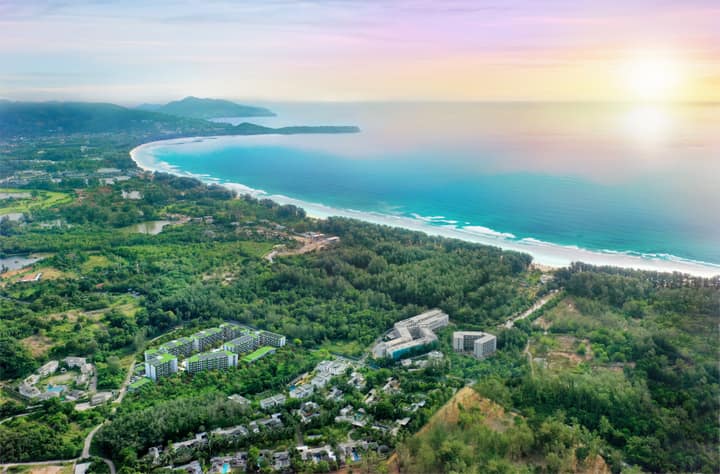
Phuket has a feature people don’t always consider before moving: the island stretches roughly fifty kilometres from north to south, and almost every important point — the airport in the north, the administrative centre in the east, the resort beaches in the west — is spread apart. There is no metro and no proper public transport, and the roads are busy in high season. So the question “how will I get around” is in practice settled by the question “where will I live”.
🔗 Basics: Cost of living → · Layan infrastructure →
2. Bike rental
A bike (scooter) is the most popular and budget-friendly transport on the island:
- cheap rental and fuel;
- mobility and parking anywhere;
- handy for short trips.
Downsides — weather (rain in low season), safety (needs experience, a licence and a helmet). For a single person or couple a bike often covers most tasks, but requires caution.
According to our cost-of-living material, long-term bike rental in 2026 runs at roughly $60–100 a month including fuel — 6–10% of a modest single-person budget. Monthly rental is noticeably cheaper than daily, and for terms of six months or more rental shops usually offer a further discount.
What to check when renting:
- Licence. Riding legally requires a motorcycle-category licence — Thai or international with the corresponding endorsement. Without it fines are routine, and more importantly the insurer can refuse a claim after an accident.
- Bike insurance. Clarify exactly what the rental shop covers: often it is only damage to the bike itself, not your health and not third-party liability. The medical side is covered by your personal policy — check it does not exclude injuries on two-wheeled transport.
- Condition. Brakes, tyres, lights — a quick check before signing; photograph the bike from all sides.
- Helmet. Not a formality: in rain and on a wet road it is your only protection.
For a family with children a bike is auxiliary, not primary, transport: handy for one person’s trip to the shop or the beach, but not for the school run in the rain.
3. Car: rental and purchase
A car is more comfortable, especially for a family:
- protection from rain and heat;
- safer for children;
- better for longer trips and shopping.
Options — rental (flexible, no ownership) or purchase (for a long stay). A car costs more than a bike to run, but for a family with kids it’s usually preferable.
| Criterion | Rental | Purchase |
|---|---|---|
| Horizon | up to 1–2 years, trial period | permanent residence |
| Upfront cost | deposit | full price or a loan (not available to every foreigner) |
| Servicing, inspection, insurance | included in the rental | on the owner |
| Flexibility | change class or walk away any time | selling takes time and a discount |
| Paperwork | passport, licence, deposit | registration to a foreigner — with proof of address |
Practical recommendation: rent for the first months after the move. You will learn how much you really drive, whether you need a second car or a bike is enough, and you won’t lose money if you decide to change area. Buying makes sense once the home is bought and the routes have settled.
To buy in their own name, a foreigner usually needs proof of a Thai residential address (a certificate from immigration or a work permit), a passport with a valid visa and compulsory vehicle insurance. The registration book, annual tax and inspection are handled by the land transport department; the rules are refined periodically, so check the current requirements before the deal.
Licence: for a long stay it makes sense to obtain a Thai driving licence — it removes questions from insurers and police and is accepted by rental companies.
4. Taxis and apps
For those who don’t want to drive, there are taxis and apps:
- app booking — convenient and transparent on price;
- local taxis — common, but with price haggling;
- handy for one-off and evening trips.
Taxis complement a bike/car well: e.g. airport runs or evenings when you’d rather not drive.
Apps like Grab (and their competitors) work across the island: the price is visible before booking, card payment, trip history. Phuket-specific nuances worth knowing:
- Resort zones and prices. Phuket has historically strong local taxi drivers with fixed rates; in some spots an app booking can take longer than in Bangkok. Not a reason to give up — just allow for the wait.
- Evenings and rain. Demand rises, fewer cars, the app fare jumps. For regular evening trips it pays to agree terms with one trusted driver.
- Long trips. A taxi from Layan to Phuket Town or the island’s south is a noticeable sum if done regularly; here your own transport wins.
- Airport. The arrivals hall has official taxi and limousine counters with fixed zone rates — a convenient option for the first arrival.
According to our budget scenarios, with your own bike or car, taxis and apps take about $20–40 a month — for occasional rides. If taxis are your main transport, this line grows several-fold and is worth comparing with car rental.
5. Public transport and shuttles
The honest answer: Phuket has no full public transport network, and you should not count on it in daily life. What exists:
- an airport — west coast bus route — runs via the main beaches to the south; useful for tourists and as a fallback, but with a timetable and stops, not door-to-door;
- local routes in Phuket Town — for residents of the centre;
- songthaews and local minibuses — infrequent, slow, mostly between Phuket Town and the beaches;
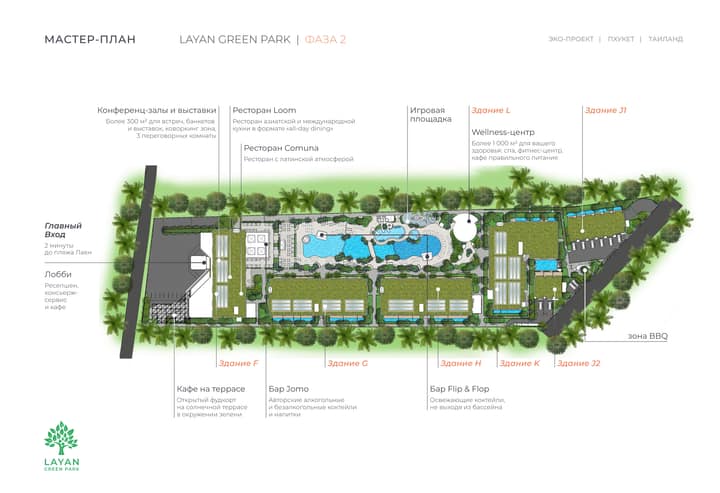
- project and hotel shuttles — the most useful format for a resident: a number of complexes run their own shuttle to the beach and the retail cluster. For example, the catalogue card for Layan Green Park lists a free shuttle to Layan beach and Boat Avenue.
The takeaway for a buyer: a shuttle in the project is a real plus for rental guests and for those who don’t want to drive, but it cannot replace personal transport. The “live without a car” logic works in Phuket only paired with a location where everything you need is within walking or five-minute reach.
6. Airport and transfers
The international airport in the island’s north is a key logistics hub:
- from the northwest (Layan, Bang Tao) — about 20 minutes, one of the closest zones;
- transfers — organised transfer for guests and yourself;
- handy for living with frequent flights.
Airport proximity is a plus for both living and rental: guests reach you easily, supporting occupancy and yield (~8–10% net via the pool).
For comparison, according to our districts map: from Naithon and Nai Yang the airport is 5–15 minutes, from Layan and Bang Tao 20–30, from Patong 45–50, from Phuket Town 35–40, and from the south (Rawai, Nai Harn) 60–75 minutes depending on traffic. For someone who flies once a month, the difference between “20 minutes” and “over an hour” is several hours of life every month and a very different stress level on early flights.
A transfer as a service makes sense in three cases: the first arrival with luggage, rental guests (the management company arranges the pickup, or you do via a trusted operator), and night flights when the app wait is longer than usual.
7. Drive-time map from Layan
To make the logistics conversation concrete, here are guide figures for a Layan resident, drawn from our catalogue cards and area articles. Times are off-peak, by car:
| Where | Guide |
|---|---|
| Layan beach | ~700 m, on foot or by shuttle |
| Boat Avenue / Porto de Phuket (supermarkets, restaurants) | ~10 minutes |
| Laguna Phuket (golf, beach clubs) | ~8 minutes |
| UWC / HeadStart international schools | 15–25 minutes |
| Bangkok Hospital network clinics in Bang Tao / Laguna | a few minutes |
| Bangkok Hospital Phuket (Phuket Town) | ~25 minutes |
| HKT airport | ~20–23 minutes |
| Phuket Town (administration, immigration, markets) | ~35–45 minutes |
| Patong | ~30–40 minutes |
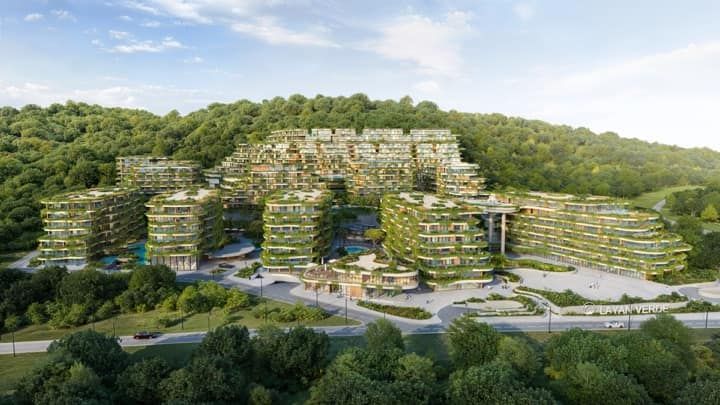
This picture explains why Layan–Bang Tao is considered one of the most balanced zones for living: everything daily within 10–15 minutes, schools and hospital within half an hour, the airport closer than from most resort areas. The Layan Real Estate projects — Layan Verde under construction and the completed Layan Green Park — sit inside this logistics.
🔗 Layan Verde review → · Layan vs Bang Tao → · Healthcare in Phuket →
8. Rainy season and high season
Transport in Phuket lives by a seasonal calendar, and it is worth factoring in:
- Rainy season (low season). Downpours are short but intense; on a bike you need to stop and wait them out. Roads flood in places, visibility drops. For a family in this period a car is not comfort but safety.
- High season. The island fills with tourists and rental cars, jams appear on the narrow west-coast roads, car parks at popular beaches are full. Drive times to popular spots grow, and app taxis get pricier at peak hours.
- Shoulder season — the most comfortable time for a driver: dry and quiet.
What this means for housing choice: if your “home — school — shop” route fits into 10–15 minutes, seasonal traffic swings are barely noticeable. If you cross half the island every day, high season turns the trip into over an hour. One more argument for counting logistics before the purchase, not after.
9. Location and transport costs
The area of residence directly affects transport:
| Factor | Effect |
|---|---|
| Proximity to schools/shops | Fewer daily trips |
| Proximity to airport | Handy for flights and guests |
| Infrastructure nearby | Less dependence on long trips |
| Remoteness | More time and cost on the road |
Areas like Layan–Bang Tao are convenient: schools, shops, clinics close, and the airport ~20 minutes away. This lowers transport costs and saves time.
The reverse logic we described in the cost of living article also holds: a “cheap” remote area often eats the rent savings through daily trips. Fuel, time, wear, a second car for the family — it all adds up to a noticeable line. That is why transport is counted together with housing, not separately: the price difference between two areas only makes sense alongside the difference in logistics.
10. Transport budget: three scenarios
Here are 2026 guide figures from our budget material. The sums are averaged, for an area with infrastructure nearby:
| Scenario | Transport | Monthly guide |
|---|---|---|
| Single, modest | Long-term bike rental + fuel | $60–100 |
| Single or couple, comfortable | Bike + taxi/apps for evenings and the airport | $80–140 |
| Family with a child | Car (rental) for the family + bike for short trips + occasional taxi | the car is the largest line; price against current offers |
For a family the car is the largest transport line, and its size depends on the class of car, the rental term and whether you buy or rent. There is no universal figure here: it is wiser to request two or three current quotes and put them in the budget together with fuel and insurance. The general principle: the closer the home to school and shops, the lower the mileage, the fuel and the need for a second vehicle.
🔗 Single budget → · Family budget → · Phuket on $1,000 a month →
11. Transport and rental yield
For an investor, logistics is not just personal convenience but a yield parameter. Guests judge a project by the same criteria as a resident:
- The road from the airport. 20 minutes versus an hour is a difference in reviews and in willingness to book short stays. The northwest wins over the south here.
- Shuttle and walkability. A guest without a car wants to walk to the beach and ride to restaurants; a project with its own shuttle meets this need, which directly affects ratings and repeat bookings.
- Parking. For guests in a rental car and for long-term tenants, a parking space is a basic requirement; confirm it when buying a unit.
- Transfer as a service. A management company that arranges the airport pickup lifts occupancy in high season — part of the service of a management programme.
All of this feeds into occupancy and final yield via the rental pool — the same ~8–10% net we quote for projects in Layan. A location with convenient logistics not only saves you money as a resident but also makes the unit more sought-after among guests.
🔗 Rental yield in Phuket → · Short-term vs long-term rental →
12. Pitfalls
- Choosing housing without logistics in mind. A remote area = daily long trips and costs.
- Riding a bike without experience or a licence. A bike needs skill, a licence and a helmet — especially in rain.
- Underestimating the season. In the rainy season a car is more comfortable and safer than a bike.
- Forgetting the airport. For frequent flights and rental, airport proximity matters.
- Treating transport as trivial. Daily trips add up to a noticeable budget item.
- Relying on the rental shop’s insurance. It often covers only the bike, not you; check your personal policy for two-wheeler exclusions.
- Buying a car in the first month. Until the routes settle, rental is more flexible; selling a car when changing area is a loss of time and money.
- Not checking parking in the project. For a family with a car and for rental guests it is a basic requirement that is easy to miss when buying off-plan.
13. Logistics checklist before buying
Before reserving a unit, run through this list — it takes half an hour and saves years of inconvenience:
- Put your points on the map: school, work, supermarket, clinic, beach, airport.
- Check the drive time to each — on a weekday in high season, not on a Sunday morning.
- Decide your transport: bike, car or a combination — and put it in the monthly budget.
- Confirm parking in the project: number of spaces, whether they are assigned to units, whether there is guest parking.
- Ask about the shuttle and walkability to the beach and shops.
- Assess the route for guests if you plan to rent out: airport transfer, nearest restaurants, beach.
- Cross-check healthcare: nearest clinic and a hospital within 25–30 minutes — more in the article on healthcare in Phuket.
If at least two points raise doubts, compare the area with a neighbouring one: often a small price difference buys entirely different logistics.
🔗 Best areas for investment → · Common investor mistakes in Phuket →
14. Case: transport and area
Consider a typical scenario. A family with a child was choosing housing and at first looked at a remote area for price. After counting daily logistics — school, shops, clinics, airport — they realised the commute would eat time and money. They chose Layan–Bang Tao: school and infrastructure 10–15 minutes away, airport ~20. A car for the family, a bike for short trips. Transport costs fell, and housing in a convenient location retains liquidity and rental demand at ~8–10% net.
Breaking their decision into steps: for the first three months they rented a car and a bike rather than buying — and in that time learned a second car was unnecessary, because the school and supermarket were ten minutes away. The bike stayed for one parent’s short trips, taxis for evenings and rare outings to Phuket Town. In high season they barely noticed the traffic: their routes did not cross the busy stretches of the west coast. And when the family leaves for the summer, the unit works in rental, with airport proximity one of the arguments in guest reviews.
Takeaway: transport in Phuket is flexible — from a budget bike to a car and taxis. But the main saving factor is location: housing near infrastructure and the airport cuts trips, costs and boosts comfort.
I’ll help choose an area with convenient logistics and select housing near infrastructure and the airport with a yield calculation.
Housing with convenient logistics
By submitting this form you agree to the privacy policy.