Layan is often chosen for quiet and nature, but investors reasonably ask: what about infrastructure? The answer is twofold: Layan itself is a calm, developing area, while everything “grown-up” — schools, clinics, retail — is next door in mature Bang Tao. Here’s what Layan and its surroundings offer, what is being built inside the projects themselves, what it costs to maintain a unit, how the area develops, and why all of it matters for renting and living.
Contents
- Where Layan is on the map
- Beach and nature
- Transport and airport
- Shops and restaurants
- Schools and healthcare nearby
- Infrastructure inside the projects
- Area development
- Infrastructure for rental
- Owner costs and utilities
- Layan and its neighbours: comparison
- Pitfalls
- Case: balancing quiet and convenience
1. Where Layan is on the map
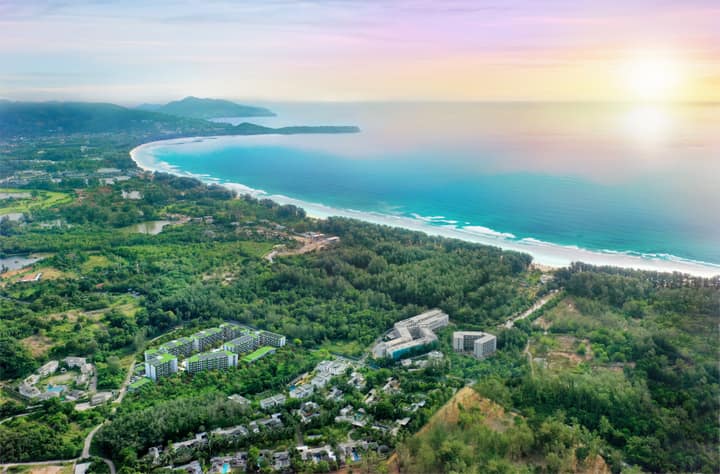
Layan is an area on Phuket’s northwest coast, between Bang Tao and Nai Thon. One of the closest resort zones to the international airport, yet it stays quiet and green. That combination is rare: privacy plus convenient logistics.
Geographically, Layan is the northern end of the large Bang Tao bay: a narrow strip of beach, dunes and greenery behind it, then hills. Dense beachfront development never took hold here because there was little free land by the sea, and what there was went to villas rather than hotels. That’s why the area still feels like the “edge of the coast”, even though Bang Tao’s retail centre is less than ten minutes away.
For reference — drive times from Layan to key points:
| Destination | Drive time |
|---|---|
| Phuket airport (HKT) | ≈ 20 minutes |
| Bang Tao (Boat Avenue, Porto de Phuket) | 5–10 minutes |
| Laguna Phuket (golf, hotels) | ≈ 8 minutes |
| Surin | 10–15 minutes |
| Kamala | ≈ 20 minutes |
| Phuket Town | 40–45 minutes |
🔗 How the island’s areas relate to each other: Phuket districts map →
2. Beach and nature
Layan Beach is considered one of the cleanest and calmest on the island: soft sand, calm sea in season, fewer crowds. Greenery and natural areas surround it. That’s what makes the area premium and draws those who value seclusion by the sea.
A distinctive feature of Layan is the natural lagoon behind the dunes that forms in the dry season: a still backwater with almost motionless water reflecting the sunset. The open horizon, with no beachfront buildings, gives one of the best sunset views on the west of the island. There are noticeably fewer beach bars and rows of sunbeds here than on the busy stretches of Bang Tao or in Surin — a deliberate positioning of the area, not a sign of being “underdeveloped”.
Seasonality matters: in high season (November–March) the sea is calm and suitable for swimming with children; in the rainy season (roughly May–October) the west coast can have waves and currents, and the lagoon behind the dunes isn’t there year-round. This is a feature of the whole west coast, but in Layan, where the beach is the main asset, it’s worth factoring into your own visits.
🔗 West-coast beaches: Best beaches of west Phuket → · detailed guide: Layan Beach →
3. Transport and airport
- Airport — ~20 minutes’ drive (one of the closest zones).
- Roads — easy access to Bang Tao, Surin, Phuket Town.
- Transport — car/bike rental, taxis, transfers.
Airport proximity is a plus for both renting (convenient for guests) and living (frequent flights).
A few practical points the map doesn’t show:
- Public transport in Phuket is limited, and Layan is no exception. Count on your own or a rented car/bike, app-based taxis and transfers. For guests of a rental unit, the airport transfer is usually arranged by the management company.
- In-project shuttles partly solve the “last mile”: Layan Green Park runs a free shuttle to the beach and Boat Avenue, which removes the need for a bike for daily shopping trips.
- The road to the airport bypasses the main tourist clusters, so the journey time barely depends on seasonal traffic in Patong or Phuket Town — a tangible advantage over the southern areas if you fly often.
- Parking is built into new projects from the start: Layan Green Park has 108 spaces; for living with your own car this matters more than it seems at the buying stage.
🔗 Island logistics: Getting around Phuket →
4. Shops and restaurants
Layan itself has local cafés and small shops; everything larger is nearby. Minutes away are Boat Avenue and Porto de Phuket (Bang Tao/Cherng Talay) with supermarkets, restaurants, shops and weekend markets. Everyday needs are fully covered.
What it looks like in practice:
- By the beach — a handful of intimate restaurants and cafés built around dinner with a sunset view, not mass footfall. No evening shows or loud music.
- Boat Avenue and Porto de Phuket (~5 km, about 10 minutes) — the main retail cluster of the northwest: supermarkets, cafés, restaurants of various cuisines, pharmacies, banks, services, a Friday market. This is where you go for anything you can’t buy near home.
- Laguna Phuket (~4 km) — a hotel cluster with restaurants, golf, spas and beach clubs; open to more than just hotel guests.
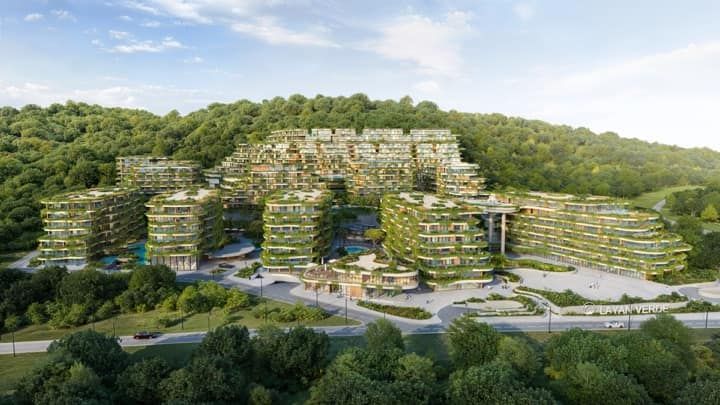
- Inside the projects — their own restaurants and services: a club restaurant and bakery in Layan Green Park, a community mall within Layan Verde after completion.
The logic is simple: daily shopping is covered by the nearest cluster 10 minutes away, and an evening by the sea by the restaurants in Layan itself. A detailed look at the neighbouring hub is in the Bang Tao guide, and at Laguna in the Laguna cluster.
5. Schools and healthcare nearby
| Area | Near Layan |
|---|---|
| International schools | Bang Tao / Cherng Talay (British, other curricula) |
| Private clinics | Bangkok Hospital and others within a drive |
| Supermarkets | Boat Avenue, Porto de Phuket |
| Sports/services | Laguna, beach clubs, fitness |
For a family, the two key questions — school and doctor — are answered within 20–25 minutes. Per the Layan Green Park project card, the international schools UWC and HeadStart are 20–25 minutes by car, Bangkok Hospital Phuket about 25 minutes. Closer, in Cherng Talay and Bang Tao, there are schools with British and other curricula, as well as private clinics and dental practices for everyday needs. School buses of the major international schools usually cover the island’s northwest — confirm this with the specific school when choosing.
The healthcare picture is typical for Phuket: clinics nearby for routine and minor cases, large private hospitals in Phuket Town and on the way there for serious ones. Twenty-five minutes to Bangkok Hospital Phuket is workable for everyday life, but if you’re choosing a unit for permanent living with children or elderly relatives, check it in person rather than on the map.
🔗 Details: International schools → · Healthcare → · collection: Property near international schools →
6. Infrastructure inside the projects
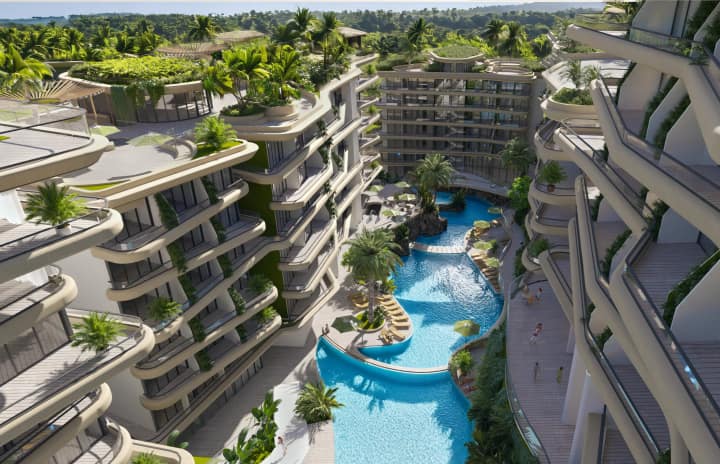
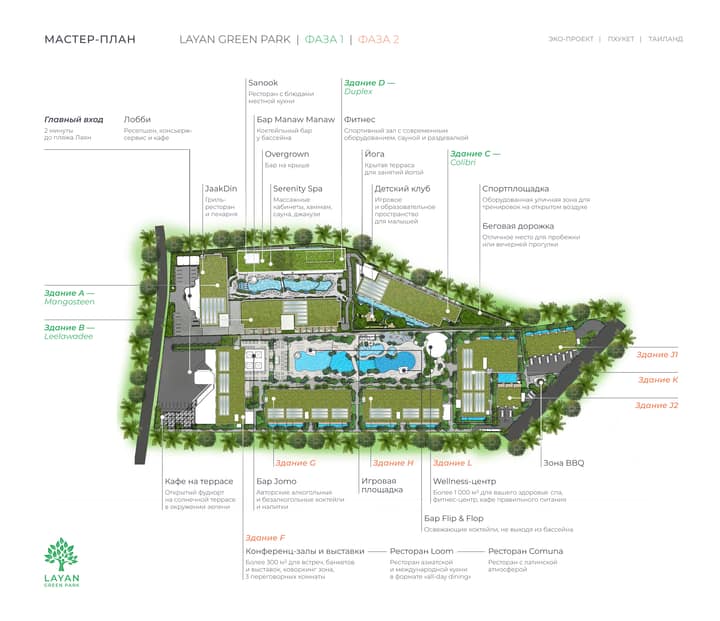
A separate layer of Layan’s infrastructure is what’s being built inside the projects themselves. In an area with no “urban” environment, it’s the in-project infrastructure that covers a resident’s and a guest’s everyday and leisure needs.
| Parameter | Layan Green Park | Layan Verde |
|---|---|---|
| Status | Phase 1 completed and operating since 2024, phase 2 due in 2026 | Under construction, completion 2028 |
| Scale | Phase 1 — 248 units, phase 2 — 296 units in 6 buildings | 774 residences on 7.5 ha |
| To Layan Beach | ~700 m, 2 minutes by shuttle | ~700 m, ~9 minutes on foot |
| Pools | 4 freshwater pools and a waterfall | Lagoon pools across the district |
| Food and services | Club restaurant, bakery, 3 lounge bars | Community mall with a waterfall, ocean club |
| Sport and wellness | Gym 253 m², sports courts 430 m², running tracks, yoga terrace, sauna and spa 306 m² | Dusit hotel infrastructure, a 5-star hotel on site |
| For children | Kids’ club 171 m² and playground 347 m² | Pedestrian environment and landscaping across the site |
| Logistics | Free shuttle to the beach and Boat Avenue, parking for 108 cars | Self-contained district with an internal pedestrian environment |
| Distinctive feature | EDGE certificate — up to 40% utility savings | Premium buildings and hotel run by Dusit International |
The difference between the projects is the stage. Layan Green Park is already operating: its infrastructure can be checked in person, and phase 1 is fully sold out by the developer, available only via resale with full payment (studios from $142,602). Layan Verde is a district of future scale: 774 residences, its own retail centre and a hotel operator — but all of that arrives by completion in 2028, and today the buyer enters at the construction stage with an instalment plan over the build period.
🔗 Project comparison: Layan Verde vs Layan Green Park →
7. Area development
Layan is actively developing: new premium beachfront projects, improving roads and services. The shortage of seaside land makes the area attractive — supply is limited and demand grows. The Layan Verde project is an example of a new district with its own infrastructure.
What exactly drives the area:
- Large projects bring infrastructure with them. A 7.5-hectare district with a community mall and a 5-star hotel is not just 774 residences but retail, restaurants and services the whole area will use. That’s how Bang Tao once developed around Laguna.
- Hotel operators raise the bar. Dusit International’s arrival in Layan Verde sets a service standard that neighbouring properties will have to match.
- Demand spills over from Bang Tao. The neighbouring area has become dense and touristy; some buyers and tenants who want quiet with the same logistics are shifting north — to Layan.
- Land scarcity caps supply. Almost no free first- or second-line plots remain around the bay, so new large projects here are the exception rather than the rule. That limits competition for what’s already built and under construction.
The flip side of development is construction nearby over the next few years. For an investor buying to rent, it’s a temporary factor; for someone relocating right now, it’s a reason to look at the specific unit’s position relative to active sites. The Layan Verde developer forecasts unit capitalisation of around +45% over the construction period — that’s the developer’s forecast, not a guarantee, and it rests on exactly this “infrastructure catching up with the location” logic. How the market views the northwest overall is in the Phuket real estate market 2026 review.
8. Infrastructure for rental
For investors, not just living but rental matters. Airport proximity, a clean beach and a premium location attract guests, while nearby Bang Tao infrastructure covers their needs. A unit in a condo-hotel with a management program gives the owner a net yield of around 8–10% (the owner receives 60% of the pool’s net profit).
Infrastructure affects rental through three mechanisms:
- Guest profile. A quiet beach without bars attracts couples, families and mature travellers — an audience that rarely hunts for discounts and often returns. That profile gives steadier occupancy than the “explosive” tourist clusters.
- Length of stay. A guest who doesn’t need to leave the complex every day — pools, restaurant, shuttle to the beach and shops inside the project — is more willing to book long stays. In low season (April–October), it’s long bookings and guests from Asia and the Middle East that support occupancy.
- Logistics for the operator. Twenty minutes to the airport means cheap and predictable transfers, and a nearby retail cluster simplifies supply and servicing of the units.
All of this works for the rental pool model: income is averaged across all units in a category, and the steadier the complex’s overall occupancy, the smoother the owner’s payouts. How the 60/40 split works and what the management company covers is in a separate article; the month-by-month seasonal picture is in the occupancy review.
🔗 How income works: Rental management program → · Rental seasons and occupancy → · Calculator
9. Owner costs and utilities
Infrastructure is not only convenience but also a recurring expense line. Three main items for a unit in a Layan condo-hotel:
| Cost | Layan Green Park | Layan Verde |
|---|---|---|
| CAM fee (common area maintenance) | 75 THB/m² per month | 85 THB/m² per month |
| Sinking fund (one-off at purchase) | 650 THB/m² | 850 THB/m² |
| Electricity and water | Government tariff | Government tariff |
For reference: a ~36 m² studio in Layan Verde at 85 THB/m² is about 3,060 THB CAM fee per month; a 30 m² studio in Layan Green Park at 75 THB/m² is 2,250 THB per month. That’s arithmetic from the project cards, not a forecast: CAM rates are approved by the owners’ meeting and can be revised.
The richer the in-project infrastructure, the higher the CAM fee — pools, spa, shuttle and 24/7 security are paid for out of it. So comparing projects on the rate alone is misleading: what matters is what it covers. A separate factor in Layan Green Park is the EDGE certificate: the developer states up to 40% utility savings thanks to energy-efficient design.
For a unit in the rental pool, the CAM fee and insurance are owner costs on top of the 60/40 split, and replacing furniture and appliances as they wear out is the owner’s line too. How to count the full cost picture is in CAM fee and sinking fund and utility bills in Phuket.
10. Layan and its neighbours: comparison
To understand what Layan’s infrastructure gives you, it helps to look at the neighbours along the coast.
| Parameter | Nai Thon / Nai Yang | Layan | Bang Tao | Surin |
|---|---|---|---|---|
| Atmosphere | Quietest, “village-like” | Quiet, premium | Dense, touristy | Compact, premium |
| Own retail | Minimal | Local cafés, shops | Boat Avenue, Porto de Phuket, Laguna | Restaurants, boutiques |
| To the airport | 10–15 minutes | ≈ 20 minutes | 25–30 minutes | 30–35 minutes |
| Schools and clinics | Only by driving out | 10–25 minutes | Within the area | 15–20 minutes |
| New supply | Limited | Scarce, large projects by the beach | Dense, lots of resale | Land shortage |
| Best for | Maximum quiet, frequent flights | Balance of quiet and logistics | Active life, everything on foot | Premium without scale |
The takeaway from the table: Layan is the only one of the four where a quiet beach, airport proximity and a full retail-and-schools cluster within 10–15 minutes come together. Nai Thon is quieter but you drive for everything; Bang Tao is more convenient for a walkable life but it’s a different atmosphere; Surin is premium but further from the airport and with even less new supply.
🔗 Head-to-head comparisons: Layan vs Bang Tao → · Surin vs Layan → · Nai Thon and Nai Yang guide →
11. Pitfalls
- Expecting “city” infrastructure in Layan. The larger stuff is nearby, in Bang Tao.
- Ignoring the season. Sea and activity depend on the season.
- Overlooking the area’s stage. Development means both potential and “construction around.”
- Looking only at the beach. Nearby logistics and services matter just as much.
- Confusing area infrastructure with project infrastructure. Pools, restaurant and shuttle exist today in the operating Layan Green Park; in Layan Verde the community mall and hotel arrive by completion in 2028.
- Comparing CAM fees without the scope. A higher rate may mean fuller infrastructure, not “overpaying”.
- Planning life without a car. Daily trips to school and shops need your own transport; the project shuttle doesn’t cover everything.
- Taking “20 minutes to the airport” from the map. Check the route at the time of day you’ll actually be driving — especially if you fly often.
12. Case: balancing quiet and convenience
Consider a typical scenario. A buyer wanted quiet but with accessible family infrastructure. Layan fit perfectly: a home by a clean beach, with school, clinic and supermarkets 10–15 minutes away in Bang Tao. The airport is close for frequent flights, and the unit works in rental while they travel. They got both privacy and convenience — no compromise.
How the decision looked in detail. The family compared three options: Bang Tao (everything on foot, but dense and noisy), Nai Thon (as quiet as it gets, but every shopping trip by car) and Layan. Two factors decided it: time to school and time to the airport. In Layan both fitted within 20–25 minutes, while the home itself stood by a beach with no music from speakers in the evening. For living they chose a resale unit in the operating Layan Green Park — the complex’s infrastructure is already in place and verifiable, and the free shuttle to the beach and Boat Avenue removed the need for a second bike. The investment part of the budget went to a studio in Layan Verde: entry at the construction stage with an instalment plan over the build period, counting on the district’s infrastructure — community mall, ocean club, Dusit hotel — “catching up” with the location by 2028.
Takeaway: Layan is quiet “plus” nearby infrastructure. For living and renting, that balance often beats a noisy centre. The key is to distinguish what’s already built, what’s under construction, and what it costs to maintain the unit you choose.
I’ll select a Layan unit for living and rental, factoring in infrastructure and a yield calculation. The area’s villas are in the collection villas in Layan.
Selection in the Layan area
By submitting this form you agree to the privacy policy.