Utilities are the budget line owners and renters in Phuket underestimate most often at the start. The spread is wide: a studio with no air conditioning barely registers an electricity bill, while a villa with a pool and constant AC can easily run five times higher. Here is a breakdown of what electricity, water, internet and condo fees really cost, where landlords build in a markup, and how eco-certification lowers bills for owners in newer projects.
Contents
1. What makes up a utility bill
In Phuket, a monthly utility payment usually breaks down into four items:
- electricity — the largest and most variable part of the bill;
- water — fixed and almost always cheap;
- internet and mobile — fiber plus a SIM card or eSIM;
- maintenance fee — a separate line for condo and villa-complex owners, not strictly a “utility” but always part of the overall cost of ownership.
The overall range spans from a modest sum for an AC-free studio to a noticeably higher one for a villa with a pool. For the broader picture, see cost of living in Phuket and cost of living in Thailand.
2. Electricity: the government tariff
Electricity in Phuket is supplied by the Provincial Electricity Authority (PEA). The government tariff runs about 4–5 THB per kilowatt-hour under a direct contract with the utility. This is the rate owners aim for when they put the meter in their own name after buying a unit or house.
| Property type | Electricity, govt. tariff | Main driver |
|---|---|---|
| Studio / 1BR | $50–100/mo | AC in the bedroom |
| 2BR apartment | $80–150/mo | AC in 2+ rooms |
| Villa / 3BR with pool | $150–350/mo | AC in every room + pool pump |
For a full budget breakdown by household type, see budget for a single person and family budget.
3. Landlord markup: where money leaks out
When renting, the meter is often registered to the landlord rather than the tenant — and that is where a legal but noticeable markup appears. Instead of the government’s 4–5 THB/kWh, landlords frequently charge 7–10 THB/kWh — a difference that can push the total electricity bill up by 40–100%.
This is not a scam: owners are entitled to set their own rate as long as it is written into the lease. The real problem is that tenants often learn the markup only after the first bill arrives. The rule is simple: confirm the per-kWh rate before signing, not after moving in. For more on hidden rental costs, see renting in Thailand.
4. Air conditioning — the main variable
Across every scenario, air conditioning drives 60–80% of the electricity bill. A few practical takeaways:
- inverter split units run 20–30% more efficiently than older models at the same cooling capacity;
- 24–26°C instead of 20–22°C noticeably reduces compressor load;
- the number of running units matters more than floor area — a studio with two AC units can cost more than a villa with one well-insulated floor.
Seasonality matters too: during the hot months (March–May), AC bills rise island-wide regardless of location.
5. Water: tariff and quirks
Water is the most predictable utility item. The Provincial Waterworks Authority (PWA) keeps the tariff low, and in most rental agreements the markup on water is either absent or minimal.
| Item | Range | Note |
|---|---|---|
| Water (any property type) | $5–15/mo | Tariff barely scales with floor area |
| Landlord markup on water | usually 0–10% | Far smaller than on electricity |
The one exception is villas with their own pool and garden: watering and pool top-ups add a moderate but noticeable amount compared with an apartment.
6. Internet and mobile service
Fiber internet is available almost everywhere on Phuket, including resort areas near Layan and Bang Tao beaches — relevant for owners working remotely too. A typical setup includes:
- home fiber (AIS Fibre, True, 3BB and similar) — stable rates, speed sufficient for video calls and streaming;
- mobile service / eSIM — inexpensive data packages with good coverage even outside tourist zones.
The combined line item runs $20–35/month per person for home internet and mobile together. For anyone planning to work from Thailand long-term, see Phuket for remote workers.
7. Condo maintenance fee — not a utility
It is important not to confuse utility bills with the common area maintenance fee. This is a separate item paid by the unit owner in a condo complex regardless of whether they live there or rent it out:
- covers cleaning, security, pool upkeep, landscaping, lobby and general infrastructure;
- usually calculated as a fixed rate per square meter per month — around ~85 THB/sqm/month at projects like Layan Green Park;
- does not depend on how much electricity or water a specific unit consumes.
This is a recurring ownership cost that should be budgeted separately from rental income — see the methodology in how to calculate ROI in Phuket.
8. Eco-certification: how to cut bills
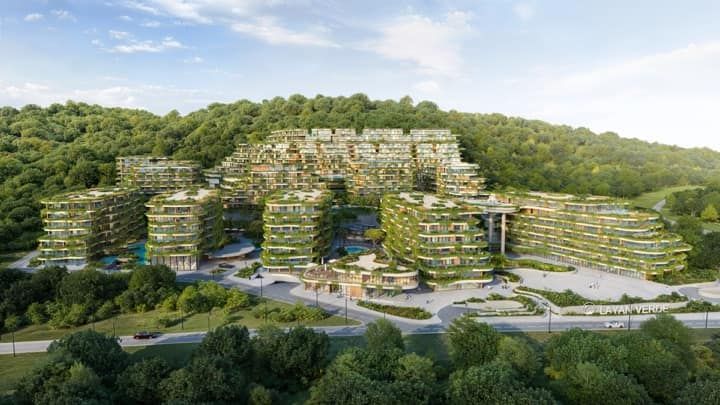
Some newer Phuket projects are built to energy-efficiency standards, which directly lowers bills for owners and tenants. Layan Green Park, Phuket’s first eco condo-hotel, holds an international EDGE certificate: energy-efficient building systems deliver savings of up to 40% on utility bills compared with a conventional building of similar class.
For an investor, this is not just a green image — it is a concrete line in the income model: a unit in the rental pool with lower operating costs on electricity and water keeps more net profit, which is split between the owner (60%) and the management company (40%) — a benchmark yield of roughly 8–10% net annually with a payback period of around 12 years. The same logic underpins Layan Verde, an eco-district of 774 residences 700 meters from Layan beach.
9. Pitfalls
- Not confirming the electricity rate before signing. The gap between 4–5 THB and 7–10 THB/kWh turns a “cheap” rental expensive from month one.
- Confusing the condo fee with utilities. The common-area charge is a separate line and does not replace electricity and water bills for your own unit.
- Ignoring AC seasonality. In the peak hot season, an electricity bill can rise 30–50% versus cooler months — budget for the peak month, not the average one.
- Not checking the meter type. If the meter is registered to the landlord rather than directly to the PEA, you cannot verify the government tariff yourself — you can only negotiate the rate in the contract.
- Ignoring energy efficiency when choosing a unit. The gap between an ordinary building and an EDGE-certified one is tens of dollars a month for years to come.
10. Case study and takeaway
A family that relocated to Phuket and rented a villa with a pool in Bang Tao budgeted $150/month for utilities, based on the apartment they had rented in Bangkok. The actual bill for the first hot month (March) came to $340: a landlord markup (8 THB/kWh instead of the government’s 4.5) and continuous AC running in four rooms plus the pool pump were the drivers. After recalculating, the family switched to a 25°C setting instead of 21°C and added inverter units in two rooms — the bill dropped to $220/month from the second month on.
The takeaway is simple: utility costs in Phuket are manageable once you know the structure of the bill in advance. Electricity is the main variable and the main source of markups, water and connectivity are predictable, and the condo fee is a separate, mandatory line for owners. Projects with eco-certification like Layan Green Park remove part of this burden structurally, not through the tenant’s own thrift.
I can send an up-to-date utility and yield calculation for a specific unit — leave a request or use the yield calculator. More on the company on the VillaCarte Group page.