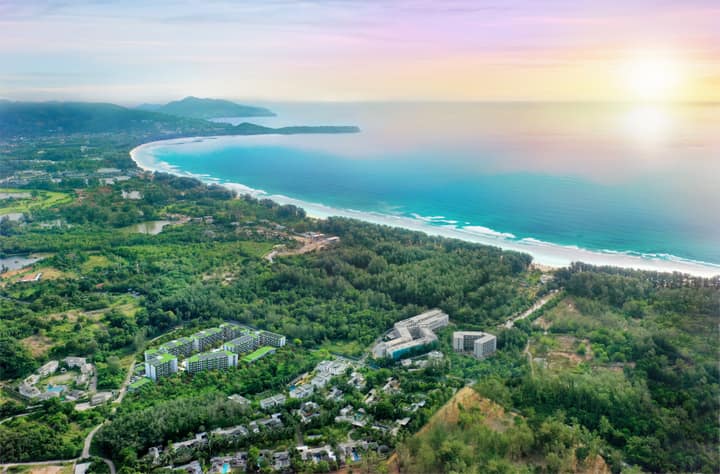
Before relocating or buying property in Thailand, almost everyone asks the same question: how much money do you actually need each month? There is no universal answer — Bangkok, Phuket and Chiang Mai run on different budgets, and the cost for a single person versus a family with children can differ several times over. This guide breaks down the budget by category, compares the three key regions, and lays out realistic scenarios for 2026.
Contents
- What a Thailand budget is made of
- Phuket vs Bangkok vs Chiang Mai
- Housing: renting vs owning
- Food and everyday spending
- Transport
- Utilities, connectivity, insurance
- Schools and healthcare for a family
- 2026 budget scenarios
- A cross-check with independent data: Numbeo, October 2026
- How to build your own budget: a six-step method
- Mini calculation: renting vs owning in Phuket
- Pitfalls
- Case study and takeaway
1. What a Thailand budget is made of
Monthly spending in Thailand breaks down into six major categories:
- housing — rent or the cost of maintaining owned property;
- food — from markets and street food to Western supermarkets and restaurants;
- transport — scooter, car, taxis, flights between cities;
- utilities and connectivity — electricity (air conditioning is the biggest driver), water, internet, mobile;
- insurance and healthcare — essential for any long-term stay;
- school — a major, separate line item for families with children.
The spread is huge: a solo digital nomad in Chiang Mai and a family with two kids in Phuket live in literally different financial worlds. Below are the numbers for each region and category.
2. Phuket vs Bangkok vs Chiang Mai
The three cities produce three different budget models:
| Region | Profile | Average comfortable single budget |
|---|---|---|
| Bangkok | Metropolis, work, infrastructure | $1,300–1,900/mo |
| Phuket | Island, tourism, beach, condo/villa | $1,500–2,200/mo |
| Chiang Mai | Mainland, slower pace, digital nomads | $900–1,400/mo |
Bangkok wins on public transport and the spread of food prices, Chiang Mai is the cheapest overall, and Phuket offsets higher beachfront housing costs with transport savings if you live near the beach and infrastructure — for example in Layan or Bang Tao, where shops, schools and clinics are within walking distance.
An important nuance: Phuket and Bangkok are more seasonal than Chiang Mai. During the high tourist season (November–April), rent, taxis and some services get more expensive on the island, while Chiang Mai costs barely move through the year. When budgeting long-term, plan for a ±15–20% seasonal corridor on Phuket rather than a fixed number.
3. Housing: renting vs owning
Housing is the largest line item in almost every scenario.
| Housing type | Bangkok (center) | Phuket (Layan/Bang Tao) | Chiang Mai |
|---|---|---|---|
| Studio/1BR rent | $700–1,200/mo | $600–1,500/mo | $350–600/mo |
| 2–3BR villa/house rent | $1,200–2,500/mo | $1,500–4,000/mo | $700–1,400/mo |
Owning property changes the math: instead of rent, you carry utilities and common-area maintenance (a benchmark of ~85 THB/sqm/month for projects like Layan Green Park). The unit can also be rented out through a rental pool while the owner is away — the owner receives 60% of the pool’s net profit, a benchmark of roughly 8–10% net annual yield with a ~12-year payback. That turns housing from a pure cost into a partly self-financing asset. See the full method in how to calculate ROI in Phuket and the yield calculator.
4. Food and everyday spending
Food in Thailand is flexible for any budget:
- street food and markets — a meal from $1.5–3, the most accessible option in any city;
- Thai cafes and food courts — $3–6 per meal;
- Western restaurants — $10–25 per person;
- supermarkets with imports — dairy, wine, ready meals cost 2–4x more than local produce.
Someone eating locally lands around $150–250/mo on food; someone focused on Western cuisine and restaurants spends $500–800/mo and up. Regional differences are minor — the grocery market in Thailand is fairly uniform, except for premium imported items, which cost more on Phuket due to island logistics.
5. Transport
Transport depends on the city and your mobility needs:
- Bangkok — BTS/MRT cover the center, transport costs are among the lowest in the region ($30–60/mo without a personal car);
- Phuket — no conventional public transport; the standard is a scooter rental ($60–100/mo) or a car ($400–700/mo); living near infrastructure (Layan–Bang Tao) cuts the number of trips needed;
- Chiang Mai — a compact city where a scooter covers most needs for $50–80/mo.
More on island logistics in getting around Phuket.
6. Utilities, connectivity, insurance
| Item | Range/mo | Note |
|---|---|---|
| Electricity (with AC) | $80–150 | The main variable is AC usage intensity |
| Water | $5–15 | Usually fixed and low |
| Internet + mobile | $20–35 | Fiber available everywhere, including resort areas |
| Health insurance (adult) | $100–300 | Rises with age and coverage level |
International insurance is essential for a comfortable stay: the public system is built for residents, while private clinics — the best option for expats — work on insurance or direct payment. More in healthcare in Phuket.
7. Schools and healthcare for a family
For families with children this is often the largest budget category:
- international school — from $8,000 to $20,000+ per year per child, the widest spread in the whole budget;
- private healthcare — quality clinics are available in all three regions, pricier in Bangkok and Phuket;
- clubs and sports — an extra $50–150/mo per child.
Full school overview in international schools in Phuket. If you’re relocating long-term, it’s worth budgeting for visa status early — see the Thailand Elite visa as an option for families without a work visa.
8. 2026 budget scenarios
| Scenario | Profile | Budget/mo |
|---|---|---|
| Single, modest | Local food, scooter, studio away from center | $700–1,000 |
| Single, comfortable | Partly Western food, car/taxi, 1BR near infrastructure | $1,500–2,000 |
| Couple, comfortable | 2BR housing, insurance for two, mixed diet | $2,500–3,000 |
| Family with a child | + international school, private healthcare | $4,000–6,000+ |
These are benchmarks, not fixed figures: the real figure depends on district, habits and the exchange rate at the time of spending. Remote work from Thailand adds its own budget and tax-residency nuances — see Phuket for remote workers.
9. A cross-check with independent data: Numbeo, October 2026
The ranges above are our own estimates from client experience, so it is worth testing them against an outside source. The largest open cost-of-living database is Numbeo: residents submit prices themselves and the index is recalculated continuously. As of the 2–15 October 2026 update, the three cities compare like this:
| Metric (Numbeo, October 2026) | Bangkok | Phuket | Chiang Mai |
|---|---|---|---|
| Cost of Living Index (New York = 100) | 41.99 | 39.28 | 31.68 |
| Single person, monthly costs excluding rent | ~23,400 THB | ~21,400 THB | ~18,100 THB |
| Family of four, monthly costs excluding rent | ~85,300 THB | ~77,800 THB | ~66,200 THB |
| Rent relative to Bangkok | baseline | ~19% higher | ~40% lower |
For Thailand as a whole Numbeo puts a single person at ~19,800 THB/month and a family of four at ~72,300 THB/month excluding rent. Three conclusions that back up the logic of this guide:
- Day-to-day life in Phuket is not more expensive than Bangkok. Excluding rent, the island is actually 6.6% cheaper than the capital — imported groceries cost more, but transport, services and food away from the tourist strips make up for it.
- The entire Phuket–Bangkok gap is rent. Housing on the island costs roughly a fifth more, and that single line decides whether a budget stays on track. That is why the “rent or own” question is sharper in Phuket than anywhere else in the country.
- Chiang Mai is cheaper on every line, but the rent gap (minus 40%) is far wider than the everyday-spending gap (minus 25%). The savings there are mostly housing savings too.
One caveat: Numbeo is crowdsourced, and its figures reflect an “average respondent” basket rather than your lifestyle. Use it to sanity-check orders of magnitude and compare cities with each other, not as a line-by-line budget. A category-by-category comparison of the island and the capital is in our separate piece on cost of living: Phuket vs Bangkok.
10. How to build your own budget: a six-step method
Rather than relying on someone else’s averages, build your own estimate. The method is simple and takes one evening.
- Pick a region and a specific district. Not “Phuket” but Layan, Bang Tao, Rawai or Phuket Town: the rent difference between districts of the island is comparable to the difference between cities. See the Phuket districts map.
- Decide on the housing format. Studio or 1BR, villa, long-term rent or purchase. This is the biggest line and it drives the next steps: a villa with a garden and pool pushes up electricity and maintenance, a condo adds a common-area fee.
- Split costs into fixed and variable. Fixed — rent or ownership costs, insurance, school, connectivity. Variable — food, transport, entertainment, trips. Budget the fixed part at the top of the range and the variable part according to your actual habits.
- Spread annual and one-off payments across the months. Insurance, visa fees, the school year, flights home, the rental deposit on move-in, buying a scooter or furniture — none of these are monthly, but none of them leave the budget. Divide the annual total by 12 and add it to the monthly figure.
- Add a seasonal corridor. For Phuket, ±15–20% on the lines that track the tourist season: short-term rent, taxis, some services. Chiang Mai barely needs one.
- Add a currency buffer. If your income is not in baht, recalculate the budget at the current Bank of Thailand rate and at a rate 10% worse — that shows you where comfort ends. The exchange-rate dynamics are covered in USD/THB and your budget.
| Category | Example lines | How to count it |
|---|---|---|
| Monthly fixed | Rent or CAM fee, insurance, internet, school (per month) | At the top of the range |
| Monthly variable | Food, transport, entertainment, sport | By your habits, with a seasonal corridor |
| Annual and one-off | Visa, flights, rental deposit, furniture, appliances, scooter | Annual total ÷ 12 |
| Reserve | Currency swings, medical costs outside insurance, the unexpected | A separate line, not “whatever is left” |
Compare your total with the scenario table in section 8: if your estimate lands well below the “comfortable” scenario for your household, you have most likely left out annual payments or the reserve. Profile-by-profile breakdowns are in a single person’s budget and a family budget.
11. Mini calculation: renting vs owning in Phuket
Since the main cost-of-living gap on the island is housing, let us cost exactly that. Take two models over one year for a single person or a couple who are happy in a studio or 1BR in the Layan–Bang Tao area.
Model A — long-term rent. By the table in section 3, a 1BR in this zone costs $600–1,500/month, i.e. $7,200–18,000 a year. Add the move-in deposit, which only comes back when the lease ends and freezes part of your budget. This money is gone for good: after five years of renting you own nothing and have no claim to a refund.
Model B — ownership. A completed phase-1 studio at Layan Green Park on resale starts at $142,602; a phase-2 studio from $224,043. Instead of rent you pay the common-area fee — 85 THB/m²/month, i.e. about 2,550 THB/month for a 30 m² studio or about 3,120 THB/month for 36.7 m² — plus utilities, which you would pay as a tenant anyway. Then the rental pool does its work: while the owner is away the unit is let out and the owner receives 60% of the pool’s net profit; the benchmark with year-round letting is ~8–10% net per year. If you live in the unit for six months and it sits in the pool for the other six, it is reasonable to assume roughly half of that figure — which is usually enough to cover the running costs of the home and part of your other spending.
| Line per year | Renting a 1BR (Layan–Bang Tao) | Owning an LGP studio |
|---|---|---|
| Housing payment | $7,200–18,000 | 0 (capital is tied up in the asset) |
| Common-area fee (CAM) | included in rent | ~30,600–37,400 THB |
| Utilities | you pay | you pay |
| Income while you are away | none | benchmark ~8–10% net a year with year-round letting, proportionally less when partial |
| What is left after 5 years | nothing | the unit and its price history |
This does not mean buying always wins: ownership needs capital up front, pool income depends on season and occupancy, and a quick resale is not always possible. But for anyone planning to live in Thailand for years, the calculation shows honestly where $7–18k a year goes under a lease. The full model with payback (benchmark ~12 years through the pool) is in how to calculate ROI in Phuket and the yield calculator; exit strategies are in how to resell property in Phuket.
12. Pitfalls
- Anchoring on a “regional average” figure. Single-person and family-with-children budgets differ 4–6x — calculate for your own scenario.
- Forgetting AC in the electricity bill. It’s the biggest variable in utilities, especially during the hot season.
- Underestimating school and insurance. For a family these are baseline, not optional, line items — budget for them upfront, not after the fact.
- Ignoring rental seasonality. During high season (November–April), Phuket rents rise; a long-term lease or ownership smooths out this risk.
- Not accounting for the exchange rate. Income in USD/EUR and spending in THB — rate swings change the real budget without any price change in baht.
- Treating housing as a pure cost. Buying through a developer with a rental pool (for example, Layan Verde or Layan Green Park) lets a unit generate income while the owner is away, partly offsetting the cost of living.
- Budgeting at the exchange rate “from when we moved”. The baht budget is stable; income in another currency is not. Recalculate the estimate at least quarterly at the current Bank of Thailand rate.
- Forgetting one-off move-in costs. Rental deposit, furniture and appliances, a scooter or a car down payment, visa fees — the first two or three months always run above the “cruising” budget.
- Applying someone else’s basket to yourself. Indices like Numbeo describe an average respondent; a family with an international school or a couple without a car live on a completely different cost structure.
13. Case study and takeaway
A couple from Europe planned to relocate to Phuket, initially anchoring on a “typical” $1,500-per-person figure from a random article online. A detailed calculation showed that with insurance, a car and beachfront housing, a comfortable couple’s budget came to around $2,800/mo — nearly double their expectation. The solution was buying an apartment in a rental-pool project near Layan Beach instead of a long-term lease: maintenance costs are offset by rental income during trips home, while the asset itself appreciates. The resulting monthly living budget dropped by roughly $400–500 because housing stopped being a pure expense.
Takeaway: the cost of living in Thailand isn’t a single number — it’s a budget built for a specific region and scenario. Housing and school are the largest categories; Chiang Mai is the cheapest overall, Bangkok is predictable thanks to transport, and Phuket offsets higher rent with beach proximity and the potential income from ownership.
I can help you build a budget for your scenario and find property on Phuket that lowers housing costs and generates income while you’re away — submit a request or see the Layan Real Estate page.
This material is for informational purposes only. Figures are approximate ranges for 2026; actual costs depend on lifestyle, district and exchange rates. Not financial advice.