A family with kids budgets differently from a single person or a couple: school, children’s insurance, a car instead of a bike, and a larger home all enter the picture. Phuket is one of the few Thai resort destinations where family infrastructure — international schools, paediatric care, kids’ clubs — is concentrated in one compact cluster by the sea. This guide breaks down a family budget with kids for 2026, category by category, with three scenarios from minimal to premium.
Contents
- Who counts a “family” budget
- Housing: a villa or a condo for a family
- School: the biggest line item after housing
- Food and everyday expenses for a family
- Transport: why a family almost always needs a car
- Utilities, connectivity and insurance for the whole family
- Visa for a family with kids
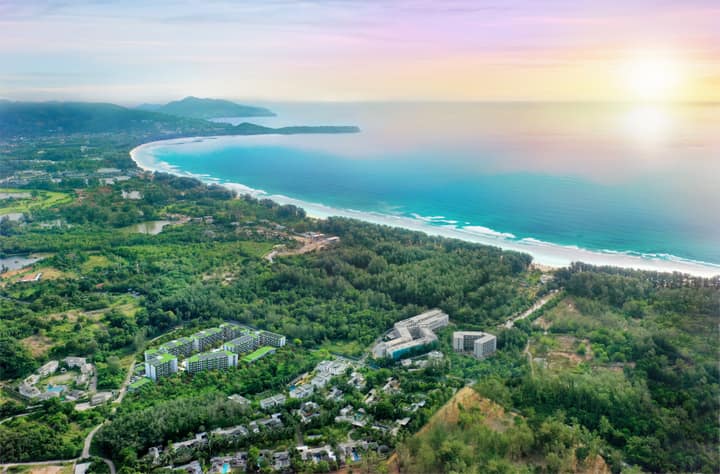
- Phuket areas that suit families
- Three budget scenarios for a family
- Pitfalls and a case study: conclusion
1. Who counts a “family” budget
“Family with kids” in Phuket covers several profiles with different spending structures:
- family with a preschooler — no school costs, but daycare, nannies and paediatric care;
- family with school-age kids — international school as a large recurring line item, tied to the school cluster;
- family with kids of different ages close together — daycare plus school at once, the heaviest budget load;
- family wintering on the island — arrives for a few months during high season, often without school (online learning or a break).
All four share the same base categories (housing, food, transport, connectivity, insurance), but school and home size change the total sharply compared to a couple’s or single person’s budget. Below is the budget broken down in order of importance for a family.
2. Housing: a villa or a condo for a family
A family almost always needs more space than a couple: a separate room for the child, room to play, and often a guest room for grandparents.
| Housing type | Rent/mo | Fit for a family |
|---|---|---|
| 2BR condo | $900–2000 | Compact, works for a family with one preschool-age child |
| 3BR condo/townhouse | $1500–3000 | A separate room for the child, closer to the school cluster |
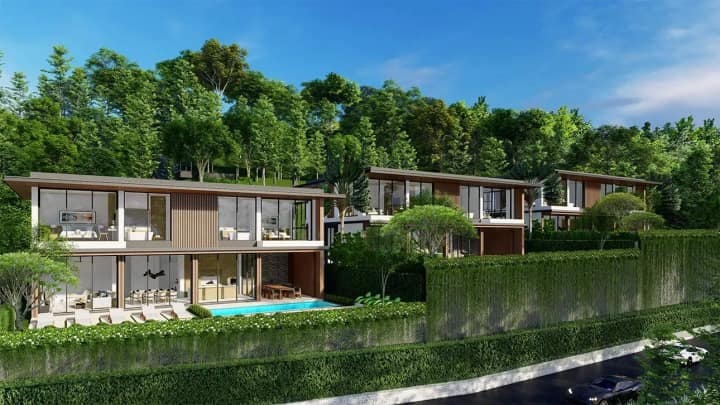
| Villa with a garden and pool | $2500–6000+ | Room to play, often chosen by families with 2+ children |
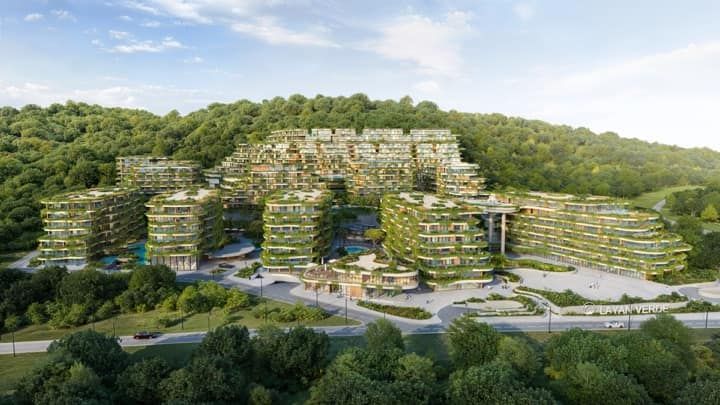
| 2–3BR ownership (rental-pool project, from) | — | from $235,995, Layan Verde |
Ownership works differently for a family than for a single person: the unit is used by the family to live in, not rented out year-round. Even so, during months the family is away — a trip back home, for instance — the unit can be rented out through the management company: the owner receives 60% of the pool’s net profit, a ~8–10% net annual benchmark with a ~12-year payback. The full methodology is in how to calculate ROI in Phuket and the yield calculator. The choice between a condo and a villa for a family usually comes down in favour of a villa’s space and privacy, budget permitting.
3. School: the biggest line item after housing
For a family with school-age kids, international school is one of the two biggest budget lines alongside housing, and often the larger of the two. The main school cluster on the island is Bang Tao–Cherng Talay, next to Layan: schools here run British, IB and other international curricula. A full breakdown of programs, accreditation, and how school shapes a housing choice is in international schools in Phuket.
Key planning rules for a family:
- tuition is a recurring, rising line item to budget for years ahead, not a single school year;
- with two or more children, school costs double or triple — they don’t scale linearly with the rest of the budget;
- uniforms, transport to school and extracurriculars add to the base tuition cost;
- living close to the school cluster saves money as well as time — on daily transport and on nanny or driver logistics.
Check exact rates directly with specific schools — they depend on the program, grade and school. When planning a family budget, treat education as its own line item, comparable in weight to rent or the cost of holding a home.
4. Food and everyday expenses for a family
Controlling food spend is harder for a family than for a single person — volume grows non-linearly with the number and age of children:
- cooking at home — usually cheaper per portion for a family than for one person, thanks to bulk buying;
- baby food and supplies — a separate line item that grows with a child’s age;
- family meals out — $15–40 for a Thai café outing, $40–100 at a Western restaurant;
- a nanny or household help — a common line for families with young children, cutting down daily load.
A family cooking at home and eating Thai food fits into $500–800/month; one oriented toward Western groceries and restaurants spends $1000–1800/month. Imported goods cost more in Phuket due to island logistics — more detail in cost of living in Thailand.
5. Transport: why a family almost always needs a car
Unlike a single person or a couple, for whom a bike in Phuket is a rational choice, a family with kids finds a bike impractical and unsafe: a car seat, a school backpack, groceries and a stroller don’t fit on a motorbike.
- car rental/lease — $400–800/month depending on the vehicle class;
- fuel and parking — $100–200/month for daily school runs;
- a driver or a nanny with a car — an option for families where both parents work, adding $300–600/month.
Most families on the island run at least one car — this is one of the categories that structurally sets a family budget apart from a single person’s or a couple’s. More on the island’s logistics in getting around Phuket.
6. Utilities, connectivity and insurance for the whole family
| Item | Range/mo (family, 2+1–2 kids) | Comment |
|---|---|---|
| Electricity (villa/3BR with AC) | $150–350 | More floor area and rooms mean a heavier AC load |
| Water | $10–20 | Rises only slightly with more residents |
| Internet + mobile | $30–50 | Covers several devices and online learning tools |
| Health insurance (2 adults + 1–2 kids) | $300–800 | Children’s policies cost less than adult ones but add up |
For a family, insurance isn’t optional — it’s a baseline item: the public system is built for residents, and private clinics — the standard choice for expats — run on insurance or direct payment, which bites hard without cover, especially in a paediatric emergency. More in healthcare in Phuket.
7. Visa for a family with kids
A family has to arrange status for every member at once, not just one person, which makes the process more complex and costlier than for a single person or a couple:
- a visa tied to one parent’s work — the rest of the family is registered as dependants, with separate fees per person;
- a visa for investors/property owners — depends on the amount and asset type, check the conditions for your specific case;
- the Thailand Elite visa — can be arranged for the whole family as a package, a one-time cost per member, but removes years of visa runs. Full breakdown in Thailand Elite visa.
For a family planning to stay in the country more than 6–12 months a year, the cost of a long-term visa status for every family member should be budgeted as its own annual or one-time line item, not treated as a minor expense.
8. Phuket areas that suit families
| Area | Pros for a family | Cons for a family |
|---|---|---|
| Layan–Bang Tao–Cherng Talay | The school cluster is nearby, plus clinics, supermarkets and the beach within walking distance | Higher rent and property prices than the island average |
| Rawai/Nai Harn | A quiet south, an expat community | Further from the main school cluster |
| Phuket Town | Cheaper housing, urban infrastructure | No sea nearby, more traffic |
For a family with school-age kids, the Layan–Bang Tao cluster usually outweighs the higher cost of living with logistics savings: school, clinics and shops are 10–15 minutes away, not across the whole island. More on the area’s infrastructure in Layan infrastructure, and a comparison with the neighbouring area in Layan vs Bang Tao.
9. Three budget scenarios for a family
| Scenario | Profile | Budget/mo |
|---|---|---|
| Minimal | 2BR rental outside the school cluster, homeschooling or daycare, bike + taxi, basic insurance | $2000–2800 |
| Comfortable | 3BR/villa near the school cluster, international school for 1 child, a car, insurance for the whole family | $4000–6500 |
| Premium | Beachside villa or a serviced project, a top school for 1–2 kids, a nanny, a car, full insurance coverage | $8000+ |
The gap between scenarios runs 3–4x, and the main driver isn’t housing — it’s the number of school-age children and the choice of school. Budget for your family’s actual composition, not a national average figure.
10. Pitfalls and a case study: conclusion
Common mistakes when planning a family budget in Phuket:
- Treating the budget as “a couple’s budget × 1.5.” School and a larger home change the spending structure non-linearly, especially as the number of children grows.
- Not budgeting for school ahead of time. Tuition is a multi-year commitment; the choice of school should be planned alongside the choice of area, not after the move.
- Skimping on children’s insurance. A paediatric emergency without cover is one of the fastest ways to wipe out a family budget.
- Choosing housing without accounting for the school commute. A cheaper, further-out area saves on rent but adds hours in traffic every day.
- Forgetting visa fees per family member. The cost of a visa status multiplies by the number of people, it doesn’t stay fixed.
A family with two school-age children budgeted around a “couple’s” figure scaled up by half and was considering a 2BR rental away from the west coast. A detailed calculation including two international-school spots, a car and insurance for four put a comfortable budget at $5800/month — noticeably higher than the initial estimate. Instead of a long-term rental, the family bought a 3BR in the Layan Green Park project near the Bang Tao school cluster: the home is used by the family year-round, and during summer trips back home the unit is rented out through the rental pool, partly offsetting holding costs.
Conclusion: for a family with kids, Phuket can cost anywhere from $2500 to $9000 a month — the difference comes down to the number of children, the school chosen and the area, not the country itself. The Layan–Bang Tao cluster suits families well: school, healthcare and the beach are all close by, and owning instead of renting partly turns housing into an asset that earns income while the family is away.
I can help put together a budget for your family’s composition and find a home near the school cluster that works for daily life and earns income while you’re away — leave a request or see the Layan Real Estate page.
This material is informational. Figures are approximate ranges for 2026; actual costs depend on the number of children, school choice, area and exchange rates — this is not financial advice.