A “22% yield” on a sales deck and the real money landing in an owner’s account are different figures. Real ROI is calculated with the management-company split, taxes, costs and capital growth. Investors who calculate correctly don’t get disappointed in year three. Here are the formulas for gross and net yield, total ROI and payback — on a real Phuket unit, factoring in instalments and all costs.
Contents
- What ROI is made of
- Gross and net yield
- Market benchmarks: what to compare against
- Formulas
- Example: a unit’s net yield
- Villa returns: ADR and occupancy
- Factoring in instalments
- Taxes in the ROI calculation
- Total ROI over several years
- ROI on exit: resale and assignment
- What not to forget
- Calculation pitfalls
- Checklist: ROI in 8 steps
- Case: two investors
1. What ROI is made of
An investor’s income in Phuket is two streams:
- Rental income — via a rental management program (a guide of ~8–10% owner net yield via the pool).
- Capital growth — especially at the construction stage, from launch to handover.
Total ROI captures both. The mistake is looking only at rent or only at growth.
The horizon you calculate over matters too. Over 1–2 years, construction-stage price growth does most of the work: the rental program hasn’t launched yet or is only ramping up to planned occupancy. Over 5–10 years the picture flips — accumulated rental income becomes comparable to, and then exceeds, the price gain. A correct calculation is therefore always scenario-specific: “enter at groundbreaking, exit at handover” and “enter at groundbreaking, hold 5–10 years” produce a different income structure for the very same unit.
2. Gross and net yield
- Gross = total rental pool revenue ÷ price — turnover before deductions (VAT, city tax, service charge, bank commission) and before the 60/40 split between owner and management company.
- Net to the owner = gross minus all deductions, multiplied by the owner’s share (60%). Real money in hand.
In Phuket, a pool model typically delivers an owner net yield of ~8–10%. Compare projects on that figure, not on the pool’s gross revenue.
Why marketing decks favour the gross figure is obvious: it’s more than twice as large and looks better on a slide. Strictly speaking it isn’t a lie — pool turnover really can run at ~20%+ of the unit price. But between turnover and the owner’s money sit VAT, city tax, the service charge, bank commission and the split with the management company. So the first question to ask of any presentation is: “is this pool revenue or the owner’s net income after all deductions?” If the seller can’t say exactly which deductions their figure includes, the figure can’t be used in a calculation.
3. Market benchmarks: what to compare against
To judge whether a project’s figure is plausible, it helps to know the market backdrop. The reference points:
| Model | Net guide | What defines it |
|---|---|---|
| Phuket market overall | ~4.5–6.5% a year | Wide spread by location and management quality |
| Pool model (rental pool) | ~8–10% to the owner | Transparent 60/40 split, program scale |
| Guaranteed yield | ~5–7% a year | Fixed rate for the first years, paid by the developer |
Two things follow from the table. First, the market-wide net average in Phuket is more modest than advertised maximums — the full breakdown of the range is in real rental yields in Phuket. Second, different income models can’t be compared head-on: guaranteed offers predictability but usually a lower ceiling; a pool smooths seasonality across units and shares the actual result; per-unit profit-share offers upside but also volatility. How guarantees are structured and what to check in the contract — in the contracted rental yield deep dive.
If a project promises meaningfully above ~10% net, that’s a reason to ask questions rather than celebrate: driven by what, at what occupancy, with exactly what deducted.
4. Formulas
- Pool gross revenue = total booking income for the year.
- Pool net profit = gross revenue − VAT − city tax − service charge − bank commission.
- Owner income = Pool net profit × 60%.
- Owner net yield = Owner income ÷ invested capital.
- Payback (years) = Investment ÷ owner income per year.
- Total ROI = (Owner income over the period + (Exit price − Entry price)) ÷ investment.
Watch the denominator: invested capital is not just the unit price. A correct calculation includes the one-time fees at handover, the furniture package and transaction costs (the full list is in section 11). The more honest the denominator, the lower the percentage — and the closer it is to reality. The second subtlety is the numerator of total ROI: owner income is taken cumulatively over the whole period, while the price gain counts only what is realizable — net of exit costs (section 10).
5. Example: a unit’s net yield
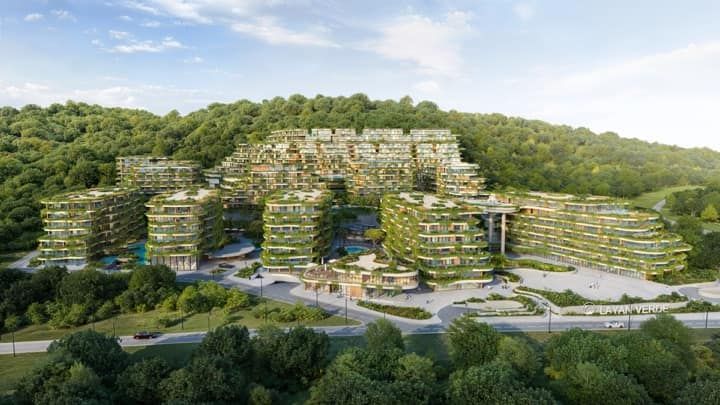
Take a Layan Verde studio at $224,776 (the price list at the time of this calculation; the catalogue entry price as of September 2026 is $235,995 — it does not change the logic) with an owner net yield of 8% (the lower end of the ~8–10% guide):
| Line | Value |
|---|---|
| Unit price | $224,776 |
| Owner net yield (pool) | 8% |
| Owner’s net income per year | ~$17,982 |
This is already the final take-home figure for the owner: it accounts for the pool’s gross revenue, VAT, city tax, service charge, bank commission, and the 60% owner / 40% management company split. Income tax in your jurisdiction, if applicable, is deducted from this on top.
Payback on net yield: 224,776 ÷ 17,982 ≈ 12.5 years on rent alone. That excludes capital growth — added below.
For sensitivity, it’s worth running the upper end of the guide too: at 10% net the same unit brings ~$22,478 a year, and payback shortens to ~10 years. The “10–12.5 years on rent” range is the honest corridor of expectations, within which the outcome depends on a given year’s occupancy and season.
🔗 The same math applies to villas — just with a higher entry ticket: Rental income villas →
6. Villa returns: ADR and occupancy
If the property isn’t in a pool — say, a standalone villa you rent out via a management company under an individual agreement — the calculation is built bottom-up, from the nightly rate:
- Annual revenue = ADR (average daily rate) × paid nights per year.
- Net income = revenue − management fee − cleaning and consumables − pool and garden upkeep − utilities − minor repairs − insurance.
- Net yield = net income ÷ investment (price + furnishing + transaction costs).
Two typical mistakes here. The first is taking the peak-season ADR and multiplying by 365: real occupancy is never 100%, and low-season rates are noticeably lower. Use annual averages. The second is underestimating running costs: a villa’s are structurally higher than a condo-hotel unit’s — pool, garden, security, rental wear and tear. That’s why a villa, despite a higher absolute nightly rate, can yield a percentage comparable to or slightly below a managed condo unit — the full format comparison is in Phuket villa yields.
7. Factoring in instalments
Instalments change the picture: you don’t invest the full sum at once. On a 35% plan the start is around $86,000, the rest by milestones to handover. While you pay in stages, the return on actually invested capital is higher, and growth toward handover falls on a smaller invested amount. That’s a leverage effect in a rising market.
Here’s how it looks in numbers on our example. A typical off-plan purchase plan at Layan Verde is 35% at signing, then equal construction-milestone payments to handover. The first instalment of ~$86,000 is under 40% of the full price, yet the unit’s entire price appreciation works for you from the day the contract is signed: the price is locked in for the full amount. If the unit is worth more by handover, the gain is measured off the full unit price while only 35% was invested at the start — that’s the leverage effect. The flip side is symmetrical: instalments are an obligation to pay on schedule, and they belong in your personal cash-flow plan, not just in the ROI formula.
🔗 More: Off-plan or ready →
8. Taxes in the ROI calculation
Net yield via the pool is a pre-personal-tax figure. To get to money-in-pocket, add the tax layer to the model:
- Withholding tax of 5% at source. When a legal entity (the management company) pays a pool profit share to an individual owner, it withholds 5% and remits it to the Revenue Department. This is not an extra tax but a prepayment: the amount is credited on the annual return, and for a small income from one unit part of it is often refunded.
- Thai personal income tax. Rental income is Thai-sourced and taxed on the progressive 0–35% scale — not on the gross amount, but on the base after a 30% deduction (or actual expenses) and personal allowances. A detailed walk-through with a worked example is in rental income tax in Thailand.
- Annual ownership tax. The Land & Building Tax on rented residential property is small, but a careful model includes it — rates and reliefs are in property taxes in Thailand.
- Your home jurisdiction. If you are tax resident elsewhere, rental income may be declarable there too — with a credit for Thai tax where a double-tax treaty applies.
For an ROI model it’s enough to plug in your effective rate: for most owners of one or two units it is well below the top 35%, thanks to deductions and the lower brackets of the scale.
9. Total ROI over several years
Add capital growth. For a $224,776 unit under the project’s real model — an owner net yield of ~8–10% via the pool plus capitalization (higher in early years, around 3% a year after):
| Metric | Value |
|---|---|
| Owner net yield | ~8–10% a year via the pool |
| Rental payback | ~12 years |
| Total ROI over 5 years | ~65% |
| Total ROI over 10 years | ~78% |
| IRR | ~40% |
It helps to see what those ~65% over 5 years are made of: five years of rent at ~8–10% net contribute roughly 40–50 percentage points cumulatively, and the rest comes from price appreciation — mostly over the construction period, as the price moves from launch level to that of a completed property. The high IRR is explained by instalments: a significant share of the capital is contributed later, so the return on money actually invested is higher in the early years.
It’s capital growth, not rent alone, that delivers a significant part of total ROI on an early entry. Model your own scenario in the yield calculator.
10. ROI on exit: resale and assignment
Total ROI is finalized at exit — and exit has its own costs that shave the paper price gain:
- Sale transaction taxes and fees: seller-side withholding tax, specific business tax or stamp duty (depending on the holding period), and transfer fees for registering the change of title. Their composition and how they’re shared between the parties are negotiated in the contract, so the outcome is calculated per deal.
- Selling costs: agent commission, preparing the unit, legal support.
- Exit route. Before handover you can assign the contract (a resale of contractual rights) — locking in the construction-stage gain without registering a title transfer. After handover you sell a completed unit, ideally with a rental track record: verified occupancy is an argument for the buyer. Strategy and typical mistakes are in how to resell Phuket property; the tax side is in the capital gains tax breakdown.
A reference point for construction-stage upside: for Layan Verde, the project model assumes price growth of around +45% over the construction period — a developer forecast, not a guarantee, and a prudent model also tests scenarios with lower growth. Sensitivity to this parameter is the main thing separating an optimistic spreadsheet from an honest one.
11. What not to forget
- One-time fees: sinking fund (
$924), leasehold registration ($2,592), meters. - Furniture package (~$10,875) — effectively mandatory for rental.
- Annual servicing: common area (~$1,109/yr).
- Income tax on rental income, if applicable in your jurisdiction.
- Vacancy between guests and seasonality.
One-time fees and the annual CAM charge aren’t trivia — they’re a structural part of a condominium’s economics: CAM funds the upkeep of common areas, the sinking fund pays for the building’s capital repairs. How they’re calculated from unit area and what underfunding leads to — in the sinking fund and CAM fee breakdown. In the ROI formula, one-time payments enlarge the denominator (investment) and annual ones shrink the numerator (net income), so skipping them inflates both sides of the fraction.
🔗 Full estimate: Phuket taxes & fees →
12. Calculation pitfalls
- Confusing pool gross revenue with net income. They’re different figures — calculate on net.
- Ignoring one-time fees. They raise investment and lower ROI.
- Forgetting vacancy and season. Occupancy isn’t 100%.
- Ignoring growth. Rent is only part of the ROI; the other part is price growth.
- Pricing at peak rate. Use the annual average.
- Comparing percentages across models head-on. A guaranteed 6% and a pool’s ~8–10% are different risk structures and different calculation bases, not simply “6 is less than 8”.
- Taking a spreadsheet on faith. Any project model is a set of assumptions about occupancy, rate and growth; request the assumptions, not just the bottom line.
13. Checklist: ROI in 8 steps
- Fix the full investment: unit price + one-time fees + furniture package + transaction costs.
- Clarify the income model: a pool with a 60/40 split, guaranteed, or individual letting — the whole formula depends on it.
- Get the owner’s net figure: what exactly is deducted (VAT, city tax, service charge, bank commission) and at what occupancy it was modelled.
- Sanity-check against the market: compare with the benchmarks in section 3 — anomalously high promises need an explanation.
- Budget for taxes: the 5% withholding at source as a prepayment, plus your effective income tax rate.
- Calculate payback: investment ÷ owner’s net annual income.
- Add capital growth: conservative, base and optimistic scenarios; label developer forecasts as forecasts.
- Calculate the exit: resale or assignment costs and transaction taxes — and only then the total ROI.
If data is missing at any step, that’s not a licence to plug in a flattering number — it’s a reason to request the data from the developer or broker.
14. Case: two investors
Consider a typical scenario. The first investor saw “pool gross revenue ~22%” in a presentation and assumed it was his personal income — on that basis he planned payback in 4–5 years. In reality, after VAT, city tax, service charge, bank commission and the 60/40 split with the management company, his net income came out at ~8–10% — a solid figure, but noticeably below his naive expectations, and disappointment was inevitable.
The second investor calculated total ROI straight off the net model: budgeting a yield of ~8–10% via the pool plus construction-stage growth and instalments. Over 5 years their total ROI came out at ~65% — realistic, with no surprises.
Takeaway: correct ROI is the owner’s net yield (already accounting for all deductions and the 60/40 split) plus capital growth, factoring in instalments. Then the numbers match reality.
I’ll calculate net yield and total ROI for a specific unit, factoring in instalments and all costs.
Unit ROI calculation
By submitting this form you agree to the privacy policy.