A Phuket condo price list almost always shows only the unit price — the full cost of ownership includes two more line items that buyers often only learn about after closing: the CAM fee (common area maintenance) and the sinking fund. One is a recurring charge for upkeep of shared areas; the other is a one-time capital-repair reserve. Both are mandatory, both are set out in Thailand’s condominium law, and both directly affect what owning a unit actually costs per year. Here is what each charge covers, how much it costs at Layan Verde and Layan Green Park, and what to check so you don’t end up with an underpriced rate that gets hiked later.
Contents
- Why an owner needs to understand these two charges
- CAM fee: what the recurring charge covers
- Sinking fund: the one-time capital-repair reserve
- Who approves and can change the rate
- How much it costs: Layan Verde vs Layan Green Park
- The numbers on real units
- What is NOT covered by CAM fee
- How this relates to net yield through the rental pool
- Pitfalls
- Mini-case and conclusion
1. Why an owner needs to understand these two charges
A full budget for buying property in Phuket doesn’t end with the unit price and one-time closing fees — there are also recurring holding costs an owner pays every year for as long as they own the unit. CAM fee and sinking fund are two charges with different natures that get conflated: one is recurring and operational, the other is one-time and capital. Lumping them into a single budget line is a common mistake that leads investors to underestimate the real cost of ownership over a 5–10 year horizon.
2. CAM fee: what the recurring charge covers
CAM fee (common area maintenance) is a monthly or annual charge owners pay for the upkeep of shared areas. A typical Phuket CAM fee covers:
- cleaning and landscaping of shared grounds, pools, lobby;
- 24/7 security, CCTV, front-desk and concierge staff;
- electricity and water in common areas (not inside the unit);
- routine maintenance of lifts, generators and common-area building systems;
- insurance on the building as a whole.
The charge is calculated by unit floor area — the larger the unit, the higher the monthly amount, regardless of whether the owner lives in it, rents it out, or leaves it vacant.
3. Sinking fund: the one-time capital-repair reserve
The sinking fund is a fundamentally different charge: a one-time payment an owner makes once, at purchase (usually alongside registering the sale). It builds the building’s juristic person reserve for major future costs — replacing the roof, façade, lift equipment, or overhauling building systems after 10–15 years of operation. Unlike CAM fee, the sinking fund isn’t paid again every year — unless co-owners vote for an additional top-up once the reserve is depleted.
4. Who approves and can change the rate
Both charges are governed by Thailand’s condominium law through the building’s juristic person (condominium juristic person), which is required to keep accounts and provide co-owners with financial statements. The key rule for an investor: the management company cannot unilaterally raise the CAM fee or sinking fund — increasing the rate requires approval by a three-quarters majority vote of co-owners at a general meeting and registration of the amended building regulations with the Land Department. That protects owners from arbitrary rate hikes, but it cuts both ways: if the reserve is underfunded from the start, raising it is a slow voting process, not a quick decision by the management company.
5. How much it costs: Layan Verde vs Layan Green Park
Rates are set at the project stage and fixed in the building’s juristic person documents. For comparison, the disclosed rates at two VillaCarte Group projects near Layan beach:
| Project | CAM fee | Sinking fund (one-time) |
|---|---|---|
| Layan Verde | 85 THB/sqm/month | 850 THB/sqm |
| Layan Green Park | 75 THB/sqm/month | 650 THB/sqm |
| Phuket market range (general benchmark) | 30–100 THB/sqm/month | 200–850 THB/sqm |
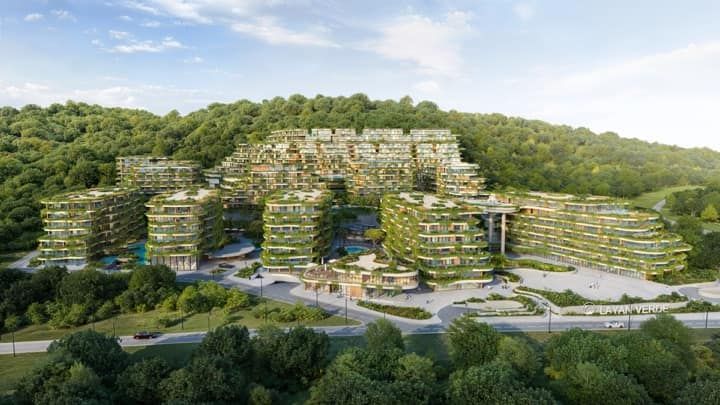
Both projects sit at the upper end of the market range for CAM fee, which tracks with complexes that carry substantial in-house infrastructure — lagoon pools, a community mall, spa, restaurants — that the fee actually pays for.
6. The numbers on real units
Converting the rates into real amounts on current price-list units (rate ~33.3–33.7 THB/USD):
| Unit | Area | CAM fee / month | CAM fee / year | Sinking fund (one-time) |
|---|---|---|---|---|
| Layan Verde, premium studio from $235,995 | 36.2 sqm | 3,077 THB (~$92) | 36,924 THB (~$1,109) | 30,770 THB (~$924) |
| Layan Verde, 1-bed from $331,796 | 51.9 sqm | 4,412 THB (~$132) | 52,938 THB (~$1,590) | 44,115 THB (~$1,325) |
| Layan Verde, 2-bed from $549,915 | 100.5 sqm | 8,543 THB (~$257) | 102,510 THB (~$3,078) | 85,425 THB (~$2,565) |
| Layan Green Park, phase 1 resale studio from $142,602 | 30 sqm | 2,250 THB (~$67) | 27,000 THB (~$802) | 19,500 THB (~$579) |
| Layan Green Park, phase 2 2-bed from $348,968 | 55.6 sqm | 4,170 THB (~$124) | 50,040 THB (~$1,487) | 36,140 THB (~$1,074) |
The 10 THB/sqm/month gap between the two projects’ CAM fees turns into a noticeable annual sum on a larger unit — so when comparing properties, look at the actual dollar figure for your target area, not the percentage difference.
7. What is NOT covered by CAM fee
A separate cost line covers what belongs to the unit itself rather than the shared areas:
- electricity and water metered inside the unit, usually at a government or commercial tariff;
- internet and cable inside the apartment;
- repairs, furniture and appliances inside the unit, and their wear between guests;
- contents insurance (if the owner arranges it separately);
- the management company’s commission for participating in the rental program — a separate percentage of pool income, not part of CAM fee.
Confusing these lines with CAM fee is a common source of underestimated maintenance budgets, especially for buyers new to the Phuket market.
8. How this relates to net yield through the rental pool
CAM fee and sinking fund are fixed ownership costs that apply whether or not the unit participates in the rental pool — every owner pays them, even one who chooses not to rent the unit out at all. The ~8–10% net annual yield benchmark (the owner receives 60% of the pool’s net profit, the management company 40%) is already built on the pool’s own operating costs; CAM fee and sinking fund sit outside that formula and are counted separately as part of the full cost of ownership. The full calculation method is covered in how to calculate ROI in Phuket: at a ~12-year payback horizon, a few hundred dollars a year of difference in CAM fee between projects has a measurable effect on the final number.
9. Pitfalls
- An underpriced CAM fee at launch. A suspiciously low rate at project launch is a warning sign — either the infrastructure is minimal, or the rate will be revised upward after handover, and raising it is a co-owner voting process, not a quick management-company decision.
- No financial statements from the juristic person. Before buying a resale, request the building juristic person’s accounts — how much is actually accumulated in the sinking fund, and whether other co-owners are in arrears.
- Confusing CAM fee with the rental pool commission. These are two different charges with different purposes — one funds the building’s upkeep, the other pays for participation in the rental program.
- Budgeting without accounting for unit size. On larger units (2–3 bedrooms, duplexes, penthouses) the absolute CAM fee and sinking fund grow proportionally with floor area — factor that in before buying, not after.
- Skipping due diligence on the building as a whole. Due diligence shouldn’t stop at the unit itself — see due diligence in Phuket.
10. Mini-case and conclusion
An investor compares a Layan Verde studio at $235,995 (36.2 sqm) with a Layan Green Park resale studio at $142,602 (30 sqm). The entry-price gap looks obvious at first glance, but a full ownership calculation adds: at Layan Verde, $924 one-time and ~$1,109 a year in upkeep; at Layan Green Park, $579 one-time and ~$802 a year. Over a 12-year holding period (the approximate payback through the rental pool), the CAM fee gap between the two projects adds up to roughly $3,700 — not a decisive sum relative to the price gap between the units, but a meaningful input to a precise net-yield calculation, and a useful argument when weighing off-plan (Layan Verde, handover 2028) against an already-operating asset (Layan Green Park, phase 1 running since 2024).
CAM fee and sinking fund are not hidden costs — they are a transparent, mandatory part of owning a condo in Phuket, set out in condominium law and the building juristic person’s documents. A gap of a few dozen baht per square metre between projects is a detail worth factoring into a comparison, but it shouldn’t outweigh the parameters that matter more: location, developer, and the rental pool’s actual occupancy.
We can send you an exact CAM fee, sinking fund and full ownership-cost breakdown for a specific unit — leave a request or browse the VillaCarte Group catalogue.
This article is for information only and is not legal or investment advice. Charge levels are set by the documents of the specific building’s juristic person and may differ from the examples above — verify the current rate and accounts at the time of the transaction.