One of the first practical questions a foreign buyer asks: can I get a mortgage in Thailand, or do I need to pay in full from my own funds? The short answer — Thai banks rarely lend to foreigners, but that doesn’t stand in the way of buying: developer installments, financing through your home country, and other schemes cover this for the vast majority of investors. Let’s cover the real financing options, their terms, and what to look for.
Contents
- Why a Thai mortgage is rare for foreigners
- Developer installments — the main route
- Post-handover plans: paying after the keys
- Financing through a bank in your home country
- Other financing sources
- How ownership form affects financing
- What money costs: installments, a loan or 100% payment
- Comparing the options
- Step-by-step financing plan
- Pitfalls
- Case: combined financing
- Case: a resale with no installments
1. Why a Thai mortgage is rare for foreigners
Thai banks historically lend for property purchases mainly to Thai citizens. For foreigners, a mortgage from a local bank is more the exception than the rule:
- available at only a handful of banks, and only under strict terms;
- requires high proven income, often Thai residency or a work permit;
- LTV (the loan share of value) is usually capped at 50–70% — the rest must be paid yourself;
- rates and documentation requirements are notably stricter than for local borrowers.
Because of this, the vast majority of foreign buyers don’t count on a Thai bank loan as their primary financing source.
What the bank actually asks for
If you do fit the profile (working in Thailand on a work permit, or living here on a long-term visa), expect a document package comparable to a European mortgage, only stricter:
- a passport with a valid visa or residence permit, and a work permit;
- proof of income for 6–12 months and bank statements — often both in Thailand and in your country of citizenship;
- the sale contract, the property documents and the developer’s documents;
- for a foreign-currency loan (a few banks with an international presence offer these) — proof of the source of funds for the down payment.
A separate cost line is registering the mortgage at the Land Department: the fee is 1% of the loan amount. In 2026 the government kept the reduced 0.01% rate on mortgage registration and the transfer fee, but the measure is aimed at Thai citizens buying a home to live in — it does not apply to a foreign buyer. More in our review of the 2026 property tax changes →.
Why collateral is a problem in itself
A bank lends against something it can repossess and sell. A foreigner cannot own land in Thailand, so a villa on a plot — even one held through a Thai company — almost never works as collateral for a bank. The realistic object of a Thai mortgage for a foreigner is a freehold condo within the foreign quota: it has its own chanote that can be encumbered. Banks generally don’t accept leasehold as collateral. This is one more reason why foreign demand in Phuket runs on developer installments rather than bank credit.
2. Developer installments — the main route
For the vast majority of investors, the real financing tool is developer installments during construction:
- payment is split into stages (e.g. a 35%/50% scheme: part at contract, part during the build, the remainder at handover);
- no bank income check or credit history required;
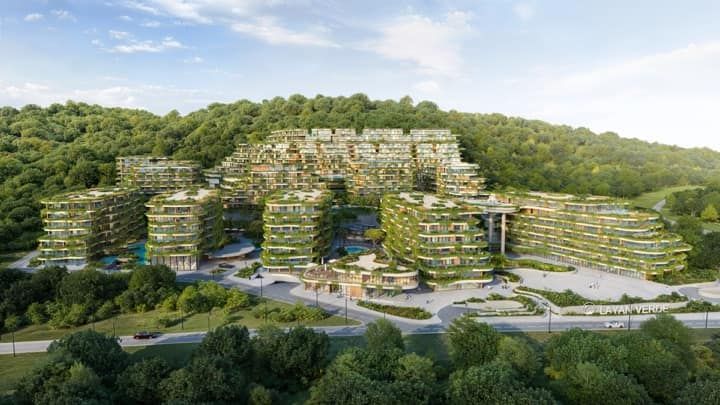
- lowers the starting payment — e.g. entering Layan Verde on the 35% plan starts at around $86,000 instead of the full $235,995 price;
- legally this is part of the sale contract, not a separate credit product.
This isn’t a “mortgage” in the banking sense, but installments are what closes the financial gap for most off-plan buyers.
How to read an installment schedule
Take the terms at Layan Verde — they’re typical of the island’s larger projects and show the mechanics well:
| Stage | 35% plan | 50% plan | 100% payment |
|---|---|---|---|
| Reservation | 200,000 THB, credited to the first payment | 200,000 THB | 200,000 THB |
| First payment at contract | 35% of price | 50% of price | balance within 14 days |
| Further payments | 5 × 13% every 6 months | 5 × 10% every 6 months | — |
| At handover (2028) | 100% paid | 100% paid | 100% paid |
The key point: construction-stage installments end at handover — by completion you’ve paid the full price. Most developers charge no interest on this kind of plan: the developer funds the build with your tranches, and you get a low entry threshold. Your real “lender” here isn’t a bank but your own cash-flow schedule over 2.5 years.
The flip side: installments exist only where construction is ongoing. At the completed Layan Green Park, phase 1 is fully sold out and units are available only as resales from owners — with full payment, no installments. If what you want is a resale of a finished asset, the financing has to be assembled entirely from the sources covered below.
🔗 In detail: Payment methods in Phuket → · Off-plan or ready → · Reservation and deposit: how not to lose it →
3. Post-handover plans: paying after the keys
A separate class of schemes is the post-handover payment plan: part of the price (usually 45–60%) is paid before the keys, the rest after completion in equal payments over one to ten years, typically at a modest interest rate. By then the unit can already be occupied or rented out, so rental income covers part of the payments.
How this differs from construction-stage installments:
- Less money frozen in the build. In a standard off-plan deal 100% is paid by handover; here it’s about half.
- Money has a cost. Interest-free long plans are almost non-existent: the typical range on the deferred portion is from 1–3% to 7–8% per year (2025 data for individual Phuket projects). Look not just at the rate but at how it accrues — on the outstanding balance or on the whole deferred sum.
- The price may be higher. Some developers build the cost of money straight into the price list. The correct comparison is the full unit cost at 100% payment versus the full cost on the plan.
In Phuket such plans are offered by certain developers — mainly the large groups and a number of projects in the south of the island. Layan Verde’s installments run during construction only, and Layan Green Park has no installments at all: phase 1 resales are sold with full payment. For a full overview of projects with deferred payments, see our post-handover plans review → and the catalog collection “post-handover payment plans” →.
4. Financing through a bank in your home country
Many investors finance a Thai purchase through tools back home rather than in Thailand:
- A mortgage or loan secured against home-country property — a standard bank product with familiar terms.
- A Lombard loan (portfolio-secured credit line) — a credit line against securities or a deposit at an overseas bank, often with flexible repayment.
- Refinancing existing property — releasing capital from an asset you already own.
The funds are then transferred to Thailand by standard bank transfer; for freehold registration, the transfer needs to arrive in foreign currency with an FET certificate.
Two nuances that are usually underestimated. First, currency risk: you service the loan in your home currency, while the asset and its rental income are denominated in baht. If the exchange rate moves, the loan payment measured against rental income changes with it. Second, compliance: the receiving Thai bank may request source-of-funds documents for large sums, and the sending bank will ask for the purpose of payment. The loan agreement and the disbursement statement answer exactly that question, so keep them at hand when you transfer.
5. Other financing sources
- Personal savings — the simplest and most common source for entering an installment plan.
- Selling other assets — property, securities, a business — to raise a lump-sum payment.
- Joint financing with a partner or family — splitting installment-stage payments across several parties to the deal.
- Crypto assets — not a payment method but a conversion step: the assets are sold through a licensed exchange, then the money follows the standard banking route with an FET for freehold. How it works — in our review of buying with crypto →.
A combination of “part own funds, part developer installments” is the most common practical model. When buying jointly, agree with your lawyer in advance who the currency transfers will come from: for freehold it’s safer that the money arrives from the future owners named on the chanote.
6. How ownership form affects financing
The choice between freehold and leasehold ties directly into your financing scheme:
- Freehold requires an official currency inflow with an FET certificate — convenient for a one-off transfer of a large sum (e.g. from an overseas loan), but less flexible for partial payments.
- Leasehold doesn’t require FET, making it simpler to pay in installments from various sources without tying to one currency channel — so it’s more often chosen by those financing the purchase gradually, without a large external loan.
There’s a reverse dependency too: the ownership form determines what can be pledged at all. A freehold condo is the only asset type against which a foreigner can theoretically get a Thai loan. Leasehold almost never works as collateral, but its currency-channel requirements are softer and the registration fee is lower: 1.1% at registration versus a ~2% transfer fee for freehold. For a buyer assembling the sum from several sources over the course of construction, that usually tips the balance.
7. What money costs: installments, a loan or 100% payment
All financing has a price — sometimes explicit (a rate), sometimes hidden (a discount forgone). Three questions worth asking before choosing a scheme:
- Is there a discount for 100% payment? Some developers discount a lump-sum payment. If the discount is meaningful and your overseas loan costs a few percent a year, paying in full with borrowed money can beat an interest-free installment plan — run both scenarios in absolute numbers.
- What does your capital earn while it’s not yet paid in? The 35% plan leaves two-thirds of the price working in your own assets for another 2.5 years. If that money earns anything above zero, interest-free construction installments are the cheapest “loan” available.
- What is the return on capital actually invested? On the 35% plan, for the first eighteen months you “hold” the unit having put in about a third of the price. Layan Verde’s developer forecasts capital growth over the construction period of around +45% — a forecast, not a guarantee, but if it plays out even partially, the return on the money actually paid in will be noticeably higher than with 100% payment.
How to calculate return on invested capital taking the payment schedule into account — in our guide to calculating ROI in Phuket →.
8. Comparing the options
| Source | Accessibility to a foreigner | Cost of money | Notes |
|---|---|---|---|
| Thai bank | Low, strict terms | Higher rate than for locals, + 1% mortgage registration | LTV 50–70%, needs income/residency in Thailand, collateral — freehold condo only |
| Developer installments during construction | High, nearly universal | Usually interest-free | The main route, part of the sale contract; 100% paid by handover |
| Post-handover plan | Medium, only at certain projects | 1–8% per year on the deferred portion (2025 data) | Half the price after the keys, rent partly covers the payments |
| Home-country loan | Medium, depends on the bank | Your bank’s rate + currency risk | Requires a currency transfer and FET for freehold |
| Personal funds | High | Forgone return on alternative investments | The simplest entry, often combined with installments |
9. Step-by-step financing plan
A universal sequence that works for most buyers:
- Fix the full deal budget, not the unit price: furniture package, sinking fund, registration, meters, annual upkeep. How to build the estimate — in our breakdown of purchase costs →.
- Work out how much you have “now” and how much “on schedule”. The former goes to the reservation and first payment, the latter to the installment tranches.
- Choose the ownership form to match your source of money: one large transfer from a loan argues for freehold; many smaller transfers from various sources argue for leasehold.
- Match the installment schedule to your inflow schedule. Tranches every 6 months should coincide with the moments when money is actually released: an asset sale, a credit-line drawdown, a bonus.
- Check the contract for late-payment terms, penalties and the cancellation procedure — this is what replaces the protection of a bank mortgage.
- Set up the currency channel. For freehold — transfers only in foreign currency with the correct purpose of payment, and an FET for every tranche.
- Keep a reserve. One missed tranche under the contract can cost more than the interest on a short loan that would have covered it.
10. Pitfalls
- Counting on a Thai mortgage as the main plan. It’s hard to access — build your budget around installments and your own funds.
- Not checking the installment terms in the contract. Late-payment penalties and cancellation conditions should be clearly written.
- Transferring money in baht for a freehold purchase. Without foreign currency and an FET, registration may fail.
- Not budgeting for one-time fees on top of the loan. Sinking fund, registration, meters — separate amounts above the unit price.
- Mixing sources without a plan. Work out in advance which portion of the sum arrives and when — installments are tied to the construction schedule.
- Treating a post-handover plan as a discount. It’s a deferral of payment for a fee; compare the full unit cost in both scenarios.
- Forgetting currency risk. A loan in euros or dollars, an asset and rent in baht — the exchange rate can eat part of the benefit of cheap financing.
- Expecting installments on a resale. On the secondary market the seller is a private owner who needs the full sum; there are no installments here.
11. Case: combined financing
Consider a typical scenario. An investor wanted to buy a unit in Layan Verde for $235,995 but didn’t have the full sum upfront and didn’t qualify for a Thai bank loan. They chose the 35% installment plan: paying the 200,000 THB reservation and the first payment from personal savings — around $86,000 at the start. The rest was split across the installment stages, synced with the gradual release of funds from a credit line against their investment portfolio back home. By the 2028 handover, the full sum had been paid without a lump-sum budget strain and without approaching a Thai bank.
12. Case: a resale with no installments
The second scenario is the opposite. The buyer wanted a finished, operating asset rather than a construction site: a studio in the completed Layan Green Park as a resale at $142,602. There are no installments on such a unit — the selling owner receives the full sum at transfer. The buyer assembled it from two parts: about half from personal savings, the rest from a loan secured against an apartment in their home country, which their bank approved within a few weeks. Both parts went to Thailand as foreign-currency transfers marked “property purchase”, an FET was obtained for each, and the unit was registered as freehold. Rental through the management programme started from the first month — and that is what services the loan back home. What happened to phase 1 prices from launch to resale — in the Layan Green Park case study →.
Takeaway: a Thai bank mortgage isn’t the main tool for a foreigner. Developer installments combined with home-country financing and personal funds close the financial gap for practically any budget — and for a finished resale, the working formula is “own funds + a loan back home + a currency transfer with FET”.
I’ll help plan a payment scheme for your budget — installments, currency transfer and the payment sequence.
Financing scheme for your purchase
By submitting this form you agree to the privacy policy.