A “22% yield” on a slide and the money that actually lands in an owner’s account are often different figures. Phuket’s rental market is uneven: the real net-yield range differs notably from advertised maximums and depends on location, format and management model. Let’s cover what yield is realistic across the market, how the Layan Verde and Layan Green Park pool model differs, how gross revenue turns into the sum on your account, what taxes take — and how not to confuse gross revenue with money in your pocket.
Contents
- The real market-wide range
- Why figures diverge
- The arithmetic: from gross revenue to money in the account
- The pool model: Layan Verde and Layan Green Park
- What drives yield
- Comparing formats
- Taxes: what remains of the ~8–10%
- The other half of the equation: capital growth
- How to verify yield before buying
- Pitfalls
- Case: expectation versus reality
1. The real market-wide range
Across the Phuket market overall, net rental yield usually sits in the ~4.5–6.5% a year range — a guide after deducting management costs, taxes and servicing expenses. Gross revenue (before deductions) can look notably higher, and that’s often the figure shown in marketing materials.
Premium beachfront locations (Layan, Bang Tao, Surin, Nai Harn) don’t always deliver the highest yield as a percentage — a high entry price isn’t always proportionally offset by rent. Absolute income can still be higher thanks to a higher nightly rate.
Laguna Phuket rental yield: what the headline excludes
For managed residences inside the Laguna Phuket resort, developer projections commonly sit around 5–7% a year. That range is useful for initial screening, but it is not a guaranteed return or an independently audited result. Laguna property carries a resort-location premium, and that higher purchase price can keep the percentage yield below a less expensive Layan unit even when the Laguna unit earns more rent in absolute dollars.
To compare a Laguna offer with another Phuket property, rebuild the number on the same basis:
| Check | What to confirm before using the yield figure |
|---|---|
| Calculation base | Full current purchase price, furniture and acquisition costs — not only the first instalment |
| Income line | Annual gross booking revenue or the owner’s distributable net income |
| Operator charges | Management or rental-pool split, channel commissions and marketing costs |
| Property costs | CAM/service charges, sinking-fund items, repairs and furniture replacement |
| Occupancy | Actual annual occupancy of a comparable operating phase, not peak-season occupancy |
| Owner use | How personal-use nights reduce rentable inventory and distributions |
| Evidence | Contract schedule, historical operator statement and the exact payout formula |
The right comparison is therefore owner net income ÷ total invested cost. A quoted 5–7% becomes meaningful only after the sales team supplies the contract inputs behind it; without those inputs it remains a developer projection.
Before comparing figures, let’s pin down the terms. Gross yield is all rental revenue divided by the property price, with nothing deducted. Net yield (net yield) is what remains for the owner after operating costs, management fees, charges and pool-level taxes. In Phuket the gap between these two figures is usually a multiple, not a few points: VAT, city tax, the service charge, bank commissions, marketing and the management company’s share all come out of revenue. So any yield conversation should start with the question: “is this gross or net, and exactly what has been deducted?”
The second base principle: yield is always calculated on the full entry price, not on the first instalment. If a unit is bought on a construction-stage payment plan, it generates no rent until handover — rental yield only starts with operation, and the annual income must be divided by the unit’s full cost including the furniture package, not by the portion already paid in.
2. Why figures diverge
The spread in yield figures comes down to several factors:
- Gross vs net. Rental pool turnover before deductions (VAT, city tax, service charge, bank commission) is much higher than what the owner receives.
- Management format. Pool, profit-share and guaranteed yield give different predictability and different percentages.
- Management-company quality. A strong operator with working properties delivers occupancy; a weak one promises a figure “on paper”.
- Location and season. Tourist flow, infrastructure and seasonality directly affect occupancy.
There’s a less obvious cause too: different calculation bases. One source divides income by a purchase price from three years ago, another by today’s market value; one includes the furniture package and transaction costs, another doesn’t. Even honest figures stop being comparable when the bases differ. Projects can only be compared correctly on one method: the owner’s net annual income ÷ the full current entry price.
🔗 How to calculate correctly: Calculating ROI in Phuket →
3. The arithmetic: from gross revenue to money in the account
Let’s show the mechanics on an illustrative unit at $235,995 (a realistic entry point for an investment condo project in Layan). The money’s path from guest to owner in a pool model looks like this:
- Pool revenue. Guests pay for nights across all units in the programme; the revenue is collected into one pot — the rental pool.
- Operating deductions. VAT, city tax, the service charge and bank commissions for acquiring and transfers come out of revenue. What remains is the pool’s net profit.
- The 60/40 split. 60% of the pool’s net profit is distributed to owners in proportion to their shares; the management company takes 40% for operations and marketing.
- Money to the owner. At an 8% net yield (the lower bound of the ~8–10% guide), the owner of a $235,995 unit receives ~$17,982 a year — already after all pool-level deductions.
The same pool’s gross revenue before deductions can look like ~22% of the unit price — and that’s exactly the figure that sometimes ends up on a marketing slide. The difference between 22% “on paper” and 8–10% “in the account” isn’t outright deception — they’re different lines of the same calculation. The investor’s job is to always ask for the bottom line.
| Step | What happens |
|---|---|
| Pool revenue | All guest payments across the programme |
| − VAT, city tax, service charge, bank | Pool-level operating deductions |
| = Pool net profit | The base for the split |
| × 60% | The owners’ share (40% to management) |
| = ~8–10% of the unit price | Owner net yield |
🔗 The income path end to end: Rental management program →
4. The pool model: Layan Verde and Layan Green Park
In pool-model projects, income is split transparently: 60% of the pool’s net profit to the owner, 40% to the management company. Under this model the owner earns a net yield of roughly ~8–10% a year — above the market-wide range thanks to the programme’s scale, Layan and Bang Tao’s strong tourist flow, and a transparent income split.
This figure already accounts for VAT, city tax, service charge and bank commission — it’s the final money to the owner, not the pool’s gross revenue.
The pool has an important property that’s often underrated: averaging. The owner’s income doesn’t depend on whether their unit or the neighbouring one got booked — the whole programme’s revenue is divided in proportion to shares. For an investor this means protection from the “unlucky unit”: floor, view and distance to the lift stop being a yield lottery. And the 60/40 split is fixed in the management contract, not left as a verbal arrangement.
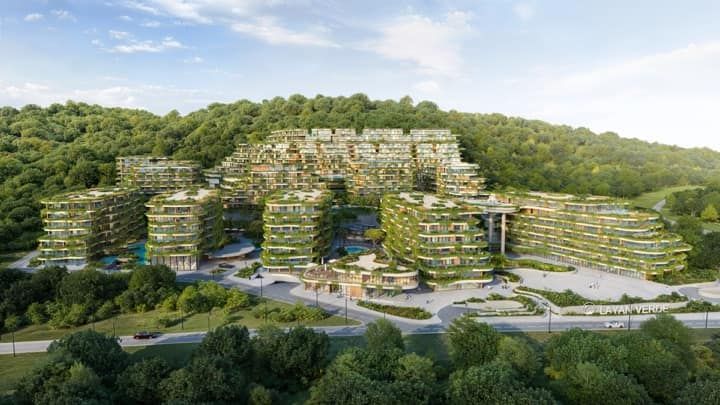
The model’s viability is tested in practice: Layan Green Park’s first phase is completed, sold out and operating — a living benchmark instead of a presentation (the phase 1 case →). At Layan Verde — Dusit-managed branded residences in the Layan area — the same pool model has been built into the project from the start. A bonus for owners in both projects is the VillaCarte Group loyalty programme: 15–25% discounts on the complex’s services (spa, restaurants, fitness, transfers) during their own stays.
🔗 How the programme works: Rental management program →
5. What drives yield
| Factor | Effect |
|---|---|
| Occupancy (annual average) | The key driver; look at the year, not the peak month |
| Property format | A studio yields more per m², a villa a higher absolute ticket |
| Management company | A strong operator means steady occupancy |
| Location | Infrastructure and tourist flow support demand |
| Income model | Pool smooths, profit-share offers upside, guaranteed offers predictability |
Two factors from the table deserve a separate note.
Occupancy. Annual yield is made up of expensive winter months (the high season runs roughly November–March) and cheaper summer ones. That’s why average annual occupancy matters more than the peak rate: 70% occupancy at a moderate rate year-round often beats 90% on peak winter nights and an idle summer. How exactly the seasons feed into the calculation is covered separately: rental seasons and occupancy →.
The operator. The management company isn’t a “service add-on” — it’s half the investment thesis. It’s the operator who handles booking channels, dynamic pricing, the mix of short- and long-stay guests and filling the low season. Two identical units with different operators can differ in yield by a factor of 1.5–2 — with the same location and the same entry price.
6. Comparing formats
| Format | Yield guide | Notes |
|---|---|---|
| Phuket market overall | ~4.5–6.5% net | Wide spread by location and management |
| Pool model (Layan Verde / Layan Green Park) | ~8–10% net to owner | Transparent 60/40 split, programme scale |
| Guaranteed yield (other projects) | ~5–7% a year | Fixed percentage for the first years |
Treat the guaranteed model with care: a fixed percentage is convenient at the start, but is sometimes “baked into” an inflated unit price — effectively the developer returning the buyer’s own money. Check what happens to income after the guarantee period ends and which model the property runs on afterwards.
🔗 Guaranteed yield in detail: How contracted yield works → · A curated set of income-focused projects: Phuket investment property →
7. Taxes: what remains of the ~8–10%
The ~8–10% net guide is the owner’s share after the 60/40 split and pool-level deductions — but before the owner’s personal income tax. From there, Thai tax mechanics apply:
- Personal income tax (PIT). Income from renting out Thai property is Thai-source income, taxed on a progressive 0–35% scale identically for residents and non-residents. The rate applies not to the gross amount but to the base after deductions.
- A 30% deduction or actual costs. For rental income the law offers a choice: a standard 30% deduction from the gross amount with no documents — or actual, documented expenses. Plus a personal allowance of 60,000 THB.
- 5% withholding at source. When a juristic entity pays the pool share to an individual owner (which is how a management programme works), the payer withholds 5% as withholding tax — a tax prepayment credited when the annual return is filed; on modest incomes the final tax often turns out lower than the amount withheld, and the difference is refunded.
In practice, for a typical unit yielding ~8–10%, the effective tax burden ends up moderate — precisely because of the 30% deduction and the lower brackets of the scale. The full breakdown with examples and a rate table is in a separate article: tax on rental income in Thailand →.
8. The other half of the equation: capital growth
Rental yield is only half of an investor’s total result. The other half is growth in the property’s own value, and it’s most visible when buying at the construction stage: the developer raises prices as completion approaches, and early buyers collect the difference “for free” simply by waiting for handover.
For Layan Verde the developer forecasts capitalisation of up to +45% over the construction period — to be clear, that’s the developer’s forecast, not a guarantee. But the mechanism itself is market-proven: Layan Green Park’s sold-out first phase showed how the sequence works — buy at launch, capture growth to handover, plug the unit into a working pool.
It’s important not to blend these two streams into one number. The correct investor model looks like this: rental yield of ~8–10% net a year from launch + a one-off value gain by handover (if buying at the construction stage) − taxes and costs on a future sale. The latter has its own article: capital gains tax →; and for the build-stage-versus-ready choice, see off-plan vs ready →.
9. How to verify yield before buying
- Ask for the real calculation model, not a marketing maximum.
- Check the occupancy history of already-completed phases (e.g. Layan Green Park’s working phase 1).
- Confirm the income split (60/40, profit-share, guaranteed) and exactly what’s deducted.
- Compare projects on owner net yield, not on pool gross revenue.
A practical checklist of questions for the management company — keep it handy before the meeting:
- Which income model applies, and where in the contract is the split fixed?
- What is deducted before the split: VAT, city tax, service charge, marketing, bank fees?
- What is the actual average annual occupancy of the operator’s working properties?
- How often are payouts made, in which currency, to an account in which country?
- Who pays for furniture depreciation, minor repairs, appliance replacement?
- How many nights a year can the owner stay themselves, and on what terms?
- What happens on exiting the programme, and can you rejoin?
- Does the operator hold a hotel licence for short-term rental?
Answers like “we’ll show you later” or “that’s internal information” to questions 2–3 are a warning sign: a strong operator has this data ready to show.
10. Pitfalls
- Treating pool gross revenue as personal income. These are different figures — confirm what’s being shown.
- Anchoring on peak season. Calculate on annual average occupancy.
- Comparing locations by percentage alone. Absolute income and entry price matter just as much.
- Not vetting the operator. Yield is only as reliable as the management company behind it.
- Forgetting personal tax. The ~8–10% net is before the owner’s personal income tax — build it into the model up front.
- Calculating yield on the first instalment. The base is the full entry price including the furniture package; otherwise the percentage is artificially inflated.
11. Case: expectation versus reality
Consider a typical scenario. An investor compared several Phuket projects and saw figures ranging from 5% to 22% across different presentations. After digging in, they realised: 22% was one project’s pool gross revenue before deductions, 5% was another’s conservative guaranteed model. They chose a project with a pool model and a transparent 60/40 split, where the owner’s net yield came out at ~8–10% — above the market-wide range and with no surprises, since the figure already accounted for all deductions.
Takeaway: “real yield” always means the owner’s net yield, not pool revenue or a marketing maximum. A model with a transparent income split (like Layan Verde and Layan Green Park) delivers above-market results with full calculation clarity.
I’ll help compare real yield across specific projects and units, without marketing maximums.
Comparing real yield
By submitting this form you agree to the privacy policy.