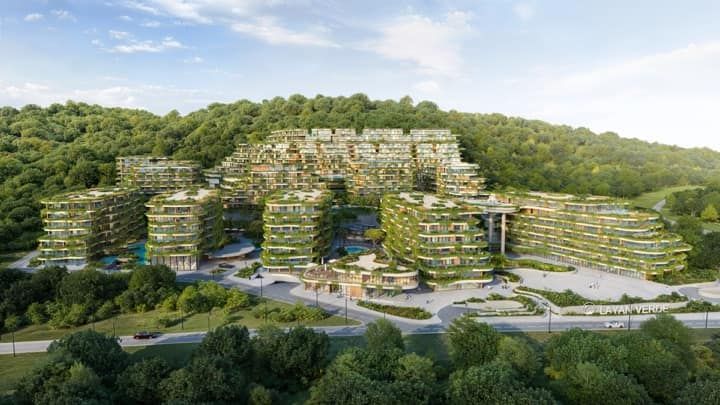
A studio or a 1-bedroom apartment is a common choice for an investor buying for rental. Both formats work well near the beach but differently: a studio gives a higher yield per square metre and a lower entry, a 1-bedroom gives steadier occupancy and a slightly higher rate. Here’s what’s smarter in 2026 — we’ll compare entry prices, yield, running costs, the rental audience and resale prospects, with figures from specific projects rather than “market averages”.
Contents
1. Studio: rental pros
- Lower entry point — studios in Layan Verde from $235,995.
- Higher yield per m² — no “extra” metres, better return on capital.
- High occupancy — couples and solo travellers actively book beach studios.
- Easier to resell — a low ticket means broad investor demand.
Studio economics rest on a simple fact: a tenant pays for a night in a location, not for square metres. A couple coming to Layan beach for a week chooses between a studio and a 1-bedroom on price and view — the 15 m² difference in floor area is secondary to them. The studio owner, meanwhile, paid noticeably less for those metres yet earns a comparable nightly rate. That’s where the studio’s edge in return per invested dollar comes from.
The second advantage is divisibility of capital. The budget of one large apartment buys two studios in different buildings or even projects: that diversifies risk (two entries in the rental pool instead of one) and, if needed, lets you sell half the portfolio without exiting the investment entirely.
2. 1-bedroom: pros
- Steadier occupancy — suits families and long-stay tenants.
- A slightly higher nightly rate and average length of stay.
- A wider buyer pool on resale — both investors and own-use buyers.
- Comfort — a separate bedroom is valued for longer stays.
A 1-bedroom is a “dual-purpose” format. It works in nightly rental, in monthly rental, and as the owner’s own holiday home. A separate bedroom is decisive for winter residents and remote workers staying a month or longer: not everyone is willing to sleep and work in the same room. So in low season, when the flow of short bookings thins out, a 1-bedroom “tops up” occupancy with longer stays more easily.
There’s a resale argument too: a studio is almost always bought by an investor running the yield numbers, while a 1-bedroom is also bought by someone choosing “a place by the sea for themselves”. The second buyer type is less sensitive to the ROI table and often decides emotionally — which widens the demand funnel when you exit the investment.
3. Comparison
| Parameter | Studio | 1-bedroom |
|---|---|---|
| Entry price | Lower | Higher |
| Yield per m² | Higher | Medium |
| Absolute income per unit | Medium | Higher |
| Occupancy | High (short-stay) | Steady (families, long-stay) |
| Audience | Couples, solo | Couples, families |
| Liquidity | High | High |
Note that both formats score well on liquidity, but through different mechanics. A studio finds an investor-buyer quickly thanks to the low ticket; a 1-bedroom thanks to a wider audience. What usually loses on liquidity is neither — it’s large 2–3-bedroom apartments in projects without strong management, where the ticket is higher and the rental maths weaker.
4. Prices in 2026: the cost of entry
Specifics from the Layan area projects (2026 catalog prices):
| Unit | Area | Price | Price per m² |
|---|---|---|---|
| Layan Verde, premium studio | 36.2 m² | from $235,995 | ~$6,320 |
| Layan Verde, 1-bedroom | 51.9 m² | from $331,796 | ~$6,270 |
| Layan Green Park, phase 1 resale studio | from 30.3 m² | from $142,602 | ~$4,960 |
| Layan Green Park, phase 1 resale 1-bedroom | — | from $271,554 | — |
What the table shows. First, the entry gap between a studio and a 1-bedroom within one project is around $97,000 (about 42% more in Layan Verde) — that’s the price of the “spare room”. Second, price per metre is nearly identical for both formats within a project — you effectively pay for area, so “what’s smarter” is decided by rental maths, not the price list. Third, the completed phase 1 of Layan Green Park offers a lower entry than off-plan — but it’s a resale of an already-operating asset that has absorbed the pre-handover price growth (phase 1 appreciated roughly 100% from sales launch to handover in 2024 — see the phase 1 case study).
For renting out, add the furniture package to the unit price: in the Layan Verde example it’s +$10,875 on the studio. The full purchase budget — fees, duties and meters — is broken down in our article on buyer costs.
Entry can be lowered with instalments: in Layan Verde, after a 200,000 THB reservation, the 35% plan applies — 35% plus five payments of 13% every 6 months — so the starting outlay on a studio is around $86,000. Projects with staged payment are collected in the catalog: instalment plans in Phuket →.
5. Yield per m² and occupancy
A studio has a higher yield per square metre and on invested capital: you don’t pay for extra metres, and the nightly rate is spread over a smaller area. A 1-bedroom gives higher absolute income per unit and steadier off-peak occupancy thanks to family demand. Both benchmark at an owner net yield of ~8–10% via the rental pool.
It’s worth understanding where that figure comes from. Across the Phuket market as a whole, net yield typically sits at ~4.5–6.5% a year — with wide variance by location and management quality. The pool model in projects like Layan Verde and Layan Green Park does better thanks to programme scale and a transparent split: 60% of the pool’s net profit goes to the owner, 40% to the management company. And pool income is distributed by shares, not by the “luck” of an individual unit: your studio sitting empty in a given week doesn’t zero out your income.
The practical takeaway for choosing a format: within a pool, the studio-versus-1-bedroom difference comes down to absolute amounts. Both units earn roughly the same percentage — but of different bases, $229k and $326k respectively. Payback from rental flow targets ~12 years in both cases; total ROI adds the appreciation of the unit itself.
🔗 How to calculate: Rental management program → · Real rental yields → · Calculator
6. Full cost of ownership
The format affects not only the entry price but also the annual running costs — they are proportional to area:
| Item | Studio 36.2 m² (Layan Verde) | 1-bedroom 51.9 m² (Layan Verde) |
|---|---|---|
| CAM fee 85 THB/m²/month | ||
| Sinking fund 850 THB/m² (one-off) | ~$924 | ~$1,325 |
| Furniture package (effectively mandatory for rental) | +$10,875 | more, in proportion to area |
Every “extra” metre of a 1-bedroom is paid for three times: at purchase, in the furniture package, and then every year in the CAM fee. For a pure buy-to-let strategy this is one more argument for the compact format. For a “rent it out but sometimes stay myself” strategy — an acceptable price of comfort.
One-off transaction costs don’t depend on format: leasehold registration is 1.1% of the price (once every 30 years), for freehold it’s a transfer fee of ~2%, plus utility meters at ~15,000 THB. A detailed breakdown of project tariffs is in our article on sinking fund and CAM fees.
7. Rental audience and seasonality
- Studio: couples, solo travellers, short trips, remote workers for 1–2 weeks.
- 1-bedroom: couples with extra space, small families, long-stay, winter residents.
If you bet on a flow of short bookings near the beach — a studio. If on steady income and longer stays — a 1-bedroom.
Seasonality overlays this picture differently for each format. In high season (roughly November–April) both are well occupied: tourist flow outstrips supply in sought-after locations. The difference shows in low season: short bookings thin out, and a studio depends more on tactical discounting, while a 1-bedroom leans on longer stays — winter residents, rotating remote workers, families staying a month. A management programme smooths these swings at pool level, but the demand structure by format is worth understanding before you buy — we covered it in the article on seasons and occupancy.
8. Short-term or long-stay
Choosing a format is effectively choosing a rental strategy:
- Short-term (nightly) rental. Maximum ADR and yield, but more operations: cleanings, check-ins, reviews. In a managed condo-hotel all of that sits with the operator. This is where the studio shines: high booking turnover on minimal floor area.
- Long-term rental (a month and up). A lower per-night rate, but stability and minimal operations. Here the 1-bedroom wins: a long-stay tenant almost always wants a separate bedroom, and often a work area too.
- Hybrid. Nightly in high season, monthly contracts in low season. Many 1-bedroom owners run exactly this: the format lets them switch between audiences.
A detailed comparison of the strategies with figures is in short-term vs long-term rental →. If you plan to put the unit into a pool, you won’t be choosing a strategy manually — but the unit’s format will still determine which demand it earns on.
9. Choosing a unit within the format
Once the format is set, the yield is decided by the specifics of the unit:
- View. Sea-view and pool-view units consistently command a higher rate and look better in listings. The purchase premium is often recouped through the rental rate.
- Floor. Upper floors are quieter and have views; lower floors by the pool win on convenience. The worst position is a mid-floor unit facing a wall or the car park.
- Layout. For a studio, metre efficiency is critical: a bed niche, a proper kitchen zone, a balcony. For a 1-bedroom — bedroom isolation and space for a desk.
- Position in the building. Corner units and units away from lifts and service areas suffer less from noise — it shows in guest reviews and affects repeat bookings.
- Purchase stage. At sales launch the choice of views and floors is widest; by handover the less attractive positions remain. That’s a separate argument for entering early — more in off-plan or completed →.
10. Resale and liquidity
The liquidity of a rental unit is tested by one question: “Who will I sell this to in 3–5 years, and how?”
- A studio sells fastest in the under-$250k segment — the deepest buyer pool in Phuket. The buyer is almost always an investor, so what sells a studio is numbers, not emotion: actual occupancy, the pool payout history, the unit’s condition.
- A 1-bedroom sells to two audiences at once — investors and own-use buyers. Time on market can be slightly longer because of the ticket, but the funnel is wider.
- For both formats the main liquidity multiplier is a working rental programme: a unit with an income history is bought as a running business, not as “concrete”.
If you bought off-plan, you can also sell before handover — by assigning the contract, locking in the price growth accrued during construction. Exit mechanics, seller taxes and typical listing periods are covered in how to resell property in Phuket →.
11. Pitfalls
- Buying a large area “for status.” For rental, yield per m² matters more than size.
- Ignoring the furniture package. It’s effectively mandatory for renting (example: +$10,875).
- Pricing at the peak rate. Budget for average annual occupancy.
- Overlooking view and floor. They affect both the rate and resale.
- Forgetting ownership costs. CAM fees and the sinking fund scale with area — compare units on full cost, not just the price list.
- Comparing percentages from presentations. “12% yield” means nothing without knowing whether it’s gross or net and who carries the costs. Compare owners’ net figures on the same methodology.
- Buying a format for someone else’s strategy. A studio in a project with no management and no tourist flow won’t deliver “studio” occupancy; a 1-bedroom in a purely touristic spot with no long-stay demand loses its main advantage.
12. Case: by strategy
Consider two investors. The first bets on maximum return on capital and a flow of short bookings — a beach studio with a low entry. The second wants steady income and longer stays plus occasional personal use — a 1-bedroom, accepting a slightly higher ticket and lower return per m².
In numbers, using Layan Verde: the first investor enters a 36.2 m² studio from $235,995 (on instalments — with a starting outlay of around $86,000) and preps the unit for the pool with the furniture package. The second pays from $331,796 for a 51.9 m² 1-bedroom, budgeting ~$480 a year in extra CAM fees versus the studio — and gets a format that leans on long stays in low season and hosts him on holidays. Both target a net ~8–10% via the pool; the difference is in absolute amounts, usage patterns and the profile of the future buyer.
Takeaway: a studio is about return on capital and liquidity; a 1-bedroom about steady flow and comfort. Both work — it’s a question of rental strategy.
I’ll select a studio or 1-bedroom for your strategy, with a per-unit yield calculation.
Find a rental unit
By submitting this form you agree to the privacy policy.