Debates about buying off-plan in Phuket usually lack one thing — verifiable outcomes. Here is a completed case with numbers: all 248 units of Layan Green Park phase 1 sold out from the developer before construction was finished, the complex was delivered in 2024 and is operating, and prices grew roughly 100% since the sales launch. Let’s break down how it happened, what’s left on the market, why the entry conditions in 2026 are no longer what the first buyers had, and what to take from it if you are choosing between a phase-1 resale, phase 2 and the same developer’s new project under construction.
Contents
- Case timeline
- Why phase 1 sold out before handover
- What happened to prices: ~100% growth
- What’s left: the resale market
- Phase 2: the same entry conditions?
- What a phase-1 buyer actually got
- Pitfalls: what could go wrong
- The math: resale, phase 2 or new off-plan
- What the case teaches: an off-plan buyer’s checklist
- Conclusion and next step
1. Case timeline
- Phase-1 sales launch — apartments of 30–144 m² in 4 buildings on a 9,940 m² plot, under-construction prices, installments through the build period (they still existed back then).
- Before construction finished — the developer sells the entire inventory: 248 of 248 units. Zero left in primary sales.
- 2024 — phase 1 is completed and launched: restaurants, spa, gym and kids’ club operating; units enter the rental pool.
- 2026 — only occasional owner resales appear on the secondary market; per the 21.07.2026 price list, a studio from 30 m² starts at 4,800,000 THB ($142,602), full payment. The developer sells phase 2 only — per the 01.09.2026 price list, its studios start from 36.7 m² at $224,043.
The key fact of the case: demand absorbed the entire inventory before the project became “completed” — meaning early buyers captured the bulk of the price growth. The second fact, just as important for today’s reader: the entry mechanism that helped that demand form — the developer’s installment plan — no longer applies to the project in 2026.
2. Why phase 1 sold out before handover
Four verifiable factors did the work:
- Entry price below the completed market. The under-construction condo-hotel sold at a discount to completed units near Bang Tao — with a shortage of new builds near Layan Beach, that created a queue.
- A clear income model. Not a “rental promise” but a rental pool: identical unit types are pooled, and owners receive 60% of net profit — a ~8–10% net annual benchmark.
- Eco positioning with a certificate. Phuket’s first condo-hotel with international EDGE certification: up to 40% utility savings — verified figures, not marketing.
- Construction-period installments. A 200,000 THB reservation and stage payments lowered the entry barrier — the classic off-plan mechanics.
Note the fourth point: it explains not only the sales speed but also who the buyers were. Installments let people enter with part of the sum and “assemble” the rest by handover — which is why many phase-1 owners bought as an investment rather than a second home. That matters for reading today’s resale market: the sellers are investors locking in profit, not families who “changed their minds”.
3. What happened to prices: ~100% growth
According to the developer, phase-1 apartments appreciated roughly 100% from the sales launch to the completed, operating complex. That matches how the market generally works: most off-plan capitalisation happens between groundbreaking and handover, after which growth slows to the market’s ~3–5% a year.
| Stage | Buyer’s price | Who earns |
|---|---|---|
| Sales launch (groundbreaking) | Lowest | The early investor — the full growth cycle |
| Mid-construction | +20–40% | The investor — the remaining growth |
| Handover and launch | +70–100% | The completed-market buyer — rent plus ~3–5%/yr |
| Resale 2 years on | Market price | The phase-1 seller locks in the profit |
How do you verify that figure yourself instead of taking the developer’s word for it? There are two reference points. The first is the phase-1 launch price lists, which agencies and presentation archives still hold. The second is the current resale price list: a studio from $142,602 for 30 m² is the price of a completed, operating asset, and it can be compared with the launch price of a similar size. The gap between the two is the actual capitalisation — adjusted for the fact that a resale includes the seller’s mark-up and room to negotiate. The full methodology is in how to calculate ROI in Phuket, and the island-wide picture is in the 2026 price trends review.
4. What’s left: the resale market
The developer now helps phase-1 owners resell — the lots are handled by the same management structure that runs the rental pool. For a buyer this is a distinct scenario with its own upsides:
- A completed unit here and now — it joins the rental pool immediately, income from the first season.
- The complex already operates — restaurants, spa, occupancy and pool reporting are visible, not projected.
- Scarcity — supply is down to single units; lots appear and go.
The phase-1 resale line-up per the 21.07.2026 price list:
| Type | Area | Price from | Terms |
|---|---|---|---|
| Studio | from 30 m² | 4,800,000 THB ($142,602) | owner resale, full payment |
| 1 bedroom | from 45.4 m² | $271,554 | owner resale, full payment |
| 2 bedrooms | from 90.4 m² | $492,876 | owner resale, full payment |
| 3 bedrooms | from 126.6 m² | $841,599 | owner resale, full payment |
| Duplex | from 120.9 m² | sold | — |
The downside is symmetrical: a resale price already includes that ~100% growth, and the whole sum is payable at once — there is no installment plan on a resale, and there can’t be, because the counterparty is a private owner, not the developer. There is no “waiting discount” either — it’s the price of a completed, operating asset.
Legally, a resale of a completed unit is a transfer of ownership at the Land Office: the title, absence of encumbrances, the unit being fully paid up to the developer and the foreign quota (if buying freehold) are all checked. The transfer fee and other transaction costs are split by agreement between the parties — that clause is negotiated alongside the price. The step-by-step check is in Phuket due diligence, and the process from the seller’s side is in how to resell property in Phuket.
5. Phase 2: the same entry conditions?
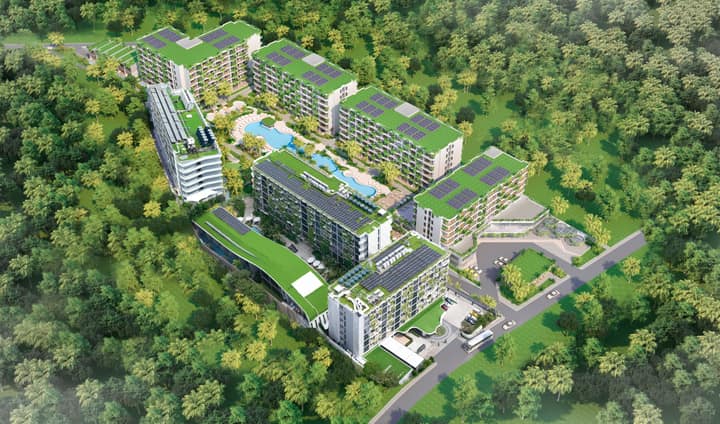
Phase 2 is 296 apartments in 6 buildings on a 16,673 m² plot, handover in 2026. Entry conditions structurally mirror phase 1 — with two material adjustments:
| Parameter | Phase 1 (then) | Phase 2 (per the 01.09.2026 price list) |
|---|---|---|
| Status | Under construction | Nearing completion, handover 2026 |
| Units | 248 | 296 |
| Studios | groundbreaking prices | from 36.7 m² — 7,424,784 THB ($224,043) |
| Entry from the developer | studios | studios from 36.7 m² — 7,424,784 THB ($224,043); 1 bedroom from 43.7 m² — $279,489; 2 bedrooms from 55.6 m² — 11,564,800 THB ($348,968); 3 bedrooms 148.2 m² — from $852,351; duplexes from 207.9 m² — from $1,115,354 |
| Installments | through construction | none: the former long post-handover plan has been withdrawn, payment per the current price list |
| Infrastructure | promises on renders | phase 1 already operating next door |
One important difference favours phase 2: the buyer sees working proof — the neighbouring phase already hosts guests, the pool pays owners, and the EDGE savings are confirmed in operation. Early phase-1 buyers had no such insurance.
Two differences do not: first, prices are no longer at groundbreaking level — a phase-2 studio per the 01.09.2026 price list starts at $224,043, whereas the first phase-1 buyers entered at launch prices that have since grown ~100%. Second, there are no installments. The developer revised the schedule as the phase sold through, and the earlier post-handover scheme was cancelled — typical market behaviour we covered in the review of post-handover payment plans in Phuket: installment schedules change faster than any other term. Those who waited “for better conditions” got worse ones.
6. What a phase-1 buyer actually got
The case is interesting for more than the price growth. It is worth looking at what exactly a phase-1 owner holds in 2026 — that is the “working model” a resale buyer is purchasing.
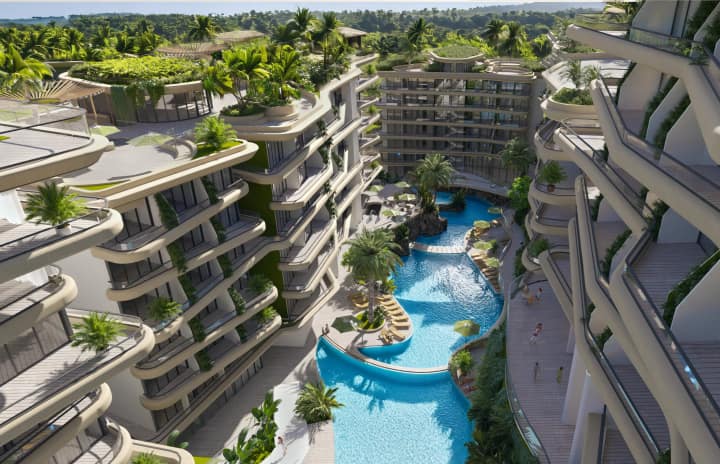
An operating hotel, not a “condo with a reception desk”. Phase 1 runs as La Green Hotel & Residence with its own infrastructure: 4 freshwater pools, the COMUNA restaurant and bakery, a 253 m² gym, a 306 m² spa area, a kids’ club, and a free shuttle to Layan Beach (~700 m) and to Boat Avenue. The guest rating — 4 out of 5 on Tripadvisor across 100 reviews — is a measure of the management company’s performance that simply cannot be checked for a project under construction.
A rental pool with a formula, not a promise. Identical unit types are grouped into pools; the owner receives 60% of the pool’s net profit, the management company the remaining 40%. The programme targets ~8–10% net a year and grants 30 days of personal use per year — in the low season, May–October. Why then is explained in the article on Phuket rental seasons: at peak, the unit should be working, not sitting empty for the owner.
Transparent owner costs. The figures here are fixed: the CAM fee is 75 THB/m² per month, the one-off sinking fund is 650 THB/m² at purchase, electricity and water are at the government tariff (and this is where the EDGE certificate with its up-to-40% savings turns from marketing into a budget line). For a 30 m² studio that is about 2,250 THB of CAM a month and 19,500 THB of sinking fund once — arithmetic from the price-list tariffs, not an estimate.
Liquidity. Single resales go quickly, and the developer handles the resale itself — for an owner this means exiting the asset does not require hunting for an agency on a “cold” market. That is a rare property among the island’s condo-hotels, where reselling a unit inside someone else’s management programme often drags on.
7. Pitfalls: what could go wrong
The phase-1 case is an argument, not a guarantee. Keep in mind:
- Past growth ≠ future growth. Phase 1’s ~100% came from a specific cycle; phase 2 may deliver less (or more, given the new-build shortage around Layan).
- “One unit left” needs verification. Availability changes fast — check the price list on the deal date, not the publication date.
- A resale is a private-party deal. Contract, assignment and outstanding-payment checks are mandatory: see Phuket due diligence.
- Pool income is not a fixed rate. 8–10% is a benchmark under the 60/40 model; actual figures depend on seasonal occupancy: see Phuket rental seasons.
- The currency trail. For future freehold registration and repatriation, structure the transfer correctly: the FET form.
- Entry conditions are not frozen. Phase 2’s installment plan has already been withdrawn; prices and remaining stock move too. The phase-1 case is about what happens to those who wait.
- Phase-2 construction noise. Guest reviews from 2025–2026 mention morning noise from the building site. For a phase-1 resale buyer this is temporary until the 2026 handover, but when viewing a unit, ask which way the windows face.
- The condo-hotel format. The unit operates under a hotel model; it is not a pure “apartment for yourself” — owner use is limited to 30 days a year, and pets are not allowed.
8. The math: resale, phase 2 or new off-plan
In 2026 a buyer who likes the location and the developer has three real scenarios — and it is no longer “early entry versus completed”, as it was for the first phase-1 buyers. Compare them on price-list figures (simplified, fees and taxes excluded):
| Scenario | Entry | Payment | What you buy | What you get |
|---|---|---|---|---|
| Phase-1 LGP studio resale | from $142,602 | full | a completed unit in an operating hotel | pool income from the first season (~8–10% net benchmark); the capital growth is already “used up” |
| Phase-2 LGP, studio | from $224,043 | per price list, no installments | a unit nearing completion, handover 2026 | a short waiting horizon and finished infrastructure next door; growth to handover is limited by how close the finish is |
| Layan Verde, sales launch | from $224,776 | construction-period installments | a branded residence managed by Dusit, 774 units, handover 2028 | the classic off-plan cycle: the developer forecasts +45% capitalisation over the build period (a forecast, not a guarantee); rental after launch |
How to read the table:
- You need cash flow now — a phase-1 resale. You pay for readiness and verifiability and give up the growth phase. It is the most “boring” and the most transparent option.
- You need a developer unit with a short wait — phase 2. The threshold is higher than a resale and there are no installments, but months, not years, separate payment from the first pool payout.
- You want the same scenario the phase-1 buyers had — groundbreaking-price entry with installments and a bet on capitalisation by handover — today that is available not at LGP but at the same developer’s Layan Verde: the point-by-point comparison is in Layan Verde vs Layan Green Park, and other projects with installment plans are in the catalogue collection.
Many investors combine the first and third scenarios: the completed unit covers the income task, the one under construction covers growth, and the risk is not concentrated in a single property. Run your own numbers in the yield calculator.
9. What the case teaches: an off-plan buyer’s checklist
The LGP case is useful beyond buyers looking at Layan specifically. It yields a universal list of checks for any project under construction in Phuket:
- The developer’s track record on the same island. Not “a group with projects in three countries” but delivered buildings here that you can visit and sleep in. For VillaCarte Group, phase 1 itself became that proof. How to vet a developer is in how to choose a developer in Phuket, and the red flags are in a separate breakdown.
- Proof of demand, not a promise. The previous phase’s sales pace, the share of repeat buyers, the fact of a sell-out before handover — these are numbers a developer either states or dodges.
- The income model in the contract. The distribution formula (60/40), the pool composition, owner-use rules, the operator’s right to change fees. If it isn’t on paper, a “~8–10%” yield doesn’t exist. What to look for in a management agreement is in the rental programme review.
- Independent verification of the product. LGP’s EDGE certificate is an example of external verification that translates into the owner’s money. For another project it might be a brand operator (like Dusit at Layan Verde) or an international audit.
- Payment terms with a date. Installments are the least stable part of any offer: LGP phase 2 lost its plan as the phase sold through. Fix the schedule in the reservation agreement and don’t count on “the same terms in six months”.
- A clear exit. Who sells your unit in two years — you on a “cold” market, or the developer through its own channel? At LGP the company handles resales itself; that is worth asking any developer before the deal.
If a project passes all six points, the phase-1 scenario is repeatable at least structurally. If it fails on the first or the third, it is better not to build “LGP-style” price growth into the model at all.
10. Conclusion and next step
The Layan Green Park phase-1 case is a rare fully closed loop for Phuket: a sales launch with installments → sold out before handover → an operating complex → a resale market of single units with ~100% growth and full payment. For a 2026 buyer this is not a promise but a precedent by the same developer in the same location — and at the same time a reminder that entry conditions don’t last: phase 2 has no studios left, and no installments either.
I’ll send the current phase-2 price list and phase-1 resales, the actual rental figures of the operating pool and a calculation for your budget — including a comparison with Layan Verde if capital growth is the goal. Leave a request or see the project page.
This material is informational only and is not a public offer or investment advice. Prices and availability per the developer’s 01.09.2026 price list (phase-1 resales — per the 21.07.2026 data) — verify at the time of the deal. Yield figures are the management programme’s targets, not a guarantee.