When buying a Phuket apartment, an investor quickly faces the question: furnish it yourself or take the developer’s furniture package? For renting out it’s no small matter: a rent-ready unit starts earning immediately, and turnkey furnishing saves time and ensures a standard for the management company. Let’s cover what a furniture package includes, how much it costs, how it is written into the contract and how it affects rental and yield.
Contents
- What a furniture package is
- What’s usually included
- How much it costs
- Why it matters to investors
- The package and the rental pool: why the standard is mandatory
- Package vs DIY furnishing
- Off-plan and resale: how furnishing enters the deal
- Contract, payment and handover
- Effect on yield
- Depreciation and refresh
- Pitfalls
- Case: a turnkey rental unit
1. What a furniture package is
A furniture package is a ready turnkey set of furniture, appliances and decor for a unit. The developer or its partner furnishes the apartment to a single design, and it’s fully ready to move in and rent right after handover.
For an investor it’s a way to avoid furnishing yourself: no searching for furniture, no shipping or assembling it, especially with a remote purchase.
It’s worth separating two terms that often sit side by side in price lists and presentations:
- Fully fitted — the built-in part, usually already included in the base unit price: kitchen units, air conditioners, sanitary ware, built-in wardrobes, wall and floor finishes.
- Fully furnished — what you buy as a package: free-standing furniture, household appliances, textiles, tableware, decor. This is what the furniture package actually is.
A “fully fitted, unfurnished” unit is a clean shell with a kitchen and air conditioning — you cannot put a guest in it. A “fully furnished” unit is one you can move into with a suitcase. When comparing prices across two projects, first check which of the two each price includes, otherwise the comparison is meaningless.
🔗 Basics: Buying process →
2. What’s usually included
The contents depend on the project and package level, but typically include:
- Furniture — bed, sofa, table, wardrobes, cabinets.
- Kitchen — appliances (stove, fridge, microwave), tableware by option.
- Appliances — air conditioners, TV, sometimes a washing machine.
- Textiles and decor — curtains, lighting, accessories.
- Bathroom — basic fit-out.
Several package levels (basic/premium) are often offered for different budgets and standards.
Basic vs premium: what actually differs
The difference between levels is usually not the list of items but their grade and completeness. A basic package covers the minimum for check-in: furniture, core appliances, curtains, basic textiles. Premium adds what creates the “hotel” feel and lets the operator position the unit in a higher category: designer lighting, hotel-grade tableware and linen, higher-end appliances, decor, sometimes smart locks and a safe.
For your own living, the level is a matter of taste. For a unit in a rental programme, the package level is usually set by the operator: the category the unit will be sold in to guests requires a matching standard.
Room-by-room checklist: what the specification should state
| Zone | What the specification should spell out |
|---|---|
| Sleeping area | Bed size and type, mattress, headboard, bedside tables, lighting |
| Living area | Sofa (often a sofa-bed in studios), coffee table, TV and its size, TV unit |
| Kitchen | Which appliances are in the base price and which in the package; tableware, cutlery, kettle |
| Bathroom | Mirror, shelving, hairdryer, accessories; towels — in the package or from the operator |
| Textiles | Curtains/blackout, bed linen and the number of sets |
| Balcony/terrace | Outdoor furniture — included or not (often a separate option) |
| Safety and household | Safe, iron and ironing board, drying rack, cleaning kit |
The more detailed the specification annexed to the contract, the fewer disputes at handover. “Fully furnished” without a list is a reason to ask for one.
3. How much it costs
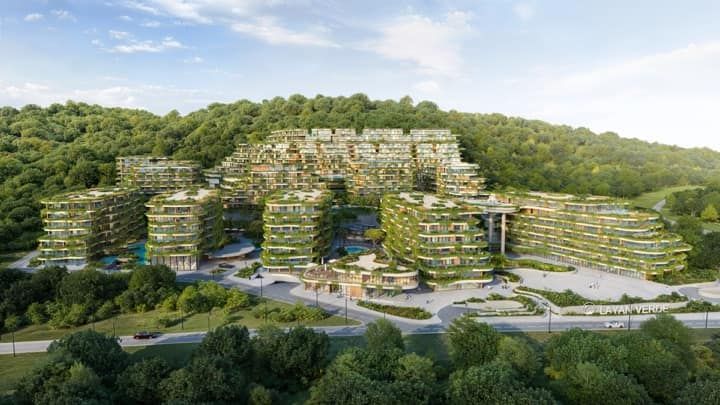
The cost depends on area and specification level. A real example from the Layan Verde project:
| Item | Amount |
|---|---|
| Unit B4-319 (36.18 m², leasehold) | $235,995 |
| Same unit furnished | $235,650 |
| Furniture package (difference) | ~$10,900 |
So the package adds around $11k to the unit price. The exact sum depends on area, level and options.
In relative terms, for this studio the package is about 4.8% of the entry price. That’s a handy benchmark for budgeting: if you’re looking at a larger unit, the package grows with it — more furniture, more appliances, often a higher grade. Its share of the price, however, usually stays in a comparable range, because the unit price itself also rises with area.
Factor in the project’s own price movement too: on the Layan Verde price list of 1 September 2026, premium studios now start from $235, while the example above is fixed at the earlier price of $224,776. The package cost is set separately and does not have to move in step with the unit price — confirm both figures as of the deal date.
4. Why it matters to investors
For renting out, a furniture package solves several tasks:
- Move-in readiness. The unit can be rented right after handover.
- Management standard. A single furnishing level fits the management company and rental pool requirements.
- Time savings. No need to search, buy and assemble furniture yourself.
- Convenience with a remote purchase. Everything’s ready without your presence on the island.
For short-term rental in a condo-hotel, ready furnishing is effectively essential: the guest must move into a fully equipped unit.
There’s also a less obvious argument — cost predictability. DIY furnishing almost always overruns the initial estimate: delivery to the island, assembly, the small items you “forgot”, replacing what didn’t fit. A package fixes the sum in advance, so you can build it straight into your net yield and payback calculation.
🔗 Buying from abroad? How to buy Phuket property remotely →
5. The package and the rental pool: why the standard is mandatory
In VillaCarte Group projects — Layan Verde and Layan Green Park — units are rented through a rental pool: units of the same type are combined into a shared inventory, and the pool’s income is split 60% to owners / 40% to the management company. This model works on one condition: units in the same category must be interchangeable for the guest.
A guest books a “premium studio”, not a specific room. If one studio has a designer bed and a wall-sized TV while the next has mismatched furniture the owner picked up “on the cheap”, the category stops being a category. The operator cannot sell such units at one price, and owners of the “strong” units end up subsidising the “weak” ones through income averaging.
That’s why pool programmes furnish to a single package — it isn’t the developer’s way of selling you furniture, it’s a technical requirement of the model. Several practical conclusions follow:
- The operator’s package defines the unit’s category. Opting out of the package in a pool project usually means fitting the unit strictly to the operator’s specification, which rarely works out cheaper.
- The hotel operator sets the bar. In Layan Verde, the premium buildings and the 5-star hotel are run by Dusit International, and the furnishing standard is geared to a hotel format, not to a “flat for letting”.
- A single standard simplifies servicing. Cleaning, replacing consumables, repairs — all cheaper and faster when the inventory shares the same items rather than hundreds of different models.
🔗 How the 60/40 split works and what the management company covers: Rental management programme →
6. Package vs DIY furnishing
| Parameter | Developer package | DIY |
|---|---|---|
| Time | Fast, turnkey | Slow: search, logistics, assembly |
| Standard | Single, for management | Depends on you |
| Remote purchase | Convenient | Hard without presence |
| Design flexibility | Limited by the package | Full |
| Price | Fixed add-on | Could be cheaper/pricier |
DIY furnishing gives more design freedom but needs time and presence. For a rental investor, the package is usually more practical.
When DIY furnishing makes sense
There are scenarios where the package isn’t needed or isn’t mandatory:
- A unit for your own living. If you don’t plan to rent the apartment out, or rent it only long-term outside a rental programme, you’re free to furnish it your way.
- Long-term rental. Tenants staying a year or longer often arrive with their own things, and a solid basic fit-out matters more to them than decor. The difference between formats is covered in short-term vs long-term rental.
- A villa or a unit outside the pool. Where there’s no interchangeability requirement, an individual interior can work as the property’s competitive edge.
- You live in Phuket. Being present removes the main problem of DIY furnishing — logistics and oversight.
Even in these cases, it’s worth requesting the developer’s package specification: it’s a ready reference for what a comfortable set-up in that specific layout actually needs.
7. Off-plan and resale: how furnishing enters the deal
The mechanics depend on whether you’re buying an off-plan unit or a completed one.
Off-plan: the package as a contract option
When buying at the construction stage — for example in Layan Verde, due for completion in 2028 — the furniture package is added to the unit price as a separate item. You fix the contents and cost now and receive the unit furnished at handover. The main price is paid in instalments tied to construction milestones; check the contract for how the package is paid — it may be linked either to the schedule or to the handover date.
The upside of the off-plan scenario: at handover you have a ready asset that goes straight into the pool. The downside: time passes between signing and handover, so at acceptance you need to check the actual contents against the recorded specification rather than rely on memory. More on how this stage works in construction and handover timelines and in the glossary: off-plan.
Resale in an operating condo-hotel
The other situation is buying a unit on the secondary market in an already operating project. Layan Green Park is completed, phase 1 is fully sold out by the developer and available only via resale with full payment: studio resales start from $142,602. Phase 1 units have been working in the rental pool since 2024, which means they’re furnished to the operator’s standard.
Here the furniture package isn’t bought separately — it’s already part of the unit, and the question comes down to two points: does the contract confirm that furniture and appliances are included in the price, and what condition are they in after several seasons of operation? It’s sensible to ask the operator for the unit’s service history and a current condition report. How phase 1 sold out before completion and what that means for resale prices is covered in the case study Layan Green Park phase 1 sold out.
| Scenario | How furnishing is documented | What to look at |
|---|---|---|
| Off-plan (Layan Verde) | Separate contract option, specification fixed now | Contents, level, payment terms, check at handover |
| Resale (Layan Green Park, phase 1) | Already part of the unit, full payment | Confirmation in the contract, actual condition, service history |
🔗 Comparing entry formats: Resale vs new build in Phuket →
8. Contract, payment and handover
The furniture package is part of the deal, not a verbal arrangement with a sales manager. A few rules that save nerves:
- The specification goes in a contract annex. The sale and purchase agreement or a separate annex should list the items and, ideally, the package level and key characteristics (bed size, TV size, appliance list). “Like the show unit” is not a specification.
- Cost and payment terms as a separate line. Easier both for your records and for a later resale: the resale buyer sees exactly what’s included in the price.
- Warranty and responsibility. Clarify who is responsible for defects and breakdowns in the first months: the developer, the furniture supplier or the management company. Appliance warranties are usually set by the manufacturer, furniture warranties by the supplier’s terms.
- Acceptance by the list. At handover, go through the specification item by item and record shortfalls and defects in a snag list. If you’re accepting remotely, ask your agent or a management company representative to do the walk-through with photo and video evidence.
- Substituted items. During construction the supplier may swap a model for an equivalent. That’s fine if the equivalent is no lower in grade — but substitutions should be recorded in the acceptance report.
None of this complicates the deal; it simply puts it on paper — the same approach as checking the unit and the developer.
9. Effect on yield
Furnishing doesn’t directly “raise the percent” but affects it indirectly:
- a ready unit enters rental faster — less downtime;
- meeting the management programme standard supports occupancy;
- the owner earns a net yield of around 8–10% via the rental pool (60% of net profit).
When calculating ROI, build the package cost into the entry price — it raises the base but also makes the unit a working asset from day one.
What it looks like in numbers
Take the studio from the example above. The base for the payback calculation isn’t $235,995 but $235,650: the package added roughly 4.8% to the entry price. If the ~8–10% owner net yield benchmark is calculated on the full asset value, then in absolute terms the income at the same percentage doesn’t change, but the payback period lengthens in proportion to the package’s share — by roughly the same 4–5%.
Working against that is another factor — downtime. An unfurnished unit cannot be rented at all, and DIY furnishing on a remote purchase easily eats up weeks. In a season where the high rates fall in November–March, a lost month costs noticeably more than the few hundred dollars “saved” on furniture. The closer the handover is to high season, the more valuable turnkey readiness becomes. How occupancy spreads across the months is covered in Phuket rental seasons.
The takeaway for the model: calculate yield on the full cost including the package, and price the “I’ll furnish it myself” alternative not just by the cost of furniture but by the cost of lost rental weeks.
10. Depreciation and refresh
Furniture in short-term rental ages faster than in your own home: guests change every few days, cleaning happens daily, and linen goes through dozens of washes per season. That’s not a flaw of the package — it’s a property of the format, and it has to be in the model.
What wears out fastest:
- Soft furnishings and mattresses — sofa upholstery, mattress, cushions.
- Textiles — bed linen, towels, curtains.
- Small appliances — kettle, hairdryer, iron.
- Surfaces — worktops, cabinet fronts, wardrobe doors.
Case furniture, large appliances and air conditioners last longer but cost more to replace.
In the pool model, it’s important to know where the line is: the management company usually covers cleaning, linen and minor repairs, but replacing furniture and appliances as they wear out is the owner’s cost. Confirm this in the management agreement upfront: who decides that an item is due for replacement, to what standard it is replaced, and how that is agreed with the owner.
An illustrative reserve calculation. Spread the ~$10,900 package cost over a notional 7–8-year life and you get roughly $1.4–1.6k per year — not a precise figure, but a way to show the order of magnitude worth holding in reserve. The real refresh schedule depends on occupancy, package quality and the operator’s rules. A depreciation reserve is an owner’s expense line just like the CAM fee and insurance; how to count all recurring costs is covered in CAM fee and sinking fund.
11. Pitfalls
- Not budgeting for the package. Furnishing is part of the entry price; count the full cost, not just the unit.
- Renting without furnishing. For short-term rental an empty unit doesn’t work — the guest needs everything ready.
- Ignoring the management standard. DIY furnishing may not fit the pool’s requirements.
- Chasing savings at the cost of quality. Cheap furniture wears out fast under short-term rental.
- Forgetting depreciation. Furniture needs refreshing over time — build it into the model.
- Confusing fully fitted with fully furnished. Comparing the price of a unit “with kitchen and air-con” to one “with furniture” is comparing different products.
- Accepting the unit without a specification. Without a list in the contract, proving a shortfall at handover is practically impossible.
- Not asking about outdoor furniture and small items. Terrace, safe, ironing board, tableware — common “outside the package” items that surface only after the first guests check in.
12. Case: a turnkey rental unit
Consider a typical scenario. An investor bought a unit remotely for short-term rental. Furnishing it themselves meant flying in, sourcing furniture, arranging logistics and assembly — weeks of time and the risk of missing the management standard. They took the developer’s furniture package (+~$11k to the price): the unit was handed over fully ready and entered the rental pool immediately at ~8–10% net. There was no furnishing downtime.
What they did right beyond the package decision itself: they requested the specification before signing, had their agent do the handover walk-through by the list with photo evidence, and found out from the management company in advance that furniture refresh is their cost, not the pool’s. In the yield model they used the full entry cost of $235,650 plus a small annual depreciation reserve — and the first annual statement held no surprises.
Takeaway: the furniture package isn’t a “spare option” but a tool for launching the asset into rental quickly. For a rental investor, especially remotely, it saves time and ensures a management-ready standard.
I’ll select a unit with a furniture package for rental and calculate the yield including the furnishing cost. Move-in-ready options are in the collection ready condos in Phuket.
Turnkey rental unit
By submitting this form you agree to the privacy policy.