Buying property abroad seems complex until you break it into steps. In Phuket the process is well-established: choose a unit, reserve, contract, pay in stages and register title. Much of it runs remotely. Let’s go step by step through what happens at each stage, which documents and fees are involved, how long it takes and where the pitfalls sit — so you move through the deal with confidence.
Contents
1. The overall deal logic
Whatever the property, the deal follows one logic: fix the price → check documents → sign the contract → pay → register title. What differs is the content of each stage:
- New-build (off-plan/ready). Contract with the developer, payment by installments tied to construction stages.
- Resale. Contract with the current owner, usually paid in one or two payments.
The ownership form — leasehold or freehold — affects documents and fees, but not the overall sequence.
It helps to understand the cast of participants from the start. On the seller’s side there’s the developer (new-build) or the owner (resale). On yours — you and, if you wish, a representative acting under power of attorney. In between sit the agency running the deal and, where needed, an independent lawyer. The final word belongs to the Land Office: that’s where title is registered, and no contract substitutes for that registration.
How new-build differs from resale stage by stage:
| Stage | New-build | Resale |
|---|---|---|
| Fixing the price | Reservation with the developer | Deposit agreed with the owner |
| Checks | Developer, permits, EIA, quota | Title, encumbrances, unpaid fees |
| Contract | Developer’s standard contract | Individually drafted sale contract |
| Payment | Installments tied to construction | Usually 1–2 payments |
| Registration | After the building is completed | Right after settlement |
🔗 Basics: Leasehold vs freehold → · Resale vs new-build →
2. Step 1. Choosing a unit
The starting point is your purchase goal: rental, living or both. It drives location, type and budget:
- Location — quiet premium (Layan) or an active centre.
- Type — studio, apartment, villa.
- Stage — off-plan (cheaper, wait) or ready (move in/rent immediately).
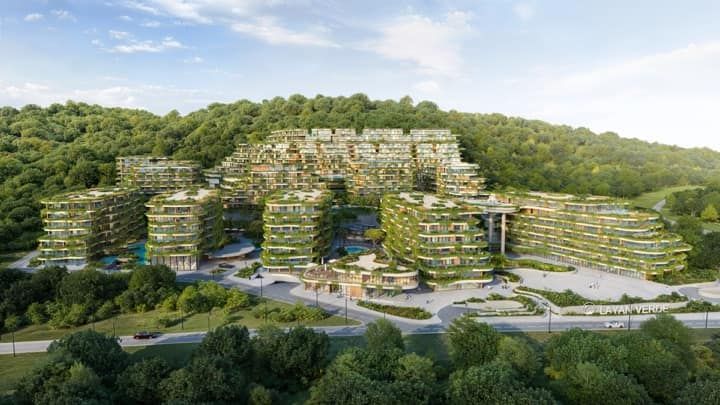
- Budget — e.g. Layan Verde from $235,995 (unit B4-319, 36.18 m², leasehold).
Yield is modelled at this stage: the owner earns ~8–10% net via the rental pool.
The difference between stages is essentially a trade of time for price. Off-plan gives a lower entry point and installments over the construction period, but demands patience and careful vetting of the developer. A ready unit costs more, yet starts earning rent immediately — the catalog’s ready condos are gathered in a dedicated collection. For Layan Verde the developer projects value growth of up to +45% over the construction period — a forecast, not a guarantee, but it illustrates the early-entry logic: the earlier the stage, the lower the price per square metre.
A separate reliability marker is completed and sold-out earlier phases by the same developer. Example: the Layan Green Park phase 1 case — delivered and fully sold out. Stories like that are verified by facts, not promises.
3. Step 2. Reservation
The unit you like is secured with a reservation:
- the reservation takes the unit off the market and fixes the price;
- on the Layan Verde project the reservation is 200,000 THB;
- it’s usually credited toward the first contract payment;
- during this period the contract is prepared and documents are checked.
The reservation signals serious intent and protects against the unit being sold to another buyer.
The reservation is documented in a short agreement (reservation agreement / booking form). Before paying, check three things in it: what exactly is being fixed (unit number, area, price, ownership form), for how long the reservation holds, and what happens to the money if the deal falls through. Refund terms vary between developers: with some the reservation is refundable until the contract is signed, with others it isn’t — verbal promises don’t count here, only the text of the agreement. If due diligence uncovers a documentation problem, a refund clause fixed in writing is your only protection.
🔗 More on deposits and refunds: Reservations and deposits in Thailand →
4. Step 3. Checking documents
Before signing, you verify:
- the developer — reputation, permits, delivery track record;
- title to the property — the title, ownership form, foreign quota (for condos);
- the contract — payment terms, deadlines, penalties, what’s included in the price;
- encumbrances — no liens or restrictions (especially on resale).
This is the due-diligence stage — where the main risks are removed.
Who runs the checks is a question of deal format. The law doesn’t oblige you to hire a lawyer, but someone must review the documents professionally: either an independent lawyer you engage yourself, or an agency with an established verification procedure. For a freehold condo, the foreign quota is checked separately — the share of the building foreigners may own: if the quota is used up, freehold cannot be registered to a foreigner and leasehold remains the route. On resale, add a check of the seller’s debts to the management company: unpaid fees must not move to you along with the unit.
For settlement, an escrow account is sometimes used — funds are released to the seller only once the conditions are met. In Thailand it’s not a mandatory standard, but by agreement between the parties the mechanism is available — check whether it’s offered on your specific project.
🔗 In detail: Due diligence in Phuket → · Verifying a Chanote →
5. Step 4. Contract and payment
After the checks you sign the sale (or lease) contract. New-build payment usually runs by staged installments:
| Stage | Example 35%/50% scheme |
|---|---|
| Reservation | Reservation (e.g. 200,000 THB) |
| Contract | First payment (part of 35%) |
| During the build | Staged payments |
| At handover | Remainder (up to 50% and final) |
Payment is usually by bank transfer. For a freehold condo, correct inbound funds from abroad (FET) matter — it’s a condition for registering to a foreigner. For leasehold there are usually fewer FET requirements, making entry more flexible.
What to look at in the sale and purchase agreement before signing:
- The subject — a precise description of the unit: number, floor, area, finish, what the price includes (furniture package, appliances).
- The payment schedule — amounts, dates or construction-stage triggers, currency and account details.
- Completion date and liability — what happens if the build is delayed: developer penalties, your right to exit the deal.
- Buyer penalties — for late payment: interest rate, the threshold for termination.
- Handover procedure — how defects are recorded and how quickly the developer must fix them.
Some projects on the market also offer post-handover installments: the remainder is paid after completion, sometimes alongside rental income. This is a term of a specific developer and a specific phase, not a market standard — confirm it’s current at the time of your deal. We’ve covered the mechanics separately: post-handover payment plans in Phuket →, and projects with installment plans are gathered in a catalog collection.
6. Step 5. Registration and handover
The final stage is registering title at the Land Department and handing over the unit:
- for freehold — registering ownership in the buyer’s name;
- for leasehold — registering the lease (roughly ~1.1% for 30 years);
- handover — accepting the unit, keys, connecting to the management company.
After handover the unit can be occupied or placed in the rental programme.
Acceptance is not a formality. The unit is inspected against a checklist: finishes, plumbing, wiring, windows and doors, the furniture package, air-conditioning. Every issue goes into the snag list — a defects schedule signed by both sides, with a deadline for fixes. Signing the acceptance act “without looking” means taking the unit as is.
You don’t have to attend registration at the Land Office in person: it can be done under power of attorney — your representative files the documents, pays the fees and collects the registered lease or title. This is standard practice in remote deals. In parallel, the water and electricity meters are transferred to the new owner and an account is opened with the management company.
7. Fees and timelines
An indicative list (depends on the project and ownership form):
| Item | Project example |
|---|---|
| Reservation | 200,000 THB (Layan Verde) |
| Installments | 35%/50% staged scheme |
| Sinking fund | ~850 THB/m² (one-off fund) |
| Common areas | ~85 THB/m²/mo |
| Leasehold registration | ~1.1% for 30 years |
| Transfer fee (freehold) | ~2% of appraised value, split by agreement |
| Water/electricity meters | ~15,000 THB |
For freehold, instead of lease registration there’s the transfer fee — the charge for transferring ownership; on resale the seller additionally carries their own taxes (specific business tax 3.3% or stamp duty 0.5%, withholding tax), and how costs are split between the parties is a matter for the contract. We’ve priced the full entry cost on a live studio example: the cost of buying property in Phuket →.
Timelines: reservation — days; contract — from a few days; payment — on the construction schedule (off-plan: months/years to completion); registration — when the property is ready.
| Stage | Time guide |
|---|---|
| Reservation | 1–3 days |
| Contract preparation and review | 1–3 weeks |
| Signing | From 1 day (remotely — exchanging signed copies) |
| Off-plan payment | On the schedule until completion (months/years) |
| Ready/resale payment | Days–weeks |
| Registration and handover | When the property is ready; the Land Office filing itself usually takes one day |
8. Buyer documents and power of attorney
The good news: for an individual buyer the paperwork is minimal.
- Passport — the core document in every deal format; the details in the contract and payment records must match it character for character.
- Proof of inbound currency (FET) — for a freehold condo: the receiving bank issues confirmation that the funds arrived from abroad in foreign currency for the purpose of buying property. The sender’s name must match the buyer’s name in the contract.
- Power of attorney — if you’re not present in person: for signing, payments and registration. For use in Thailand the POA must meet the receiving side’s requirements — confirm the form and certification procedure in advance with the lawyer or agency running your deal.
- Marriage certificate — may be needed if the property is registered to spouses or the bank asks about the source of funds.
No “purchase permits” are required for a foreigner buying a condo or leasehold — the restrictions are built into the ownership form itself (the quota, the lease term), not into separate approvals.
9. After handover: rental, taxes, resale
The deal is closed, keys in hand — the asset’s life begins.
Rental. If the goal is income, the unit joins the hotel’s or management company’s rental programme: the operator handles guests, cleaning, marketing and reporting, and the owner receives their share of revenue. How these programmes work and what to check in the operator agreement — in our review of Phuket rental management programmes →.
Taxes. Rental income in Thailand is taxable — rates and deductions depend on residency and how the income is received; ownership also carries the annual land & building tax. Details: property taxes in Thailand → and tax on rental income →.
Ownership costs. Monthly common-area fees, metered utilities, optional insurance. These belong in your yield model back at the unit-selection stage — they’re already reflected in the “~8–10% net” calculation.
Exiting the investment. The unit can be resold — on a growing project sometimes even before construction completes (assignment under the developer contract). The exit mechanics, commissions and typical time on market are covered separately: how to resell Phuket property →.
10. Pitfalls
- Skipping due diligence. Reserving without checking the developer and documents is a risk.
- Not reading the contract. What’s in the price, penalties, deadlines — all in the contract, not in verbal promises.
- Ignoring FET on freehold. Incorrect inbound funds complicate registration to a foreigner.
- Forgetting the fees. Sinking fund, common areas, registration — count the full entry cost, not just the unit price.
- Paying before the contract. Any payment goes against signed documents and to verified account details.
- Reserving without exit terms. If the reservation agreement doesn’t spell out a refund when documents fail the checks, the deposit will most likely stay with the seller if the deal collapses.
- Not checking the foreign quota. For a freehold condo, a used-up quota means ownership cannot be registered to a foreigner — only leasehold remains.
- Signing the acceptance act without an inspection. Defects that never made it into the snag list become your problem after signing, not the developer’s.
11. Case: a remote deal
Consider a typical scenario. An investor chose a unit online, got a yield calculation and presentation, and reserved it with the price fixed. While the contract was prepared, the developer and documents were checked. The contract was signed remotely, payments made in stages by bank transfer. They came to the island only at handover — to accept the unit and place it in rental. The whole deal ran remotely and transparently.
The only stages where physical presence genuinely helps are the viewing (replaced by a video tour and online presentation) and the acceptance (replaced by acceptance under power of attorney with a photo report). Everything else is paperwork and payments, which have long worked at a distance. The full format is covered in a dedicated guide: how to buy Phuket property remotely →.
Takeaway: the Phuket buying process is a clear sequence of steps. Taken in order, with a check at each stage, the deal can be closed calmly and even remotely.
12. Buyer’s checklist
The whole process in short — check yourself against it as the deal moves:
- Define the goal (rental / living / mix) and a budget that includes the fees, not just the unit price.
- Choose a location and 2–3 candidate units; compare stage, ownership form and income model.
- Vet the developer: delivery history, earlier phases, permits.
- Read the reservation agreement, get the refund terms in writing — and only then pay the reservation.
- Run due diligence: title, quota, encumbrances, contract.
- Check the payment schedule and account details; for freehold, plan the currency transfer for FET.
- Sign the contract; pay strictly on schedule and against signed documents.
- Accept the unit against a checklist; record the snag list.
- Register title at the Land Office (in person or by POA).
- Transfer the meters, join the rental programme, account for income taxes.
I’ll walk you through every step — from choosing a unit to handover — with document checks and a yield calculation.
Deal support in Phuket
By submitting this form you agree to the privacy policy.