One of an investor’s first questions in Phuket: buy a new-build from the developer or a ready resale from the current owner? Each option has its own logic on price, yield, risk and liquidity. A new-build means installments and growth potential; a resale means a ready asset and quick income. Let’s compare both formats by parameter — from payment structure and fees to property checks and a five-year scenario — to choose for your goal.
Contents
- Three formats on the market
- Price and installments
- What the buyer pays on top of the price
- Yield and entering rental
- Risks of each format
- Resale due diligence: step by step
- How to judge a fair resale price
- Liquidity and resale
- Comparison table
- A five-year scenario
- Who each suits
- Pitfalls
- Case: choosing for a goal
1. Three formats on the market
In Phuket an investor effectively chooses between three options:
- Off-plan — a new-build under construction. Cheapest, installments, income after completion.
- Ready (new, completed) — a new-build after handover. Move in/rent immediately, but pricier than off-plan.
- Resale — a resale from the current owner. A ready asset with a history, but usually without installments.
Off-plan and ready are primary sales from the developer; resale is a deal with a private seller.
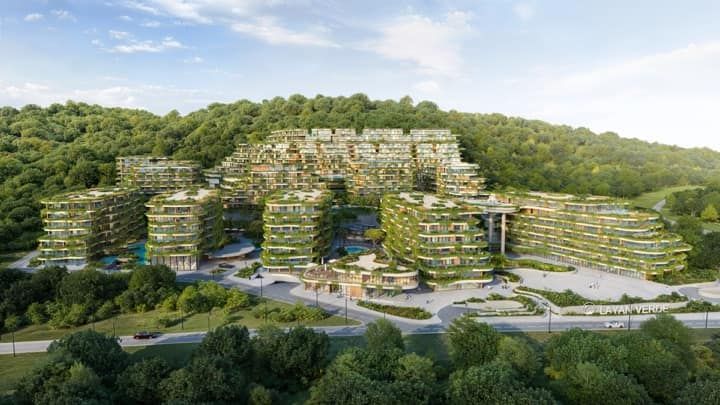
An important nuance: a “resale” in Phuket is not necessarily old stock. Often it is a unit in a new complex that the first owner bought at the foundation stage and is selling after handover. That is exactly how phase 1 of Layan Green Park works: the developer sold all 248 units before construction finished, the complex has been operating since 2024, and today the only way in is a resale from an owner. By age it is a new-build; by deal type it is a resale.
Where resales are found in practice: through agencies with direct access to owners in specific complexes, through the management company (it is the first to know which owners are ready to exit), and in catalogs where resales are flagged separately. In the Layan Real Estate catalog such units carry the note “resale from owner”.
🔗 Basics: Off-plan vs ready → · Completed condos in the catalog →
2. Price and installments
The main price difference is installments:
- New-build. Installments tied to construction stages (e.g. a 35%/50% scheme). Off-plan is the lowest entry: e.g. Layan Verde from $235,995. Price rises as completion nears.
- Resale. Usually paid in one or two payments directly to the seller, without developer installments. Often pricier per sqm than a comparable new-build.
New-build installments lower the entry barrier and spread payments over time — a strong argument for investors.
What the money looks like in each deal
| Off-plan (Layan Verde) | Resale (Layan Green Park phase 1) | |
|---|---|---|
| Reservation | 200,000 THB | Deposit to the seller by agreement (usually 5–10%) |
| First payment | 35% or 50% on signing the contract | Balance on registration at the Land Office |
| Further payments | 5 payments of 13% (or 10%) every 6 months until the 2028 handover | None — the deal is closed |
| Total before keys | Spread over the construction period | 100% within 2–6 weeks |
| Entry example | Studios from $235,995 | Studios from $142,602 |
Note that a resale studio in LGP is cheaper than a studio in Layan Verde in absolute terms — but these are different products (30 sqm in an operating eco condo-hotel versus 36.2 sqm in a branded quarter managed by Dusit with handover in 2028) and a different shape of money: LGP needs the whole sum at once, while Layan Verde needs 35% at the start. Compare not the price tags but “how much capital is tied up and when it starts working”.
And once more on installments for completed stock: LGP phase 1 has none in any form — neither for the construction period (it is over) nor post-handover. In Phuket, installments are an attribute of a project under construction, not a completed one.
🔗 Post-handover payment plans: where they exist → · Projects with installment plans →
3. What the buyer pays on top of the price
The price tag is not the whole deal. Fees and one-off contributions are structured differently for a new-build and a resale.
| Item | New-build from the developer | Resale from an owner |
|---|---|---|
| Transfer fee (freehold) | ~2% — buyer’s share per contract | ~2% — split with the seller as fixed in the contract |
| Leasehold registration | 1.1% on registration | 1.1% on re-registration to the new lessee |
| Sinking fund | One-off at handover (Layan Verde — 850 THB/sqm, LGP — 650 THB/sqm) | Usually already paid by the first owner |
| CAM fee | From handover (LV — 85 THB/sqm/month, LGP — 75) | From the deal date; check the seller’s arrears |
| SBT 3.3% / stamp duty 0.5% | Not applicable to the buyer | Paid by the seller (SBT if selling within the first 5 years) |
| Withholding tax | — | Paid by the seller |
| Lawyer / due diligence | Optional | Practically mandatory |
Two practical consequences. First, on a resale the sinking fund is not paid a second time — a small but real plus of the format. Second, the seller’s taxes (SBT or stamp duty, withholding tax) are formally the seller’s expense, but experienced sellers price them in — which is why a resale of a unit bought less than 5 years ago often costs a little more: the seller is recovering the SBT.
🔗 Full buyer’s cost sheet in Phuket → · Sinking fund and CAM →
4. Yield and entering rental
- Ready asset (ready/resale). Produces income immediately — rentable from month one. A resale may come with a ready occupancy history.
- Off-plan. Income starts after completion, but entry is cheaper and price can grow during the build.
In both cases, in a project with a management company the owner earns a net yield of around 8–10% via the rental pool (owner takes 60% of net profit). The difference is in when income starts and the entry price.
What a rental history gives you
A resale in an operating complex has something a new-build cannot have by definition — actual payouts to the owner for past seasons. That lets you:
- calculate yield from real pool figures rather than an “expected rate”;
- see how the property gets through low season (May–October), not just the peak months;
- understand whether CAM is rising and how the owner’s share in the rental pool has changed.
When buying a resale in LGP, ask for the pool statements for 2024–2025 — that is normal practice, and a seller who refuses to show them is telling you something.
🔗 Calculating ROI → · Calculator · Rental management programme →
5. Risks of each format
New-build (especially off-plan):
- timeline and developer-reliability risk — removed by choosing a proven developer with a delivery record;
- waiting for income until completion.
Resale:
- condition and wear — needs an inspection;
- hidden encumbrances and debts — removed by due diligence;
- no installments — the full sum is needed.
Let’s add the less obvious risks. For a resale it is obligations to the management company: if the unit is in a rental pool, the operator contract usually passes to the new owner together with the unit, and leaving the pool “at will” may not be possible. That is not a minus if you are buying for income, but it should not be a surprise. The second nuance is the foreign quota: a foreign seller selling to a foreigner transfers the unit within the quota, whereas buying from a Thai owner can run into the quota being exhausted.
For a new-build the hidden risk is terms changing as sales progress: payment schedules, the finish package and even the management company can be adjusted from one release to the next. Everything that is critical to you should be fixed in the contract, not in the presentation.
🔗 How to choose a developer → · Due diligence → · Developer red flags →
6. Resale due diligence: step by step
A completed unit does not require vetting the developer, but it does require vetting the seller and the unit itself. The standard procedure takes 1–3 weeks:
- A copy of the Chanote and an extract from the Land Office. Verify the owner, the area, and the absence of mortgages and encumbrances. How to verify a Chanote →
- A letter from the condominium juristic person. CAM arrears, sinking-fund status, availability of foreign quota — without this letter the Land Office will not register a transfer to a foreigner.
- FET forms from the original purchase. They confirm that the money for the unit came from abroad; you will need them to repatriate funds when you sell. About FET →
- The management company contract. Pool terms, duration, exit procedure, owner’s share — what passes with the unit.
- Rental statements for past seasons and current bookings.
- Inspection and inventory. Condition of the systems, furniture and appliances; exactly what is included in the price.
- The sale and purchase agreement with a lawyer: settlement procedure, who pays which fees, the registration date.
In scope this is comparable to vetting a developer on off-plan — the focus simply shifts from “will it be delivered” to “is what has been delivered clean”.
7. How to judge a fair resale price
For a new-build the price is set by the developer’s price list. For a resale it is an agreement with the seller, and you need a benchmark.
- The developer’s price for a comparable unit. If the developer is still selling in the complex, a resale is usually a little below its price list — otherwise the buyer would go to the developer. If sales are finished (as in LGP phase 1), there is no “from the developer” benchmark and the price is set by scarcity: the occasional resale in a sold-out complex trades at a premium to the launch price.
- Realised growth. According to the developer, LGP phase 1 rose roughly 100% from sales launch to an operating complex. The resale price ($142,602 for a studio) already includes that growth — there is no “discount for waiting” here; it is the price of a ready asset with an income history.
- Yield as a sanity check. Divide the actual annual pool payouts by the asking price. If the result is noticeably below the ~8–10% net benchmark, either the price is inflated or the unit has an occupancy problem.
- The seller’s tax position. Owned for less than 5 years — the 3.3% SBT is almost certainly sitting in the price; that is a legitimate basis for negotiation.
Experience shows that a well-located resale in an operating complex rarely sells at a large discount. Discounts appear where there is a problem — with location, condition or management. A cheap resale is a reason not to celebrate but to investigate.
8. Liquidity and resale
Liquidity depends not on the format itself but on the “location + condition + rental” combination:
- More liquid — modern projects in in-demand locations (e.g. Layan), with a management company and steady rental.
- Slower — old stock without renovation or a rental programme, in a poor location.
A new-build in a good location often wins by resale time thanks to price growth during the build and the asset’s “freshness”.
Who buys resales in Phuket? Mostly the same investors who buy primary stock, but with a different motivation: they want income now, do not want to wait for construction and are willing to pay for certainty. So a resale’s liquidity depends directly on how convincing its income history is. A unit with transparent pool statements and steady occupancy goes fast; a unit with no history, let “on its own”, sells slowly and with haggling.
Another factor is the seller’s tax calendar: a sale within the first 5 years of ownership attracts 3.3% SBT, after that 0.5% stamp duty. That is one reason there are few “fresh” resales from recently completed complexes on the market: owners are better off waiting for the five-year threshold.
🔗 How to resell in Phuket → · Capital gains tax in Thailand →
9. Comparison table
| Parameter | Off-plan | Ready (new) | Resale |
|---|---|---|---|
| Entry price | Lowest | Medium | Often higher per sqm |
| Installments | Yes, staged | Sometimes | Usually none |
| Income | After completion | Immediately | Immediately |
| Price-growth potential | High | Medium | Lower |
| Construction risk | Yes | No | No |
| Condition | New | New | Needs inspection |
| Rental history | None | None | Yes (if in a pool) |
| Sinking fund | Paid by the buyer | Paid by the buyer | Usually already paid |
| Freehold quota | Usually available | Depends on what is left | Depends on the seller and quota |
| Seller | Developer | Developer | Private individual |
| Key check | Developer and contract | Developer and unit | Title, debts, income history |
10. A five-year scenario
Let’s look at the three formats over a single horizon — five years from the deal. No numbers forecast; we look at the structure.
| Year | Off-plan (handover in ~2 years) | Ready (new) | Resale |
|---|---|---|---|
| 0 | First payment 35–50%, construction | 100% payment, rental launch | 100% payment, rental already running |
| 1 | Scheduled payments, no income | First full season, statistics forming | Full season with a known history |
| 2 | Handover, transfer, sinking fund, rental start | Rental, market-pace growth | Rental, market-pace growth |
| 3–4 | Rental from the new value base; a sale attracts SBT | Rental; a sale attracts SBT | Rental; SBT depends on how long you have held it |
| 5 | SBT threshold passed — exit with 0.5% stamp duty | Same | Same |
What the table shows. Off-plan “buys” two years without income in exchange for installments and growth to handover. Ready and resale deliver cash flow from the first season — the difference between them is that a resale already has a history while a ready unit is only building one. And for all three formats the five-year holding threshold is the natural exit point from a tax standpoint.
11. Who each suits
- Off-plan — those wanting minimum entry, installments and price growth, ready to wait for completion.
- Ready — those needing a new asset with immediate income, no waiting for the build.
- Resale — those wanting a specific location/unit with a rental history and ready to pay without installments.
Often the optimum for an investor is off-plan or ready in a strong location with a management company: a balance of entry price, income and liquidity.
A separate scenario is a sold-out complex you specifically want to be in. If the goal is a particular operating project where the developer has already sold everything, a resale becomes not a compromise but the only door. That is how entry into phase 1 of Layan Green Park works: a resale with full payment — or nothing. For those who value installments and growth more, it makes more sense to look at Layan Verde, under construction in the same district.
12. Pitfalls
- Looking only at price per sqm. Installments, when income starts and growth potential matter more than price-per-sqm in a vacuum.
- Ignoring the developer on off-plan. Construction risk is removed by the developer’s reputation, not a low price.
- Not inspecting a resale. Wear, hidden debts and encumbrances — check before the deal.
- Forgetting liquidity. Cheap illiquid stock is hard to resell; model the exit in advance.
- Comparing without a goal. “Better” is always relative to your task: income now or growth to completion.
- Buying a resale without a juristic-person letter. Without it the transfer to a foreigner will not be registered, and the seller’s CAM arrears become yours.
- Losing the FET forms. Without proof of currency inflow for the first purchase, repatriating funds on your own sale becomes harder.
- Believing in “installments on completed stock”. If the complex is completed and sold out, developer installments do not exist; an offer of “installments from the owner” is a reason to check who actually holds the title, and on what terms, until full payment.
- Not reading the operator contract. The pool terms pass to you with the unit; finding out about them after the deal is too late.
13. Case: choosing for a goal
Consider a typical scenario. An investor wanted minimum entry and growth potential. A resale demanded the full sum upfront and cost more per sqm; a ready new-build also had no installments at that point. They chose off-plan in a strong location: low entry, staged installments, and by completion, price growth plus a rental start at ~8–10% net. The wait for the build was offset by entry savings and value appreciation.
Now the reverse scenario. A second investor wanted a specific operating complex with a history and income from month one — and was not prepared to wait for construction. Their choice: a resale studio in Layan Green Park phase 1 at $142,602 with full payment. Before the deal they obtained a juristic-person letter, pool statements for past seasons and a copy of the Chanote, and checked the quota and the operator contract. They will not get “foundation-stage” growth — according to the developer, phase 1 has already risen roughly 100% since launch, and that appreciation went to the first owner. But pool payouts run from the first season, and there was no sinking fund to pay.
Both decisions are right — because both match the goal. The mistake would be to swap them: for the first investor a resale would have frozen all the capital with no growth; for the second, off-plan would have meant two years of waiting instead of income.
Takeaway: “resale or new-build” is a question of goal, not fashion. For capital growth and low entry, off-plan wins; for income here and now, ready or a quality resale with a verified history.
I’ll match the format to your goal — entry, income or growth — with a yield calculation and property check.
Choosing new-build or resale
By submitting this form you agree to the privacy policy.