Taxes in Thailand for a property owner are low by global standards, but understanding the structure matters: one-time transaction fees, the annual land and building tax, and rental income tax. Not knowing leads to budget “surprises.” Here’s every item — who pays how much, how freehold and leasehold differ, how the picture changes when you own through a company, and what to do about reporting at home — in clear figures.
Contents
- Overview of taxes and fees
- One-time transaction fees
- Who pays what
- Annual taxes and costs
- Rental income tax
- Tax on sale
- Freehold vs leasehold: the tax burden over 10 years
- Individual vs Thai company
- Residency, double-tax treaties and reporting at home
- Owner’s calendar: when to pay what
- Pitfalls
- Case: a tax estimate
1. Overview of taxes and fees
Taxes fall into three groups:
- One-time at the deal — transfer fee, stamp/business tax, leasehold registration.
- Annual — land and building tax, common area fee (a cost, not a tax).
- On income — income tax on rental and tax on sale.
It helps to lay them out along the life of the asset from the start — then no item comes as a surprise:
| Moment | What is paid | Who calculates |
|---|---|---|
| Signing the contract | Reservation, sinking fund, meters (costs, not taxes) | Developer / contract |
| Registration at the Land Department | Transfer fee or leasehold registration; on resale — the seller’s SBT/stamp duty and withholding | Land Department |
| Every year of ownership | Land and Building Tax, CAM fee, utilities | Local authority / management company |
| Every year of renting out | Income tax on rental income, 5% withholding at source | Owner / management company |
| Exit | Transfer fee, SBT or stamp duty, withholding | Land Department |
One important caveat: in Thailand most transaction fees are calculated not on the contract price but on the appraised value kept by the Land Department. In Phuket it is usually below market, so the actual percentages “of the unit price” come out lower than the headline rates.
2. One-time transaction fees
| Fee | Rate (indicative) | Who pays | Base |
|---|---|---|---|
| Transfer fee (freehold) | ~2% | Split / by contract | Appraised value |
| Leasehold registration | ~1.1% (every 30 yrs) | Buyer | Value |
| Specific Business Tax (SBT) | 3.3% | Seller | If held < 5 years |
| Stamp duty | 0.5% | Seller | If SBT doesn’t apply |
| Withholding tax | Progressive / 1% | Seller | At transfer |
On the primary market the transfer fee is often split 50/50 or covered by the developer as a promotion.
How each fee works
- Transfer fee 2% — the charge for registering the transfer of ownership of a freehold unit. A foreigner buying a condo in the foreign quota also needs the FET form — proof that the funds were brought in from abroad; without it the Land Department will not register the deal. In 2026 the cabinet extended the reduced 0.01% fee until 30 June 2027 — but that relief is aimed at Thai home buyers, not foreign investors, so budget the full 2%.
- Leasehold registration ~1.1% — made up of a 1% registration fee and 0.1% stamp duty on the lease amount. Paid when the 30-year lease is registered and again on renewal for the next term — once a generation, not on every resale.
- SBT 3.3% — specific business tax of 3% plus a 10% municipal surcharge on it. It applies if the seller held the property for less than 5 years: the state treats such a sale as “commercial.” There are exceptions — for instance if the seller was registered at the property in the house book (tabien baan) for at least a year — but for a foreign investor that is a rare case.
- Stamp duty 0.5% — the alternative to SBT: applies when the property was held 5 years or longer. SBT and stamp duty are never paid together.
- Withholding tax — the tax at source that the Land Department withholds from the seller at registration. For an individual it is computed on a progressive scale from the appraised value with a deduction that grows with each year held; for a company it is 1% of the higher of appraised and sale value.
🔗 Full entry estimate: Phuket taxes & fees →
3. Who pays what
- Buyer: a share of the transfer fee (freehold) or leasehold registration (~1.1%), sinking fund, meters.
- Seller (resale): SBT/stamp and withholding tax.
- Developer (primary): often covers part of the transfer fee.
The final split is in the contract — the first thing to fix in writing.
Three typical Phuket scenarios look like this:
| Scenario | Buyer pays | Seller pays |
|---|---|---|
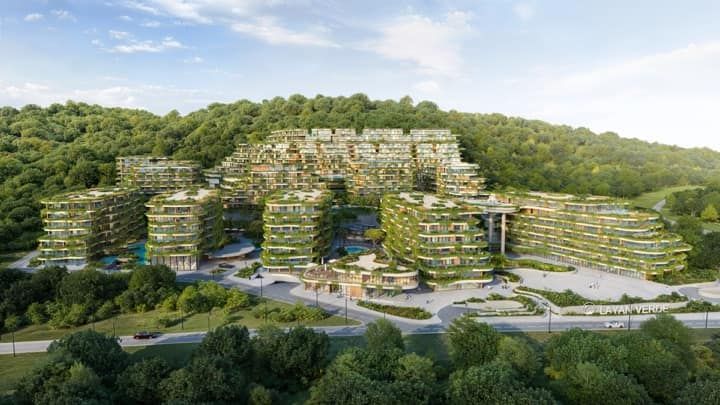
| Primary leasehold (Layan Verde) | Registration 1.1%, sinking fund, meters | — (the developer registers the lease) |
| Primary freehold | Their share of the transfer fee (often 50% or 0% under a promotion) | Developer — its share of the transfer fee |
| Resale (Layan Green Park) | Assignment registration / share of transfer fee per contract | SBT 3.3% or stamp duty 0.5%, withholding |
On resale the fee split is a bargaining point: a seller who wants a quicker exit often absorbs part of the registration costs. If you are the buyer, ask for the offer to fix not just the price but the exact “who pays what” formula — otherwise the haggling moves to registration day.
4. Annual taxes and costs
- Land and Building Tax — the annual tax on land and buildings; residential rates are low, primary homes have exemptions and thresholds.
- Common area fee — the complex servicing charge (Phuket benchmark ~85 THB/m²/mo). A cost, not a tax, but recurring.
- Sinking fund — a one-time contribution to the capital-repair fund at purchase (e.g. 850 THB/m²).
- Utilities — water and electricity by meter.
Land and Building Tax in detail
The tax has been in force since 2020, replacing the old House and Land Tax and Local Development Tax. For the residential category the law sets a range of 0.02–0.3% of appraised value — not of the unit’s market price. From 2020 the cabinet granted a discount off the statutory rate almost every year; 2026 is the first year the tax is levied at the full rate with no temporary relief. In absolute baht the amount may rise slightly, but for a typical studio it remains an order of magnitude below the common area fee.
The primary-home exemption works for an owner registered at the property in the house book. A foreign investor renting the unit out through a rental pool usually cannot rely on it — budget the tax at the full residential rate. It is administered by the local authority, which appraises the property, announces the rate and sends a notice; payment falls in the first half of the year.
🔗 What actually changed: 2026 tax changes →
CAM fee and sinking fund on real units
| Item | Layan Verde studio 36.18 m² | Layan Green Park resale studio 30 m² |
|---|---|---|
| Sinking fund (one-time) | 30,753 THB / $924 | ~$579 |
| Common area fee (per year) | 36,904 THB / ~$1,109 | ~$802 |
The CAM fee is paid whether or not the unit is rented out and is not part of the pool’s net-yield calculation — it is a separate line in the total cost of ownership.
🔗 The two fees explained: CAM fee and sinking fund →
5. Rental income tax
Rental income is subject to income tax. In a condo-hotel with a rental pool this is factored into net yield: the owner receives their share (per the project model, ~60% of net profit) already net of taxes and the management fee. The resulting owner net-yield benchmark is ~8–10%.
How an individual owner’s tax is calculated
- Income category. Rent is a separate category of assessable income (Section 40(5) of the Revenue Code). The progressive 0–35% scale applies: up to 150,000 THB a year — 0%, then brackets of 5–35%, each rate taxing only its own slice of income.
- Deduction. The standard deduction is 30% of gross rent with no documents, or actual expenses with supporting evidence. For a typical condo in a rental pool the standard 30% is usually both better and simpler.
- Personal allowance. 60,000 THB per taxpayer is deducted from the base.
- Withholding at source. When a juristic person pays the owner — which is how the management program works — the management company withholds 5% and remits it to the Revenue Department. This is not an extra tax but a prepayment: it is credited in the annual return.
- Filing. The owner files the annual PND.90 (and, for rental income, the half-year PND.94), pays the difference or receives a refund.
In practice, for a single studio with pool income of around 430,000 THB a year, the tax on the scale after deductions comes to roughly 4,600 THB — an effective rate of about 1% of gross income. That is below the 5% withheld at source, so the owner usually receives a refund on filing.
🔗 How income is calculated: Rental management program → · Rental income tax → · Calculator
6. Tax on sale
On resale, fees arise (transfer fee, possibly SBT if held <5 years, withholding). The price gain is captured in the withholding tax. A detailed breakdown is in the dedicated article on tax at sale.
The key switch is the holding period:
| Holding period | What the seller pays |
|---|---|
| Under 5 years | SBT 3.3% + withholding + share of transfer fee per contract |
| 5 years and longer | Stamp duty 0.5% + withholding + share of transfer fee per contract |
For an investor holding a unit from off-plan, the clock starts at registration of title, not at the date of the sale-and-purchase agreement — worth keeping in mind when planning an exit right after handover.
🔗 More: Capital gains tax in Thailand → · How to resell a unit →
7. Freehold vs leasehold: the tax burden over 10 years
The “freehold or leasehold” debate usually revolves around the legal nature of the right, but it has a tax dimension too. Compare two identical studios over 10 years of ownership with one resale at the end:
| Item | Freehold | Leasehold |
|---|---|---|
| Entry | Share of 2% transfer fee (0–100% per contract) | Registration 1.1% |
| Annually | Land and Building Tax + CAM fee | Land and Building Tax (usually via the landowner) + CAM fee |
| Rental | Income tax — the same | Income tax — the same |
| Exit after 10 years | Stamp duty 0.5% + withholding + share of transfer fee | Assignment registration; terms per the lease |
| Renewal | Not required | Registration of a new term ~1.1% every 30 years |
Bottom line: over a single ownership cycle leasehold is cheaper at entry, and the difference at exit depends on how assignment is written into the lease. Freehold loses at entry but is simpler to resell: the buyer pays clear Land Department fees rather than untangling a renewal structure. The shorter the remaining lease term, the more that difference matters.
🔗 Full comparison: Freehold vs leasehold in Thailand →
8. Individual vs Thai company
Foreigners sometimes hold property through a Thai company — most often a villa on land, which a foreigner cannot own outright. For a condo in the foreign quota there is no need for this, and a company’s tax picture is noticeably heavier:
| Parameter | Individual | Thai company |
|---|---|---|
| Tax on rent | Progressive scale after the 30% and 60,000 THB deductions | Corporate income tax, bookkeeping and audit |
| Withholding at source | 5% on payments from the management company | Under the rules for juristic persons |
| Withholding on sale | Progressive with a deduction for years held | 1% of the higher of appraised and sale value |
| SBT | Not applicable after 5 years | The stamp-duty regime after 5 years is generally unavailable — confirm |
| Ongoing costs | A tax return only | Annual accounts, audit, nominee shareholders |
For one or two condos in a rental pool, personal ownership is almost always simpler and cheaper. A company is justified for a villa on land with a structure set up by a lawyer and real business activity — otherwise it is also a risk in light of the crackdown on nominee schemes.
🔗 The structure explained: Villa ownership via a Thai company →
9. Residency, double-tax treaties and reporting at home
Three questions an owner must close beyond the Thai fees:
- Residency. Anyone spending 180 days or more in Thailand in a calendar year becomes a Thai tax resident. That does not affect the tax on rent from a Phuket unit — it is Thai-source income and is paid regardless — but it changes the regime for your foreign income. More: the 180-day rule →.
- Double-tax treaty. Rental income taxed in Thailand usually also lands in your home-country return. A treaty in force lets you credit the Thai tax paid, provided you have a certificate of payment and proof of residency. Without the paperwork the risk of paying twice is real. More: double-tax treaties with Thailand →.
- Visa reliefs. The LTR visa exempts foreign income remitted to Thailand, but not rent from Thai property — that is taxed on the ordinary scale. More: LTR tax benefits →.
10. Owner’s calendar: when to pay what
So that nothing “surfaces” unexpectedly, here is the order of actions for the first year:
- Before the deal. Ask the developer or seller for the unit’s appraised value and the full fee-split formula; put the sinking fund, registration/transfer fee and meters into the entry estimate.
- Registration. For freehold — prepare the FET; for leasehold — check who registers the lease and pays the 1.1%. Collect the registration documents from the Land Department: you will need them both for the treaty credit and for a future sale.
- First year. Pay the CAM fee (usually once a year in advance), wait for the Land and Building Tax notice from the local authority and pay it on time.
- Rental. Keep the 5% withholding certificates from the management company — they are what gets the tax credited in your return.
- Filing. File the half-year PND.94 and the annual PND.90; if needed, request a certificate of tax paid for the credit at home.
- Exit planning. Note the date of title registration: the 5 years after which SBT gives way to stamp duty run from it.
11. Pitfalls
- Counting only the price. One-time fees add percentages to the budget.
- Confusing freehold and leasehold fees. 2% transfer vs 1.1% lease registration.
- Forgetting the annual ones. Common area and land tax are recurring.
- Ignoring rental income tax. It lowers net yield.
- Not checking current rates. Rules and exemptions can change.
- Counting on the relief for Thai buyers. The reduced 0.01% transfer fee until mid-2027 does not apply to a foreign investor.
- Losing withholding certificates. Without them the 5% cannot be credited in the return, nor the Thai tax in your country of residence.
- Opening a company “just in case.” For a condo it means extra accounts, audit and risk with no tax benefit.
12. Case: a tax estimate
Consider a typical scenario. A buyer focuses only on the unit price and “yield,” without budgeting fees. In reality, a leasehold deal added: lease registration ~1.1%, sinking fund, meters; annually — the common area fee and a small land tax; on rental — income tax (already built into net yield via the rental pool). They accounted for none of it, and the “net” picture came in below expectations — not because of the taxes themselves, but because they weren’t calculated in advance.
Put this onto a real unit — the most affordable Layan Verde studio (B4-319, 36.18 m², leasehold, $235,995):
| Item | When | Amount |
|---|---|---|
| Leasehold registration 1.1% | One-time at registration | 86,242 THB / $2,592 |
| Sinking fund 850 THB/m² | One-time | 30,753 THB / $924 |
| Meters | One-time | 15,000 THB / $451 |
| Common area fee 85 THB/m²/mo | Annually | 36,904 THB / ~$1,109 |
| Land and Building Tax | Annually | 0.02–0.3% of appraised value — a small amount |
| Rental income tax | Annually | Effectively about 1% of gross income for one studio after deductions |
Total one-time fees — about $3,970 on top of the price; annual — about $1,109 plus a small land and building tax. These are the numbers that belong in the estimate next to the ~8–10% net-yield benchmark, so that projects are compared honestly.
Takeaway: taxes in Thailand are moderate, but you must build them into the estimate and the net-yield calculation from the start.
I’ll calculate a full tax estimate for your unit and ownership form together with a lawyer.
Per-unit tax estimate
By submitting this form you agree to the privacy policy.
Sources
Primary sources for this topic. Rates, fees and procedures change — at the time of your transaction check them directly rather than relying on this article.
- The Revenue Department of Thailand — income tax, withholding tax, stamp duty
- Department of Lands, Thailand — title deeds, Chanote, registration of transfers and leaseholds
Informational only, not tax advice; rates and exemptions can change — confirm current ones with a lawyer at the time of the deal.