An agent in Phuket is the filter between you and hundreds of projects, half of which don’t deserve your attention. A good agency saves you weeks of screening, knows the real history of every developer and accompanies the deal through registration. This ranking covers the agencies worth considering in 2026 — from niche west-coast specialists to international luxury brands. Criteria: specialization, developer partnerships, post-deal support and transparency.
Contents
1. How we ranked
Four criteria: specialization (the area and segment where the agency is genuinely strong), inventory source (direct developer partnerships versus reposting other people’s listings), support (through registration and beyond — rental, management) and transparency (willingness to show the developer directly, honest yield math). As with developers, the “best” agency depends on your goal: a rental investment, a villa to live in, or the luxury segment.
2. Comparison table
| Agency | Specialization | Strength |
|---|---|---|
| VillaCarte Group (Layan RE) | Phuket west coast: developer + agency | Ecosystem: build, sales, rental management |
| Engel & Völkers | Luxury villas | Global brand, cross-border |
| Knight Frank | Luxury + consulting | Market analytics, institutional approach |
| Siam Real Estate | Island-wide market | Long history, large catalog |
| FazWaz | Marketplace model | Largest listing coverage |
| Lazudi | Tech agency | Clean search, market data |
| Thai Residential | Phuket guides and matching | Educational content for foreigners |
| Tranio | International broker | Cross-border deals, overseas investors |
3. Top 8 Phuket real estate agencies
1. VillaCarte Group — the “developer + agency + management” ecosystem
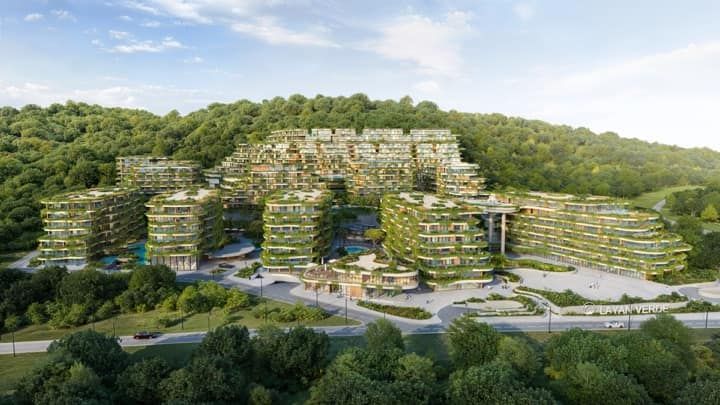
The only player in this ranking that closes the property’s entire life cycle inside one group: VillaCarte Group builds its own projects in Layan (Layan Verde with 774 residences and Layan Green Park, whose 248-unit phase 1 was delivered in 2024), sells them alongside partner projects across the island, and manages rentals after the deal through its own management company and rental pool. For a buyer this means three practical things. First, price: the work runs on direct agreements, so a unit costs the same as in the developer’s sales office. Second, data: matching is driven by the numbers in an in-house catalog of the island’s projects with price medians and declared yields — and you see the calculation before the deal, not after. Third, accountability after registration: the party that sold you a unit for rental income is the same party delivering that income — furniture packages, guest management, owner reports, plus a loyalty program with 15–25% discounts on the complexes’ services during your own stays. Buyer-side matching and support within the group is run by the Layan RE agency team: English, Russian and Ukrainian support and a full remote-deal cycle, from video tours to registration by power of attorney.
Best for: rental-income investors, west-coast buyers and anyone who wants one accountable party behind the matching, the construction and the rental — including fully remote deals.
2. Engel & Völkers Phuket
The local office of the global luxury network: premium villas and residences, international service standards, clients from around the world. Strong where a recognizable brand and deal confidentiality matter. The mass condo segment is not their field.
Best for: the luxury segment and cross-border buyers.
3. Knight Frank Thailand
An international consultancy with a long presence in Thailand: market analytics, valuation, institutional and private premium clients. The approach is more “banking” than resort.
Best for: buyers who value reports, valuation and institutional process.
4. Siam Real Estate
One of the island’s longest-established agencies with a large catalog across all areas and segments — from condos to villas. Breadth is the main advantage; depth in a specific district depends on the agent.
Best for: a first broad overview of the whole island’s market.
5. FazWaz
A property marketplace with Thailand’s largest listing coverage and an agent network. Convenient as a starting point for search and price comparison; deal support depends on the specific network agent.
Best for: independent market monitoring and initial shortlisting.
6. Lazudi
A tech-driven agency (Thailand and the region): clean search interface, pricing data, online processes. A young team with a tech approach; resort-market depth in Phuket is still growing.
Best for: buyers who value a smooth digital process.
7. Thai Residential
A Phuket-focused agency known for detailed guides for foreign buyers (ownership, taxes, districts). A good educational entry into the market plus tailored matching.
Best for: those starting by learning the market’s rules.
8. Tranio
An international overseas-property broker: Thailand is one destination alongside Europe and Asia. Strong in cross-border logic (taxes, transfers, country comparison); local Phuket depth comes through partners.
Best for: investors comparing Phuket with other countries.
4. Agency, portal or developer sales office
Buyers usually choose between three channels, each with its own mechanics.
The developer’s sales office knows its project perfectly — but only its own: no one there will tell you a competitor across the road is building at a better price per square meter. This channel works when you have already chosen the project and want to talk to the source.
A listing portal (FazWaz, DDproperty and the like) gives you breadth: thousands of listings, filters, price comparison. The weak spot is depth and freshness: some listings are stale, the advertised “price from” doesn’t always exist in current availability, and deal support depends on whichever network agent happens to pick up your request.
An agency with direct partnerships combines choice with accountability: the inventory comes from developer agreements (prices and availability are current), and one person runs the deal from reservation to registration. That is why our criteria put inventory source above catalog size: a hundred current units are worth more than ten thousand stale ones.
The working combination for most buyers: monitor the market on portals, run the deal through a specialized agency — and cross-check its price with the sales office directly.
5. Phuket’s agency market in 2026: what has changed
Three shifts define what a good agency looks like today. Remote deals became the norm: a significant share of buyers choose a unit via video tours and sign by power of attorney, so remote processes — from document checks to online construction reports — have moved from a bonus to a baseline requirement.
Data beat promises. The 2026 buyer arrives with Google open and looks at statistics, not brochures: agencies that publish real numbers — price medians, seasonal occupancy, honest yield math that accounts for vacancy and management fees — win trust over those promising a “guaranteed 10%”.
Rental management became part of the deal. An agent used to disappear after registration; now investors expect the sales channel to answer for the income too: rental pool, reporting, guest management. That structurally favors groups with their own management company — which is exactly why the vertical “developer + agency + management” model keeps gaining share against classic intermediaries.
6. Common buyer mistakes when choosing an agent
- Choosing by listing count. Thousands of properties in a catalog don’t mean the agent understands even one of them. Ask about a specific district: how many deals closed there in the past year, what the real seasonal occupancy is.
- Believing a “guaranteed yield” said out loud. A number without a model is marketing. Ask for the math: price, occupancy, management fee, low-season vacancy, taxes. How to do it honestly is in our breakdown of real rental yield.
- Working without checking partnerships. An agent who can’t show a developer agreement or the sales office’s direct contact may simply be reselling someone else’s listing with a markup.
- Paying a deposit before checking documents. “The unit is going, reserve today” is classic pressure. A day to verify the Chanote, permits and the reservation contract changes nothing for an honest deal — and everything for a dishonest one.
- Ignoring post-sale service. Who checks guests in, who fixes the air conditioner, who files the owner’s taxes? If the answer is “you’ll find someone”, cut the projected yield in half.
Mini-case. A typical scenario from our consultations: an investor picked a condo “with an 8% guarantee” on the advice of a generalist agent who vanished after the deal. The project turned out to have no management company, self-managed rental delivered half the promised occupancy, and the unit went up for resale eighteen months later at a discount. The parallel scenario — the same budget in a project with a working rental pool and reporting: duller on paper, but the income is real rather than promotional.
7. How to choose an agent
Three checks before you start. Partnerships: ask for confirmation of the developer agreement and the sales office’s direct contact — a reliable agent has nothing to hide, and most property scams are built on opacity. Specialization: an “island-wide” agent is worse than one who knows your district down to the specific construction phase — cross-check what they say against the buying process. Support: if you are buying remotely, make sure the process covers a remote deal through registration, and for investments — that yield is calculated with numbers, as in our breakdown of real rental yield.
We'll match a property to your goal — with direct developer prices, honest yield math and support through registration.
By submitting the form you agree to the privacy policy.
This material is informational; company profiles reflect public information at the time of publication — confirm terms directly when transacting.