Sooner or later every buyer of an expensive Phuket lot hits the same question: is the hotel name on the facade worth paying for? The price gap is visible to the naked eye, but it is usually discussed in feelings — “prestigious”, “safe”, “overpriced”. We measured it across our own catalogue of 348 projects — then controlled it by format, and the picture turned out more interesting than the head-on comparison.
The premium, measured
Figures as of 26 August 2026, produced by the same calculation published in the price index. The “branded” slice is our branded residences collection: 25 projects where the hotel operator is visible to the buyer and guest.
| Metric | Branded | Non-branded |
|---|---|---|
| Projects in the catalogue | 25 | 323 |
| Median entry price | $416,960 | $596,943 |
| Median $/sqm | $6,274 | $3,298 |
| Off-plan / completed | 13 / 12 | 202 / 121 |
A branded square metre costs 90% more. That is the head-on price of the brand — not a feeling, a catalogue median.
The second row contradicts intuition: the median entry price of branded projects is lower, $416,960 against $596,943. The explanation is format: operators sell compact units of an expensive metre — studios and apartments built for hotel-style rental — while the non-branded segment is pulled upwards by large villas. A brand does not always mean “more to enter”; it almost always means “more per metre”.
The honest correction: the premium within a format
The head-on 90% is a striking number, but it is partly explained by segment composition: the branded slice is heavy on seaside apart-hotels, the non-branded one on inland villas. The fairer comparison is metre against metre within one format:
| Format | Branded, $/sqm | Non-branded, $/sqm | Premium |
|---|---|---|---|
| Condos | $5,508 | $3,953 | +39% |
| Apart-hotels | $6,566 | $5,185 | +27% |
| Villas | $6,521 | $2,516 | +159%* |
*The villa sample is thin — only 4 branded villa projects in the catalogue, all luxury (Avadina Hills, Anantara Layan, Banyan Tree Grand, Angsana Villas), so the figure is more honestly read as “luxury versus the whole villa market” than as a pure brand premium.
The conclusion that survives the format control: a comparable branded metre costs a quarter to a third more than a non-branded one. The rest of the head-on 90% is the shape of supply. That is the working number for the decision: are you paying +27–39% for what is listed below?
What the premium consists of
The operator does not charge for a logo. Four concrete things sit inside that metre.
Construction and handover standards. The brand risks its name for decades ahead, so it audits the developer harder than any buyer could: staged supervision, finishing and engineering standards, chain-checklist handover. For an off-plan buyer this is a second control loop they could not organise themselves — a construction audit run by a party financially interested in the building meeting its standards.
The operator’s distribution. The unit enters the chain’s booking channels — the global site, loyalty programmes, corporate contracts. Occupancy depends less on how well a local developer can advertise, and the difference shows most in low season, when independent properties compete on discounts while chain properties hold their rate on a loyal audience.
Chain-standard management. Hotel service, common-area upkeep, tenant rotation, a renovation fund — things that in an ordinary condo depend on luck with the management company. Ten years on, the difference is physical: chain properties age slower, because the maintenance regime is part of the operator contract, not the goodwill of a local firm.
Exit liquidity. In the narrow market of expensive lots, the operator’s name is the thing the next buyer understands without explanations. The seller of a non-branded luxury home explains why the house is good; the seller of a Banyan Tree residence names the brand.
The brand map: all 25 projects
The full collection, grouped by operator, with developer prices as of this article. This is not a ranking: the projects are at different stages and serve different goals.
| Operator | Project | District | From | Stage |
|---|---|---|---|---|
| Banyan Group | Banyan Tree Grand Residences | Bang Tao | ~THB 87.8m | off-plan |
| Banyan Group | Banyan Tree Beach Residences Oceanus | Bang Tao | ~$5.68m | off-plan |
| Banyan Group | Angsana Beachfront Residences | Bang Tao | ~$2.85m | completed |
| Banyan Group | Angsana Oceanview Residences | Bang Tao | ~$1.76m | completed |
| Banyan Group | Angsana Villas | Bang Tao | ~$565k | completed |
| Banyan Group | Angsana Golf Residences Topaz | Bang Tao | ~$699k | off-plan |
| Banyan Group | Cassia | Bang Tao | ~$172k | completed |
| Banyan Group | Garrya Residences | Bang Tao | ~$484k | off-plan |
| Minor / Anantara | The Residences at Anantara Layan | Layan | ~THB 466m | completed |
| Minor / Anantara | Avadina Hills | Layan | ~$16.8m | completed |
| Minor / Anantara | Kiara Reserve | Layan | ~$1.32m | off-plan |
| Dusit International | Layan Verde | Layan | $235,995 | off-plan |
| Marriott Autograph | PEYLAA | Bang Tao | ~$230.9k | off-plan |
| IHG / InterContinental | The Residences at InterContinental | Kamala | ~$417k | off-plan |
| Accor / MGallery | MGallery MontAzure Lakeside | Kamala | ~$302k | off-plan |
| Twinpalms | Twinpalms Residences MontAzure | Kamala | resale from ~THB 18m | completed |
| Andara (the resort’s own brand) | Andara | Kamala | ~$1.74m | completed |
| Wyndham | Wyndham Grand Nai Harn | Nai Harn | ~$240k | completed |
| Wyndham | La Vita | Rawai | ~$154k | completed |
| Wyndham | Sea Heaven | Nai Thon | ~THB 3.92m | off-plan |
| Wyndham | Fantasea Chalong | Chalong | ~$84.5k | off-plan |
| Wyndham | Aceller Hotel & Residence | Chalong | ~$89.8k | off-plan |
| Wyndham / Registry | The Ozone Lagunia | Bang Tao | ~$129k | off-plan |
| Best Western | The Title V | Rawai | ~$125k | completed |
| Wyndham | Proud Residence | Karon | ~$148k | completed |
The entry spread runs from ~$84.5k to ~$16.8m — two hundred times between the extremes of one collection. Hence the table’s main takeaway: “branded residences” is not a price segment but a management-model segment. It contains luxury that competes with Aman-tier resorts and apart-hotels cheaper than the island’s median condo — the one thing they share is an operator with something to lose behind every unit.
Note also who is not in this table. The developer’s own Laguna-series projects (Laguna Park, Skypark, Lakelands) are excluded: Laguna is a developer brand, not a hotel operator, and those residences are managed like ordinary condos. That is precisely the line we draw between a branded residence and a famous name on a construction fence.
Geography: why half the brands sit in Bang Tao
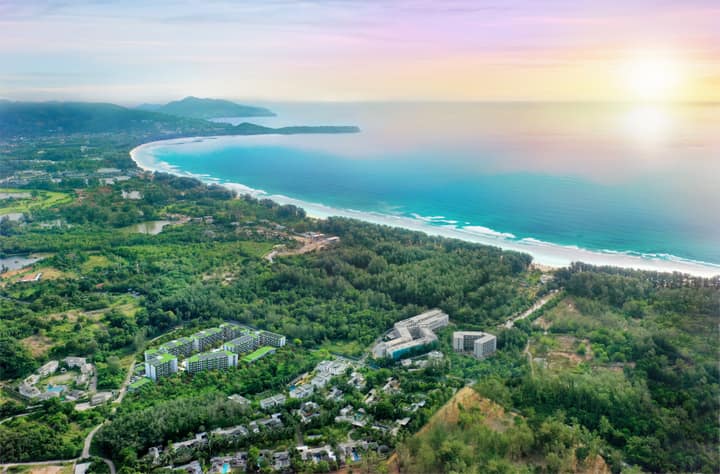
Ten projects out of twenty-five are in Bang Tao, and that is legacy, not chance. Laguna Phuket — Asia’s first integrated resort, built by Banyan Group on a former tin mine — spent thirty years drawing hotel chains to this corner of the island. The infrastructure that grew around it (Boat Avenue, schools, marinas) now attracts the next operators on its own: Marriott’s PEYLAA is launching here too.
The second cluster is Layan with four projects, including the island’s most expensive lots (Avadina Hills, Anantara Layan). The third is Kamala with its “millionaire’s mile” along the shore. The south (Rawai, Chalong, Nai Harn, Karon) is being developed by brands in a different genre: affordable apart-hotels under Wyndham and Best Western with entries below $250k — there the premium works for occupancy, not prestige.
The practical rule for an investor: in the west a brand amplifies an already expensive location; in the south it substitutes for one. A Chalong project gets booking channels from the Wyndham name that the district lacks on its own; a Bang Tao project adds brand premium to a market that already works.
Completed brand or off-plan with a brand
The segment splits almost in half: 12 completed projects against 13 off-plan. These are two different ways to buy the same premium, and the choice deserves to be conscious.
A completed branded project sells history. Cassia has years inside the Laguna pool, Andara has operated since 2009, Angsana Villas carries public ratings from thousands of guests. Here the premium can be verified before buying: request actual occupancy, past pool reports, read the reviews. You pay more, but you buy a confirmed cash flow — a rare luxury in a market where almost everything is sold on a forecast.
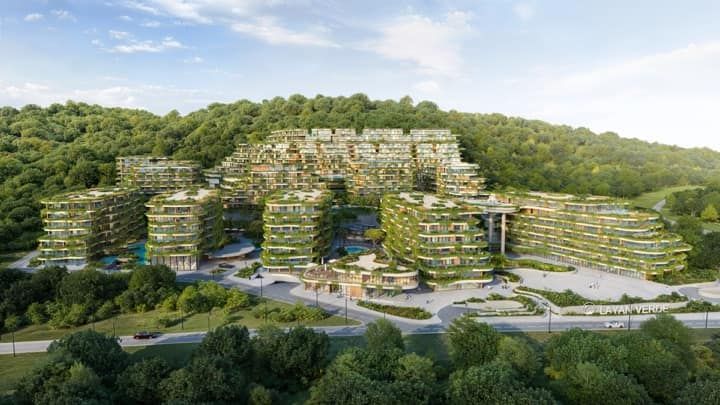
Off-plan with a brand sells two bets at once. The first is the usual construction bet: the price grows from groundbreaking to handover. The second is the brand bet: the operator is signed but the building is not yet delivered, and the market prices a contract cheaper than a working property. An example from our own portfolio: Layan Verde with Dusit International enters from $235,995 today, with a growth forecast of up to +45% by the December 2028 handover (Layan Real Estate’s own forecast for its own project, not a guarantee). Buying during construction gets you a branded metre at a non-branded price — if the construction reaches the finish line on schedule.
The off-plan risk in the branded segment is not the operator but the developer: a chain contract does not pour concrete. So developer due diligence matters more than the logo — the same checks as for any off-plan: delivered track record, financing, construction pace. The brand adds one plus: chains audit developers before signing, so the very fact of a Dusit or Marriott contract is somebody’s completed due diligence. Do not rely on it alone, but as a second filter it works.
The practical rule: for income from month one — a completed brand with history; for maximum delta — off-plan with a strong developer. Mixing the two strategies in one decision is the classic mistake: you cannot pay a completed project’s premium and still expect construction-stage growth.
When the premium pays back — and when it does not
There are two payback mechanisms: rent and resale. Neither works everywhere.
Rent pays the premium back where the operator genuinely delivers above-market occupancy and rates — check actual pool reports, not the brochure. Ask for numbers from operating phases: Cassia and Angsana Villas have years of history and public guest ratings; new projects have only a forecast.
Some branded projects back the forecast with a contractual guarantee for the first years: La Vita — 6% for 2 years, MGallery MontAzure — 6% for 3 years, Wyndham Grand Nai Harn — a programme with 7% for 5 years. A guarantee is not a gift: it is priced in, and the main question is what happens after it expires. But as a de-risking tool for the first years it works, and legally it is a different document from a “forecast”.
Resale pays it back in the segment where buyers look at brands at all — typically from ~$400k upwards. In the budget segment the name premium is easy to pay and hard to recover: a $150k buyer chooses on price, and on the secondary market your branded unit competes with the non-branded neighbour on that single criterion.
And the honest caveat we attach to every review: the entry premium is a fact, the payback is a forecast. Quoted yields of branded projects are developer and operator forecasts; across our catalogue the median of such forecasts is 6% a year, with a 3–15% range.
How the operator contract works
For the buyer, a “brand” is legally a stack of contracts, and they come in different strengths.
Management or franchise. The strong construction is a hotel management agreement (HMA): the operator runs the property with its own team and answers for the result with its reputation. Weaker is a licence on the name, where a local company manages “to the chain’s standards”: same name, different control. Ask directly which scheme your project uses.
Term and exit. Operator contracts are usually long — 10–20 years with renewals — but they contain termination clauses. What matters is what stays with the owners if the brand leaves: the building, the management company, the reserve fund — or only memories of a logo.
Who pays for the standards. Furniture packages to chain specification (FF&E), renovation-fund contributions, branding fees — these are the owner’s recurring costs, and they run higher than in an ordinary condo. Ask for the full fee schedule before the deposit: the brand premium lives not only in the price per metre but in the cost of ownership.
Cost of branded residence ownership in Phuket
The purchase price is only the first line of the ownership budget. A defensible comparison asks each project for the same schedule and separates costs that are paid once, every year, or only when the unit enters a rental programme. Amounts vary by operator and contract, so a project brochure without the underlying schedule is not enough evidence for a number.
| Cost layer | When it is paid | What to request before reservation |
|---|---|---|
| Purchase and transfer | At contract stages and transfer | Unit price, payment schedule, transfer-fee split, taxes and legal costs |
| FF&E package | During construction or before opening | Mandatory specification, replacement responsibility and whether it is included in the advertised price |
| Common-area fee | Recurring | Rate basis, budget, escalation rule and services included |
| Hotel or brand fee | Recurring or revenue-linked | Fixed and percentage components, calculation base and operator termination terms |
| Rental management | When the unit is rented | Revenue split, channel fees, owner-use restrictions and which operating expenses are deducted first |
| Sinking or renovation fund | Upfront and/or periodic | Initial contribution, planned refurbishment cycle and replenishment rules |
| Utilities, insurance and maintenance | Recurring and event-driven | Metering, insurance scope, in-unit maintenance and major-repair responsibility |
For two units with the same entry price, the one with the lower headline management percentage can still cost more if channel fees, FF&E replacement and owner-use restrictions sit outside that number. We therefore model the cash flow from the full documents, not from a quoted yield: purchase schedule, management agreement, fee table, rental-pool waterfall and the rules that apply after any guarantee expires.
The mistakes we see most often
Buying a “brand” out of a marketing brochure. A third of the false positives in our collection audit were projects where a hotel was mentioned in marketing, but no operator had signed for the residences. There is one criterion: an operator agreement covering your units.
Comparing a branded apart-hotel metre with a villa metre. They are different assets; the correct comparison is within a format, and it yields +27–39%, not +90%.
Reading a guarantee as a yield forever. 6–7% for the first years is a contract period; afterwards the unit lives on actual occupancy. The post-guarantee model is the main question to ask a project.
Ignoring the cost of ownership. Chain fees run higher. If the entry premium pays back through rent but ownership costs eat the difference — the maths did not work.
🔗 Related reads: Layan vs Bang Tao · Condo vs Villa · The rental management programme
How to verify a branded project: the checklist
- Is the operator agreement signed — and for what exactly: managing the residences, or only the hotel on site. Ask for the operator’s legal entity named in the contract.
- Management or a licence on the name. An HMA is stronger than a franchise: the operator answers with its own team, not somebody else’s “to standards”.
- What the operator guarantees versus forecasts. “A guaranteed 7% for 3 years” and “a 7% forecast” are legally different universes; ask for both documents.
- The owner’s full cost schedule. The FF&E package, renovation fund, chain fees — before the deposit, not after.
- What happens on termination. A brand can leave; what matters is what stays with the owners — standards, the management company, naming rights.
We run this verification for the buyer free of charge — as an agency we sell units at developer prices, and the developer pays our commission.