“I’ll buy a condo on Phuket — does that get me a retirement visa?” No: property and visa status are separate tracks. The Thailand retirement visa (legally the Non-Immigrant O or O-A category) grants long-term stay to those aged 50 and up, but it’s issued on age, money and insurance — not on owning a home. Here’s a breakdown of the requirements, amounts and renewal process for 2026, and how it fits together with buying a unit for the rental pool.
Contents
- Who qualifies for the retirement visa
- Non-O vs O-A: the difference
- Money: 800,000 THB or income
- Health insurance
- How to apply
- Extending in-country: TM.7 and the deposit “seasoning” rule
- 90-day reporting and re-entry permits
- Pitfalls: what most often goes wrong
- Mini case study: a Layan Green Park studio and the visa track
- Conclusion and next step
1. Who qualifies for the retirement visa
The only hard requirement on the applicant is being 50 or older at the time of application. “Retirement” is the category’s working name, not a requirement to be formally retired — it suits someone still working remotely for a foreign employer just as well as someone who simply wants to spend half the year on Phuket. Beyond age you need: a passport valid for at least 6 more months, a clean police record (for O-A), and either funds on deposit or qualifying income under one of the schemes below. The visa isn’t tied to nationality — it’s open to passport holders from most countries, including Russia, Ukraine and other CIS states.
2. Non-O vs O-A: the difference
In practice the “retirement visa” is obtained through two different tracks, and the choice changes both the paperwork and where you need to be when you apply.
| Parameter | Non-Immigrant O (retirement grounds) | Non-Immigrant O-A |
|---|---|---|
| Where it’s issued | Inside Thailand, as an extension of stay at an immigration office | At a Thai embassy/consulate abroad, in advance |
| Starting point | Entry on a regular tourist or 90-day non-immigrant visa | The visa itself is issued for 1 year before you fly out |
| Police clearance certificate | Not required | Required |
| Health insurance on entry | Not always formally required, but often requested by immigration | Mandatory — minimum $100,000 or 3,000,000 THB coverage |
| Best for | Those already in Thailand who’d rather not fly home for a visa | Those planning the move in advance, applying from their home country |
Both tracks converge on the same outcome — an annual extension of stay under the retirement criterion — but they start from different places.
3. Money: 800,000 THB or income
The financial threshold is the main entry barrier, and it’s identical for both categories:
- A deposit in a Thai bank account — 800,000 THB (~$23,880 at ~33.5 THB/USD).
- Verified income — from 65,000 THB a month (~$1,940): pension, rental income, salary — supported by an embassy income letter or bank statements.
- A combination — income plus a smaller deposit, as long as they add up to 800,000 THB over 12 months.
For a first application under the deposit route, the funds must have sat in the account for at least 2 months before you apply; for the annual renewal, at least 3 months. After the renewal is approved, the balance must stay intact for another 3 months before you can draw it down — while keeping the minimum balance until the next renewal cycle.
4. Health insurance
Requirements differ by visa type:
- O-A (applied for abroad) — insurance is mandatory under current embassy rules: minimum coverage of $100,000 or 3,000,000 THB per policy year, from an approved insurer.
- Non-O extended inside Thailand — there’s historically been no blanket formal requirement, but individual immigration offices increasingly ask for proof at renewal, and going without leaves you exposed to full cash rates at a private hospital in an emergency.
Practical takeaway: even where insurance isn’t strictly mandatory, budget for it — Thai private healthcare is built around insurance coverage, not out-of-pocket list prices.
5. How to apply
The process differs between the two tracks:
- O-A from abroad: assemble the package (passport, photo, medical certificate, police clearance, insurance policy, proof of funds) → submit it at the Thai embassy/consulate in your home country → receive a 1-year visa before you fly out.
- Non-O inside Thailand: enter on a tourist or 90-day non-immigrant visa on retirement grounds → 30–45 days before your current permission to stay expires, file for an extension of stay at your local immigration office (form TM.7) with your passport, photo, bank letter/income proof, and insurance if requested.
Either way, documents need to be recent: immigration only accepts bank letters and statements with a recent date, usually no older than a few days.
6. Extending in-country: TM.7 and the deposit “seasoning” rule
Once the initial status is granted, the ongoing process is an annual TM.7 renewal cycle. The key detail to track is the timeline for the funds in the account:
| Stage | Requirement on the 800,000 THB |
|---|---|
| First application (in-country or after entering on O-A) | Funds seasoned for at least 2 months |
| Annual renewal | Funds seasoned for at least 3 months before the application date |
| After the renewal is approved | Hold intact for another 3 months |
| Rest of the year | Spending is allowed as long as the minimum balance is kept until the next cycle |
Missing this timeline is the most common technical reason for a renewal to be refused: immigration checks the bank statement across the whole required period, not just the balance on the application date.
7. 90-day reporting and re-entry permits
Beyond the annual renewal, there are two ongoing, independent obligations:
- 90-day reporting — every 90 days you must report your current address to immigration: in person at an office, by post (allow 7–10 days for processing), or online via the immigration portal. Missing it means a fine and complications at your next renewal.
- Re-entry permit — if you need to leave Thailand (even for a weekend) without holding a multiple-entry visa, an extension of stay without a re-entry permit is automatically cancelled the moment you exit. The permit must be arranged in advance at immigration: roughly 1,000 THB for a single re-entry, roughly 3,800 THB for multiple re-entries covering the full visa period.
These are the two most common technical reasons people unexpectedly lose status they’ve held for years — not from a substantive refusal, but from a missed formality.
8. Pitfalls: what most often goes wrong
- Forgetting the re-entry permit before a trip home. The costliest mistake: the status is cancelled and the whole extension process has to restart.
- Drawing down the deposit too early. Withdraw part of it a month after renewal instead of waiting the required three, and the gap shows up on the next statement review.
- Outdated bank letters. Immigration only accepts recently dated statements — a letter collected “just in case” a month earlier may not be accepted.
- Mixing up the visa with the property purchase. Owning a freehold unit at Layan Verde or Layan Green Park doesn’t substitute for any of the visa criteria — these are two parallel, legally unrelated processes.
- Assuming automatic renewal. Every year you need to reassemble the package and file 30–45 days before expiry — the visa is never renewed “by default.”
9. Mini case study: a Layan Green Park studio and the visa track
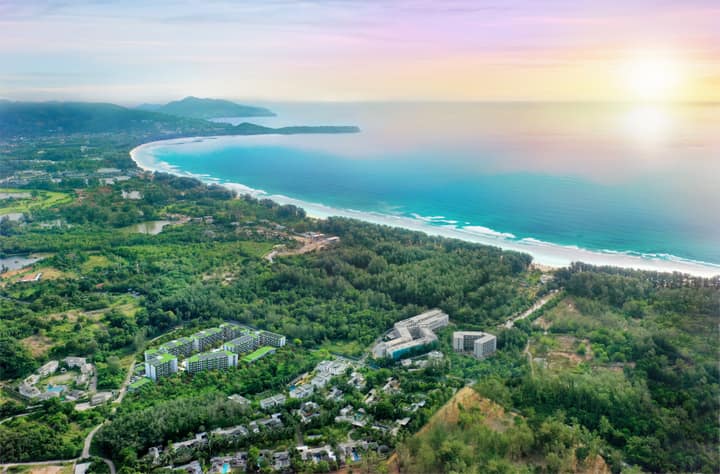
A buyer, 58, Russian national. Goal: spend 6–7 months a year on Phuket and let a management company handle the unit the rest of the time. He bought a completed studio in Layan Green Park phase 1 as a resale — the unit joined the rental pool immediately, with income under the 60/40 model (the owner receives 60% of the pool’s net profit) starting from the first season. In parallel, entirely separate from the purchase, he applied for Non-O on retirement grounds: entered on a 90-day visa, deposited 800,000 THB in a Thai account 2 months before applying, and secured his first TM.7 renewal. A visa agent under a separate contract handles his ongoing 90-day reports and re-entry permits for trips home — that’s not part of the developer’s or management company’s services. Both processes — the purchase and the visa — ran independently, but were timed to line up for a smoother move-in.
10. Conclusion and next step
Thailand’s retirement visa is a workable, predictable tool for anyone 50 and older, but it demands discipline: funds on schedule, recent documents, a TM.7 filed on time, 90-day reports, and a re-entry permit before every trip abroad. None of that is tied to a property purchase — but a comfortable, rental-ready unit near Layan Beach makes the day-to-day logistics of a long stay noticeably easier while the visa process runs. For transferring funds into a Thai account for the visa deposit, structure the currency transfer correctly — see our guide to the FET form; alternative visa categories for property owners are covered in our Thailand visa overview and the Thailand Elite article.
We’ll match a property to your visa track, run the numbers in the yield calculator, and recommend vetted visa agents — leave a request and the Layan Real Estate team will be in touch.
This material is informational only and is not legal or immigration advice. Visa requirements and amounts change periodically — verify current conditions with a Thai embassy or an accredited visa agent before filing.