“When will it be finished?” is the first question buyers ask about off-plan property, and one of the most underrated from a risk standpoint. The handover date determines when the asset starts earning income, how the installment schedule is structured, and how much the entry price is. Here is how construction unfolds in Thailand, how long it typically takes, and how to read timelines in a contract, using Layan Verde and Layan Green Park as examples.
Contents
- What “handover date” means in a contract
- Construction stages: from groundbreaking to keys
- How installments track the schedule
- Layan Verde: the timeline to 2028
- Layan Green Park: phase 2 and the phase-1 precedent
- Why timelines slip
- Condo vs villa vs condo-hotel: comparing timelines
- Buyer-side construction control: what to request at each stage
- Unit handover: what to check at delivery
- Seasonality, the calendar and the cost of a delay
- Pitfalls: what to check in the contract
- Mini case: early entry vs buying at handover
- Conclusion and next step
1. What “handover date” means in a contract
In Thai off-plan sale-and-purchase contracts, the completion date is the date by which the developer commits to finishing construction and delivering the unit to the buyer. Three distinct milestones are often confused:
- Building completion date — the operating permit is issued and common areas are finished.
- Unit handover date — the specific apartment is ready for inspection and acceptance.
- Rental launch date — the unit is registered in the rental pool and starts generating income.
Between the first and the third date, one to three months typically pass for inspection, furnishing, and operational launch. This is not a developer failure — it is a normal part of the process, and it belongs in any cash-flow projection.
2. Construction stages: from groundbreaking to keys
A standard multi-unit construction cycle in Phuket runs through the same stages, though the duration of each varies with project scale.
| Stage | What happens | Typical share of timeline |
|---|---|---|
| Site prep and foundation | Permits, pile field, groundwork | 15–20% |
| Frame and floors | Concrete works, the building rises | 35–40% |
| Facade and MEP | Glazing, electrical, plumbing, elevators | 20–25% |
| Finishing and landscaping | Interior finishes, landscaping, pools, amenities | 15–20% |
| Handover and launch | Operating permit, unit handover, pool launch | 5–10% |
The key takeaway for investors: the bulk of price appreciation happens in the first two stages, when buyer risk is highest — not at the end, once the project is visible and de-risked.
3. How installments track the schedule
Installment plans in Phuket almost always sync with construction: the closer to handover, the larger the payment. This protects both the developer (stage financing) and the buyer (paying for what is already visible).
Gardens of Eden’s schedule illustrates this: half the price is paid across construction stages, and the remaining 50% after the keys are handed over, in instalments over up to 3 years. This structure lowers the burden at the peak of the deal and lets buyers enter an operating asset without settling the full amount upfront.
4. Layan Verde: the timeline to 2028
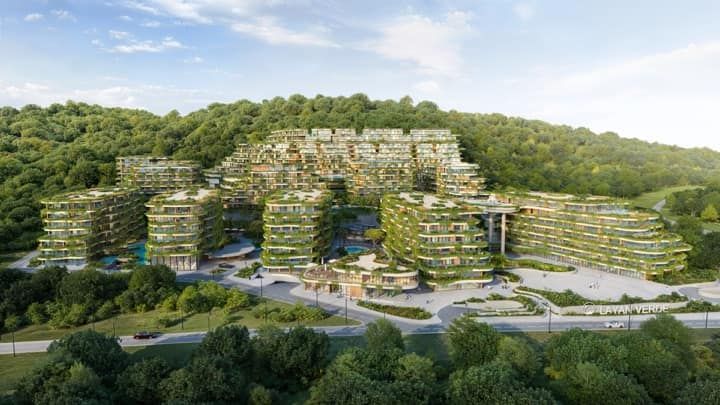
Layan Verde is a large-scale project of 774 residences on a 7.5-hectare plot, 700 m from Layan Beach, with handover planned for 2028. The scale explains the longer horizon: this is not a single phase of fifty units, but a full eco-district with multiple buildings, communal zones, coworking space, and a restaurant group.
The current price list from 01.09.2026: premium studios from 36.2 m² starting at 7,833,125 THB ($235,995, up from a launch price of $224,776), 1-bedrooms from $331,796, 2-bedrooms from $549,915, 3-bedrooms from $924,533, private-pool residences from $667,050, and penthouses up to ~$4.1M. Even at this early stage, studio prices have already climbed — the same “price rises as handover approaches” effect described in Section 2.
Compare premium top-floor inventory across the island in our Phuket penthouses and duplexes collection.
5. Layan Green Park: phase 2 and the phase-1 precedent
Layan Green Park is Phuket’s first eco condo-hotel with EDGE certification (up to 40% utility savings), 2 minutes from Layan Beach. Phase 1 (248 units) sold out from the developer, has operated since 2024, and appreciated roughly 100% from launch to handover — a full breakdown is in the sold-out phase-1 case study. Only resales are on the market now: studios from 30.3 m² starting at $142,602, 1-bedrooms from $271,554, 2-bedrooms from $492,876, 3-bedrooms from $841,599.
Phase 2 (296 units) is under construction with handover in 2026; per the 01.09.2026 price list, studios from 36.7 m² starting at $224,043, 2-bedrooms from 55.6 m² starting at $348,968 and duplexes from $1,115,354 are available. For a phase-2 buyer, the handover date is not an abstraction — the neighbouring phase 1 already operates, pays owners through the pool, and confirms the developer delivers on schedule.
6. Why timelines slip
Even reliable developers can see timelines shift. The main causes worth understanding upfront:
- The rainy season. May–October slows some exterior works — experienced developers build this into the schedule, but the buffer is not unlimited.
- Materials and equipment supply. Elevators, MEP systems, and facade materials are often imported — logistics add unpredictability.
- Buyer-requested changes. Finish customization or layout changes delay specific units, not the whole complex.
- Permitting procedures. The final operating permit is a separate step after physical construction ends, and it also takes time.
None of these factors automatically signals a problem — but each is worth confirming with the developer and checking against their track record on prior phases: see how to choose a developer and developer red flags.
7. Condo vs villa vs condo-hotel: comparing timelines
| Property type | Typical build time | Schedule characteristic |
|---|---|---|
| Villa on an individual plot | 12–18 months | Faster, but depends on a single contractor |
| Condo complex (multiple buildings) | 24–42 months | Longer, but phased and lower-risk |
| Condo-hotel with an operating model | 24–30 months | Plus an operational launch after handover |
A condo-hotel like Layan Green Park adds one more stage to the construction timeline — setting up the operating model and rental pool, since income starts not at key handover but after the management company launches.
8. Buyer-side construction control: what to request at each stage
An off-plan buyer does not run the construction site, but can and should monitor it — especially from another country. The logic is simple: every installment is tied to a stage, so before every installment you have a legitimate reason to ask for proof that the stage is actually complete. Below is what to ask for and which answers should raise a flag.
| Stage | What to request from the developer | What should raise a flag |
|---|---|---|
| Before the contract | Land title document (chanote), building permit, status of project approvals, track record of previous phases and projects | Appeals to “trust us” without documents; land held by an entity other than the developer with no clear structure |
| Foundations and groundworks | Dated photo and video report, confirmation that piling is complete before the “stage” installment | Undated reports or a single camera angle; a request to pay the next installment “in advance” |
| Structure and floors | Monthly progress on the building where your unit sits, compared against the schedule in the contract | Your building falling behind with no explanation and no written revision of the schedule |
| Façade and MEP | Specification of materials and equipment (lifts, air conditioning, windows) checked against the brochure | Brands and materials swapped for “equivalents” without notice |
| Finishing and landscaping | Finish samples, a show unit or a completed unit to inspect; status of common areas and pools | Finished apartments with unfinished infrastructure: you can move in, but you cannot live there or let it out |
| Handover | Certificate of occupancy, inspection date, procedure for fixing defects | Signing the handover act “before inspection” or without a defect list |
Three practical rules. First, ask for reports on your building, not the project as a whole — in multi-phase districts the buildings move at different speeds. Second, keep all correspondence about deadlines in one place — in a dispute over a delay, what counts is the developer’s written notices, not memory. Third, check every installment against the contract, not against a manager’s reminder: a “stage” payment is due only after the stage is confirmed. How reservation and the first payments work is covered in deposits and reservation in Thailand and ways to pay for property in Phuket; title verification is in how to check a chanote.
For a remote buyer all of this is done by an agent on the ground: visiting the site, filming progress on your building, checking documents before each installment. How to organise that without flying in is covered in buying property in Phuket remotely.
9. Unit handover: what to check at delivery
Building completion and unit handover are two different events (see section 1), and the second is when the buyer first sees the result in person. Handover is not a formality: once the act is signed, defects are harder to get fixed, and putting a unit into the rental pool with unresolved snags pushes the first income back. The full step-by-step list is in our separate Phuket property handover checklist; here is the backbone of the process.
Documents you should have in hand at handover:
| Document | Why you need it |
|---|---|
| Certificate of occupancy for the building | Confirms the property is legally complete, not “almost ready” |
| Sale and purchase agreement with the unit specification | The reference for checking floor area, layout, finishes and fit-out |
| Unit plan with dimensions | Comparing actual floor area with the contractual one — discrepancies are governed by the contract terms |
| Handover act and defect list (snag list) | Records the condition at handover and the developer’s obligation to fix defects |
| Documents for registration of title | Transfer of ownership or a long lease is registered at the Department of Lands — without that step you own a contract, not a unit |
| Condominium rules and the management agreement | Terms of use, common-area fee, procedure for joining the rental pool |
What to check physically. Finishes (walls, floors, joints, doors), services (water, pressure, drainage, electrics, sockets, air conditioning, hot water), windows and glazing (watertightness — critical in the rainy season), sanitaryware and built-in furniture, fit-out against the specification. Every snag goes on the list with a photo and a date; the deadline for fixing it is the one written in the contract, not a verbal one. If the unit comes with a furnishing package for letting, check its contents too — see furnishing packages in Phuket.
What happens after handover. Registration of title at the Department of Lands, setting up utility accounts, handing the unit to the management company and enrolling it in the rental pool. As noted in section 1, this takes one to three months — build it into your cash-flow model as the norm, not as a delay. Taxes and fees at registration are a separate topic, covered in property taxes in Thailand.
10. Seasonality, the calendar and the cost of a delay
A Phuket completion date should be read alongside the island’s calendar. Two seasons directly affect both the construction and the economics of the unit:
- the rainy season (May–October) slows external works — façade, roofing, landscaping; experienced developers build this into the schedule;
- the high season (November–April) is the peak of rental rates and occupancy, i.e. the bulk of the year’s income for a unit in the pool.
The practical conclusion: a handover scheduled for autumn gives you a chance to have the unit letting by the high season, while a three-to-six-month delay can push the first income a whole season forward. How the seasons affect occupancy is covered in Phuket’s rainy season and rental seasons and occupancy.
What a delay costs. Let us run the numbers from this article. A Layan Green Park phase-2 studio at the 01.09.2026 price list is $224,043; the rental-pool yield benchmark is ~8–10% net a year, i.e. roughly $17,900–22,400 a year.
| Delay in starting rentals | Forgone income (benchmark) | Comment |
|---|---|---|
| 3 months | ~$4,500–5,600 | Usually falls within the contract’s grace period — no compensation |
| 6 months | ~$9,000–11,200 | Upper end of a typical grace period; beyond it, contractual compensation should kick in |
| 12 months | ~$17,900–22,400 | A full annual cycle lost, including one high season |
These figures are arithmetic from the yield benchmark, not a forecast for a specific unit: the actual result depends on which season the launch lands in and on occupancy. But the scale is clear: a delay within the grace period is thousands of dollars the investor absorbs alone, so a reserve for it should be planned in advance rather than left to hoped-for compensation. By contrast, post-handover installments work the other way — they let you pay part of the price out of the unit’s income; how such plans are structured is covered in post-handover payment plans in Phuket.
11. Pitfalls: what to check in the contract
- No grace period. The contract should explicitly state the allowed delay (usually 3–6 months) and what happens once it is exceeded.
- A vague “handover date.” Clarify whether it refers to building completion, unit handover, or rental launch — these are different dates, see Section 1.
- Installments not tied to construction stages. If the payment schedule is disconnected from actual construction progress, that warrants further questions to the developer.
- No photo or video progress reports. Reliable projects publish regular progress updates — their absence is worth asking about directly.
- Skipping due diligence. Before signing, verify the title, permits, and developer reputation — see the due diligence checklist.
- Paying a “stage” installment before the stage is confirmed. The installment schedule protects the buyer only when every payment follows verified progress — require a dated report on your building before transferring.
- Signing the handover act without a defect list. A signature without a snag list is acceptance of the unit “as is”; record every defect with a photo and the contractual deadline for fixing it — see the handover checklist.
12. Mini case: early entry vs buying at handover
An investor is weighing two options in Phuket in September 2026: a Layan Green Park phase-2 studio at $224,043 (36.7 m², 2026 handover, stage-based payments) or a completed phase-1 resale studio at $142,602 with a smaller footprint, already in the rental pool. The first option bets on repeating the phase-1 scenario (~100% growth to handover) at a lower entry threshold thanks to installments. The second delivers income from month one (~8–10% net annual via the rental pool, where the owner receives 60% of net pool profit) with zero construction risk, but at a price that already includes past growth. Both scenarios are viable — the choice depends on the investor’s horizon and willingness to wait for handover. Run the exact numbers for your budget in the yield calculator.
13. Conclusion and next step
The handover date is not a formality in a contract — it is the parameter that drives the entry price, the installment schedule, and the moment income begins. Large-scale projects like Layan Verde have a longer horizon (2028); compact phases like Layan Green Park have a shorter one (2026); but in both cases price rises as completion approaches, and payback through the rental pool targets roughly 12 years at ~8–10% net annual yield.
I’ll send the current construction schedule, installment status, and a yield calculation for your budget — leave a request or explore the VillaCarte Group page.
This material is informational only and is not legal advice, a public offer, or investment advice. Timelines, prices, and installment terms are as of 01.09.2026 — verify at the time of the deal.