While Phuket’s west coast fills up with hotels and beachfront villas, a different Phuket lives in the center of the island — administrative, business-driven and historic. Phuket Town is the old city with Sino-Portuguese architecture, government offices, hospitals and the island’s most affordable property. There’s no beach on the doorstep, but there is city life and steady demand for long-term rentals. Here’s who buying in the old town suits, and how this economy differs from the resort west.
Contents
- What Phuket Town is, and who it suits
- The old town: Sino-Portuguese heritage
- New Phuket Town: the Bypass Road and malls
- Who lives here
- Infrastructure: hospitals, schools, government offices
- The property market
- Rental: a long-term economy instead of tourist flow
- Logistics
- Comparing with other areas
- Pitfalls
- Mini case and takeaway
1. What Phuket Town is, and who it suits
Phuket Town is the provincial administrative center: government offices, the island’s largest hospitals, courts, banks and most of the office-based business are here. It’s the only major area on Phuket without a tourist beach of its own — the sea is closer to Chalong and Rawai in the south, 15–20 minutes away.
Who buying here suits:
- Anyone looking for the most affordable entry into the island’s property market — prices here are noticeably lower than anywhere on the resort coast.
- Buyers targeting long-term rental to local professionals, university students, hospital staff and office workers.
- Expats and digital nomads who work on the island rather than vacation there — infrastructure and logistics matter more than a sea view.
- Not for anyone counting on tourist-driven yield — for that, look at Layan or Bang Tao on the west coast instead.
2. The old town: Sino-Portuguese heritage
Phuket Town’s historic center took shape in the 19th and early 20th century around the tin-mining business: Chinese entrepreneurs built houses in a style blending southern Chinese and Portuguese (via Malacca and Penang) traditions — colonnades, shutters, inner courtyards. Thalang Road, Dibuk Road and Krabi Road preserve this architecture almost untouched.
Today the old town is museums, art cafés, boutique hotels in restored shophouses and a Sunday Walking Street with street food and craft stalls. The atmosphere is closer to a historic Asian city center than a beach resort — a distinct pocket of demand that doesn’t overlap with the west coast’s beach tourism.
3. New Phuket Town: the Bypass Road and malls
Beyond the historic quarter, the city grows along the Bypass Road: modern malls Central Phuket and Central Floresta, supermarkets, chain restaurants and new residential complexes are concentrated here. It’s effectively a second, modern layer of the city on top of the historic one.
For a buyer, that means a choice between two different formats within the same area: the atmospheric but older housing stock of the historic center, or modern condos near the Bypass Road with developed infrastructure but no historic character.
4. Who lives here
Phuket Town’s audience is primarily local: civil servants, doctors and hospital staff, faculty and students of Prince of Songkla University’s Phuket campus, office and mall employees. It’s the island’s most densely populated area by local residents.
Among expats, the city is popular with those who work on Phuket full-time rather than come to vacation: remote employees, small-business owners, international-school teachers. Unlike the tourist areas of the west, this creates steady year-round housing demand that doesn’t depend on the high and low tourist seasons.
5. Infrastructure: hospitals, schools, government offices
By density of urban infrastructure, Phuket Town leads the island: the largest hospitals (the public Vachira Phuket Hospital and the private Bangkok Hospital Phuket), courts, the immigration office, every major bank, the large malls Central Phuket and Central Floresta, markets and hundreds of local cafés.
There are fewer international schools in the city itself than on the west coast — people head toward Kathu or the west of the island for those. Island-wide logistics are covered in how to get around Phuket.
6. The property market
Phuket Town is the most affordable segment of the island’s market by entry price. Supply splits into three groups:
| Segment | Location | Entry price |
|---|---|---|
| Studios and 1-bedrooms in new builds | Near the Bypass Road, closer to Central Phuket | from ~$50,000–60,000 |
| Mid-range modern condos | Central and surrounding areas | from ~$70,000–90,000 |
| Restored shophouses | Historic center | from ~$150,000 |
The key reason for the affordability is the absence of a sea premium: buyers pay for urban infrastructure and logistics, not for a view or a beach. That makes Phuket Town the lowest-budget entry point on the whole island.
7. Rental: a long-term economy instead of tourist flow
Phuket Town’s rental economy works differently than the resort west. Demand is mostly long-term: students, doctors and hospital staff, civil servants and remote-working expats rent for 6–12 months or longer. Rates are lower than short-term tourist rental on the beaches, but so is vacancy — units rarely sit empty between tenants, and seasonality is weak.
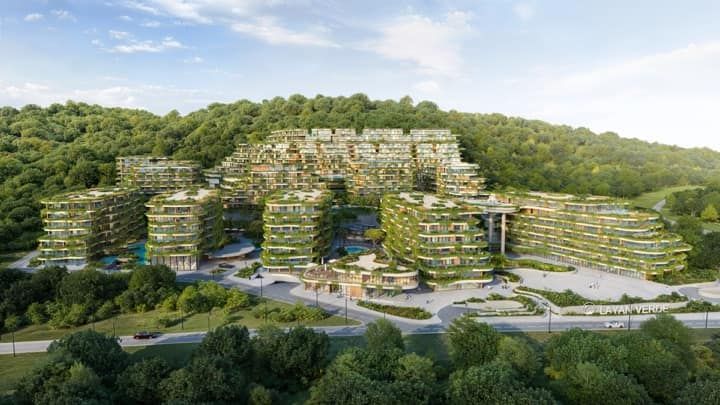
There’s no single managed model comparable to the resort west here: owners rent directly or through local agencies, and reporting and occupancy aren’t standardized. By comparison, projects up north run a transparent rental pool: the already-operating Layan Green Park, Phuket’s first eco condo-hotel with EDGE certification, pools similar units together and pays the owner 60% of the pool’s net profit — a benchmark of ~8–10% net per year, with payback around 12 years. The under-construction Layan Verde will follow the same model: 774 residences on 7.5 ha, 700 m from Layan beach, delivery in 2028. It’s a fundamentally different product: not budget long-term rental to locals, but tourist income with transparent reporting across the whole complex. Run your own scenario in the yield calculator.
8. Logistics
Phuket Town sits in the southeastern part of the island, closer to the south than to the west coast beaches:
- Chalong and Rawai to the south — 15–20 minutes.
- Kata and Karon — 20 minutes, Patong — 20–25 minutes.
- Kamala and Surin — 30–35 minutes.
- Layan and Bang Tao up north — 35–40 minutes.
- The airport — about 30–35 minutes depending on traffic.
It’s a fairly central point on the island with even access in almost every direction — a trade-off between being close to any beach and having none of its own.
9. Comparing with other areas
| Criterion | Phuket Town | Patong | Layan (north) |
|---|---|---|---|
| Character | Administrative and business hub | Tourist hub, nightlife | Quiet, growing resort |
| Entry price | From ~$50,000 | From ~$70,000 | Mid, thanks to new builds |
| Beach | None, nearest 15–20 min away | Its own, touristy | Its own, calm |
| Rental audience | Locals, remote-working expats | Short-term tourists | Tourists via managed pool |
| Rental model | Long-term, self-managed | Fragmented, no pool | Rental pool, ~8–10% net |
| To airport | ≈30–35 min | ≈45–50 min | ≈20–30 min |
A full overview of every area on the island is in where to stay in Phuket.
10. Pitfalls
- Expecting tourist-level yield from a property in the city. The main tourist flow heads to the west coast beaches — long-term rental is more reliable in Phuket Town than short-term tourist letting.
- Buying a shophouse in the historic center without checking the structure’s condition. Old buildings require restoration under heritage-preservation rules — repairs and approvals cost more than for an ordinary condo.
- Confusing “cheap” with “liquid.” A low entry price doesn’t always mean an easy resale — demand for city properties comes mostly from local buyers and tenants, not foreign investors.
- Not checking a specific building’s transport access. The city stretches between the historic center and the Bypass Road — distance to a hospital, school or mall can vary by 15–20 minutes within the same area.
- Comparing city yield directly with a resort rental pool. These are different models with different audiences — see self-managed rental vs. a management company for how to compare approaches.
11. Mini case and takeaway
Mini case. An investor with a $60,000 budget compared a studio near Phuket Town’s Bypass Road with a smaller resale studio in Layan Green Park phase 1. The city studio was rented to a nurse from the local hospital on a year-long contract, delivering a stable but modest ~5–6% net yield with no management overhead. The Layan Green Park unit required a higher entry budget but went straight into a working rental pool with a ~8–10% net benchmark and reporting across the whole complex. The investor kept both in the portfolio: the city for stability and a low entry point, the north for higher, transparent yield.
Takeaway: Phuket Town isn’t a resort investment — it’s a bet on the island’s urban economy: the most affordable entry point, steady demand from locals and remote-working expats, and no tourist seasonality. For yield comparable to a managed pool, it makes more sense to compare the city with projects up north, in Layan, where the rental-pool model already runs and is backed by reporting.
We’ll help you find the right fit — from a budget studio in Phuket Town for long-term rental to a rental-pool unit in Layan for tourist income. Browse the project portfolio at VillaCarte Group or leave a request below.
Find the right property in Phuket Town or up north
By submitting the form, you agree to the privacy policy.