“Where to stay in Phuket” is a question with no single right answer: it differs for a tourist on a two-week trip, a digital nomad staying half a year, a family with children, and an investor renting out a unit through a management company. The island stretches roughly 48 km north to south, and the difference between areas is a difference in price, infrastructure, quiet and rental audience. This guide covers all the key locations in Phuket — from the quiet north near the airport to touristy Patong and local Phuket Town — explaining who fits where.
Contents
- How to choose an area for your goal
- Layan — quiet premium on the beachfront
- Bang Tao and Laguna — the biggest resort hub
- Surin and Kamala — premium and family growth
- Naithon and Nai Yang — quiet near the airport
- Patong — tourism and nightlife
- Rawai and Nai Harn — the south, for living
- Phuket Town and the east coast
- Comparing the areas
- Pitfalls of choosing an area, and a mini case
1. How to choose an area for your goal
Before comparing beaches and prices, define your profile:
- Tourist for 1–3 weeks — proximity to entertainment and restaurants matters, the specific beach is secondary.
- Digital nomad / long-stay — coworking spaces, internet, cafés, the ability to live without a car.
- Family with children — international schools, pediatrics, a calm beach, safety.
- Retiree / long-stay 50+ — quiet, healthcare, community, minimal stairs and noise.
- Investor renting out a unit — the area itself matters less than yield, occupancy and resale liquidity.
Below are five criteria for any profile: the beach and water, infrastructure, quiet vs. activity, distance from the airport, and entry price. For more on island logistics, see how to get around Phuket.
2. Layan — quiet premium on the beachfront
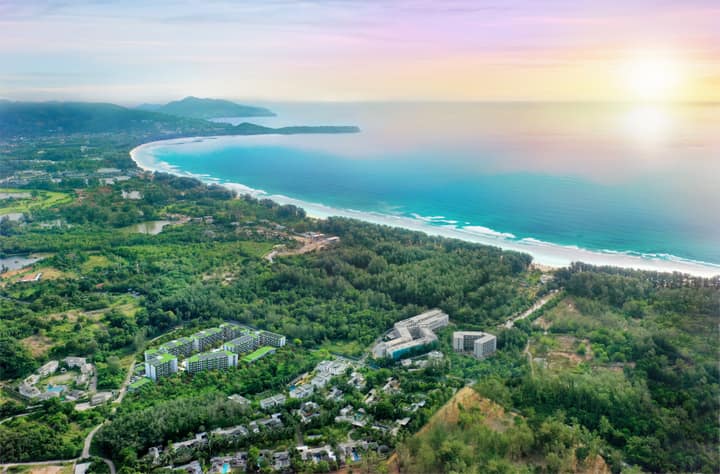
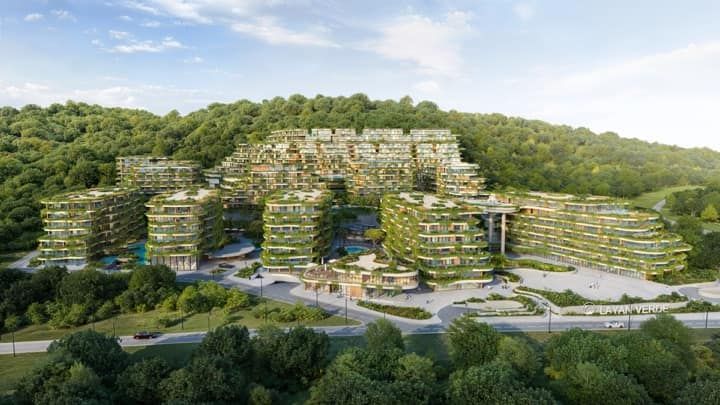
Layan is the northernmost part of the west-coast premium strip: one of the cleanest and least crowded beaches on the island, minimal dense development, a growing new-build market. Layan Verde is under construction here — a self-contained eco-district on 7.5 ha, 700 m from the beach, 774 residences, delivery in 2028 — and Layan Green Park is already operating: Phuket’s first eco condo-hotel with EDGE certification (up to 40% savings on utilities), 2 minutes from the beach.
Pros: privacy, upside potential in new-build value, clean water. Con: infrastructure (shops, restaurants) is still developing — for a fuller service scene people head to neighbouring Bang Tao. See the Layan area page and the comparison Layan or Bang Tao for more.
3. Bang Tao and Laguna — the biggest resort hub
Bang Tao is the most developed resort cluster on the west coast: the Laguna complex with a golf course, Boat Avenue with restaurants and shops, international schools, clinics, international hotel brands. Infrastructure here works year-round, not just in season — that delivers steady rental demand.
The upside for an investor: predictable occupancy and a clear audience — families, mid-to-high budget couples, long-stay guests. The downside: finished-property prices are higher than in growing Layan next door. See the Bang Tao area page and the best west-coast beaches review.
4. Surin and Kamala — premium and family growth
Surin is one of Phuket’s most prestigious beaches, nicknamed the “millionaire’s beach” for its status and beachfront villas: premium developments, a high rental ticket, but also a high entry threshold.
Kamala is a calm family area between Surin and Patong with growing infrastructure. Cheaper than Surin, but with noticeable demand growth in recent years — a balance of price and upside for families and long-stay guests. See the direct comparisons Kamala or Bang Tao and Surin or Layan.
5. Naithon and Nai Yang — quiet near the airport
Naithon and Nai Yang are the northernmost part of the west coast, closest to the airport (10–15 minutes). The beaches are less developed and almost free of beachfront construction, infrastructure is minimal — a couple of cafés and mini-marts instead of a restaurant cluster.
Who it suits: people who value quiet over service, fly often and don’t want to lose time on airport transfers, and investors eyeing an area at an early growth stage. The downside — for full infrastructure and active nightlife you still need to drive south, to Bang Tao or Patong.
6. Patong — tourism and nightlife
Patong is the centre of mass tourism and nightlife in Phuket: Patong beach, Bangla Road, the highest density of hotels, bars and restaurants. For short-term rental this delivers the highest occupancy on the island year-round.
For living and family long-stay the area suits less well: noise, dense traffic, a tourist rather than calm urban environment. For an investor it’s a workable option for short-term daily rental, but with a narrower, more specific buyer audience on resale than the western premium areas.
7. Rawai and Nai Harn — the south, for living
The south of the island — Rawai and Nai Harn — is valued for its expat community, calm atmosphere and more affordable rental and purchase prices than the west coast. There’s less mass tourism here, more local cafés, yoga studios and coworking spaces for those living in Phuket long-term.
The downside is distance: from the airport to the south is about 50–60 minutes depending on traffic, and to the west-coast premium beaches, 25–40 minutes. A good choice for those who value lifestyle over airport proximity.
8. Phuket Town and the east coast
Phuket Town is the old town with Sino-Portuguese architecture, local markets and the most affordable long-term rental on the island. There’s no sea outside the window, but there’s urban life, cafés and proximity to hospitals and government offices — a typical choice for people who work on the island rather than vacation there.
The east coast (Panwa, Koh Kaew) has quiet bays, marinas, and views of the mainland instead of open sea. Less tourist rental demand, but lower prices and a calmer atmosphere for your own life rather than for renting out.
If boating is part of daily life, compare Phuket property near marinas and yacht clubs.
9. Comparing the areas
| Area | Audience | Beach | Infrastructure | Who it suits |
|---|---|---|---|---|
| Layan | Privacy, investors | Clean, uncrowded | Growing | Quiet + capital growth |
| Bang Tao | Families, long-stay | Developed, wide | Maximum (Laguna) | Steady income and service |
| Surin | Premium | Prestigious | Pockets of premium | Status, high ticket |
| Kamala | Families | Calm | Growing | Balance of price and growth |
| Naithon/Nai Yang | Quiet, early entry | Uncrowded | Minimal | Airport proximity |
| Patong | Tourists | Mass tourism | Maximum (tourist) | Short-term rental |
| Rawai/Nai Harn | Expats, community | Calm | Local | Lifestyle, budget |
| Phuket Town | Local residents | No sea | Urban | Budget, working on the island |
| Island belt | Entry price benchmark | Rental yield* | Time to airport |
|---|---|---|---|
| West-premium (Layan, Bang Tao) | From $150,000 (new builds) | ~8–10% net | 20–30 min |
| West-status (Surin) | High | High ticket, niche demand | 25–35 min |
| North (Naithon, Nai Yang) | Below average | Still forming | 10–15 min |
| South (Rawai, Nai Harn) | Affordable | Average, local market | 50–60 min |
| Phuket Town / east | Most affordable | Low for short-term rental | 25–45 min |
*Benchmark net yield via the rental pool program (the owner receives 60% of the pool’s net profit); payback on the west coast is around 12 years. Exact yield depends on the specific property and occupancy. Run your own scenario in the yield calculator.
10. Pitfalls of choosing an area, and a mini case
Common mistakes when choosing an area:
- Chasing the lowest price. A cheap entry point often means weak rental demand and lower resale liquidity.
- Ignoring the audience. Patong and Layan are different rental models with completely different guests; confusing them means losing money on management.
- Judging by peak season. Occupancy and yield should be assessed on a year-round average, not the high season.
- Forgetting about logistics. An hour to the airport or to the nearest supermarket is a real downside for long-term living, even with a perfect beach nearby.
- Not checking who manages the asset. For an investment goal, the area matters less than the villa vs. condo format and the rental management program.
Mini case. Three different buyers choose three different areas. A family with children relocating permanently chooses Bang Tao — for the international school and clinics within walking distance. A digital nomad staying six months rents a studio in Kamala — calm, but close to the cafés and coworking spaces of Surin and Patong. An investor who wants to enter a new build at launch and expects the value to grow by handover buys a studio in Layan — banking on ~8–10% net yield once the rental pool starts.
Bottom line: there is no single “best” area in Phuket — there’s an area for a specific goal. For income and service, the west with mature infrastructure (Bang Tao, Surin); for capital growth, new builds in the north of the west coast (Layan); for lifestyle on a budget, the south and Phuket Town.
We’ll help you pick an area and a specific unit for your goal, budget and strategy — from a studio in the rental pool to a villa for your own use. Browse the project portfolio at VillaCarte Group or leave a request below.
Find an area and unit for your goal
By submitting the form, you agree to the privacy policy.