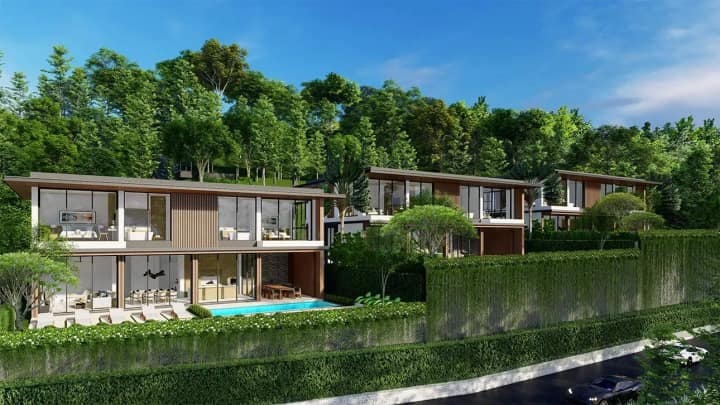
“I want a villa with a pool” is close to a universal buyer request in Phuket. But a private pool is not just a pretty detail in the listing photos — it’s a concrete line item in the purchase price, and a concrete line item in monthly costs. Let’s break it down by numbers: how much a pool adds to the purchase price, how much it lifts the nightly rental rate, what it costs to maintain the pool — and when it makes more sense not to build or buy a standalone villa but to take a unit with a private pool inside a managed complex instead.
Contents
- Why count the pool premium separately
- How much a pool adds to the purchase price
- How much a pool adds to rental income
- The cost of maintaining a private pool
- Payback on the pool premium
- The alternative: a private pool in condo format
- Pool villa vs pool condo
- Pitfalls
- Mini case study
- Conclusion and next step
1. Why count the pool premium separately
Sellers and developers almost never break a villa’s price down into “the house” and “the pool” separately — it’s always one combined figure. But for an investor the distinction matters: part of the pool premium gets paid back through a higher rental rate, and part just raises the entry ticket without a proportional lift in income. Run the villa’s yield calculation without separating these lines and it’s easy to overpay for a pool that looks great in photos but rents poorly.
The starting point for the calculation is the general yield methodology covered in how to calculate ROI in Phuket; here we apply it specifically to the “pool” variable.
2. How much a pool adds to the purchase price
The pool’s size, finish (tiling, infinity edge, heating), the plot area it takes up, and the location all feed into the price premium — beachfront and hillside sea-view properties usually carry a higher pool premium than inland locations.
| Factor | Effect on the premium |
|---|---|
| Pool size and shape (lap pool vs full-size) | Bigger, more “photogenic” pools carry a higher premium |
| Infinity edge / sea view | Meaningfully raises the premium, especially on the Layan and Surin hillsides |
| Finish (tiling, lighting, heating) | Moderate contribution, but noticeable in listing marketing |
| Location (beachfront vs inland) | Beachfront pool premium is higher than in inland areas |
| Ready-built vs newly built | A fresh pool with no wear commands more than a worn one |
Based on market observation in Phuket, a villa with a private pool typically costs roughly 15–30% more than a comparable house on the same size plot without one — the spread is wide precisely because of the factors above. The broader pricing context is covered in Thailand property prices by region.
3. How much a pool adds to rental income
For renters, a private pool is one of the first search filters on booking platforms, right alongside bedroom count and beach distance. A house without a pool competes on price; a house with a pool competes on the quality of the stay.
Key effects:
- Nightly rate. A villa with a private pool typically charges 20–40% more per night than a comparable villa without one in the same area.
- Booking conversion. On booking platforms the “private pool” filter is often switched on by default — a villa with no pool physically drops out of part of the search results.
- Guest segment. A pool attracts families with children and groups seeking privacy, not just beach proximity — the same premium segment described in villa rental yield in Phuket.
But a higher rate isn’t the same as higher net yield: part of that rate increase gets consumed by upkeep, covered next.
4. The cost of maintaining a private pool
A private pool is a separate, ongoing cost line that falls entirely on the villa owner (unlike a shared pool in a condo complex, where costs are split across all units through the management company):
| Cost item | Frequency |
|---|---|
| Chemicals and water balancing | Regular, often weekly |
| Cleaning the pool and skimmers | Regular |
| Pump and filter servicing | Regular, plus periodic repairs |
| Heating (if fitted) | Adds to the electricity bill |
| Tile/pool cosmetic repairs | Every few years |
| Insurance / water-safety fencing | Often mandatory under management terms if rented to families |
This is the same logic covered in the broader breakdown of villa upkeep costs — see villa rental yield in Phuket: the pool, garden and security together make up the main gap between a villa’s gross and net income.
5. Payback on the pool premium
If the purchase-price premium is roughly 15–30% and the nightly-rate premium is 20–40%, active rental with good occupancy typically lets the extra pool income offset both the entry premium and the upkeep costs over a medium-term horizon. The logic mirrors the asset as a whole: net income ÷ entry price = net yield, payback = 100% ÷ net yield.
For comparison: through a managed condo unit’s rental pool, the owner receives 60% of the pool’s net profit — a benchmark of ~8–10% net annually with a ~12-year payback. For a villa with a private pool, the numbers are calculated individually: both gross income and costs run higher, so the resulting percentage can land on either side of that benchmark depending on occupancy and management quality. Run your own scenario in the yield calculator.
6. The alternative: a private pool in condo format
If you want your own pool without holding the chemicals, repairs and security on yourself, Phuket has a middle-ground format — residences with a private pool or pool terrace inside a managed condo-hotel complex:
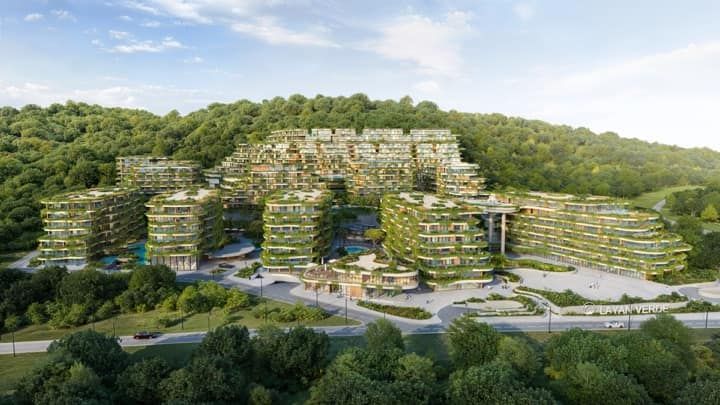
- Layan Verde — 774 residences on 7.5 hectares, 700 m from Layan Beach, completion in 2028; the lineup includes luxury units with private pools starting from $667,050, with penthouses reaching up to ~$4.1M.
- Layan Green Park — Phuket’s first eco condo-hotel with EDGE certification (up to 40% utility savings), 2 minutes from Layan Beach; some residences are designed with terraces and private water.
The difference from a classic villa is that the pool — shared or private — in these projects is maintained by the management company as part of the complex’s service, not by the owner directly. The premium “your own pool” experience stays, while the operational load comes off the owner. A full project breakdown is in Layan Verde: 2026 review.
7. Pool villa vs pool condo
| Parameter | Villa with a private pool | Residence with a private pool in a condo-hotel |
|---|---|---|
| Entry | Higher, 15–30% premium over a no-pool house | From $667,050 (Layan Verde luxury units) |
| Pool upkeep | On the owner: chemicals, repairs, security | On the management company as part of the service |
| Rental | Through a private manager or agent | Through the management company’s rental pool |
| Yield | Individual calculation, higher costs | Benchmark ~8–10% net through the pool |
| Privacy | Maximum, a standalone plot | High, but within a complex |
| Resale liquidity | Niche, longer exposure | Higher — a familiar format, a wider buyer pool |
A broader comparison of the two formats without a pool focus is in condo or villa in Phuket.
8. Pitfalls
- Judging the pool premium from listing photos alone. The real price gap depends on pool size, finish and location — verify it against the specific property, not a general “more expensive/cheaper” feeling.
- Not factoring upkeep into the yield calculation. The gross nightly rate with a pool is higher, but net yield only counts after subtracting chemicals, repairs and security.
- Ignoring seasonality of villa demand. A pool villa’s occupancy is more seasonal than a condo-hotel with a steady flow through its management company — see rental seasons in Phuket.
- Skimping on water safety/fencing. When renting to families this isn’t optional — it’s a requirement under most management and insurance terms.
- Comparing a villa to a condo head-to-head by yield percentage alone. These are different asset profiles — a villa’s absolute income and costs both run higher, so calculate them separately.
9. Mini case study
An investor compared two options at a similar budget: a villa with a private pool in Bang Tao and a residence with a private pool terrace in a project near Layan beach. The villa delivered a higher gross nightly rate and full plot privacy, but required a dedicated rental manager, regular pool servicing and security — after subtracting those costs, net yield came out noticeably below the gross rate. The residence with a private pool in the managed complex showed a more modest nightly rate, but pool and grounds upkeep were already covered by the management company, and income flowed through the rental pool with no operational involvement from the owner. The final call came down to the goal, not the math: the investor chose the managed residence for simplicity and predictable net yield, keeping a standalone villa as an option for future personal use.
10. Conclusion and next step
A private pool genuinely lifts both the villa’s entry price (roughly 15–30%) and the nightly rental rate (20–40%) — but between those two figures sits a line of ongoing upkeep costs that’s easy to overlook during a viewing. Before paying the pool premium, calculate net yield rather than the gross rate, and weigh a standalone villa against the alternative — a residence with a private pool inside a managed complex like Layan Verde or Layan Green Park, where pool upkeep is off the owner’s plate.
I’ll send the pool premium math, upkeep costs and a villa-vs-residence comparison for your budget — leave a request or see the VillaCarte Group projects.
Calculation: pool villa vs residence with a private pool
By submitting this form you agree to the privacy policy.