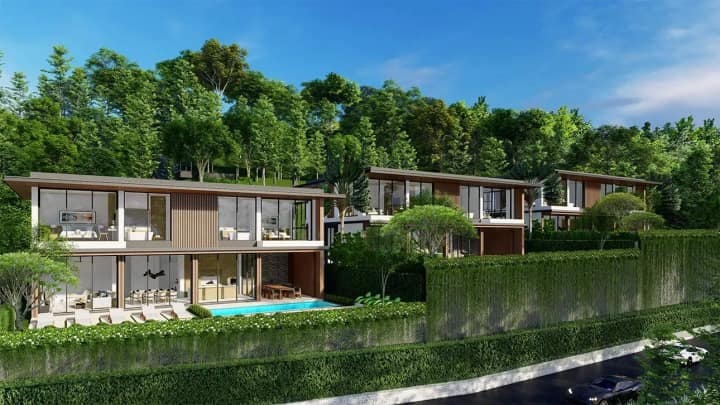
“Cheap property in Thailand” and “premium property in Thailand” aren’t about concrete quality — they’re about entirely different risk models. The budget segment has its own traps: opaque construction, no management, hidden costs. The premium segment has different ones: overpaying for the brand, narrow resale liquidity, inflated yield expectations. Here’s both segments broken down by the numbers, so the decision isn’t built on the price per square metre in a listing.
Contents
1. What “cheap” and “premium” actually mean
These labels are blurry in the Thai market, and sellers use that to their advantage:
- “Cheap” usually means a low entry threshold — but the reason can be distance from the sea, an early construction stage with no confirmed demand, or the absence of a management company, not just a “good deal”.
- “Premium” usually means beachfront, a known brand, or expensive finishes — but that’s no guarantee of income or resale liquidity.
- The same budget can land in either segment depending on location: a studio near Layan beach and a villa inland can cost the same but carry a very different risk structure.
For the rest of this article, both labels are used as price-segment markers, not quality judgments — each with its own set of traps.
2. What makes up the price of a segment
- Location and distance to the sea. The price gap between 5 and 15 minutes from the beach on Phuket’s west coast can reach 2–3x for a comparable size — a detailed breakdown is in property prices by region in Thailand.
- Developer reputation and track record. A company with a verifiable portfolio of delivered projects prices in less risk for the buyer — while an opaque company may discount on paper and make up for it during construction.
- Whether a management company and rental pool exist. A property with no rental programme is almost always cheaper at entry, but shifts all the leasing work onto the owner.
- Finish class and amenities. Pools, spas, coworking, on-site restaurants are what the premium segment is actually paying for, not just square metres.
- Construction stage. Off-plan is cheaper than a completed property — the same general mechanics as buying off-plan, not something specific to a given segment.
3. Real price ranges
Rough market ranges for the Phuket condo format — from budget to premium:
| Segment | Studio | 1-bedroom | 2-bedroom |
|---|---|---|---|
| Budget (no rental pool, far from the sea) | from $80,000 | from $130,000 | from $200,000 |
| Mid-range (managed complex, 10–15 min to the sea) | from $150,000 | from $270,000 | from $490,000 |
| Premium (beachfront, eco-certified, branded) | from $235,995 | from $331,796 | from $549,915 |
For reference: premium-class studios at Layan Verde start from 36.2 m² at $235,995 (up from a starting $224,776), while phase 1 of Layan Green Park is resale-only on the secondary market, with studios from 30.3 m² starting at $142,602. The spread within a single project shows that “cheap” and “expensive” aren’t absolute categories — they’re a point on a given property’s appreciation curve.
4. Traps of the cheap segment
- No management company or rental programme. A low entry price is offset by having to find tenants, pay for cleaning, and handle day-to-day issues yourself.
- An opaque developer. A discount on paper can mean cut corners on materials or a delayed handover — the warning signs are covered in developer red flags.
- Understated floor area or uncounted common zones. Actual usable area can be smaller than advertised — verify against documents, not renders.
- Unverified land status and quota. Cheap properties are more often sold without a full legal check — the mandatory step before a deposit is covered in due diligence in Phuket.
- Hidden upkeep costs. No single service fee doesn’t mean no costs — garden, security, and repairs still land on the owner, just as they arise rather than as a line item.
5. Traps of the premium segment
- Overpaying for the brand without checking the income. Attractive renders and a known name don’t equal yield — the income model needs its own verification, not blind trust.
- Narrow resale liquidity. The higher the ticket, the fewer buyers on the secondary market — an exit deal can take longer than in the mid-range segment.
- Inflated yield expectations. Even in a premium complex, yield is set by the rental-pool model and occupancy, not the unit price — sometimes a premium property with no active management earns less than a mid-range condo with a transparent pool.
- Paying for the early stage of a premium launch. An early entry into a premium project is a bet on future appreciation, not a guaranteed premium here and now — see the scenario comparison in resale vs new build.
- The illusion of “risk insurance”. A high price doesn’t remove the need for due diligence — a premium-segment developer needs the same scrutiny as any other.
6. Yield: segment does not equal income
The key mistake when comparing cheap and premium segments is looking for yield in the price rather than in the management model:
| Parameter | No rental pool (any segment) | Rental pool (60/40 model) |
|---|---|---|
| Who finds tenants | Owner, independently | Management company |
| Income transparency | Depends on effort and season | Pool reporting, owner’s share — 60% of net profit |
| Yield benchmark | Not guaranteed | ~8–10% net annual |
| Payback | Not systematically tracked | ~12 years |
| Personal use | Unrestricted | Usually an agreed number of days per year |
For an exact yield calculation, see how to calculate ROI in Phuket, and run your own numbers in the yield calculator.
7. Liquidity and resale
Liquidity behaves differently across segments:
- The cheap segment is usually more liquid by buyer count — the entry threshold is lower and demand is broader, but resale competition among listings is also higher.
- The mid-range segment (managed complexes near Layan and Bang Tao) tends to hold the best balance between demand and price — a clear income model attracts both end-users and investors.
- The premium segment sells more slowly: fewer buyers with the matching budget, and purchase decisions take longer.
No segment guarantees an instant resale — plan your ownership horizon in advance rather than counting on a fast exit.
8. A sober-choice checklist
Before deciding between a cheap and a premium property, it’s worth going through these points:
- Does the property have a working or confirmed rental programme — a fact, not a promise?
- Who is the developer, and do they have delivered projects with an operating track record?
- Has the land status and the foreign ownership quota been verified for this specific unit?
- What does the service fee actually cover, and does it match real upkeep costs?
- What ownership horizon are you planning for — it determines how critical exit liquidity is.
Common mistakes at this stage are covered separately in top investor mistakes in Phuket.
9. Mini case: one budget, two decisions
An investor with a budget of around $230,000 was considering two studios. The first was in an unverified complex inland, with no management company and no finished amenities, but priced 15% below the developer’s own list for a comparable unit. The second was a premium studio near Layan beach with eco-certification and a rental pool on 60/40 terms.
On closer inspection, the first option would have required finding tenants independently and budgeting separately for security and cleaning — meaning the “discount” at entry was partly offset by operating costs and time. The second option went straight into the rental pool with a ~8–10% net annual benchmark and a clear payback of around 12 years. The price gap at entry turned out to be smaller than the gap in income transparency over the ownership horizon.
10. Conclusion and next step
Cheap and premium property in Thailand isn’t a matter of “better” or “worse” — it’s a matter of different risk sets: the budget segment’s risk sits in construction and management transparency, the premium segment’s in liquidity and inflated yield expectations. The income model and developer due diligence matter more to the final outcome than the property’s class alone.
We can match a property to your budget and goal — income, personal use, or both — and run the real yield numbers. Leave a request or browse the catalogue on the VillaCarte Group page.
This material is for informational purposes only and does not constitute legal advice or an investment recommendation. Prices and ranges are indicative as of the publication date — verify current figures at the time of the deal.