On July 23, 2026, Thailand’s largest listed developer, Sansiri, announced a plan to invest 40 billion baht in new Phuket projects between 2027 and 2030 — a volume matching everything the company has built on the island over the previous 15 years. At the same time, the company disclosed a figure more interesting than the plan itself: the share of foreign buyers in its Phuket sales has risen to 50%, with the largest groups coming from Russia and China. Here’s a breakdown of the numbers and what they mean for anyone already invested in, or considering, property on the island.
Contents
- What was announced on July 23
- The 2027–2030 plan: the numbers
- What’s launching already in 2026
- Sansiri’s first Phuket pool villa project
- The shift in buyer structure
- Where the demand actually is
- Part of a broader trend
- Sansiri in Phuket: what is already in the catalog
- Sansiri vs the Layan flagships: an investor’s comparison
- How to verify a developer’s claims — and what this means for supply
- Pitfalls
- Mini case
- Conclusion and next step
1. What was announced on July 23
Sansiri — a developer listed on the Stock Exchange of Thailand (SET) and one of the country’s largest — announced a new four-year Phuket development plan. The company entered the island in 2011 and has since built around 10,000 units (condos and low-rise homes) worth a combined 40 billion baht. The new plan effectively doubles the pace: the same 40bn baht investment volume, but compressed into just 4 years — 2027 to 2030.
2. The 2027–2030 plan: the numbers
| Metric | Value |
|---|---|
| Plan period | 2027–2030 |
| Total new project value | 40bn baht |
| Number of new projects | 30 |
| Condominiums | 17 projects, 25bn baht |
| Low-rise homes (villas/townhomes) | 13 projects, 15bn baht |
| For comparison: Sansiri’s entire Phuket footprint, 2011–2026 | ~10,000 units, 40bn baht over 15 years |
The table tells the real story: the company isn’t just continuing to operate in Phuket — it plans to nearly quadruple its annual pace of new project launches compared with its average over the previous 15 years.
3. What’s launching already in 2026
The 2027–2030 plan isn’t abstract — it’s backed by a concrete launch already underway in the second half of 2026: seven projects worth 10bn baht.
| Type | Location |
|---|---|
| Condominium | Cherng Talay |
| Condominium | Phuket Town |
| Condominium | Patong |
| Condominium | Rawai |
| Pool villa | Bangjo |
| Pool villa | Pa Sak |
| Pool villa | Phru Jampa |
Worth noting: the return to Patong — Sansiri’s first project there in a decade since its original launch in the area.
By the company’s own figures, Phuket sales in the first half of 2026 already reached 3bn baht, beating the initial target — the annual goal has since been raised to 5bn baht.
4. Sansiri’s first Phuket pool villa project
One of the seven projects — “The Tales Story One” in the Bangjo–Cherng Talay area — is the company’s first pool villa project on the island:
- 13 villas;
- priced from 45 million baht;
- plots of 140–150 sq wah;
- 400+ sqm of living space, three bedrooms;
- the company’s own rental estimate: 300,000–400,000 baht/month in regular season, 600,000–900,000 baht/month at peak.
The company is emphasizing a build-first strategy: the project is fully constructed before sales launch, so buyers see the finished product rather than a render — a direct response to growing buyer concern over construction quality and delivery delays in the villa segment.
5. The shift in buyer structure
The most significant number in the announcement isn’t about construction — it’s about who is buying. According to Sansiri, Phuket’s sales structure shifted as follows in the first half of 2026:
| Buyer group | Previously | H1 2026 |
|---|---|---|
| Thai buyers | 70–75% | ~50% |
| Foreign buyers | 25–30% | ~50% |
| Largest foreign groups | — | Russia, China |
The foreign demand share hasn’t just grown — it has caught up to Thai demand for the first time. For an investor, this isn’t abstract statistics: one of Thailand’s largest developers is recording exactly the dynamic underpinning the Phuket investment thesis of the past several years — a steady, growing flow of foreign, including Russian-speaking, capital into the island’s property market.
6. Where the demand actually is
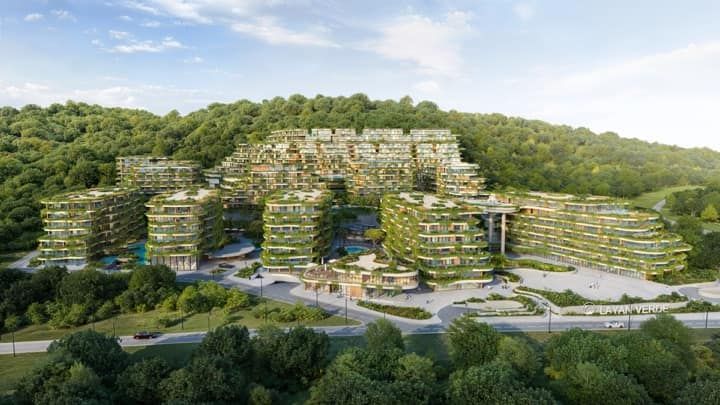
The company directly names the areas with the strongest foreign demand: Nai Yang, Bang Tao, Surin, Karon, Rawai and Patong beaches. That’s largely the west coast — the same zone where Layan beach and the Layan Verde and Layan Green Park projects are located. For how these neighbouring west-coast locations actually differ, see Layan vs Bang Tao and the broader best areas for investment guide.
7. Part of a broader trend
Sansiri’s expansion isn’t an isolated event — it continues a trend we covered in early July: Bangkok’s condo market is oversupplied by mid-2026 (roughly 350,000 unsold units, at prices approaching the 2019 pre-pandemic peak), and developers are deliberately shifting capital to Phuket, where analysts at Kiatnakin Phatra Securities forecast 8–10% annual price growth versus 5–7% in Bangkok — details in “Bangkok’s condo glut and the shift to Phuket”. Sansiri’s July 23 announcement is, in effect, the first concrete monetary confirmation of that forecast from one of the market’s biggest players.
8. Sansiri in Phuket: what is already in the catalog
The 2027–2030 plan is easier to judge against what the company has already built and is selling on the island. As of October 2026 the Layan Real Estate catalog lists seven Sansiri projects, from completed homes delivered in 2013–2015 to off-plan launches due in 2028. Prices are indicative, taken from the catalog cards.
| Project | Format and location | From | Completion | Rental model |
|---|---|---|---|---|
| The Base Cherngtalay | Condo, Cherng Talay, ~2.5 km to Bang Tao | ~$136,241 | Phase 1 — June 2026, ready to move in | Developer programme, ~7% forecast |
| Rhea by Sansiri | Condo, 295 units in 3 buildings, ~350 m to Bang Tao and ~600 m to Surin | ~$164,758 | November 2027 | Developer programme, ~7% forecast |
| Canvaz Palette Cherngtalay | Apartments and duplexes, ~2 km to Bang Tao | ~$211,767 | Early 2028 | Developer programme, ~5% forecast |
| Canvas | Condo, Cherng Talay, ~2.3 km to Bang Tao | ~$231,729 | Early 2026 | No rental programme |
| The Tales Story One | 13 pool villas, Bang Jo, 329–401 m², 3 bedrooms | ~$1,349,730 | Developer states 10–24 months from first payment | Developer forecast ~5% |
| Baan Mai Khao | Condo, Mai Khao | ~$318,167 | Completed, December 2015 | — |
| Burasiri Koh Kaew | Houses, Koh Kaew | ~$372,040 | Completed in 2013 | — |
What the table shows. First, the geography matches the announcement: four of the five current projects sit in Cherng Talay and around Bang Tao — precisely the districts the company named as the zones of strongest foreign demand. Second, the entry point into a Sansiri condo on the island today is $136–232k, one of the lowest price levels among listed developers on this stretch of coast. Third, Sansiri’s rental programmes are developer forecasts (~5–7% a year), not a contractually fixed return: the figure depends on occupancy after handover, and the catalog cards flag this explicitly.
Which of these projects belong to the “seven launches of 2026” from the announcement the company did not specify in the publication — so check the sales-launch date on the card, not the news headline. A full run-down of the island’s developers and their strengths is in best developers in Phuket 2026.
9. Sansiri vs the Layan flagships: an investor’s comparison
For a buyer choosing between a “big listed brand” and the group’s projects in Layan, it helps to put the parameters side by side. We take the two Sansiri condos closest in price and both flagships of Layan.
| Parameter | The Base Cherngtalay | Rhea by Sansiri | Layan Green Park | Layan Verde |
|---|---|---|---|---|
| Developer | Sansiri (listed, SET: SIRI) | Sansiri (listed, SET: SIRI) | VillaCarte Group | VillaCarte Group |
| Beach | Bang Tao, ~2.5 km | Bang Tao ~350 m, Surin ~600 m | Layan, ~2 minutes | Layan, ~700 m |
| Entry | from ~$136,241 | from ~$164,758 | phase-1 resale from $142,602, phase 2 from $224,043 | from $235,995 |
| Status | phase 1 completed (June 2026) | off-plan, November 2027 | phase 1 operating since 2024, phase 2 due 2026 | off-plan, December 2028 |
| Scale | condo | 295 units, 3 buildings | 248 + 296 units | 774 residences on 7.5 ha |
| Yield | developer forecast ~7% | developer forecast ~7% | rental pool, 60% of net profit to the owner, benchmark ~8–10% net | rental pool, 60% of net profit to the owner, benchmark ~8–10% net |
| Distinctive feature | completed building, Boat Avenue 10 minutes on foot | two beaches within walking distance | the island’s first eco condo-hotel (EDGE, up to 40% utility savings) | a district with its own infrastructure, hotel operated by Dusit |
Three observations.
- Different distances to the sea mean different products. Rhea and Layan Green Park are “beach on foot”; The Base and Canvas are closer to “a home near Cherng Talay’s infrastructure” with a drive to the water. On the island’s rental market those are two different audiences and two different rate levels — see beach vs hillside.
- Different income models. Sansiri offers a programme with a forecast return; the Layan flagships run a pool with a profit split fixed in the contract (60% to the owner, 40% to the management company). Neither model promises an outcome — in both cases the result depends on occupancy — but the pool gives a transparent formula while the forecast gives a benchmark. The difference between these approaches is covered in rental management programmes in Phuket.
- Different track records. Sansiri has 15 years on the island and roughly 10,000 delivered units; VillaCarte Group has a Layan Green Park phase 1 that sold out before handover, has operated since 2024 and roughly doubled in price from launch. Both arguments can be verified — and it is these, not marketing promises, that deserve comparison.
If you are choosing between the two Layan flagships themselves, see Layan Verde vs Layan Green Park.
10. How to verify a developer’s claims — and what this means for supply
The 40-billion-baht headline is a company statement, and a private investor has two tools to separate plan from marketing.
Stock-exchange reporting. Sansiri trades on the Stock Exchange of Thailand under the ticker SIRI, and everything material — launches, presales, revenue from unit transfers, debt load — passes through public quarterly reports and investor presentations on the SET website. That is also where you can see whether the Phuket sales target is being met (3 billion baht in the first half and a 5-billion-baht annual plan, by the company’s own figures). The rule is simple: if a plan does not show up in subsequent reporting, it remains a plan.
Project cards. The second layer of verification is not “what was promised” but “what is actually on sale”: launch date, completion schedule, entry price and rental-programme terms for each project. That is what the catalog is for: it shows how the announced districts and formats turn into specific units, and lets you compare them with alternatives, as in the table above. The method for vetting any developer, listed or not, is in how to choose a developer in Phuket and developer red flags.
What this means for supply. Seventeen new condo projects in four years, mostly on the west coast, is a noticeable addition of supply in the same districts where other developers are already selling. For an investor, three practical conclusions follow:
- Look at how fast previous phases sold, not at the size of the announcement. A phase that sold out before handover is the best indicator of real demand in a location — Layan Green Park phase 1 is one example.
- Look for differentiation that cannot be copied. Distance to the beach, operating infrastructure, building certification, an in-house management model — anything that cannot be reproduced simply by adding more buildings.
- Compare yields on one basis. A “~7%” forecast and a pool benchmark of “~8–10% net” are calculated by different methods: ask whether the figure is gross revenue or net profit after the management company’s costs. The methodology is explained in rental yield in Phuket.
The arrival of a large listed player raises confidence in the district as a whole — and at the same time sharpens competition for the same tenant and the same buyer. The projects that win are those with an answer to “why here”, not only “who built it”. How to choose between a construction-stage purchase and a completed unit under these conditions is covered in off-plan vs ready property in Phuket.
11. Pitfalls
- “A major developer is moving in — prices will definitely rise.” One company’s investment plan is a signal of overall market confidence, not a commitment that any specific asset’s price or any specific deal’s yield will rise. Location, developer, management model and the legal cleanliness of the ownership structure still matter far more than the general news cycle.
- Conflating condos and villas. 25bn baht of Sansiri’s plan goes to condominiums, 15bn to low-rise homes and villas — these are different segments with different yield and liquidity dynamics; treating them as one undifferentiated “Phuket market” is misleading. See “Condo vs villa in Phuket”.
- A developer’s rental estimate is not a contractually fixed yield. The 300,000–400,000 baht/month figure (600,000–900,000 at peak) for “The Tales Story One” is the company’s own marketing estimate, not an income fixed in a contract; for how to actually calculate villa rental returns, see “Villa rental yield in Phuket”.
- Ignoring the differences within the “west coast.” Patong, Rawai, Bang Tao and Layan differ from each other in audience, infrastructure and price ceiling far more than the umbrella label suggests.
- Confusing a developer forecast with a pool formula. “~7% a year” in Sansiri’s programme and “~8–10% net” through a rental pool with a 60/40 split come from different methodologies; compare them only after bringing both to one basis (net profit after the management company’s costs).
- Buying the “brand” instead of the location. A listed developer’s name lowers construction risk, but it does not change the distance to the beach or the depth of the rental market in a given district; the same company has units 350 m from the sea and units 2.5 km away.
12. Mini case
An investor from Moscow was considering a Bangkok condo in spring 2026 as the conservative option — “a big city, a liquid market.” After the data on Bangkok’s condo oversupply and Phuket’s stronger growth forecast came out, he shifted his decision toward Layan. The Sansiri news served as additional confirmation, not the original trigger: the fact that Thailand’s largest developer was recording the exact same demand shift in its own sales removed some of his remaining doubt that the Phuket reallocation thesis wasn’t just resort-developer marketing, but a trend visible in independent data.
13. Conclusion and next step
Sansiri’s July 23, 2026 announcement is really two facts in one: first, Thailand’s largest developer is physically doubling its pace of investment in Phuket; second, its own sales data shows the share of foreign buyers — chiefly from Russia and China — has caught up to Thai buyers for the first time. That’s not a reason to buy anything on the island unchecked — but it is a solid data point supporting the thesis behind the Layan investment strategy.
Happy to walk you through how Sansiri’s plan numbers compare to the parameters and yields of Layan Verde and Layan Green Park in Layan: leave a request.
A Phuket market breakdown for your budget and goals
By submitting this form you agree to the privacy policy.
This material is informational and based on Sansiri’s public statements and open sources at the time of publication; it is not investment advice or a commitment to returns.