Bangkok and Phuket are the two most obvious addresses for a Thai property investment, yet they are different asset classes that get mistakenly compared as interchangeable. Bangkok is a ten-million-strong business megacity with a metro system, an office economy, and a condominium market that in 2026 is visibly oversupplied. Phuket is an island with its own international airport, a resort economy, and a structured rental-pool income model that does not depend on Thailand’s mortgage market. Here is a side-by-side breakdown by the numbers: what is happening to new supply in the capital, why developers are physically shifting capital west, and what it means for an investor choosing between a “diversified capital asset” and “managed resort income.”
Contents
- Two different asset classes
- The numbers behind Bangkok’s 2026 condo glut
- Logistics and demand structure
- Entry price and property types
- Yield and management model
- Foreign quota and ownership structure
- Where developer capital is actually moving
- Comparison table
- Pitfalls
- Case study: choosing between the megacity and the resort
1. Two different asset classes
Bangkok is a mature capital-city property market: tens of thousands of condominiums along the BTS and MRT lines, demand from the Thai middle class buying a first home on a mortgage, and local investors renting units out to office workers and students. It is a large market, liquid by transaction count — but dependent on one narrow chokepoint: mortgage approval from Thai banks.
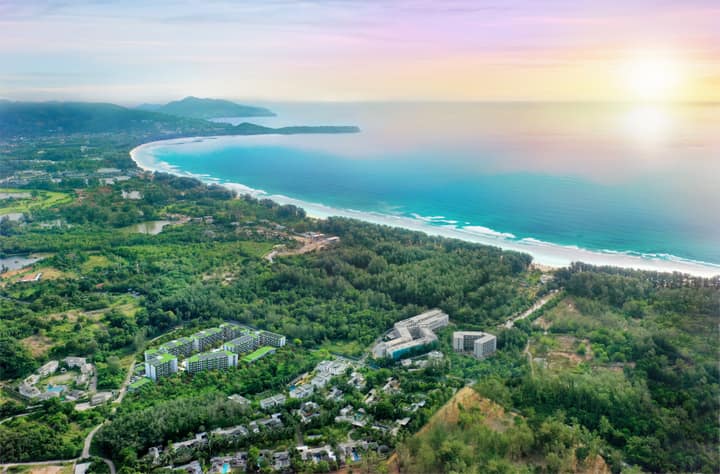
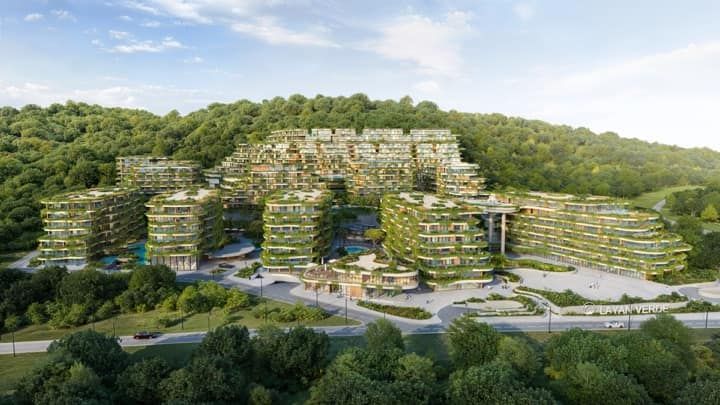
Phuket is built on a fundamentally different logic. The island receives long-haul international tourists directly, with no Bangkok stopover, and is developed with modern condo-hotels running a unified income model — like Layan Verde and Layan Green Park near Layan beach. Demand here comes not from a Thai borrower but from a foreign buyer, usually paying cash or on a developer instalment plan — exchange rates and regional interest matter more to this market than a Thai bank’s lending decisions. A detailed quantitative look at the island is in our article on the Phuket market in 2026.
2. The numbers behind Bangkok’s 2026 condo glut
On July 9, 2026, Bangkok Post published Cushman & Wakefield Thailand data: the average price of new condominiums in Greater Bangkok in H1 2026 reached THB 120,364/sqm — nearly the pre-pandemic 2019 level (THB 120,633/sqm) and the second-highest figure on record after the 2018 peak (THB 126,373/sqm). At first glance, that looks like a sign of recovery.
| Period | Average new condo price, THB/sqm |
|---|---|
| 2018 (historic peak) | 126,373 |
| 2019 | 120,633 |
| 2020 (pandemic) | 92,920 |
| End of 2025 | 110,000 |
| H1 2026 | 120,364 (+9.4% vs end of 2025) |
But the figure hides another story. The rise in average price largely reflects a structural shift: developers have essentially stopped building budget housing and moved launches toward the expensive segment along the BTS Sukhumvit line. Per Nation Thailand, Greater Bangkok still holds roughly 350,000 unsold condominiums — at an average transfer rate of about 60,000 units a year, clearing that backlog will take 5–6 years. Only 6,174 new units launched in Q1 2026, and none of them in the central business district; the booking rate on new launches fell to 24.3% from 43.8% the previous quarter.
Cushman & Wakefield Thailand’s head of research, Surachet Kongcheep, frames the cause this way: this downturn differs from previous cycles because mid- and lower-segment buyers simply cannot get mortgage approval — Thai banks tightened criteria after years of rising defaults. That is why the average price is climbing (the remaining sample is mostly expensive lots), not because the market as a whole has strengthened. See our detailed breakdown of this story in developers pivoting from Bangkok to Phuket.
3. Logistics and demand structure
Bangkok is the country’s transport hub: Suvarnabhumi International Airport and an extensive metro network (BTS and MRT) that removes the need for a personal vehicle for almost any unit near a station. That is convenient for local rentals, but it means a capital-city apartment’s value is set primarily by its distance to the nearest station, not by the sea or a beach.
Phuket is a resort island with its own international airport, HKT, receiving direct flights from Europe, China, Russia, India and the Middle East with no Bangkok transfer. Demand for the island comes from tourists and long-term residents looking for the sea, not an office within walking distance. These are structurally different tenant groups: in Bangkok, a Thai professional or student on a long-term lease; on Phuket, a tourist or remote resident staying anywhere from a few days to a few months — which is exactly what makes the resort-style rental-pool model, with its higher average nightly rate, possible.
4. Entry price and property types
| Parameter | Phuket | Bangkok |
|---|---|---|
| Dominant format | Condo-hotels with rental pools, and villas | High-rise condominiums along BTS/MRT lines |
| Typical entry point (condo) | From ~$140–235K with instalments in new projects | Wide range — from budget studios near outlying stations to premium lots near Sukhumvit |
| State of new supply in 2026 | Shortage of quality new-builds near the island’s west-coast beaches | Glut: ~350,000 unsold units, 5–6 years to clear |
| Developer instalments | Standard (35%+35%+30% and similar schemes) | Available, but demand is constrained by mortgage access for local buyers |
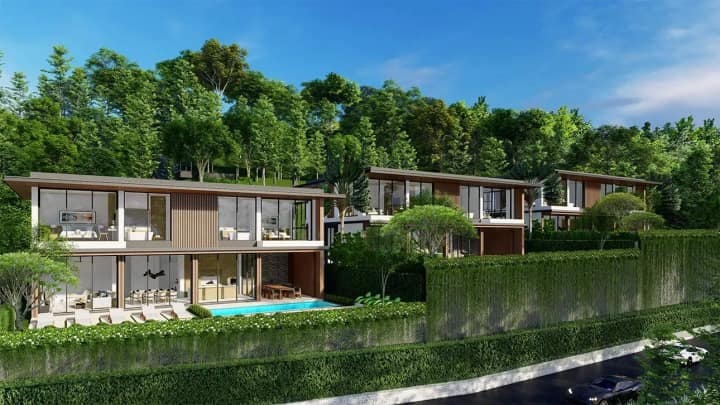
Layan Green Park, for example, is an eco condo-hotel near Layan beach: phase 1 (248 units) sold out with the developer and has been operating since 2024, with only resales now on the market from 4,800,000 THB ($142,602) for a studio; phase 2 (296 units) is on sale with 2026 handover, starting at $224,043 for a studio. Layan Verde offers premium studios from 36.2 sqm starting at $235,995. A comparably sized unit in a new Bangkok project near a BTS station costs a similar or larger sum — but the buyer is taking a stake in a market with nearly 350,000 competing unsold units, not a spot in a supply-constrained beachside district. Payment structures and instalment schemes on Phuket are covered in Phuket payment methods.
5. Yield and management model
- Phuket. The flagship model is a rental pool: identical unit types are pooled, owners receive 60% of net profit, the management company keeps 40%. The benchmark for completed properties is roughly 8–10% net a year, with payback around 12 years. See our ROI methodology for the calculation.
- Bangkok. There is practically no public model with a unified profit-sharing formula at the scale of Phuket’s flagship resort projects. Renting a Bangkok condo is mostly individual management: the owner self-manages to a local professional or expat tenant, or hires an agency without a standardised programme. Yield here depends heavily on the specific building, proximity to a metro station, and management quality rather than a transparent programme with a fixed share.
The core difference is the same one that separates Phuket from any other mainland Thai market: on the island, income in the modern segment is first and foremost a system (a pool, reporting, a management company with a unified policy); in Bangkok it is a specific property and a specific owner, who either handles rental themselves or hires a manager without a single formula.
6. Foreign quota and ownership structure
Thailand’s legal framework is identical for both markets: a foreigner can own a condominium in freehold within the 49%-of-floor-area quota, while land is only accessible via leasehold or a permitted ownership structure. See freehold vs leasehold for details.
The difference is practical, not legal:
- In Bangkok, the 49% quota in established high-rises near popular stations is often already claimed by earlier buyers — a foreigner has to hunt for projects where the quota is still open, or pay a premium for the remaining freehold units.
- On Phuket, particularly in the new districts near Layan and Bang Tao beaches, condo-hotels and condominiums are being built actively, opening the freehold quota fresh each time — meaning a wider selection of direct-ownership options in new beachside developments than in the capital’s established stock.
7. Where developer capital is actually moving
Large developers’ response to an oversupplied, mortgage-locked Bangkok is geographic diversification, and this is not speculation — it is a documented decision by specific companies. Per Nation Thailand, Sansiri, one of Thailand’s largest developers, has earmarked THB 2 billion for land acquisition focused specifically on Phuket, citing steady foreign buyer demand as the reason. Kiatnakin Phatra Securities analysts forecast 8–10% annual price growth for Phuket in 2026, versus 5–7% for Bangkok.
Per KKP Bank data cited by Nation Thailand, the island steadily absorbs roughly 1,000 foreign condominium transfers a year, up 10% in 2025, while in the same regional dataset Bangkok itself posted a more modest 9% gain, Chiang Mai lost 28%, and Chonburi (Pattaya) fell 15%. That does not mean the capital is emptying out — but it confirms that institutional capital and developers are deliberately reallocating budgets toward a market where demand is not tied to Thai mortgage lending.
8. Comparison table
| Parameter | Phuket | Bangkok |
|---|---|---|
| Access | Direct international airport (HKT) | Suvarnabhumi International Airport + BTS/MRT metro |
| Condo market state, 2026 | Shortage of beachside new-builds on the west coast | ~350,000 unsold units, 5–6 years to clear |
| 2026 price growth forecast (Kiatnakin Phatra) | 8–10% a year | 5–7% a year |
| Income model | Rental pool, ~8–10% net, unified formula | Individual management, yield depends on building and station |
| Buyer profile | Foreign, often cash | Thai borrower + local/foreign investor |
| Demand constraint | Exchange rates and regional interest | Mortgage approval from Thai banks |
| Foreign quota in new projects | Often reopened fresh in condo-hotels | Fills up quickly in popular metro-adjacent complexes |
| Developer institutional capital (2026) | Inflow — e.g. THB 2bn from Sansiri for land | Launch focus shifting to the expensive BTS-adjacent segment |
9. Pitfalls
- Mistaking the rise in Bangkok’s average condo price for a healthier market. It reflects a shift in the launch mix toward the expensive BTS-adjacent segment, not rising demand across all price tiers — see our breakdown of developers pivoting to Phuket.
- Assuming a capital-city condo is automatically more liquid. With 350,000 unsold units and falling new-launch booking rates, exiting a mid-segment Bangkok asset can take years, not months.
- Expecting pool-level yield while self-managing a Bangkok condo. Without a rental-pool system and a transparent formula, income depends on the specific building, metro station and management quality, not a guaranteed rate.
- Not checking whether the foreign quota is still open in a specific capital-city building. In popular metro-adjacent projects the 49% quota may already be claimed — confirm this before putting down a deposit, just as on Phuket.
- Ignoring the forecast nature of the 8–10% and 5–7% figures. These are Kiatnakin Phatra Securities’ 2026 forecasts, not settled facts — track quarterly movement in both markets.
- Conflating different growth metrics. Bangkok’s new-build price growth (Cushman & Wakefield) and the growth in ownership transfers by region (KKP Bank) are different indicators from different sources; they do not add up directly and should not be compared as a single figure.
10. Case study: choosing between the megacity and the resort
An investor with a budget of roughly $230,000 was weighing a studio near a BTS station in Bangkok against a studio in an under-construction eco-district on Phuket in early 2026. The Bangkok option was appealing for its large pool of professional tenants and mature metro infrastructure. But due diligence revealed several hundred comparable unsold units still on the market from neighbouring developers in the same district, no management programme with a public profit-sharing model, and rental proposed either self-managed or through a local agency with no transparent reporting. The studio near Layan beach on Phuket, by contrast, belonged to a project with an open freehold quota, construction-period instalments, and a ready-made 60/40 rental-pool model benchmarked at roughly 8–10% net after launch. The investor chose Phuket — not because Bangkok is a “worse” city, but because for the goal of “managed income without hands-on administration,” the island’s market proved structurally more resistant to local oversupply.
Bottom line: Bangkok and Phuket solve different investment problems. Bangkok offers scale, a metro system, and a large local rental market, but in 2026 it is also a market with a visible glut and a dependence on Thai mortgage lending that has effectively frozen the mid- and lower-segments. Phuket is smaller in absolute numbers but structurally healthier as a resort market: a shortage of quality new beachside supply, an institutional inflow of developer capital, and structured yield through rental pools that is not tied to Thai bank lending decisions. For a “buy and collect managed passive income” strategy, the numbers currently favour Phuket; for diversifying into a large capital-city rental market for local residents, Bangkok deserves a close look — with mandatory checks on the specific building, the remaining foreign quota, and the district’s real, not advertised, sales pace.
I can help compare specific Phuket properties against your budget and goal, with a yield calculation in the ROI calculator — or let’s discuss strategy through Layan Real Estate.
Get matched to your strategy
By submitting this form, you agree to our privacy policy.