Hua Hin and Phuket are two Thai coastal resorts with nearly a century of history each, yet they run on completely different property-market logic. Hua Hin is a royal resort 200 km from Bangkok, where Thais have gone for weekend breaks since the 1920s and foreigners settle in for the long haul in search of calm and golf. Phuket is an island with its own international airport, a mature condo-hotel industry, and a structured rental-pool income model. One market wins on proximity to the capital and an unhurried pace of life; the other wins on direct access to the world and managed yield. Here is a side-by-side breakdown so the choice rests on numbers and verifiable facts, not a holiday impression.
Contents
1. Two portraits of one coastline
Hua Hin is Thailand’s oldest seaside resort: the royal family has vacationed here since the 1920s (the Klai Kangwon summer palace still stands today), and by the mid-20th century wealthy Bangkokians were following suit on weekends. This is a market with a domestic character — a large share of demand comes not from tourists but from Thais buying a seaside home 2.5 hours from their Bangkok jobs, plus long-term foreign residents (many Scandinavians, Germans, Swiss) drawn to the slower pace, the golf courses, and the lower cost of living.
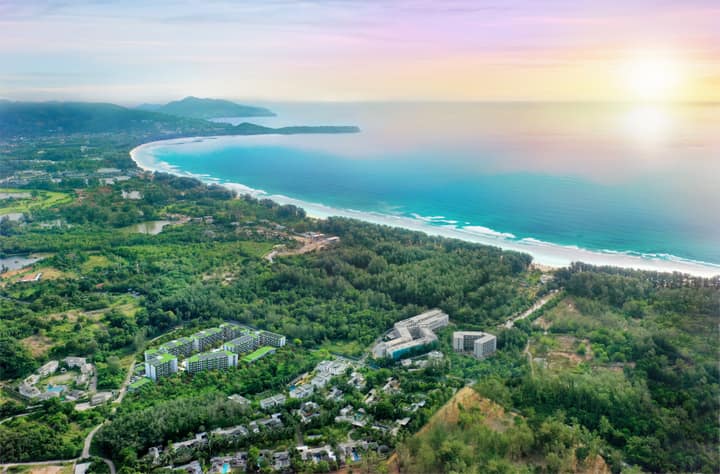
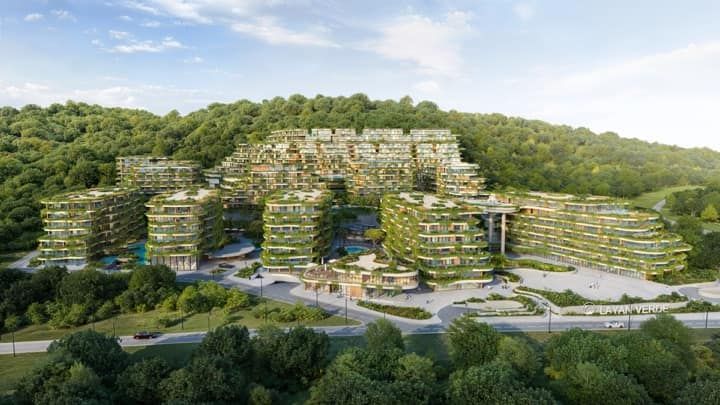
Phuket operates at a different scale and on different logic. The island receives long-haul international tourists directly, with no Bangkok stopover, and is built up with modern condo-hotels running a unified income model — like Layan Verde and Layan Green Park near Layan beach. According to KKP Bank data cited by Nation Thailand, in 2025 foreign ownership transfers in Prachuap Khiri Khan province (Hua Hin) rose 66% — one of the fastest rates nationwide amid a broader cooldown (Bangkok +9%, Chonburi −15%, Chiang Mai −28%). That signals rising interest, but the province’s absolute deal volume still trails well behind the traditional heavyweights — Bangkok, Chonburi and Phuket. A detailed quantitative look at the island is in our article on the Phuket market in 2026.
2. Logistics: road and rail versus a direct flight
Logistics shape tourist flow, owner profile, and eventual liquidity — it is the first thing worth checking when picking a resort.
- Hua Hin. About 200 km from Bangkok; the drive along Phetkasem Road (Highway 4) takes roughly 2.5–3 hours by car or bus. The State Railway of Thailand also runs the route, an option for anyone who would rather not drive. Its own airport, HHQ, serves just one scheduled route as of May 2026 per Nation Thailand — Chiang Mai–Hua Hin on Thai AirAsia; an international Kuala Lumpur route ran from 2018 to 2020 before pandemic suspension. The runway (2,100×35 m) is now being upgraded to secure an aerodrome certificate and bring back international flights — officials cited August 2026 as a target, but that remains a plan, not current reality.
- Phuket (HKT). A working international airport today, with direct flights from Europe, China, Russia, India and the Middle East, no Bangkok transfer required. The trade-off is distance from the capital: roughly 860 km, a stretch almost nobody attempts to drive.
The difference is fundamental: Hua Hin wins on domestic and nearby demand — almost anyone can get there, by car, bus or train, no plane ticket required. Phuket wins on international demand — a direct flight opens up a far wider tenant geography, but it asks the visitor to commit to flying rather than simply getting in a car.
3. Entry price
| Parameter | Phuket | Hua Hin |
|---|---|---|
| Dominant format | Condo-hotels with rental pools, and villas | Mid-rise and low-rise condominiums, plus villas and townhouses on Thai-titled land |
| Typical entry point (condo) | From ~$140–230K with instalments in new projects | Wide range — from budget units in older stock to expensive beachfront new-builds |
| New-supply quality | Large single-developer projects with district-wide infrastructure | Mixed market — from boutique one-off projects to mass housing for the Thai middle class |
| Developer instalments | Standard (35%+35%+30% and similar schemes) | Found in new-builds, but more variable given the range of local developers |
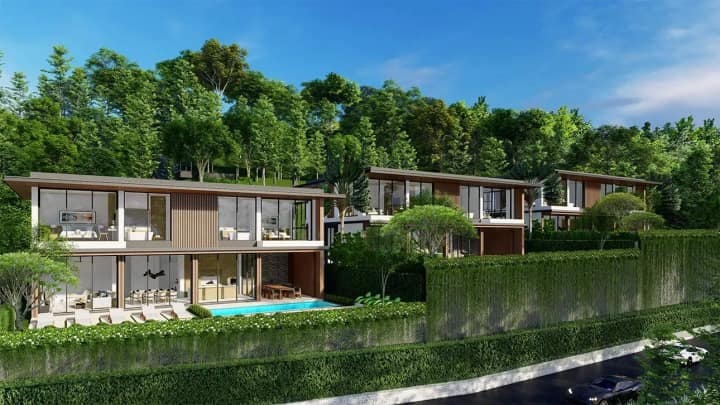
Layan Green Park, for example, is an eco condo-hotel near Layan beach: phase 1 (248 units) sold out with the developer and has been operating since 2024, with only resales now on the market from THB 4,800,000 ($142,602) for a studio; phase 2 (296 units) is on sale with 2026 handover, starting at $224,043 for a studio. Layan Verde offers premium studios from 36.2 sqm starting at $235,995. Hua Hin has fewer comparably scaled, standardised offerings: the market is more fragmented across dozens of local developers and decades of construction of varying quality, and a significant share of demand goes to villas and townhouses on leased or permitted land rather than pure freehold condominiums.
4. Yield and management model
- Phuket. The flagship model is a rental pool: identical unit types are pooled, owners receive 60% of net profit, the management company keeps 40%. The benchmark for completed properties is roughly 8–10% net a year, with payback around 12 years. See our ROI methodology for the calculation.
- Hua Hin. Large public rental pools at the scale of Phuket’s branded projects are practically absent here. Rental demand comes mainly from Thai weekend visitors from Bangkok and long-term foreign residents rather than year-round international tourism — occupancy and seasonality track the Thai holiday calendar more closely than direct flight schedules. Management tends to be individual, through a local operator or self-managed, without a single profit-sharing formula.
The core difference: on Phuket, income in the modern segment is first and foremost a system (a pool, reporting, a management company with a unified policy); in Hua Hin it is more often a specific property and a specific owner, who either self-manages or hires a local manager without a standardised model.
5. Ownership structure and the foreign quota
Thailand’s legal framework is identical for both resorts: a foreigner can own a condominium in freehold within the 49%-of-floor-area quota, while land under a villa is only accessible via leasehold or a permitted ownership structure. See freehold vs leasehold for details.
The difference is practical, not legal:
- Hua Hin has a notably higher share of villas and townhouses on Thai-titled land — a format popular with locals and long-term residents, but for a foreigner it always means leasehold or a structure through a Thai company, never direct land ownership.
- On Phuket, particularly in the new districts near Layan and Bang Tao beaches, condo-hotels and condominiums are being built actively, opening the freehold quota fresh each time — meaning a wider selection of direct-ownership options in new beachside developments.
6. Tourist flow and target audience
Hua Hin has historically lived on mixed demand: Thai families and couples on weekend trips from Bangkok, long-term foreign residents (many older Scandinavians, Germans and Swiss), and golf enthusiasts — the resort has one of Thailand’s oldest golf courses plus several modern complexes nearby. Hua Hin’s beaches are calmer and shallower, which suits families with children but makes the resort less oriented toward active beach tourism than Phuket.
Phuket receives a longer-haul, more diverse tourist — direct flights bring demand from Europe, the Middle East, India and China simultaneously. Per KKP Bank data (Nation Thailand), it is provinces with an international tourism profile and premium housing — Phuket included — that show growth in the value of foreign transactions driven by demand for expensive, high-quality housing, whereas Prachuap Khiri Khan’s 2025 growth was primarily quantitative, off a small base, rather than driven by a jump in average ticket size.
For an owner, this cuts two ways: Hua Hin offers more predictable but more seasonal domestic demand tied to the Thai holiday calendar; Phuket offers a year-round international flow with a higher average rental ticket and a structured income-sharing model.
7. Infrastructure and quality of life
Hua Hin is a compact, unhurried resort: a beachfront promenade, night markets like Cicada and the central Night Market, international-standard hospitals (including Bangkok Hospital Hua Hin), several golf courses within half an hour’s drive, and the Thai king’s summer residence. It is a quiet environment without Patong’s or Bang Tao’s beach-club nightlife — many foreign residents choose Hua Hin precisely for the quiet and the relatively low cost of living while still keeping access to good healthcare and international dining.
Phuket is noticeably larger and more varied by district: quiet residential zones near Layan beach sit alongside lively Bang Tao and touristy Patong, letting a buyer pick the format that fits the goal — from an investment asset in a calm area to a property built for maximum tourist footfall. Our detailed guide is where to stay in Phuket; Hua Hin as an unhurried retirement alternative is covered in best places to retire in Thailand.
8. Comparison table
| Parameter | Phuket | Hua Hin |
|---|---|---|
| Access | Direct international airport (HKT) | Road/train from Bangkok ~2.5–3 hrs; HHQ currently serves one domestic route |
| Foreign deal growth (2025, KKP Bank/Nation Thailand) | Value growth driven by the premium segment | +66% in Prachuap Khiri Khan — one of the country’s fastest-growing, off a small base |
| Income model | Rental pool, ~8–10% net, unified formula | Individual management, higher forecast volatility |
| Foreign quota in new projects | Often reopened fresh in condo-hotels | Notable market share is villas/townhouses on Thai land (leasehold) |
| Target guest | Long-haul, diverse, year-round | Thai weekend demand + long-term foreign residents |
| Beach character | Varied — from beach-club to quiet coves | Calm, shallow, family-friendly |
| International airport | Operating today | Under upgrade, targeting a 2026 return |
9. Pitfalls
- Mistaking the HHQ upgrade for finished infrastructure. Even if works wrap up by August 2026, that is still a plan to bring back international flights, not a working direct link to Europe or China — today, foreign tourists reach Hua Hin mainly via Bangkok.
- Treating Prachuap Khiri Khan’s percentage growth as a sign of market scale. The 66% gain in 2025 is growth off a base far smaller than Bangkok’s, Chonburi’s or Phuket’s; in absolute deal count, the province remains substantially smaller than the traditional leaders.
- Expecting pool-level yield while self-managing a villa in Hua Hin. Without a rental-pool system and a transparent formula, income depends on your own effort or a specific local manager, not a guaranteed rate.
- Confusing a villa on Thai land with a freehold condo. Hua Hin’s high share of villas and townhouses usually means leasehold for a foreigner, not direct ownership — confirm this before putting down a deposit.
- Underestimating the seasonality of domestic demand. Occupancy in Hua Hin tracks Thai holidays and weekends more closely than international tourist flow — a different risk profile than Phuket’s.
10. Case study: choosing between the two resorts
An investor with a budget of roughly $220,000 was weighing a villa in a quiet Hua Hin neighbourhood against a studio in an under-construction condo-hotel on Phuket. The Hua Hin villa was appealing for its proximity to Bangkok — convenient for the owner’s own weekend visits — and the resort’s unhurried atmosphere. But due diligence revealed the land under the villa was structured as a 30-year leasehold with a renewal option, there was no management company with a public profit-sharing model, and rental was proposed either self-managed or through a local agent with no transparent reporting. The studio near Layan beach on Phuket, by contrast, belonged to a fresh project with an open freehold quota, construction-period instalments, and a ready-made 60/40 rental-pool model benchmarked at roughly 8–10% net after launch. The investor chose Phuket — not because Hua Hin is “worse” to live in, but because for the goal of “transparent passive income without hands-on management,” Phuket’s system proved more predictable.
Bottom line: Hua Hin and Phuket solve different problems. Hua Hin offers proximity to Bangkok, an unhurried pace, golf, and growing (if still modest in volume) foreign buyer interest, but without a mature managed-rental system and with leasehold dominating the villa segment. Phuket offers direct international access, a mature condo-hotel industry, and structured income through rental pools. For a “buy and collect managed passive income” strategy, the numbers currently favour Phuket; for a “second home by the sea a couple of hours from Bangkok” strategy, Hua Hin deserves a close look — with mandatory checks on ownership structure and rental management model.
I can help compare specific Phuket properties against your budget and goal, with a yield calculation in the ROI calculator — or let’s discuss strategy through Layan Real Estate.
Get matched to your strategy
By submitting this form, you agree to our privacy policy.