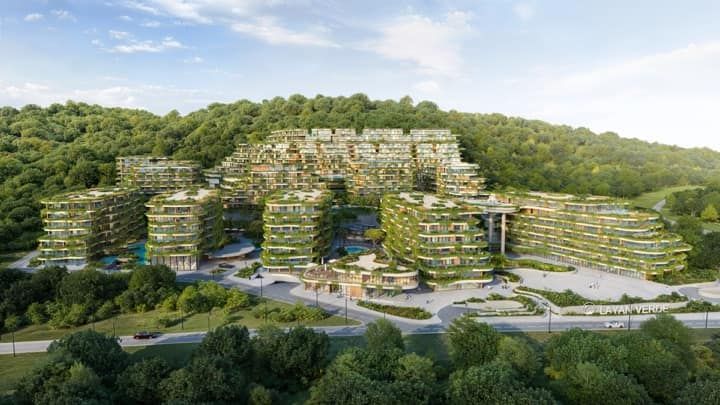
An owner of a condo in a Phuket rental pool usually already knows their “net” yield — a benchmark of roughly 8–10% a year net, the owner’s share after a 60/40 split with the management company. But that figure is not what actually lands in the bank account: on top of it sits the owner’s personal income tax, and along the way a withholding tax is deducted. Here is exactly what a condo owner pays tax on, which deductions are available, how withholding at source works, and when owning through a Thai company is worth considering.
Contents
- What kind of tax it is and who pays
- Income category and rate
- Deductions: 30% or actual expenses
- The 5% withholding tax: how it works at source
- The income’s path in a rental pool: from the pool to the filing
- Personal ownership vs a Thai company
- Filing: forms and deadlines
- Pitfalls
- Mini-case: what an owner actually keeps
- Conclusion and next step
1. What kind of tax it is and who pays
This is the individual owner’s personal income tax (PIT) — not a corporate tax, and not a local property tax. It is paid by whoever receives the income: the condo owner, whether they rent the unit out themselves or through a rental management program. Nationality and visa status do not matter — only the source of the income does. Renting out property physically located in Thailand is always Thai-sourced income, so both residents and non-residents are taxed on it the same way (the 180-day rule is covered in the tax residency article — for this particular tax, it changes nothing).
2. Income category and rate
Income from renting out property is a distinct category of assessable income, section 40(5) of Thailand’s Revenue Code. It is taxed on the same progressive 0–35% scale as salary, but with its own set of deductions (section 3). The full eight-bracket table and effective-rate math are in income tax rates for a foreigner; here is a condensed reference:
| Taxable base, THB/year | Rate |
|---|---|
| 0 – 150,000 | 0% |
| 150,001 – 500,000 | 5–10% |
| 500,001 – 1,000,000 | 15–20% |
| 1,000,001 – 4,000,000 | 25–30% |
| over 4,000,000 | 35% |
The key point: the rate applies not to gross rental income but to the taxable base — that is, after the deductions covered below.
3. Deductions: 30% or actual expenses
For category 40(5), the law offers a choice of two deduction methods, and they cannot be combined — only one applies to all income of this type for the year:
| Method | How it is calculated | When it is better |
|---|---|---|
| Standard (30%) | 30% of gross rental income, no documents needed | A typical rental-pool unit: operations already sit with the management company, so there is little to document |
| Actual expenses | The sum of documented expenses (repairs, insurance, a share of the management fee, loan interest) | A larger property with genuinely high costs, if documented expenses exceed 30% |
After that, a personal allowance of 60,000 THB per taxpayer is deducted from the base (plus a spousal allowance for a joint filing) — and only the remainder is taxed on the scale from section 2.
4. The 5% withholding tax: how it works at source
A separate mechanism that is often confused with the tax itself. When rent — or a share of rental-pool profit — is paid to an individual owner by a legal entity, which is exactly how the rental management program at Layan Verde and Layan Green Park is structured, the payer must withhold 5% at source and remit it to the Revenue Department on the owner’s behalf, issuing a withholding certificate.
This is not an additional tax but a prepayment: the withheld amount is a credit applied when the annual return is filed. The owner declares the full gross income, calculates tax under the rules in sections 2–3, and then subtracts the 5% already withheld from the result. The difference is either a top-up payment or a refund (see the calculation in section 9, where withholding turns out to exceed the final tax).
5. The income’s path in a rental pool: from the pool to the filing
It is important not to confuse two separate calculation layers that happen one after another:
- The pool level. The management company collects rental revenue and deducts operating costs, VAT, city tax and the service fee, arriving at the pool’s net profit.
- The 60/40 split. The owner receives 60% of the pool’s net profit, the management company keeps 40% for operations and marketing. This is the ~8–10% net annual benchmark usually cited in a project’s presentation.
- Withholding at source. From the share paid to the owner, the management company withholds 5% (section 4) — the amount that reaches the owner’s account is already net of this withholding.
- The owner’s personal income tax. At year-end, the owner declares their full share (before withholding) as category 40(5) income, applies the 30% or actual-expense deduction (section 3), the 60,000 THB personal allowance, and the scale (section 2), then subtracts the 5% already withheld.
The 60/40 split and personal income tax are two independent calculations at different levels — not the same deduction applied twice.
6. Personal ownership vs a Thai company
Owners of several units sometimes consider structuring the rental through a Thai company — and the logic changes there:
| Parameter | Personal ownership | Ownership through a Thai company |
|---|---|---|
| Tax rate on profit | Progressive 0–35% | Flat 20% (corporate income tax) |
| Income reaching the owner | Directly, per the scale above | Via dividends — plus 10% withholding on dividends |
| Combined burden | Up to 35% at the top brackets | ~28% (20% + 10% on the remaining 80%) |
| Break-even threshold | Modest income from 1–2 units — almost always cheaper | High combined income from several units, where the marginal personal rate is already 30–35% |
| Extra complexity | Minimal | Bookkeeping, audit, minimum capital, restrictions on business activities |
For an owner of a single studio or one-bedroom in a pool, a company almost never pays for the added administrative complexity — the personal scale with deductions produces an effective rate well below 35%. A company structure is worth discussing separately with a lawyer — the general risks and mechanics are covered in Thai company villa ownership.
7. Filing: forms and deadlines
- PND.90 — the main annual return for any income other than salary alone, including rent; due by 31 March of the following year.
- PND.94 — an interim return for the first half of the year (January–June), specifically for certain income categories including rental income; due by 30 September of the same year, with the amount paid credited against the annual calculation.
- A withholding certificate (from the management company or a corporate tenant) is a required attachment to the return — it is what the credit is applied against.
For more on forms, late-filing penalties and the logic of the returns, see income tax rates for a foreigner.
8. Pitfalls
- Treating the 8–10% net pool yield as the final take-home income. That is the owner’s share before personal income tax — the tax is layered on top as a separate calculation.
- Confusing the 5% withholding tax with the final tax liability. It is a prepayment credit, not a final rate — the actual amount owed or refunded is only known once the return is filed.
- Skipping the filing because withholding feels like “tax already paid.” The obligation to declare income is not removed by the fact that part of it was already withheld at source.
- Combining the 30% deduction with the actual-expense deduction. Only one method applies to all category 40(5) income for the year.
- Assuming that transferring the income abroad cancels the Thai tax. Rental income from Thai property is taxed on the basis that it was earned in Thailand — regardless of whether the money stays in a Thai account or is transferred abroad.
9. Mini-case: what an owner actually keeps
An owner of a one-bedroom at Layan Verde (~$331,796) receives a net share of ~9% a year from the rental pool (within the 8–10% benchmark). At an exchange rate of ~33.7 THB/USD, applying the standard 30% deduction and the 60,000 THB personal allowance — simplified, ignoring other deductions:
| Parameter | Value |
|---|---|
| Owner’s share from the pool, ~9%/year | ~987,600 THB |
| 5% withholding tax deducted by the manager | ~49,400 THB |
| After the 30% deduction (category 40(5)) | ~691,300 THB |
| After the 60,000 THB personal allowance | ~631,300 THB |
| Tax on the progressive scale | ~47,200 THB |
| Result on filing PND.90 | Refund of ~2,200 THB (withheld more than assessed) |
At small to moderate income from a single unit, the 5% withholding often turns out to be more than enough — filing does not add to the owner’s bill, it returns the difference. For the unit’s underlying economics and the full yield methodology before tax, see how to calculate ROI in Phuket and the yield calculator.
10. Conclusion and next step
Rental income tax in Thailand is the owner’s personal income tax on a 0–35% progressive scale applied to their share from the pool — not a separate “rental tax rate.” The 5% withholding tax deducted at payment is not the final tax but a prepayment credited when filing PND.90 or the interim PND.94. For typical income from one or two studios or one-bedrooms in a rental pool, the effective final burden is usually moderate thanks to the 30% deduction and the personal allowance — and sometimes the withholding even exceeds the final calculation.
We can send a tax-burden calculation for a specific unit at Layan Green Park or Layan Verde in Layan — leave a request or check the current price list at VillaCarte Group.
This article is for information only and is not tax or legal advice. Rates, deductions and filing thresholds are set by the Revenue Department of Thailand — verify current rules with an accredited tax advisor before filing or transacting.