A foreigner who owns a condo in Phuket and earns rental income through a rental pool eventually asks the same question: how much do they actually owe the Thai government. In Thailand the answer is not a single number — it is a progressive scale from 0% to 35%, applied to the taxable base after deductions, not to gross income. Here are the 2026 rates, who pays what, how the deduction on rental income is calculated, and when a tax return is genuinely required.
Contents
- Who this matters to, and why
- Resident or non-resident: where the calculation starts
- The progressive tax scale for 2026
- Deductions and the tax-free threshold
- Tax on rental income
- DTAs and the LTR visa: legal ways to lower the burden
- Filing a return: forms and deadlines
- Pitfalls
- Mini-case: what a studio owner and a 2-bedroom owner pay
- Conclusion and next step
1. Who this matters to, and why
Personal Income Tax (PIT) in Thailand applies to anyone earning income from Thai sources — regardless of nationality or visa. For a Phuket property owner, this mainly means rental income: a studio or an apartment in a rental pool formally generates assessable income for the owner, which must be declared under the same rules as a local employee’s salary. Residency and foreign income are a separate question, but that question is about what is taxed, not about the rates: see our article on the remittance rule for more.
2. Resident or non-resident: where the calculation starts
Anyone who spends 180 days or more in Thailand in a calendar year becomes a tax resident — the rule is covered in detail in our article on 180-day residency. For Thai-sourced income, including rental income from Phuket property, residency status does not change the rate: both residents and non-residents pay on the same progressive scale. Residency matters for something else — only a resident falls under the remittance rule for foreign income brought into Thailand. A non-resident does not pay Thai tax on that foreign income at all, but the obligation to declare Thai rental income still applies to them.
3. The progressive tax scale for 2026
The scale has eight tiers and applies to the taxable base — income after deductions and allowances, not the gross amount:
| Taxable base, THB/year | Rate |
|---|---|
| 0 – 150,000 | 0% (exempt) |
| 150,001 – 300,000 | 5% |
| 300,001 – 500,000 | 10% |
| 500,001 – 750,000 | 15% |
| 750,001 – 1,000,000 | 20% |
| 1,000,001 – 2,000,000 | 25% |
| 2,000,001 – 4,000,000 | 30% |
| Over 4,000,000 | 35% |
The rate applies to each slice of income, not the whole amount — the same way most countries with progressive income tax work: income in the THB 300,001–500,000 band is taxed at 10% only within that band, not on the entire income. This is the key reason the effective (real) tax burden is almost always noticeably lower than the top rate of the bracket a taxpayer lands in — see the worked example in section 9.
4. Deductions and the tax-free threshold
Before the scale in section 3 is applied, expenses (by income type) and personal allowances are subtracted from gross income. For a Phuket property owner, the main ones are:
| Deduction | Amount |
|---|---|
| Personal tax-free allowance (per taxpayer) | THB 60,000 |
| Standard deduction on employment/service income | 50% of income, capped at THB 100,000 |
| Standard deduction on rental income | 30% of gross rental income |
| Spouse allowance (joint filing, spouse with no income) | THB 60,000 |
The resulting taxable base = gross income − the standard deduction for that income type − personal allowances. It is this base, not the amount received from the rental pool or an employer, that goes into the rate table in section 3.
5. Tax on rental income
Income from renting out property in Thailand is a separate category of assessable income (property income). It carries a standard 30% deduction on the gross annual rental amount — no need to collect receipts for expenses. If the actual costs of the property (repairs, insurance, part of the management fee) exceed 30%, the actual-expense deduction can be claimed with supporting documents — but for a typical condo in a managed format, the standard 30% is usually simpler and better value.
An important detail for an owner in a rental pool: the profit share distributed to the owner (~8–10% net a year under the 60/40 model, where the owner gets 60% of the pool’s net profit and the management company gets 40%) is already income net of the pool’s operating costs and management fee. The 30% tax deduction applies on top of this when calculating the owner’s personal PIT — it is not a substitute for the pool’s operating costs. The two are easy to conflate but are separate calculations.
6. DTAs and the LTR visa: legal ways to lower the burden
Two legal tools that apply not to Thai rental income (which is always taxed) but to how the Thai system interacts with a foreign one:
- Double tax agreements (DTAs). Thailand has DTAs with dozens of countries. If tax has already been withheld abroad on the same income, a DTA usually allows it to be credited against the Thai liability through a tax-credit mechanism — but this is not automatic; it requires declaring the income and attaching proof of tax paid abroad.
- The LTR visa. Three of the four categories (Wealthy Global Citizen, Wealthy Pensioner, Work-from-Thailand Professional) are exempt from Thai tax on foreign income remitted into Thailand. The Highly-Skilled Professional category instead pays a flat 17% rate on income from a Thai employer. Important: both benefits concern foreign income — rental income from Phuket property is Thai-sourced and does not fall under either one, so it is taxed on the standard scale from section 3.
7. Filing a return: forms and deadlines
- PND.91 — for salary income only (category 40(1)), due by 31 March of the following year.
- PND.90 — for any income beyond salary alone, including rental income; the same deadline of 31 March of the following year.
- PND.94 — a mid-year return covering January–June for certain income categories, including rental income; due by 30 September of the same year, and any tax paid on it is credited against the annual return.
The obligation to file arises once a taxpayer’s annual gross income exceeds the statutory threshold — even if the final calculation results in zero tax due after deductions. Missing the deadline carries a fine plus interest on any unpaid amount.
8. Pitfalls
- Confusing the effective rate with the top rate of a bracket. Falling into the “25%” bracket does not mean all your income is taxed at 25% — only the slice within that bracket is (see the worked example in section 9).
- Assuming the LTR visa exempts rental income in Phuket. The exemption applies only to foreign income — Thai rental income is always taxed, regardless of visa status.
- Skipping the return because the amount due looks small. The filing obligation depends on gross income before deductions, not on the final tax amount owed.
- Confusing the personal 30% rental deduction with the rental pool’s 60/40 profit split. These are two independent calculations at different levels: the pool first calculates net profit and splits it 60/40, then the owner applies a personal tax deduction to their own share.
- Not claiming a DTA credit for tax already withheld abroad. DTA relief is not automatic — it must be claimed with supporting documents when filing the Thai return.
9. Mini-case: what a studio owner and a 2-bedroom owner pay
Take two rental-pool owners earning ~9% net a year (within the 8–10% benchmark) and apply the standard 30% rental deduction and the THB 60,000 personal allowance — simplified, ignoring other deductions and exchange-rate assumptions:
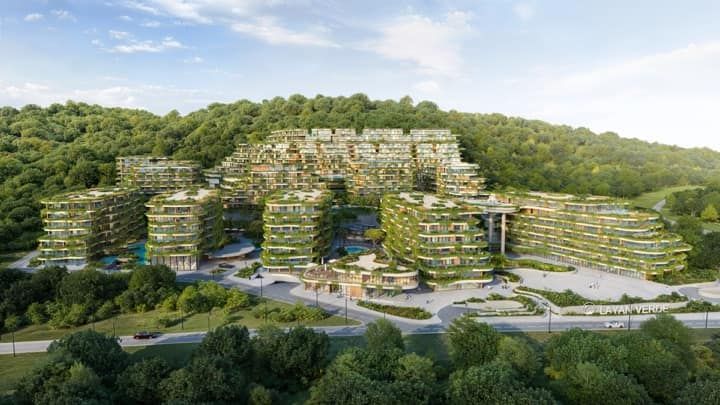
| Parameter | Studio, Layan Green Park (resale, ~$142,602) | 2-bedroom, Layan Verde (~$549,915) |
|---|---|---|
| Pool income, ~9%/year | ~THB 432,500 | ~THB 1,642,700 |
| After the 30% rental deduction | ~THB 302,750 | ~THB 1,149,890 |
| After the THB 60,000 personal allowance | ~THB 242,750 | ~THB 1,089,890 |
| Tax on the progressive scale | ~THB 4,640 | ~THB 137,470 |
| Effective rate on gross income | ~1.1% | ~8.4% |
The difference is telling: at the modest income of a single studio, the effective rate is close to zero thanks to the deductions, while a higher income moves toward the middle of the scale — yet still stays well below the 35% top rate, which only applies to income above THB 4 million, a threshold neither scenario reaches.
10. Conclusion and next step
Thailand’s progressive personal income tax scale (0–35%) applies to Thai-sourced income, including rental income from Phuket property, equally for residents and non-residents. What actually determines the real burden is not the headline percentages but the deductions: the standard 30% on rental income, the THB 60,000 personal allowance, and the PND.90/PND.94 filing structure. For a typical owner of one studio in a rental pool, the effective rate usually ends up a single-digit percentage, not the headline-grabbing 35%.
I can put together a tax-burden estimate for a specific unit and yield — leave a request or check the current price list for Layan Green Park and Layan Verde at VillaCarte Group.
This material is for informational purposes only and does not constitute tax or legal advice. Rates, deductions and filing thresholds may be updated by Thailand’s Revenue Department — before filing a return or planning a transaction, verify the current rules with an accredited tax consultant.