On 23 September 2026, Bangkok Post, citing the international consultancy Savills, reported that Thailand ranks second in the Asia-Pacific region by the volume of branded residence pipeline — projects already announced and under construction under the management of hotel and lifestyle operators. It’s not an isolated headline but another confirmation of a trend an earlier industry report, from C9 Hotelworks, had already flagged: Thailand’s already-operating branded residence market grew 13.3% over the year to reach 205.3 billion baht, and Phuket became Asia’s largest resort branded residence market — 3,465 units, more than any other resort destination in the region. Here’s what’s behind both reports, how pipeline differs from already-launched supply, where Layan Verde fits into this picture, and what it means for an investor weighing a branded project against an unbranded one on the island.
Contents
- Two reports, one trend: Savills and C9 Hotelworks
- Thailand — No.2 in Asia by pipeline (Savills)
- The market today: 205.3bn baht and 13.3% growth
- Thailand’s geography: Bangkok, Phuket, Hua Hin, Pattaya, Koh Samui
- Phuket — Asia’s largest resort branded market
- Why the resort segment specifically is growing
- The brand premium: what a name on the facade costs
- Case study: Layan Verde and the Dusit International operator
- Pitfalls: what these numbers don’t mean
- What this means for an investor
1. Two reports, one trend: Savills and C9 Hotelworks
Two independent industry reports on Asia’s branded residence sector have come out over the past three months, and both put Thailand near the top of the rankings on different metrics. The first, C9 Hotelworks’ «Asia Branded Residences Market Review 2026», published 17 June 2026, describes the market that’s already up and running: how many units are actually delivered and occupied, who manages them, and what they’re worth in money terms. The second, Savills’ «Branded Residences Asia Pacific 2026», which Bangkok Post covered on 23 September 2026, looks forward and measures pipeline — projects announced and under construction but not yet delivered.
The distinction between the two matters for an investor. Launched supply is what you can buy finished or nearly finished today, with an operating track record and the first occupancy reports to check. Pipeline is what will shape competition for tenants and buyers two to five years out: the more new branded projects enter the same market, the more the existing ones will be judged on their actual management track record rather than just the name on the building. Both reports show Thailand — and Phuket specifically — as one of the region’s fastest-growing and already-established branded residence markets, just viewed from two different angles of the same picture.
2. Thailand — No.2 in Asia by pipeline (Savills)
According to Savills, Asia-Pacific remains the world’s second most mature branded residence market (about 23% of all completed schemes worldwide today), but the next wave of growth will be shaped less by scale on its own than by diversification — who’s buying, and on what terms. Savills projects the region’s pipeline will grow 97% by 2032 — 187 additional projects on top of what already exists. Most of that growth will land in two markets, Vietnam and Thailand, which together have more than 75 new branded residences in the pipeline.
That’s where the figure Bangkok Post reported comes from: Thailand currently ranks second in the region by pipeline volume, behind only Vietnam. Savills expects fast-growing Vietnam to overtake Thailand by 2032 and become Asia’s leading branded residence location — but that’s a forecast on a six-year horizon, not the current standing. Savills attributes demand less to foreign capital than to the growth of wealthy and ultra-wealthy populations within the region itself: buyers increasingly want a branded home closer to home, not purely as an overseas investment. One notable detail of the pipeline mix — luxury accounts for 48% of new projects, upscale another 23% — shows developers broadening supply beyond pure luxury toward more accessible price points with the same service package and a recognisable brand attached.
3. The market today: 205.3bn baht and 13.3% growth
While the pipeline is still being built, Thailand’s already-operating branded residence market, per C9 Hotelworks, looks like this:
| Metric | Value |
|---|---|
| Market value | 205.3bn baht (≈$6.4bn) |
| Year-on-year growth | +13.3% |
| Launched units | 13,124 |
| Properties | 63 |
| Thailand’s share of Asia’s launched supply | 26% (the highest in the region) |
| New pipeline units, 2026–2028 | 18,545 |
| Luxury-tier projects | 30 (Vietnam — 18, South Korea — 13) |
| Standalone units (no attached hotel) | 3,008 (22% of national supply vs. a 17% Asia average) |
For scale: C9 Hotelworks values the whole Asian branded residence market at 1.3 trillion baht and more than 50,000 units, growing 30.3% year-on-year. So Asia overall is growing faster than Thailand (13.3%), but Thailand already holds a quarter of the region’s entire launched supply — this isn’t a market catching up, it’s one of the markets defining the category. Thirty active luxury-tier projects is more than any other Asian country, ahead of Vietnam and South Korea, which follow behind.
4. Thailand’s geography: Bangkok, Phuket, Hua Hin, Pattaya, Koh Samui
Branded residences are distributed very unevenly within the country — which is exactly why Bangkok dominates the headlines while Phuket dominates the «largest resort market» category:
| City/region | Units | Status |
|---|---|---|
| Bangkok | 5,031 | Thailand’s largest urban market (53% luxury condominiums) |
| Phuket | 3,465 | Asia’s largest resort/villa branded market by unit count |
| Hua Hin | 3,017 | The country’s second-largest resort market |
| Pattaya | 1,775 | An established resort market dominated by condo-hotels |
| Koh Samui | 480 | An emerging market, growing off a low base |
Bangkok outnumbers Phuket in absolute units, but these are two different products: the capital is mostly urban luxury condominiums for local buyers and relocators, while Phuket, Hua Hin and Koh Samui are about resort villas and condo-hotels running on a rental-income model aimed at international buyers and tourism demand. That’s why it makes more sense to compare Phuket against other resort destinations rather than against Bangkok — and in that comparison, the island clearly leads.
5. Phuket — Asia’s largest resort branded market
Phuket’s 3,465 units isn’t just second place nationally — it’s first place among all resort and villa branded markets in Asia: neither Bali nor any other resort destination in the region matches that many already-delivered branded units in this segment. In its pipeline report, Savills separately names Bali and Phuket as the two most popular resort destinations for new branded residences — meaning the island leads not just on the facts (launched supply) but on the growth trajectory (pipeline) too.
Among the projects that show up in Savills’ Thailand pipeline data are SLS Residences Phuket and MGallery MontAzure Phuket on the island itself, alongside Dusit Ajara Hua Hin and Dusit Central Park Bangkok elsewhere in the country — meaning the same Dusit brand is expanding simultaneously in Bangkok and Hua Hin, competing for the same buyer who’s also looking at Phuket. At the individual-brand level, Savills names Four Seasons and Aman as the region’s leaders by number of standalone projects, while at the parent-group level it’s Banyan Group, whose Banyan Tree and Angsana brands already operate on Phuket within the Laguna cluster.
6. Why the resort segment specifically is growing
The key structural detail in the Savills report is a pipeline shift toward resort property: while resort schemes make up around 50% of Asia’s already-completed branded projects, that share rises to 65% within the pipeline. In other words, developers and operators are increasingly betting on resort destinations rather than urban towers — and Phuket is a direct beneficiary of that bet.
The logic is straightforward: a resort branded residence sells more than square metres — it sells a ready-made revenue management system, bookings through the operator’s hotel network, service standards, and brand recognition for a guest booking through a familiar app or loyalty programme. For an owner, that translates into more predictable occupancy than self-managed rental. For the island as a whole, it reinforces Phuket’s position as a resort with a density of international branded supply comparable to cities many times its population.
7. The brand premium: what a name on the facade costs
Market growth is one side of the coin; the other is what buyers already pay for a brand today. Per Layan Real Estate’s own catalogue as of 26.08.2026 (348 island-wide projects, 25 of them branded, with operators such as Dusit, Marriott, Banyan Tree, Anantara and MGallery): a median of $6,274/sqm in branded projects versus $3,298/sqm in the rest — a gap of roughly 90%. Within individual formats the gap is narrower: branded condos cost about 39% more per square metre than unbranded equivalents, branded aparthotels about 27% more.
The median entry price for branded projects, meanwhile, is actually lower than for unbranded ones — $416,960 versus $596,943 — because operators tend to sell compact studios at a high per-metre price rather than larger family units. A full breakdown by format, all 25 operators on the island, and the question of when the premium actually pays off through occupancy and resale liquidity is in a separate article, «Branded Residences in Phuket: What the Premium Buys You, and When It Pays Off».
8. Case study: Layan Verde and the Dusit International operator
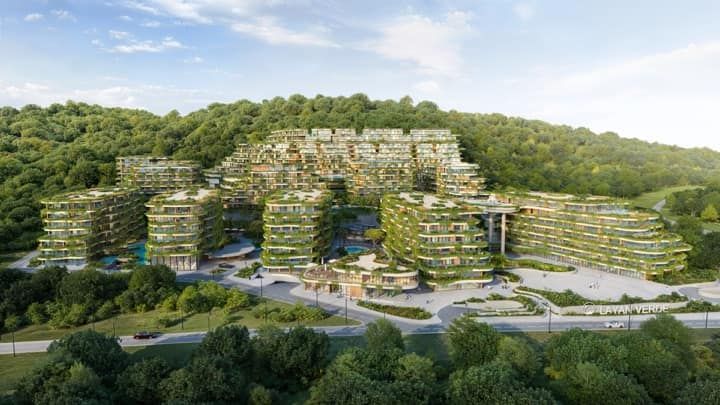
Layan Verde is a concrete example of what a branded residence looks like from the inside of the statistics Savills and C9 Hotelworks are describing: a seafront eco-district in Layan with 774 residences, where the hotel operator is Dusit International — premium buildings and a 5-star hotel operate on the same grounds as the residential blocks. Formally, it’s one of the units behind that 3,465-branded-residence figure C9 Hotelworks counted on Phuket, and one of the projects operators are competing over in Savills’ pipeline report — Dusit is simultaneously expanding in Hua Hin (Dusit Ajara) and Bangkok (Dusit Central Park).
Entry pricing at Layan Verde currently starts from $235,995 for a 36.2 sqm studio, with a target owner yield under the rental-pool model of roughly 8–10% net (60% of the pool’s net profit to the owner). By comparison, the neighbouring Layan Green Park (phase 1 resale from $142,602, phase 2 from $224,043) is an EDGE-certified eco condo-hotel but without a third-party hotel brand operator — so it doesn’t formally fall into the «branded residences» category from the Savills and C9 Hotelworks reports, even though it runs on a similar rental-income model. The difference between these two neighbouring projects is a useful illustration that «brand», in this industry, means a specific managing operator — not simply build quality or location.
9. Pitfalls: what these numbers don’t mean
The headline «Thailand — No.2 in Asia» is easy to read more broadly than the data actually supports. A few caveats worth keeping in mind:
- Pipeline isn’t guaranteed supply. An announced project can slip on delivery, change operator, or never reach market at the stated scale — Savills’ figures describe developer intentions today, not finished real estate.
- Second place in pipeline and leadership in launched supply are different metrics. Thailand already holds 26% of Asia’s operating market today (a fact), but it’s Vietnam, not Thailand, that overtakes on future supply — don’t confuse current leadership with the 2032 forecast.
- National data isn’t Phuket data. The 97% pipeline growth forecast applies to the whole Asia-Pacific region, not a guarantee that a proportional number of new projects will land specifically on the island.
- A price premium isn’t a yield guarantee. The 90% per-metre price gap is a documented fact from a catalogue snapshot on a given date — not a promise that rental income or resale will recoup that premium for any specific unit.
- Not every project with a nice name is a branded residence. As the Layan Green Park example shows, a developer can run a strong rental-income product without an official hotel operator — and, conversely, a hotel mentioned in marketing copy doesn’t make a residence «branded» in the terminology these reports use.
10. What this means for an investor
Two reports, published three months apart, paint the same picture from two angles: Thailand is already Asia’s established leader in operating branded residence supply (26% of the market, 205.3bn baht, 13.3% annual growth) and, at the same time, one of the two main drivers of the region’s future growth (second place in pipeline, more than 75 new projects alongside Vietnam). Phuket, within that picture, isn’t a secondary market riding on Bangkok’s coattails — it’s a leader in its own right: Asia’s largest resort branded market by unit count, with a growing roster of operators (SLS, MGallery, Dusit, and others) who see the same resort demand on the island that Savills describes in its forecast of the resort share rising to 65% of pipeline.
For an investor, that has two practical implications. First, choosing between a branded and unbranded project on Phuket today is a choice with a documented price tag (roughly a 90% per-metre premium) and rising competition among operators for the same coastline — not a niche curiosity. Second, when picking a specific operator, it’s worth looking beyond the name to the scale of its regional footprint: Dusit International, which manages Layan Verde, is simultaneously expanding in Hua Hin and Bangkok, which points to a long-term brand-level bet on the Thai market as a whole rather than a one-off project.
I can send you a current shortlist of branded and unbranded projects that fit your budget, compare yield and rental-pool terms with real numbers, and answer questions about a specific operator. Leave a request or browse the catalogue on the agency page.
This material is for informational purposes only and does not constitute investment advice. Figures are drawn from Savills («Branded Residences Asia Pacific 2026») and C9 Hotelworks («Asia Branded Residences Market Review 2026») as of the reports’ publication dates; the 2032 projections are industry targets, not a guaranteed outcome.