Tourists know Koh Phangan for one thing: the Full Moon Party, when thousands gather on Haad Rin beach every month. To an investor, the same name means something else today — a small property market that analysts are comparing to Phuket five years ago. Per Nation Thailand, THB 7.94 billion was invested in Phangan projects in Q1 2026 alone — a figure that would have sounded like a joke five years ago for an island with no airport. Here’s how this market differs structurally from Phuket — not which one is “better,” but exactly what an investor gets, and risks, in each case.
Contents
- Two islands, two different assets
- Logistics: an island with no airport
- Entry price: land and villas versus a condo-hotel
- Yield and management model
- Ownership structure: leasehold with almost no alternative
- Tourist flow: from Full Moon Party to wellness hub
- Infrastructure and quality of life
- Comparison table
- Pitfalls
- Case study: choosing between the islands
1. Two islands, two different assets
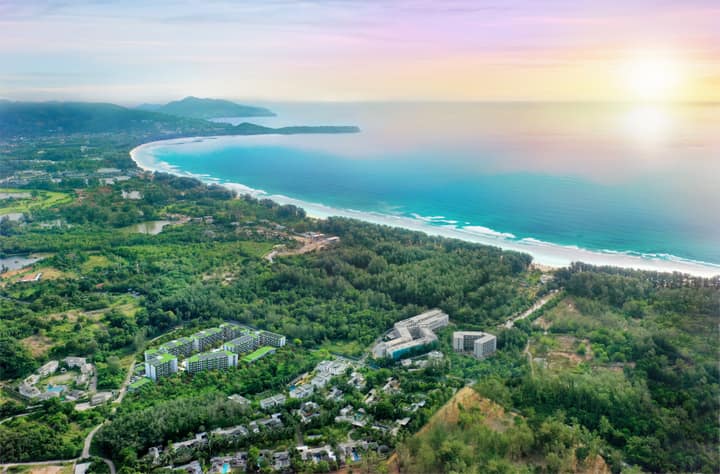
- Phuket. A mature resort property market: over 37,000 units of inventory, a developed condo-hotel segment with rental pools, an international airport, and established locations such as Layan and Bang Tao. See the Phuket market in 2026 for details.
- Koh Phangan. A market in its early growth phase: per Nation Thailand, the island counts 41 active projects and 438 units for sale (Q1 2026) — villas dominate (26 projects, 294 units, THB 6.83bn), while condos are almost nonexistent (4 projects, 66 units, THB 380m). For scale, that’s fewer units than a single mid-sized condo-hotel on Phuket.
The difference isn’t one of degree — it’s structural. Phuket sells a complete system: an airport, a management company, a rental pool, a secondary market. Phangan sells an early entry point into one island’s growth cycle, where most of that infrastructure hasn’t been built yet.
2. Logistics: an island with no airport
This is the first and most practical difference, because it shapes construction costs, tourist flow, and ultimate liquidity all at once.
- Phuket (HKT) — an international airport with direct flights from Europe, China, Russia, India and the Middle East. High throughput keeps tourist flow stable even in the off-season.
- Koh Phangan — has no airport of its own at all. The only way in is by ferry: from Samui (USM airport, privately owned by Bangkok Airways) it takes 20–60 minutes depending on the operator; from mainland Surat Thani, a combined bus-and-ferry trip takes around 3 hours with the fastest operator, Lomprayah, and up to 7 hours with others; from Chumphon airport, 5–8 hours. During monsoon season, ferry services are periodically suspended for storm warnings, which hits guest arrivals and construction-material logistics directly.
For an owner this means: on Phuket, guests fly in directly and cheaply, keeping short-term rental turnover high year-round. On Phangan, every guest carries “double” logistics (a flight to Samui or the mainland, plus a ferry), and any storm can cut the island off from schedule for a day or two — a factor that can’t be solved with money, only priced into the occupancy model.
3. Entry price: land and villas versus a condo-hotel
The two markets trade in different assets. On Phuket, an investor typically chooses between a villa and a condo-hotel with a ready-made financial model; on Phangan, it’s almost always a choice between a villa and a plot of land for development, because condominiums are structurally scarce there.
| Parameter | Phuket | Koh Phangan |
|---|---|---|
| Dominant format | Condo-hotels with rental pools + villas | Villas (26 of 41 projects) and land plots; condos are rare |
| Typical villa | Wide range, from compact units to luxury villas with a management company | From |
| Beachfront land | Rarely sold directly to a foreigner outside a developer project | THB 20,000–40,000/sqm on average (2024 data); sea-view plots up to 1 rai (~1,600 sqm) reach THB 8–10m at peak demand |
| Developer installments | Standard (35%+35%+30% and similar schemes) | Offered by some newer projects, but not a market norm |
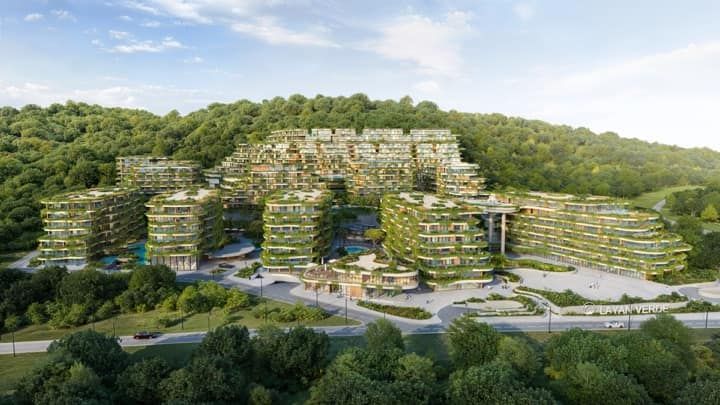
For example, Layan Verde on Phuket offers premium studios from 36.2 sqm starting at $235,995 with installments during construction, while Layan Green Park is a working eco condo-hotel where phase-1 studio resales start at $142,602 and the developer’s phase 2 starts at $224,043. Phangan has no comparably large, transparent supply: the market consists mostly of individual villas and land lots for self-build, each with its own bespoke deal terms rather than a standard price list.
4. Yield and management model
- Phuket. The flagship model is a rental pool: identical unit types are pooled, and owners receive 60% of net profit, with the management company taking 40%. The benchmark for completed properties is ~8–10% net a year, with payback around 12 years.
- Koh Phangan. There is no large-scale rental pool — management is almost always individual, through a local operator or the owner directly. Occupancy is heavily tied to the calendar: peak spikes around the Full Moon Party (roughly monthly) sit alongside a growing but still niche demand from wellness guests and digital nomads who stay for weeks or months rather than a weekend. The result: yield can be higher in specific weeks, but noticeably more volatile on an annual basis, since there’s no transparent pool formula or reporting.
The difference is structural: on Phuket, income is a system (a pool, reporting, a management company with a track record); on Phangan, it’s almost always a specific property and a specific manager, whose risk and yield are hard to verify before the deal.
5. Ownership structure: leasehold with almost no alternative
The legal framework is the same across Thailand: the Land Code Act bars a foreigner from registering land in their own name, while a condominium can be held as freehold within the 49%-of-floor-area quota. See freehold vs leasehold for the mechanics.
The difference between the islands isn’t the law — it’s what there is to choose from in the first place:
- On Phuket, a developed condo segment gives buyers a wide choice of freehold options near the sea; the alternative for villas is leasehold or an ownership structure through a Thai company, but that’s a deliberate choice among many options.
- On Phangan, condos are scarce (4 projects, 66 units on the whole island, per Nation Thailand), so freehold as such is available to only a handful of buyers. The overwhelming majority of villa and land deals run through a 30-year leasehold with renewal options — not an alternative, but effectively the only practical route for a foreigner, which calls for especially careful legal review of the contract and the renewal structure.
6. Tourist flow: from Full Moon Party to wellness hub
For decades, Phangan has been synonymous with one event: the Full Moon Party on Haad Rin beach, which historically drew tens of thousands of people in a single night and shaped the island’s image as a low-spend, short-stay backpacker destination. That tourist flow still exists and keeps occupancy up on specific calendar dates, but it builds poor ownership economics: guests come for one night, not a month.
The more interesting shift for an investor is rising demand from a different audience. Per Nation Thailand, the Sri Thanu and Haad Yao zones on the west/northwest coast are becoming a recognized hub for digital nomads and wellness guests — yoga retreats, co-working spaces, and long-term villa rentals measured in months. Among property buyers, a group of investors from Israel, Europe and Australia stands out, more often holding a property for long-term personal use paired with professional rental management rather than as a purely speculative asset.
Phuket plays in a different league on diversification: the island absorbs mass international tourist flow — family, luxury, business — through direct flights, which smooths seasonal dips and isn’t tied to one niche segment or event calendar.
7. Infrastructure and quality of life
Phuket is a mature infrastructure market: international schools, major hospitals such as Bangkok Hospital Phuket, malls, and established expat areas like Layan and Bang Tao. See the detailed guide where to stay in Phuket.
Phangan is noticeably more compact: there’s no large multi-specialty hospital on the island — serious cases are evacuated by ferry to Samui or the mainland — and international schools are scarce. The island’s infrastructure hub is Thong Sala (port, market, banks, basic services) and Baan Tai, but at a scale nowhere near Phuket’s. For an investor planning to live in the property part of the year, not just rent it out, this matters: Phuket covers healthcare, education and everyday services; Phangan, so far, does not.
8. Comparison table
| Parameter | Phuket | Koh Phangan |
|---|---|---|
| Airport | International, dozens of destinations | None; ferry from Samui or the mainland |
| Access during storms | Not an issue | Ferries suspend under storm warnings |
| Dominant format | Condo-hotels + villas | Villas and land; condos are rare |
| Income model | Rental pool, ~8–10% net, ~12-year payback | Individual management, high volatility |
| Ownership structure | Freehold quota + leasehold, wide choice | Almost exclusively 30-year leasehold |
| Market size (Q1 2026) | 37,000+ units of inventory | 438 units, 41 projects, THB 7.94bn |
| Tourist flow | Diversified, international | Full Moon Party + a growing wellness/nomad segment |
| Infrastructure | Mature (schools, hospitals, retail) | Compact, no major hospital |
| Exit liquidity | Higher, developed secondary market | Lower, small and young market |
9. Pitfalls
- Confusing a land plot with ready-to-build permission. A land seller on Phangan doesn’t always guarantee a building permit for the area you need — verify zoning and permits before wiring any money.
- Signing a leasehold without legal review of the renewal options. A 30-year contract with no clearly written renewal mechanism is legally weaker than a seller’s pitch suggests — it needs its own due diligence, similar to due diligence on Phuket.
- Calculating yield off Full Moon Party peak weeks. High occupancy on party nights doesn’t mean high annual yield — work from actual 12-month figures, not the best weekend.
- Underestimating construction logistics. Building materials reach Phangan by ferry, which raises costs and extends timelines compared with Phuket, where materials arrive directly by bridge.
- Ignoring exit liquidity. Phangan’s market is small (438 units on the whole island as of Q1 2026) — there are far fewer buyers on resale than in Phuket’s mature secondary market.
- Treating Colliers’ forecast as a guarantee. The “Phuket five years ago” comparison is an analyst’s judgment based on current momentum, not a guaranteed repeat of that growth.
10. Case study: choosing between the islands
An investor with a budget of around $230,000 was weighing a land plot on Phangan’s west coast for a self-built villa against a studio in a working condo-hotel on Phuket. The land looked attractive on price per square meter and the island’s growth story — but due diligence found the plot could only be held via a 30-year leasehold with no written renewal mechanism, building the villa meant a standalone 12–18-month project with materials shipped in by ferry, and renting out the finished property would mean going through a local operator with no transparent reporting — all at the investor’s own risk in the off-season, once the Full Moon Party crowd had moved on. A studio resale at Layan Green Park near Layan Beach, by contrast, plugged straight into a working rental pool with a ~8–10% net benchmark and a clear 60/40 formula — no construction, no ferry, no dependence on a single calendar event. The investor chose Phuket, not because the Phangan idea was bad on its own, but because their goal was predictable passive income from year one, not participation in a niche market’s early growth cycle.
Bottom line. Phangan and Phuket aren’t head-to-head competitors — they’re different bets. Phangan may suit someone who believes Colliers’ forecast of a repeat Phuket-style growth cycle and is willing to live with no airport, leasehold with no real alternative, and an early-stage market, in exchange for a low entry price. Phuket is the choice for an investor who wants systemic yield, liquidity and infrastructure proven over decades, not potential.
I can help compare specific Phuket properties for your budget and goal, with a yield calculation in the ROI calculator — or let’s discuss strategy through Layan Real Estate.
Find the right fit for your strategy
By submitting the form, you agree to the privacy policy.