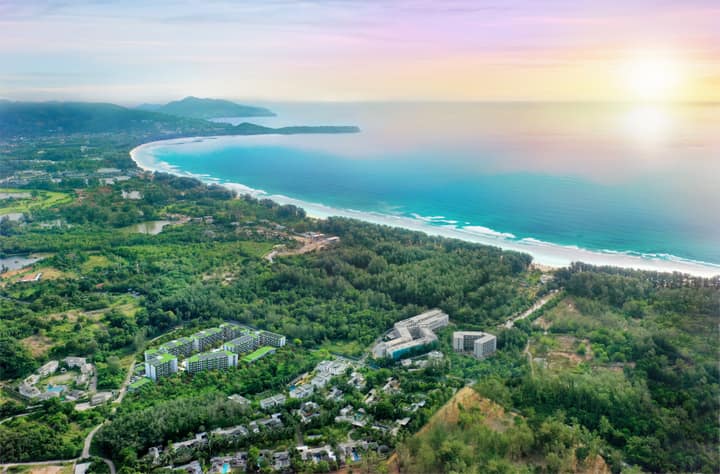
“How do I get from Bangkok to Phuket” sounds like a simple question, but the honest answer depends entirely on who is asking. A tourist with a suitcase weighs price against comfort. A villa or condo owner flying in for their allotted 30 days a year thinks about flight frequency and a backup plan if the main one gets cancelled. And an investor who hasn’t bought yet, but is comparing districts, needs to understand something less obvious: logistics is not a lifestyle detail — it is one of the factors that determines how easily a unit fills with renters, and how quickly the owner can reach the property if something needs attention. This guide covers every real way to travel from Bangkok to Phuket — flying, bus, train-plus-bus, and driving — with honest numbers on time and cost, plus a look at how air connectivity, and the second airport now under construction, shape the investment case for specific districts, above all the island’s northwest, home to Layan and Bang Tao.
Contents
- Every way to get there: overview
- Flying: routes, timing, frequency
- Train and bus: the realistic timeline
- Driving and private transfer
- Comparing the options: table
- From Phuket airport to Layan and Bang Tao: the last mile
- Why logistics is an investment factor
- Phuket’s second airport: what changes by 2030
- Pitfalls: common logistics mistakes
- Mini case study and conclusion
1. Every way to get there: overview
Bangkok and Phuket sit roughly 860 km apart by road and about 680 km as the crow flies. Over that distance, four genuinely different options exist:
- Flying — the only option if time is worth more than money. This is how the vast majority of visitors travel, including nearly every international tourist who lands in Bangkok first and connects onward to Phuket.
- VIP bus — a budget option for travellers in no hurry: an overnight ride of 12–14 hours.
- Train plus bus — an option “for enthusiasts”: the train only reaches Surat Thani, and a bus covers the rest. Slower and more complicated than a direct bus, but it can make sense as part of a longer route through southern Thailand.
- Private car or transfer — 10–12 hours behind the wheel, used mostly by expats and villa owners relocating with belongings or pets.
Below is a closer, honest look at each option — not the marketing-brochure minimum.
2. Flying: routes, timing, frequency
A direct Bangkok–Phuket flight is the fastest and by far the most common option: 1 hour 20 minutes to 1 hour 35 minutes each way. Flights operate from both Bangkok airports:
- Suvarnabhumi (BKK) — Thai Airways, plus a share of Thai AirAsia and Thai Lion Air flights.
- Don Mueang (DMK) — the main low-cost hub: Thai AirAsia, Nok Air, Thai VietJet.
The schedule is dense: departures start around 06:30 and continue until 22:00, spaced roughly every 20–40 minutes during peak season. That frequency is more than a convenience — it means an owner enrolled in a rental program can fly out on nearly any given day without long-range planning, and tourist flow isn’t hostage to one or two flights a day the way it is on less developed Southeast Asian routes.
One detail worth flagging for anyone comparing fares: pricing on the Bangkok–Phuket route swings sharply with booking date and season. In low season (May–October), a low-cost fare can undercut the price of a taxi ride across Bangkok itself; in high season (November–April), particularly around New Year and Chinese New Year, prices can jump 3–5x, and seats on the most convenient morning and evening departures sell out well in advance. If you own a villa and plan to fly in during high season, it pays to book 2–3 months ahead rather than a week out.
There are also connecting itineraries via Krabi, Surat Thani, or Chiang Mai, which make no sense for a straightforward Bangkok–Phuket trip but occasionally appear within multi-city itineraries for travellers combining Phuket with mainland Thailand or other islands.
3. Train and bus: the realistic timeline
Worth clearing up a common misconception right away: there has never been a direct train to Phuket, and there still isn’t one. Thailand’s rail network (State Railway of Thailand) doesn’t reach the island at all — the nearest major station is in Surat Thani, roughly 300 km from Phuket. The classic “train plus bus” route looks like this:
- Overnight train Bangkok → Surat Thani: 10–12 hours, second-class sleeper cars — the most comfortable budget option for anyone who wants to sleep through the journey.
- Bus or minivan Surat Thani → Phuket: another 5–6 hours, including a ferry crossing or bypass route depending on the operator.
All told, that’s 15–18 hours one way with a transfer — longer and less predictable than a direct bus. This route only really makes sense for travellers combining Phuket with other stops in southern mainland Thailand, such as Khao Sok or Krabi along the way.
A direct Bangkok–Phuket bus is a more straightforward budget option: VIP buses from Bangkok’s bus terminals (Southern Bus Terminal, and partly Mo Chit) run overnight, taking 12–14 hours. Buses range from standard air-conditioned coaches to VIP services with reclining seats and minimal stops. Fares are noticeably cheaper than flying, but given the travel time, this is almost never the choice of investors or property owners making regular trips — it’s mainly used by budget-conscious tourists or travellers who simply avoid flying.
4. Driving and private transfer
The driving route follows Highway 4 (Phetkasem Highway) through Chumphon, Surat Thani, and Phang Nga, crossing onto Phuket island via the Sarasin Bridge — the island’s only land link to the mainland. The distance is around 860 km, and the drive takes 10–12 hours excluding food and fuel stops; expect congestion approaching the bridge on Friday evenings ahead of long weekends and at the start of high season.
Who actually uses this option:
- Expats and villa owners relocating with personal belongings, furniture, or pets — flying pets is more complicated and expensive, so driving sometimes turns out to be more practical.
- Travellers combining several stops — Hua Hin, Chumphon, Krabi — as part of one longer trip through the south.
- Private transfer drivers, who offer a Bangkok–Phuket transfer as a premium alternative to the bus: more comfortable, but pricier and no faster.
For a one-off trip to view a property or sign paperwork, driving is almost never the rational choice — flying wins on both time and how fatigued you arrive.
5. Comparing the options: table
| Option | Travel time | Price benchmark | Best for |
|---|---|---|---|
| Direct flight | 1h20m–1h35m | anywhere from a budget low-cost fare to a high-season premium | the vast majority of tourists, every property owner, investors |
| Direct VIP bus | 12–14 hours | noticeably cheaper than flying | budget travellers, those who avoid flying |
| Train + bus (via Surat Thani) | 15–18 hours | mid-range, sleeper car plus bus fare | combined routes through southern Thailand |
| Private car / transfer | 10–12 hours driving | fuel and toll costs, or a transfer fare | relocating with belongings, pets, multi-city trips |
Reading the table is simple: if you’re flying for a deal, a property viewing, or a short visit to your own unit, there’s really one option — flying. The other three are choices for people whose time isn’t critical, or who have a secondary goal (moving belongings, seeing southern mainland Thailand along the way).
6. From Phuket airport to Layan and Bang Tao: the last mile
Landing at HKT is only part of the journey — getting to a specific district still takes time, and distances across the island vary enormously. The island’s northwest — Layan, Bang Tao, Mai Khao — sits closest to the airport:
| District / property | Distance from HKT | Drive time |
|---|---|---|
| Mai Khao (closest beach to the airport) | ~5 km | ~10 minutes |
| Bang Tao / Laguna | ~13 km | ~15–20 minutes |
| Layan (Layan Verde, Layan Green Park) | ~14 km | ~20–23 minutes |
| Patong | ~32 km | ~40–45 minutes |
| Rawai / Nai Harn (south of the island) | ~45 km | ~55–65 minutes |
| Phuket Town | ~30 km | ~35–40 minutes |
For comparison: the drive from the airport to the island’s southern districts during rush hour can take longer than the flight from Bangkok itself. That’s a difference a tourist feels on day one of a holiday — and one a rental-pool guest remembers when deciding where to book next time. For a closer look at the areas, see Layan beach guide and Bang Tao beach guide, and for how well districts connect to each other across the island, see getting around Phuket.
7. Why logistics is an investment factor
At first glance, flight time from Bangkok looks like a tourist’s concern, not an investor’s. In practice, it ties into at least three things that directly affect a property’s yield.
Flight frequency equals a stable flow of guests. A dense schedule (departures every 20–40 minutes at peak, running 06:30 to 22:00) means a tourist can change plans, rebook, or fly in on short notice — which keeps a rental pool’s occupancy up regardless of whether the guest flew in directly from their home country or connected through Bangkok. On routes with only one or two flights a day, demand is far more fragile: a cancelled flight or a schedule change from a single carrier can crater an entire season’s occupancy.
Distance from the airport to the district is part of a renter’s decision. Guests booking a 5–10 day stay, all else equal, favour districts with a short transfer from the airport — this applies both to the initial trip and to repeat bookings within a single visit (a day trip to Phi Phi and back, for example). The island’s northwest — Layan, Bang Tao, Mai Khao — systematically wins out over the southern districts on exactly this metric, and that shows up in rental demand.
Convenience for the owner. Under the rental-pool models used by Layan Verde and Layan Green Park, owners get 30 days of personal stay per year — and short, predictable air links to Bangkok (and through it, the rest of the world) directly determine whether that right is something an owner can actually use, rather than a line in a brochure.
Bangkok’s role as a hub is worth flagging separately: most international guests fly to Phuket via Suvarnabhumi or Don Mueang, even where direct international flights into HKT exist from some countries. That makes the stability and pricing of the domestic Bangkok–Phuket leg itself a real part of the logistics chain that shapes overall tourist arrivals on the island — not a side detail. For the broader market picture, and how tourist flow translates into rental demand, see Phuket real estate market 2026: numbers, trends, forecast.
8. Phuket’s second airport: what changes by 2030
One of the island’s most significant infrastructure projects on a multi-year horizon is Andaman International Airport in Phang Nga province, north of Phuket. Building a second runway on HKT’s own site is technically impossible because of the surrounding terrain, so Thai authorities chose a different route: building an entirely separate airport.
Key facts on the project, based on Thai government statements and reporting from Thai media:
- The project is being carried out by state-owned Airports of Thailand (AOT), with construction in the Khok Kloi sub-district, Takua Thung district, Phang Nga province.
- HKT currently handles around 12.5 million passengers a year — noticeably above the terminal’s designed capacity, which creates queues during peak arrival and departure hours.
- Once the new airport opens, the two airports combined are planned to handle roughly 18 million passengers a year.
- According to Thai transport authorities, once Andaman International Airport reaches full capacity, HKT could shift primarily to domestic flights, with a significant share of international traffic moving to the new airport.
- The targeted opening is around 2030 — meaning this is a 4+ year horizon, not a factor relevant to next season.
For an investor looking at the island’s northwest — Layan, Bang Tao, Mai Khao — this isn’t an abstract news item. The new airport sits to the north of HKT, geographically closer to precisely these districts than to Patong or the island’s south. If the traffic-shift scenario plays out as described, the areas around Layan and Bang Tao beaches would gain a shorter transport link to the island’s primary airport over the medium term — a factor worth keeping in mind when choosing a location for the long haul, not just for today’s commute.
One important caveat: timelines for large infrastructure projects slip in every country, and 2030 is a target date, not a guarantee. Treat the second airport as a plausible, but not guaranteed, upside for the location — not a fact to bake directly into a financial model.
9. Pitfalls: common logistics mistakes
- Planning a property visit for “any day.” During high season (December–January, April), fares and seat availability on convenient flights differ sharply from low season — book ahead if the date is tied to a specific deal or meeting.
- Not building in a backup flight for important dates. Signing a contract, or a handover inspection with the developer (see the handover checklist), isn’t the kind of event to schedule on the last flight of the day with no fallback.
- Assuming the train is a fast option. Rail simply doesn’t reach the island; “train to Phuket” always means train plus bus, and it’s slower than a direct bus.
- Underestimating traffic from the island’s south to the airport. Owners with property in the south (Rawai, Nai Harn) should build in more than an hour to the airport during high season and rush hour.
- Driving from Bangkok “to save time.” 10–12 hours behind the wheel is almost always slower and more tiring than flying — this option is justified only when relocating with belongings or pets.
- Ignoring the difference between HKT and the future Andaman International Airport when choosing a district. With a 5+ year investment horizon, it’s worth factoring in that access to the second airport would disproportionately benefit the island’s northwest.
10. Mini case study and conclusion
An investor from London was weighing a rental studio purchase between a southern district and Layan. On paper, the southern option looked more attractive on price per square metre. The difference only became clear once the full trip cycle was factored in: the drive from the airport to the southern district ran over an hour during high season, and the investor planned to use their 30 days of personal stay not as one block, but as several short visits — flying in for a weekend to inspect the property, flying back to handle business in Bangkok, and returning a week later. Under that pattern, a 40-minute difference each way between the airport and Layan versus an hour-plus to the island’s south added up to several extra hours a year spent in traffic rather than on the beach or in meetings with the management company. The choice ultimately fell on Layan Green Park — where phase 2, priced from $224,043 as of the 1 September 2026 price list, sells studios with a short transport link to HKT (~20–23 minutes): not a minor convenience, but part of the financial model, since an owner’s time saved on logistics is just as real as savings on the CAM fee.
Bangkok–Phuket logistics is one of those rare cases where the tourist question and the investment question line up almost word for word. A fast, dense flight schedule keeps tourist flow stable, a short drive from the airport widens the pool of potential renters, and the prospect of a second airport in Phang Nga is upside specifically for the island’s northwest, home to Layan and Bang Tao. When choosing a property, it’s worth looking beyond price per square metre and the view from the window, to how long the trip from Suvarnabhumi to your future unit’s doorstep will actually take — and how often you’re prepared to make that trip.
We’ll map the logistics and economics of a specific property to your travel pattern — run the numbers in the ROI calculator and get the current price list. Leave a request or see how the Layan Real Estate agency works.