“How much money do you need to retire in Thailand?” has no single right answer, because the question mixes two different things: a formal visa threshold and an actual cost of living. Some people manage on $800/month, others spend $3,000+, and both live in Thailand legally and comfortably by their own standard. Here is the breakdown: the visa money requirements, a monthly budget across scenarios, one-time setup costs, and a rough capital target for the years ahead — factoring in that a ready unit in a rental pool can offset part of that capital with rental income.
Contents
- Capital vs monthly budget: don’t confuse them
- Visa threshold: 800,000 THB or income
- Alternatives: DTV and LTR
- Monthly budget: three scenarios
- Housing: renting drains the budget, buying can earn income
- Health insurance: a growing line item
- One-time setup costs
- How much capital you actually need
- Traps
- Mini case and takeaway
1. Capital vs monthly budget: don’t confuse them
The first mistake in any calculation is mixing up money “for the visa” with money “for living.” They are two independent requirements:
- Visa threshold — funds on deposit or verified income that unlock long-term stay. Not spent directly on food or rent — it is financial proof for immigration.
- Living budget — what actually goes out each month on housing, food, insurance, transport and utilities.
- Capital for the years ahead — the amount that needs to cover the living budget over the full planning horizon if there is no steady income from abroad.
The rest of this guide covers all three separately, starting with the formal visa requirement, the most common source of confusion.
2. Visa threshold: 800,000 THB or income
The classic Thailand retirement visa (Non-O/O-A) requires one of two paths:
| Criterion | Amount | Note |
|---|---|---|
| Deposit in a Thai bank account | 800,000 THB (~$23,880) | Must season 2 months before the first application, 3 months before renewal |
| Verified income | from 65,000 THB/month (~$1,940) | A pension/income letter instead of a deposit |
| Combination | Deposit + income totalling 800,000 THB/year | For applicants without the full deposit |
This money is not a living budget — it is financial proof for immigration. It cannot be spent on rent or food directly; the balance has to stay untouched through the checkpoint periods.
3. Alternatives: DTV and LTR
The retirement visa isn’t the only route to a long stay in Thailand, and for some profiles other categories work out cheaper:
- DTV — for remote workers who don’t necessarily meet the 50+ age bar. Deposit from 500,000 THB (~$14,930) with no seasoning period, 5-year visa with 180-day entries.
- LTR — for wealthier applicants: assets from $1 million (Wealthy Global Citizen) or income from $40,000–80,000/year (Wealthy Pensioner, age 50+). Costs more upfront but grants up to 10 years of stay and tax perks on foreign-sourced income.
The visa choice directly changes the capital structure: LTR demands more money at entry but saves time and money on annual renewals; the retirement visa has a lower threshold but requires yearly re-confirmation.
4. Monthly budget: three scenarios
Actual living costs don’t match the visa threshold and depend on lifestyle. Reference figures for one person in Phuket:
| Scenario | Profile | Budget/month |
|---|---|---|
| Minimal | Local food, a scooter, basic or existing housing, basic insurance | $700–1,000 |
| Comfortable | Owned housing near Layan–Bang Tao, mixed cuisine, full insurance | $1,300–2,000 |
| Premium | A villa or larger unit, a car, comprehensive insurance, dining out | $2,500–3,500+ |
For the detailed line-by-line methodology, see Thailand’s cost of living for one person; for whether the tightest scenario is realistic, see living in Phuket on $1,000/month.
5. Housing: renting drains the budget, buying can earn income
Housing is the largest line item in almost every scenario, and the models differ fundamentally:
- Renting — flexible, no large upfront capital, but it fully leaves the budget every month with nothing left for the years ahead.
- Buying for personal use — a one-time capital outlay, then only utilities and condo fees, no rent payments.
- Buying into a rental pool — the same one-time capital, but the unit partly or fully pays for itself with rental income during periods the owner isn’t using their personal-stay allowance. Reference yield — roughly 8–10% net a year through the 60/40 model (60% of pool profit to the owner, 40% to the management company), payback around 12 years.
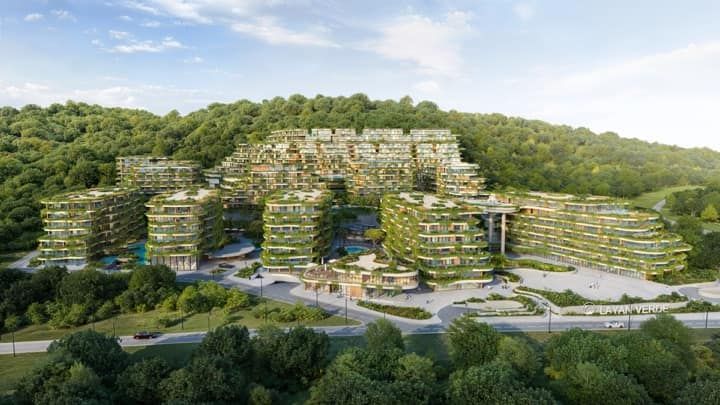
Over a long horizon (10+ retirement years), a ready unit at Layan Green Park or the under-construction Layan Verde is a way to ease the pressure on capital: part of the monthly budget gets covered by rental income instead of drawn from savings. Run your own numbers in the yield calculator.
6. Health insurance: a growing line item
Policy cost rises with age, and without coverage a single serious hospitalisation can wipe out several years of savings:
- budget $100–300+/month per adult depending on age and coverage;
- O-A applicants filing abroad must show insurance on entry — a minimum of $100,000 or 3,000,000 THB in coverage;
- private hospitals in Phuket are high quality but not cheap — the public system is built for residents, not tourists and non-immigrant visa holders.
For more on how healthcare is organised on the island, see healthcare in Phuket.
7. One-time setup costs
Beyond the monthly budget, there are costs that hit once at the start and often fall outside the first calculation:
- visa costs (fees, agent services, a flight abroad to apply for O-A);
- relocation and initial setup (rental deposit, furniture if the unit is unfurnished);
- the first year’s health insurance premium paid upfront;
- legal support for a purchase running in parallel with the visa process.
A reasonable buffer for the start is $3,000–8,000 on top of the monthly budget, depending on whether housing is bought right away or rented first while scouting the market.
8. How much capital you actually need
Without a steady income from abroad, capital needs to cover the living budget over the full planning horizon. A rough rule of thumb is annual budget times the number of years, with a cushion for inflation and emergencies:
| Scenario | Budget/year | Capital for ~15–20 years (reference) |
|---|---|---|
| Minimal | $8,400–12,000 | $150,000–240,000 |
| Comfortable | $15,600–24,000 | $280,000–480,000 |
| Premium | $30,000–42,000+ | $550,000–840,000+ |
This is an illustrative planning estimate, not investment advice — the actual figure depends on inflation, returns on savings, and any additional income. Rental income from a ready unit in a rental pool reduces the capital required by covering part of the monthly cost without drawing down the core sum — see the model in detail in the rental management programme.
9. Traps
- Confusing the visa threshold with the living budget. 800,000 THB on deposit isn’t money for food and rent — it is a separate requirement that cannot be touched.
- Calculating capital without insurance. Skipping a policy is the fastest way to wipe out savings at the first serious incident.
- Ignoring seasonality and exchange rates. Costs in Phuket swing ±15–20% between seasons, and capital held in foreign currency depends on the THB rate at the time of spending.
- Planning with no emergency buffer. AC repairs, an urgent flight home, changing visa rules — line items that rarely make the first calculation.
- Treating rental income as guaranteed. The 8–10% reference through the 60/40 pool is a model, not a fixed rate; the actual figure depends on seasonal occupancy.
10. Mini case and takeaway
A couple, aged 55 and 52, Ukrainian nationals. Planned budget: the comfortable scenario, $1,800/month for two plus insurance. Instead of renting for years, they bought a ready resale studio in Phase 1 of Layan Green Park — the unit went straight into the rental pool. For the first two years the couple spends most of their time in Europe, the unit is mostly rented out and produces income that covers part of the monthly budget without touching the core capital. Once they relocate to Phuket full-time, they use their personal-stay allowance, and pool income drops in proportion to the days the unit isn’t rented.
Takeaway: “how much money you need to retire in Thailand” is a three-layer question: the visa threshold (from 800,000 THB), the monthly budget ($700–3,500+ depending on scenario), and capital for the years ahead ($150,000–840,000+ on a rough estimate). A ready unit in a rental pool near Layan Beach isn’t a requirement, but it is a working way to ease the pressure on savings through rental income.
Let’s run the numbers for your situation — visa route, monthly budget and the yield on a ready unit — leave a request and the Layan Real Estate team will put the figures together for you.
This material is for informational purposes only and does not constitute financial, legal or visa advice. Visa requirements and costs change periodically — confirm current conditions with a qualified specialist before planning. Property prices are as of the 01.09.2026 price list — verify at the time of the deal.