For a tourist, Phuket airport is simply the gateway to a holiday — land, collect the bag, get in a taxi. For the owner of a villa or condo in a rental program, it is an entirely different object of attention: how many destinations connect the island to the world directly, how much capacity the terminals actually have, and how fast a guest can get from the jet bridge to the district where the property sits. An airport with a growing number of direct routes from different countries is not just an attractive statistic — it is the actual engine behind rental-pool occupancy: the wider the geography of guests, the less any single property depends on demand from one country. This guide looks at Phuket airport (HKT) from exactly that angle: where it flies, what its infrastructure and capacity look like, what is happening with the expansion, how to get from it to Layan and Bang Tao without overpaying, and why all of this belongs in an investment decision, not just holiday logistics.
Contents
- Phuket airport at a glance
- Terminals and capacity
- Where HKT flies: the route map
- Passenger traffic and the 2026 records
- From the airport to your district: taxi, Grab, transfer, car rental
- Immigration, visa on arrival, and practical details
- The second airport: Andaman International in Phang Nga
- Why the airport’s route network is a yield factor
- Pitfalls
- Mini-case and conclusion
1. Phuket airport at a glance
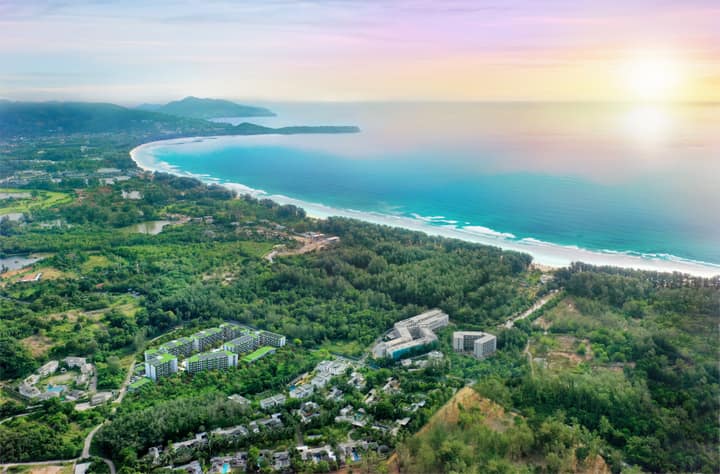
Phuket International Airport (code HKT) sits on the north of the island, between Mai Khao and Bang Tao beaches — which makes it geographically closer to the northwest coast, home to Layan and Bang Tao, than to the island’s southern and eastern districts. It is run by Airports of Thailand (AOT), the state company that also operates the country’s five other major airports, including Suvarnabhumi and Don Mueang in Bangkok.
HKT is Thailand’s second-busiest airport after the Bangkok hubs and the main air gateway to the Andaman coast: beyond Phuket itself, a large share of tourists and property owners heading to Krabi, Phang Nga, and nearby islands transit through it. For the property market, that means the state and development of this specific airport — not some abstract “Thailand tourism appeal” — largely drives rental demand across the island’s entire west coast.
Structurally, the airport has a domestic terminal and an international terminal standing side by side, sharing an arrivals area for those meeting guests, taxi ranks, and a transfer zone. That layout makes connecting between a domestic and an international flight easier for anyone routing through Bangkok — but it is the same layout that becomes a bottleneck during high-season peak hours, when several wide-body aircraft land at once.
2. Terminals and capacity
HKT’s core problem in recent years is the gap between design capacity and actual passenger throughput. The terminals were originally built for a certain volume of simultaneous flights, but arrivals to the island have grown faster than the infrastructure could be upgraded. According to Airports of Thailand, design capacity sits at roughly 12.5 million passengers a year, while actual high-season load already regularly exceeds that benchmark.
The response is a renovation and expansion program, part of AOT’s broader investment plan across several of the country’s airports. For Phuket, the goal is to raise terminal capacity to around 18 million passengers a year, with investment in this phase estimated at roughly THB10 billion.
| Metric | Current state | Target after expansion |
|---|---|---|
| Design capacity | ~12.5 million passengers/year | ~18 million passengers/year |
| AOT investment in this expansion phase | — | ~THB10 billion |
| Estimated completion | — | by around 2029 |
| Daily traffic record (14 Feb 2026) | 393 flights, 71,613 passengers | — |
Here is how an investor should read that table: terminal expansion is not an abstract construction project — it is a direct signal that the regulator recognises sustained excess demand for air travel to the island and is willing to commit state funds to it for years to come. Until the renovation is complete, peak high-season days (New Year, Chinese New Year, European Christmas holidays) will keep producing queues at immigration and baggage claim — plan for that rather than treating it as a one-off glitch.
3. Where HKT flies: the route map
Phuket airport’s route network has expanded noticeably in recent years and keeps growing in 2026 — not just through charters, but through scheduled service to new destinations.
Domestic flights connect Phuket with both Bangkok airports (Suvarnabhumi and Don Mueang), as well as Chiang Mai, U-Tapao (for those heading on to Pattaya), and several other Thai cities — a detailed breakdown of the Bangkok route specifically, including frequency and fares, is in our Bangkok to Phuket guide.
International destinations have diversified noticeably:
| Region | Examples of direct routes (2026) |
|---|---|
| Russia | Moscow, St Petersburg, Yekaterinburg, Novosibirsk, Irkutsk, Krasnoyarsk, Khabarovsk, Vladivostok — year-round service |
| Middle East | Doha, Dubai, Istanbul |
| Asia | Ho Chi Minh City (scheduled service from April 2026), Bengaluru (from June 2026), plus Singapore, Hong Kong, and other regional hubs |
| Europe | new and expanded 2026 routes, including seasonal service to London (Heathrow) from autumn |
Route diversification has been the trend of the past couple of years: airlines keep adding direct flights from cities that used to require a Bangkok connection. For a property owner, that means a broader, more resilient base of potential tenants and buyers than a few years ago, when the island was more heavily tied to one or two key source markets.
4. Passenger traffic and the 2026 records
On 14 February 2026, Phuket airport set a new daily record: 393 flights (146 domestic and 247 international) and 71,613 passengers (23,031 domestic and 48,582 international) — surpassing the previous 2019 record of 374 flights and 71,387 passengers. Phuket Governor Nirat Pongsitthaworn tied the growth to the island’s familiar strengths — the sea, the climate, the food, and local hospitality — and set a target of 14 million tourists for 2026.
For an investor, what matters in these numbers isn’t the record itself but what it shows: demand for the island has already surpassed pre-pandemic highs and keeps growing, on both the domestic and the international side at once. That is confirmed, actual demand, not an analyst’s forecast — and it’s exactly what underlies the terminal expansion discussed above. The broader picture of how tourist arrivals translate into property prices and rental rates is covered in Phuket real estate market 2026: numbers, trends, forecast.
There is a flip side to the growth worth noting: record traffic means heavier load on airport infrastructure precisely when passenger volume is highest — that is, during high season, which is also when owners most often plan to use their own days of personal stay. Build in extra time for immigration and terminal queues when planning such trips.
5. From the airport to your district: taxi, Grab, transfer, car rental
Landing at HKT is only the start of the journey — next comes getting to the actual district, and here a guest or owner has several options with different trade-offs between price, predictability, and convenience.
| Method | Price tier | Predictability | Notes |
|---|---|---|---|
| Official taxi counter in arrivals | mid-range | high — fixed fare by zone | look for the counter, don’t take offers from people at the terminal exit |
| Pre-booked transfer (hotel, management company, agency) | mid-to-above-average | maximum — price and time known in advance | meet-and-greet with a name board; convenient with luggage or kids |
| Grab (app-based) | market rate, often below the taxi counter | high — price is locked in the app before the ride | requires mobile data/eSIM right after landing |
| Car rental | depends on vehicle class and rental period | moderate | requires an international driving permit; get full insurance up front |
| Public minivan/shuttle | cheapest | lower — fixed schedule, transfers | typically covers Patong and central destinations, not a direct route to Layan or Bang Tao |
From the airport, Bang Tao is about 15–20 minutes by car, and Layan is around 20–23 minutes — among the closest west-coast districts to the airport, covered in more detail with a full distance table for every district in our Bangkok to Phuket logistics guide.
The main practical rule: agree on a taxi fare at the official counter in arrivals or through an app — not with someone who approaches you at baggage claim offering a “cheap” transfer. That is exactly where an inflated, meterless, receipt-free fare tends to come from.
6. Immigration, visa on arrival, and practical details
Citizens of many countries do not need a visa in advance for a short tourist visit to Thailand — check the exact conditions for your passport on the official Immigration Bureau portal or a dedicated visa resource before travelling, rather than relying on outdated forum posts: visa-exemption terms and their duration change periodically.
Practical details worth knowing ahead of time:
- Immigration queues run longest right when wide-body international flights land, which coincides with high-season peak hours — allow 30–60 minutes for immigration during those periods.
- SIM cards and eSIM — local carrier counters sit right in the arrivals area; setup takes a few minutes and gives you mobile data immediately for booking a taxi through an app.
- Currency exchange — airport rates are traditionally less favourable than exchange counters in town; for a small amount to cover the first few hours it doesn’t matter much, but for larger sums it’s better to wait until you reach the hotel or town.
- Baggage and terminal transfers — if your flight connects through Bangkok, build in extra time for the connection to account for possible delays on the domestic leg.
For anyone considering a property purchase and planning longer stays, visas go beyond airport logistics — the relevant mechanisms (including visas tied to property ownership) are covered separately in our guides to visas for property owners and the LTR visa.
7. The second airport: Andaman International in Phang Nga
One of the most significant infrastructure projects directly affecting HKT’s future is the construction of Andaman International Airport in Phang Nga province, north of Phuket. The reason for building a separate airport rather than a second runway on HKT’s own site is the terrain around the existing airport, which physically doesn’t allow the airfield to expand.
In short: the new airport is meant to take pressure off HKT, and as it ramps up to full capacity, international traffic may partly shift there, leaving HKT more focused on domestic flights. The estimated opening horizon is the late 2020s, and for the Layan area that’s a separate, long-term factor: the new site sits north of HKT — geographically closer to the island’s northwest than to Patong or the south.
Since this is a substantial topic in its own right, a detailed breakdown of the timeline, capacity, and why it specifically benefits Layan and Bang Tao is in How to get from Bangkok to Phuket, and why it matters for investors, where the second airport gets its own section with tables and timeline caveats.
8. Why the airport’s route network is a yield factor
Three mechanisms link the airport’s route map to actual money in a rental-program owner’s pocket.
Diversification lowers demand volatility. If an airport has direct flights to a dozen countries rather than two or three, a dip in arrivals from one market — say, due to geopolitics, currency swings, or seasonal restrictions — gets partly offset by demand from other regions. An island too dependent on a single source-country of tourists is far more exposed to external shocks; the dynamics of exactly that kind of dependency and its risks are covered in Russian summer travel to Thailand in 2026 and Russia’s share of buyer demand.
Direct flights widen the rental-program guest pool. Every new direct route — from Bengaluru, Ho Chi Minh City, or a European hub — is a market of potential tenants who no longer need to plan a connecting flight. For units in a rental program, such as Layan Verde and Layan Green Park, that directly affects pool occupancy independent of seasonal demand swings in any single country. For more on how these programs and income splits work, see our guide to Phuket’s rental management program, and on occupancy seasonality, Phuket rental seasons.
Growing capacity confirms long-term demand. A government doesn’t commit billions of baht to terminal expansion for a short-term spike: AOT’s investment in upgrading HKT is a bet on sustained tourist-arrival growth for years to come — and, by extension, on sustained rental demand over the same horizon. Run the numbers for a specific unit in our yield calculator.
9. Pitfalls
- Agreeing to a taxi fare at the terminal exit instead of the counter. The price difference can be a multiple; always find the official counter with a fixed zone fare, or book through an app.
- Cutting a connection too close during high season. Peak traffic days coincide with the longest immigration queues — the record day of 14 February 2026 showed just how tight the schedule can get.
- Assuming visa-exemption rules are the same for everyone and never change. Terms depend on nationality and are periodically revised — check current rules before every trip rather than relying on your last one.
- Ignoring the difference between HKT and the future Andaman International Airport when choosing a district for the long term. On a 5+ year horizon, geographic proximity to the new site is a real, if not guaranteed, factor in favour of the island’s northwest.
- Judging a location purely by distance to the beach, without looking at the airport’s route network. Two districts at the same distance from the sea can differ noticeably in rental-demand resilience if one clearly benefits from a growing number of direct international flights and the other doesn’t.
- Exchanging a large sum of currency “for the whole trip” at the airport. Terminal rates are almost always worse than in town — exchange the minimum for the first few hours and do the rest once you’ve arrived.
10. Mini-case and conclusion
An investor from St Petersburg was choosing between two studios at a similar price per square metre: one in the south of the island, the other at Layan Green Park in the northwest. On paper, the only difference was distance to the beach. A closer look showed the second option winning on two fronts at once: travel time from the airport (around 20–23 minutes versus over an hour to the south during high season) and route diversification — flights from his home city to Phuket run year-round, direct, without a Bangkok connection, which simplifies his own visits during his 30 days of personal stay per year. He ultimately chose a phase 2 studio, priced from $224,043 as of the price list dated 1 September 2026 — not just for the price, but because short, reliable air connectivity lowers the risk of empty weeks in low season and makes his own trips logistically simpler.
Phuket airport is not background infrastructure — it is one of the few objective indicators of the local property market’s health: growing traffic, an expanding route network, and government investment in terminal capacity all point to confirmed, not forecast, demand. When choosing a district to buy in, it’s worth looking beyond the sea view and beach distance to how diversified and resilient the air logistics are that bring guests into your rental pool.
We’ll walk through the logistics of a specific district against your own scenario — personal visits, rental-program yield, dependency on specific tourist markets — and run the numbers in our ROI calculator. Leave a request or see how Layan Real Estate works.
This article is for informational purposes only and is not investment advice. Capacity, investment, and passenger-traffic figures reflect the publication dates of the cited sources — check official AOT and Immigration Bureau resources for current numbers. Visa-exemption terms depend on nationality and are subject to change.