Phuket has two faces, and they look in opposite directions. The west coast opens onto the Andaman Sea: wide beaches, sunsets over the water, tourist flow, and virtually all of the island’s resort infrastructure — Patong, Karon, Kata, Kamala, Surin, Bang Tao, Layan. The east coast turns toward Phang Nga Bay: calmer water, no surf, almost no swimming beaches — but deep-water bays for yachts, Koh Kaew’s marinas, and the quiet Cape Panwa peninsula. To a tourist, this is simply “the other side of the island.” To a property buyer, it’s two different assets with different logic for price, income, and logistics. We break down both coasts by the numbers: what things cost, where yield is actually measurable and where you have to build it yourself, and which side fits which goal.
Contents
- Two coasts, one island
- West: beaches, tourist flow, development belts
- East: marinas, privacy, town
- Prices by format: west vs east
- Rental yield: pool model vs self-management
- Logistics: airport, roads, travel time
- Living infrastructure: schools, clinics, community
- Pitfalls when choosing a coast
- Mini case: a villa in Panwa or a studio in Layan
- Conclusion and next step
1. Two coasts, one island
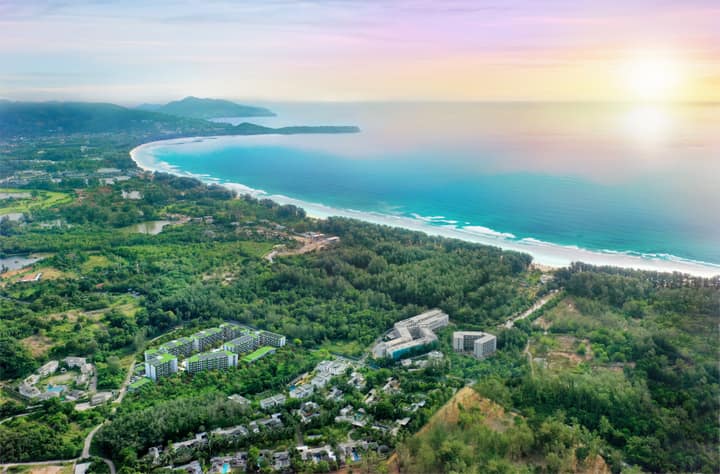
Phuket is an island of roughly 570 km², stretched about 48 km from north to south. A mountain ridge running along the western part of the island physically splits it into two different worlds. To the west lies the open Andaman Sea with no sheltering islands: real surf, wide sandy beaches, dramatic sunsets, and monsoon swells during the rainy season (May–October). To the east, the island faces Phang Nga Bay, sheltered by a chain of limestone islands: the water is calm almost year-round, there’s no meaningful surf, and the shoreline is more often rocky or mangrove-lined.
That geography shaped everything else. The west coast became Phuket’s tourist face: mass tourist flow, hotels, restaurants, beach clubs, and the island’s entire short-term rental industry settled here. The east coast remained the island’s working and residential side: fishing piers, port infrastructure, two yacht marinas, and Phuket Town — the administrative and commercial centre with its historic quarter. The difference isn’t just scenery; it’s the type of buyer. The west mostly sells holidays and income; the east sells quiet and functionality.
It’s worth remembering that neither coast is a monolith. Within the west there’s its own hierarchy of belts, from the quiet north to the tourist hub of Patong; on the east, from business-oriented Phuket Town to the gated Cape Panwa peninsula. We covered the full map of the island’s belts in a separate guide — Phuket district map for buyers. Here we focus specifically on the west–east axis: how price, income, and lifestyle logic differ on either side of the ridge.
2. West: beaches, tourist flow, development belts
The west coast isn’t a single market — it’s a ribbon of belts with different characters, running north to south:
- Naithon and Nai Yang — the quiet north near the airport, minimal development, a land-and-villa market without a unified price list.
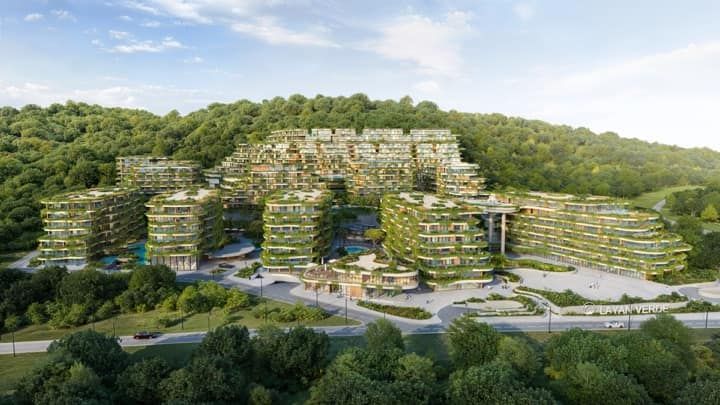
- Layan — the cleanest, least crowded beach in the premium belt, the only place on the island with a transparent 60/40 rental pool model, running across two projects from the same developer.
- Bang Tao and Laguna — the island’s largest resort hub: the Laguna Phuket golf resort, Boat Avenue, international schools and clinics.
- Surin — Phuket’s “Beverly Hills,” the belt’s most prestigious and expensive beach: villas, beach clubs, the highest entry price point.
- Kamala — a transitional district between Surin and Patong, home to a “millionaire’s mile” along the coast.
- Patong — the island’s main tourist hub: Bangla Road, the highest hotel density, and the highest short-term rental occupancy on the island.
- Karon and Kata, south of Patong, continue the same tourist-belt profile in a somewhat quieter format.
- Rawai and Nai Harn — the southern edge of the west coast, a long-term expat community and one of the island’s best beaches.
What unites the whole belt is open water, beach life, and the fact that this is where almost all of the island’s tourist flow goes today. According to Bangkok Post, demand for Phuket property remained strong through 2026, with major developers continuing to expand their project pipelines on the island — for example, developer Sansiri announced plans for THB 40 billion in new Phuket projects amid rising demand. That demand pressure concentrates first and foremost on the west coast, where the island’s tourism and hospitality infrastructure is centred.
3. East: marinas, privacy, town
The east coast is organized differently — not a ribbon of beach towns, but a handful of distinct locations around Phang Nga Bay:
- Phuket Town — the old town with no sea view, but a historic Sino-European quarter, markets, and the most affordable long-term rentals on the island.
- Koh Kaew — an area at the entrance to the Pak Phra strait with two yacht marinas, Boat Lagoon and Royal Phuket Marina; apartments and villas here often come with a private mooring.
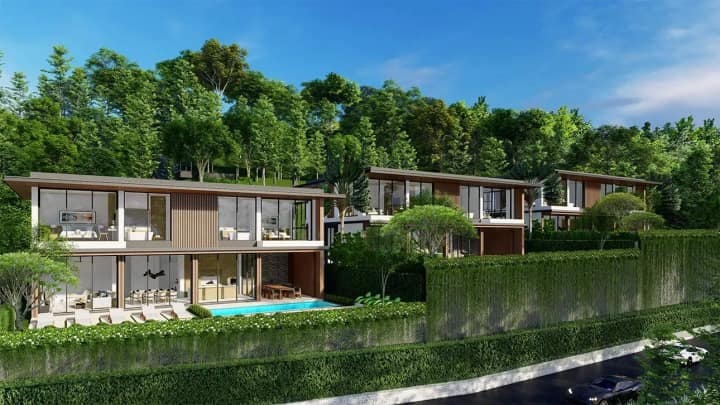
- Cape Panwa — a narrow, gated peninsula in the southeast, mostly clifftop villas with bay views, two high-end hotels, and minimal tourist transit.
A detailed breakdown of the east coast by beach, price, and infrastructure is in a separate guide, Cape Panwa and Koh Kaew for investors. What matters here is the core difference from the west: the east doesn’t sell beach holidays — it sells privacy, calm water for yachting, and proximity to the island’s business infrastructure — hospitals, schools, and the airport via town. There is almost no mass resort development on the east coast; instead there are villas, small-scale residential developments, and marinas.
4. Prices by format: west vs east
Entry prices on both coasts span a wide range, but the logic differs: on the west, price rises with beach proximity and district status; on the east, it rises with privacy and the quality of the bay view.
| Belt | Area | Format | Price from |
|---|---|---|---|
| West | Patong | Studio | from $60,000 |
| West | Rawai | Condo | from $100,000 |
| West | Kamala | Inland condo | from $130,000 |
| West | Kamala | Sea-view unit | from $250,000 |
| West | Bang Tao / Laguna | Condo (resale) | from ~$172,000 |
| West | Layan | Studio, LGP phase 1 resale | from $142,602 |
| West | Layan | Studio, Layan Verde off-plan | from $235,995 |
| West | Nai Harn | Lagoon-front villa | from $400,000 |
| East | Koh Kaew | Marina-side condo | from $120,000–150,000 |
| East | Koh Kaew | Marina-side villa | from $400,000 |
| East | Cape Panwa | Mid-tier villa | from $700,000–900,000 |
| East | Cape Panwa | Top-tier clifftop villa | from $2–4 million |
The table shows that the lower entry bar on both coasts is roughly comparable — Patong and Koh Kaew start in a similar range — but the upper end of the market is structured differently. On the west, the priciest listings are status villas in Surin and Kamala right on the tourist-facing coast; on the east, they’re secluded Cape Panwa villas, where the same budget buys not tourist flow but a complete absence of neighbours and an unobstructed bay view. The formats look similar on paper (a villa by the water), but the product is different: one is built for rental and status, the other for privacy itself.
5. Rental yield: pool model vs self-management
This is arguably the key distinction for an investor, as opposed to someone buying a home for personal use. On the west — specifically in one district, Layan — there’s a transparent, standardized income model: a rental pool. Same-type units are pooled together, the owner receives 60% of the pool’s net profit, and the management company keeps 40%. The benchmark yield is ~8–10% net a year, with a payback period of roughly 12 years. This runs across two neighbouring projects from the same developer — Layan Verde (studios from $235,995, handover 2028, construction-period installments) and Layan Green Park (phase 1 resales from $142,602, phase 2 from $224,043) — and phase 1 of LGP has already been operating since 2024, so the pool numbers are verifiable, not forecast.
The rest of the west coast works differently. Bang Tao and Laguna have resort programs run by individual hotels and complexes, with developer forecasts around ~6–8% a year — but that’s a forecast for a specific property, not the island as a whole. In Surin, Kamala, Patong, Rawai, and Nai Harn there’s no unified pool model at all: rental means self-management through an agency or a local manager, with results that depend heavily on the specific property, the season, and who’s actually running it.
The east coast, in this sense, is closer to “the rest of the west” than to Layan: large public rental pools on the scale of branded projects are essentially absent. Cape Panwa villas and Koh Kaew apartments are rented individually — by the owner, a local management company, or a hotel operator if the villa runs as a boutique hotel. A transparent, unified profit-sharing formula comparable to Layan’s 60/40 hasn’t emerged on the east coast: the market historically grew around personal residence and yachting, not rental income as the primary purpose of the purchase.
| Parameter | Layan (west) | Rest of the west | East |
|---|---|---|---|
| Income model | 60/40 rental pool | Individual resort programs / self-managed | Individual, no pool |
| Reporting transparency | High — one formula | Varies by operator | Low — by agreement with a manager |
| Yield benchmark | ~8–10% net | ~6–8% (forecast, case by case) | Not standardized |
| Who manages | Project management company | Hotel, agency, or the owner | Owner or a local manager |
6. Logistics: airport, roads, travel time
Phuket International Airport (HKT) sits in the island’s northwest — that sharply favours the northern west coast and makes the east coast, apart from Phuket Town, one of the most remote parts of the island.
| Area | Coast | Time to airport |
|---|---|---|
| Naithon, Nai Yang | West | 5–15 min |
| Layan | West | ~20 min |
| Bang Tao / Laguna | West | ~30 min |
| Surin | West | 25–35 min |
| Kamala | West | ~40 min |
| Patong | West | 45–50 min |
| Rawai, Nai Harn | West | 60–75 min |
| Phuket Town | East (town) | 30–35 min |
| Koh Kaew | East | 35–40 min |
| Cape Panwa | East | 55–60 min |
The east loses to the west on nearly every line except one: Phuket Town, formally on the eastern side of the island, is logistically more convenient than most of the southern and central west coast — it sits roughly in the middle of the island, equally close to the airport and to both coasts. Koh Kaew, and especially Cape Panwa, compete on travel time more with the southern west-coast belt (Rawai, Nai Harn) than with the north. For an owner who plans to fly in and out often, this isn’t an abstract number: the gap between 20 minutes from Layan and an hour from Cape Panwa is a real extra hour each way, multiplied by every visit of the year.
7. Living infrastructure: schools, clinics, community
Day-to-day infrastructure density on Phuket is also uneven, and mostly in the west’s favour. International schools and major private clinics (including Bangkok Hospital Phuket) are concentrated along the west coast, primarily in the Bang Tao–Layan belt and around Chalong further south. Retail and entertainment — Boat Avenue, Porto de Phuket, large supermarkets — also line the west coast.
The east compensates differently: Phuket Town is itself a substantial urban centre with markets, government offices, hospitals, and a historic quarter, and Koh Kaew, thanks to its proximity to town (about 10 minutes), effectively borrows that infrastructure while adding its own marinas and yacht clubs. Cape Panwa is the exception here: minimal infrastructure of its own, dependent on trips into town or on the hotels within the peninsula (Sri Panwa, Cape Panwa Hotel).
Community differs between the two coasts as well. The west, especially in the south (Rawai, Nai Harn) and the premium belt (Surin, Bang Tao), has a dense long-term expat and tourist community with an active social scene. The east is quieter: Koh Kaew is more about marina neighbours and yacht clubs, while Cape Panwa is about seclusion, where the nearest neighbour might be hundreds of metres away.
8. Pitfalls when choosing a coast
- Expecting a beach holiday from the east coast. The east barely offers beaches in the usual sense — if your purpose includes swimming from the shore and sun loungers, the east will disappoint no matter how nice the bay view is.
- Treating the east as a “quiet west” in terms of yield. The absence of a unified pool model doesn’t mean higher yield through exclusivity — it means yield isn’t a measurable figure at all; the calculation has to be done property by property, not coast by coast.
- Ignoring logistics for the sake of the view. An hour’s drive to Cape Panwa is noticeable if you fly in and out often; for a home you visit twice a year it barely matters, for an asset with frequent visits it matters a lot.
- Confusing the west coast’s tourist hub with its premium belt. Patong and Layan are both “west,” but in terms of yield, audience, and rental model they are completely different markets — look at the specific belt, not the compass direction.
- Skipping the property format check. A condo in a managed pool and a villa under individual management are fundamentally different economics regardless of coast — the difference is covered in condo or villa for an investor.
- Judging the whole east coast by Cape Panwa alone. Koh Kaew and Phuket Town differ sharply from the gated peninsula in logistics and infrastructure — generalizing “the east coast” as one thing is misleading.
9. Mini case: a villa in Panwa or a studio in Layan
A buyer with a budget of about $350,000 weighed two fundamentally different scenarios. The first was a mid-tier villa on Cape Panwa, around $750,000 with the full budget plus a top-up: a quiet peninsula, a bay view, zero tourist noise — but an hour’s drive to the airport and no unified rental model, meaning income would have to be built through a local manager with opaque reporting. The second scenario was a studio in phase 2 of Layan Green Park in Layan, fitting the budget entirely, with inclusion in the 60/40 rental pool and a benchmark of ~8–10% net starting from the 2026 handover.
The decision came down to one question: did the buyer primarily need a quiet personal base by the sea, or a measurable income asset with verifiable reporting? In the end, the budget was split unevenly — the smaller portion went to the Layan studio as a clear income asset, and the east-coast villa was set aside as the next purchase, no longer an investment but a personal one, on a longer horizon. That’s a common pattern: the west covers the income goal, the east covers privacy and lifestyle, and there’s no need to fold both into a single deal.
10. Conclusion and next step
West and east Phuket aren’t competitors for the same buyer — they’re two different products serving two different goals. The west means tourist flow, wide beaches, the island’s most developed infrastructure, and the only place with a transparent income model through a rental pool — Layan. The east means calm water in Phang Nga Bay, marinas, the privacy of Cape Panwa, and the business hub of Phuket Town, but without standardized yield and with noticeably longer airport commutes outside of town itself. Industry coverage suggests demand for island property remained strong on both sides of the ridge through 2026, with developers continuing to expand their project pipelines — competition for quality listings keeps growing.
If your goal is measurable income with a clear formula, it makes sense to start the search on the west coast, in Layan. If your goal is privacy, yachting, and a personal life away from tourist crowds, look east. Many clients end up pursuing both goals in parallel rather than committing to one coast for good.
We’ll help you find the right property on either side of the island — from a studio in Layan’s rental pool to a villa for personal use on the east coast. Browse the VillaCarte Group portfolio or leave a request — we’ll calculate the yield for your scenario.