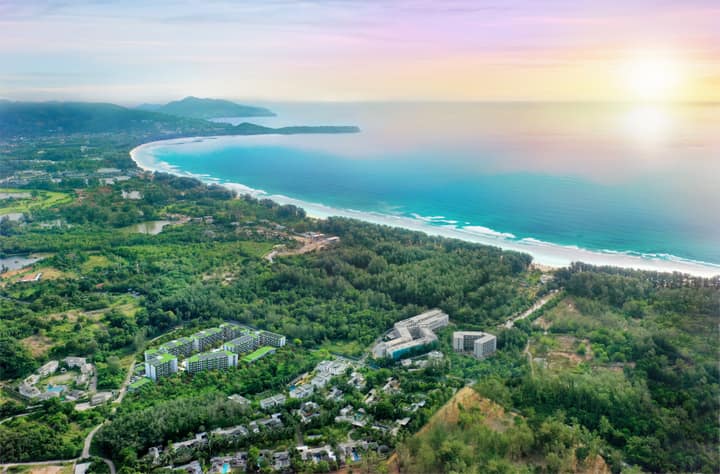
Phuket has a comparison axis sharper than “west versus east” or “one district versus another”: beachfront versus hillside. It’s a choice within a single beach belt — Kamala, Surin, Rawai, Nai Harn — between a unit a few metres from the water and a villa on a rise with a view over the bay. Both formats sell the same coastline, just through different means: beachfront is proximity and the sound of surf outside the window; hillside is panorama, privacy and more land for a saner price per square metre. For an investor these are two different assets with different economics, different risks, and — as a closer look shows — a different regulatory history. Phuket’s hillsides saw the actual building rules change in 2024–2025, while beachfront found itself in 2026 at the centre of a government campaign against illegal beach encroachment. Here’s what pays off better, and what to check before choosing either.
Contents
- Two assets on one axis: beach and hill
- Beachfront: what the buyer gets and gives up
- Hillside: view, privacy and the new zoning regime
- Prices by format: beachfront vs hillside
- Rental yield: beach tourist flow versus the view premium
- Beachfront traps: erosion, easements, the 2026 crackdown
- Hillside traps: slope, access road, utilities
- How buyers choose between formats: a checklist
- Mini case: one budget, two plots
- Conclusion and next step
1. Two assets on one axis: beach and hill
Phuket’s west coast isn’t only laid out along the shore — it’s also laid out across it, from the waterline inland and often up the ridge that runs the length of the western coastline. In most resort belts, from Patong in the south to Naithon in the north, development splits into two fundamentally different layers. The first is a narrow strip right by the water: hotels, condominiums, villas within walking distance of the beach. The second is the slopes and rises behind that strip, where the terrain trades a few minutes of driving or climbing for a panoramic view over the bay.
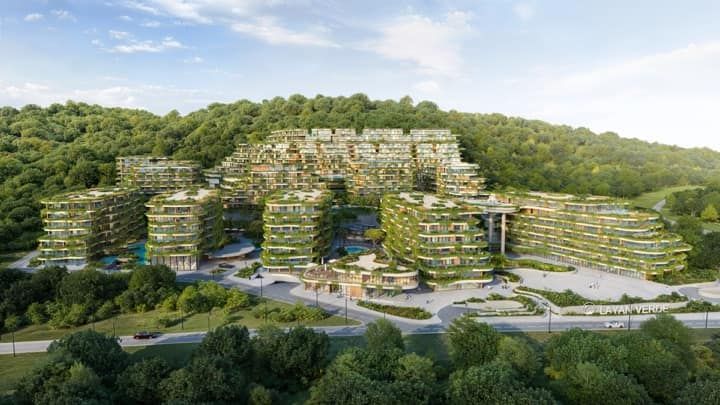
This vertical axis is especially visible in the Kamala–Surin belt, which we’ve already covered in the blog as the “millionaire’s mile”: Kamala and Surin sit next to each other, but within each of them price and format differ sharply depending on whether a property sits by the water or up on the hillside above the bay. A similar logic runs through Rawai and Nai Harn in the south of the island, where hillside view villas by the lake sit alongside houses a few steps from the beach. The Layan–Bang Tao belt is built differently: the terrain there is gentler, and both flagship projects in the area, Layan Verde and Layan Green Park, sit effectively on the beachfront in the broad sense — 700 metres and a two-minute walk from the beach respectively, with no clearly separate “hillside” product.
One caveat up front: “beachfront” and “hillside” aren’t always mutually exclusive categories. Part of the view premium can come not from the plot’s natural elevation but from the floor within a tall building — Layan Verde’s ocean-view luxury residences, for instance, sit in the same quarter 700 metres from the shore as the regular studios, yet sell for 3–4 times more purely because of the view, not distance from the water. So the question isn’t only where a property sits, but how its position is actually monetised — which is what the rest of this guide is about.
2. Beachfront: what the buyer gets and gives up
Beachfront means plots and buildings within direct sight of the water and usually within a five-minute walk of the shoreline. For a buyer, it’s the island’s clearest product: the beach outside the door, the sound of surf, maximum tourist flow and maximum liquidity for short-term rental — a guest never needs convincing that a place two steps from the sea is worth the premium.
The flip side is three structural constraints specific to beachfront:
- Land scarcity. The strip along the water is physically finite, and no new plots appear — hence the highest price per square metre in the belt.
- Climate load. Salt air and monsoon winds (May–October) wear down façades, metal fixtures and appliances faster, which raises the maintenance budget compared with a property further inland.
- Legal sensitivity of the boundary with the beach. Under Thai law, beaches are public land, and a plot can border a beach but cannot legally block access to it. This isn’t an abstract risk: in 2026 Phuket authorities ran a series of checks precisely along this boundary (more in the traps section below).
Beachfront still remains the benchmark against which the rest of the island’s inventory gets compared — see the full breakdown in where to stay in Phuket and in the west vs east coast comparison, where western tourist flow is entirely tied to proximity to the water.
3. Hillside: view, privacy and the new zoning regime
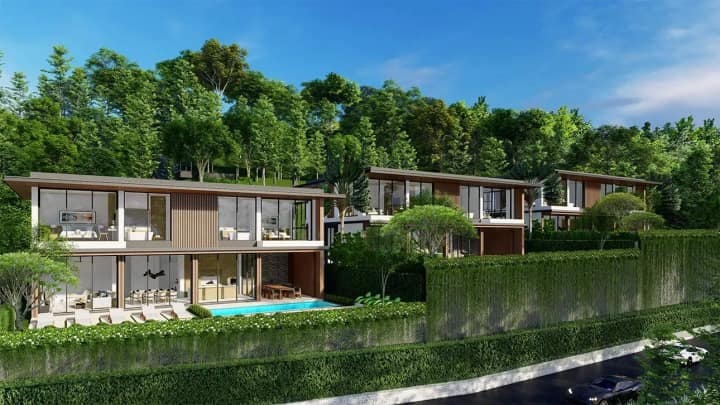
Hillside villas and residences solve a different problem: a panoramic bay view, distance from tourist noise, and typically more land for the same money — slope lowers the cost of preparing a plot near the sea but raises it on the slope itself through engineering (retaining walls, drainage, a more complex foundation). That’s why the classic hillside product isn’t a condo but a villa with a private pool — a format that justifies the more complex, costlier build through plot size and view status.
The regulatory history of Phuket’s hillsides has shifted more visibly over the past two years than that of the beachfront. Since 2017 the island had a ban on construction above 80 metres above sea level; according to The Thaiger, in December 2024 the government approved a zoning revision and raised the permitted building altitude in Zone 6 — most of the island, excluding the coastline, the protected Nakkerd Range and dense Phuket Town — to 140 metres. The order took effect on 14 December 2024; new structures in the expanded zone remain capped on building height and footprint, and the green-space share requirement for the plot stays in place — so the expanded zone doesn’t mean unrestricted hillside development, it adds supply while keeping the environmental limits.
For an investor this has two practical consequences. First, over the past year the market has potentially gained plots on higher ground that used to be legally “frozen” — this widens the choice but calls for a closer check of the title date and the specific plot’s status relative to the new zone. Second, a plot’s slope is itself a constraint on density and buildable area, not just on the view: steep slopes require costlier engineering prep and, as a result, either shrink the final house footprint or inflate the construction budget. For more on how build timelines and stages generally work on the island, see Thailand construction timelines.
4. Prices by format: beachfront vs hillside
Below are benchmarks from districts already covered in the blog, where both formats exist side by side.
| District | Format | Position | Price from |
|---|---|---|---|
| Bang Tao / Laguna | Condo | Beachfront / near the beach | from ~$172,000 (resale) |
| Layan | Studio, LGP phase 1 resale | 2 min to the beach | from $142,602 |
| Layan | Studio, off-plan Layan Verde | ~700 m to the beach | from $235,995 |
| Layan | Layan Verde ocean-view luxury residence | Upper floors, ocean view | from $667,050 |
| Kamala | Condo away from the water | Set back from the coast | from $130,000 |
| Kamala | View unit | On the hillside | from ~$250,000 |
| Kamala–Surin | “Millionaire’s mile” villa | Hills above the bay | from ~$1,000,000 |
| Kamala | Twinpalms Residences MontAzure, resale | Beachfront, southern cliffs | from ~18M THB |
| Rawai | Villa | Set back from the coast | from ~$180,000 |
| Nai Harn | View villa | Hills near the lake | from ~$400,000 |
| Nai Harn | Waterfront villa | Beachfront / by the lagoon | from $400,000–1,000,000 |
| Cape Panwa | Top-tier cliff villa | Beachfront, cliffs | from $2–4M |
The pattern isn’t obvious at first glance, but it holds: the lowest entry threshold usually belongs neither to beachfront nor to hillside as such, but to properties set back from both — a condo away from the coast with no view and no direct beach access. At the top of the market, though, hillside and beachfront compete almost evenly: a top-tier cliff villa in Cape Panwa is priced comparably to a top-tier “millionaire’s mile” view villa — both sell the same resource, positional exclusivity, just through different means: proximity to water in one case, elevation in the other.
5. Rental yield: beach tourist flow versus the view premium
It’s important to separate two questions here: how much a property can rent for per night, and how predictably that income can be calculated in advance.
Beachfront usually wins on occupancy: proximity to the beach is a universal argument for short bookings that needs no explaining to a guest and works well in any season except the monsoon. A hillside property with a good view can compete with — and sometimes beat — beachfront on nightly rate: panorama and privacy sell as a premium experience, especially for villas with a private terrace pool, but occupancy more often depends on how well the specific property is marketed and how good the manager is, rather than on location alone.
The one place on the west coast where yield can actually be calculated from a formula rather than estimated from comparables is the Layan market: the rental pool 60/40 model at Layan Verde and Layan Green Park gives a ~8–10% net annual benchmark, verifiable against LGP phase 1’s actual operation since 2024. This isn’t tied to whether a unit is literally on the beachfront — the model works for a studio 700 metres from the water just as it does for a view residence on the upper floors of the same quarter, because both sit inside the same pool.
| Parameter | Beachfront (outside Layan) | Hillside | Layan (rental pool) |
|---|---|---|---|
| Income model | Individual letting, agency | Individual letting, often via a local operator | Rental pool 60/40 |
| Yield benchmark | Depends on the property and season | Depends on the property, view and marketing quality | ~8–10% net (verifiable at LGP phase 1) |
| Reporting transparency | Low — by agreement | Low — by agreement | High — a single formula |
| What the property sells to a guest | Proximity to water | View, privacy, a pool terrace | Beach proximity + a transparent model |
For how to calculate yield outside a pool, see how to calculate ROI in Phuket, and specifically for villas with a private pool, is a private pool worth it in Phuket.
6. Beachfront traps: erosion, easements, the 2026 crackdown
- Public beach easement. Under Thai law, the island’s beaches are public land, and development cannot block access to them even where it formally borders a private plot. In 2026 this stopped being theoretical: Thailand’s prime minister announced a crackdown on illegal beach encroachment (including at Freedom Beach), resulting in 23 criminal cases and more than 30 land title deeds seized covering dozens of rai; the Ministry of Natural Resources and Environment announced demolitions of illegal structures at several island beaches, including Nui Beach, starting July 2026. For a beachfront buyer, the takeaway is a rule with no exceptions: verifying title cleanliness and the plot’s actual boundary with the beach is mandatory, not optional.
- Erosion and the monsoon season. The coastal strip is more exposed to storm surges and erosion during the rainy season (May–October) than plots further inland — this affects the condition of seawalls and retaining structures right by the water and requires regular upkeep.
- Faster wear on finishes. Salt air and humidity break down metal, air conditioning units and façade finishes noticeably faster than a few hundred metres from the shore — the maintenance line item is on average higher on the beachfront.
- A “beach view” isn’t the same as “beach access”. Some beachfront listings sell a water view across a road or neighbouring plot with no direct access — check the actual walk from the door to the waterline in person, not from drone photos.
- The price already prices in the scarcity. Because land by the water is finite, beachfront is almost never “underpriced” — negotiation there is about the specific metres and the view, not about the position itself.
For the general title and boundary verification process, see due diligence in Phuket, and for common scams around coastal plots, property scams in Thailand.
7. Hillside traps: slope, access road, utilities
- A plot’s slope limits footprint, not just the view. A steep slope requires costlier engineering — retaining walls, pile foundations, careful drainage — and part of the zoning regime directly ties permitted density and buildable area to the land’s gradient.
- The access road is due diligence, not a footnote. On elevated ground it’s easy to buy a plot with a great view and a poor, monsoon-washed-out access road; checking road condition during the rainy season (May–October) should be part of the viewing, not an afterthought.
- Utilities cost more going uphill. Connecting water, electricity and sewage on a slope is usually harder and pricier than on a flat plot by a road; budget for this as a separate line item when buying land for your own build.
- Title date matters after the 2024–2025 zoning revision. Raising the permitted building altitude to 140 metres in Zone 6 doesn’t remove the green-space share requirement or the specific plot’s parameters — verify land status as of the deal date rather than relying on the general rule.
- There’s no formalised rental model. Unlike Layan, hillside villas have no unified rental pool — yield is calculated per property and per manager, and promises of “the same as the neighbour’s” should be checked against figures, not taken as a claim.
For how to choose a manager for a villa without a pool, see self-managed letting versus a rental pool (relevant for hillside villas outside Layan too).
8. How buyers choose between formats: a checklist
- What comes first — cash flow or lifestyle? If the goal is measurable income, it makes sense to start with beachfront projects that have a transparent pool model (Layan), rather than individually let hillside villas.
- How critical is beach proximity to you personally? For an owner who visits the island a couple of times a year, ten minutes to the water doesn’t matter; for someone living there full-time who wants to walk to the beach daily, it does.
- Has the plot boundary with public land been verified? Mandatory for beachfront — see the section on easements and the 2026 crackdown.
- Have slope, access and title date been checked? Mandatory for hillside — especially if the plot falls within the zone expanded by the 2024–2025 zoning revision.
- Who will manage the rental, and how? A pool with a formula exists only at Layan; every other format needs a specific management contract, not general promises of a yield percentage.
- What matters more — price per square metre or the uniqueness of the position? Top-tier beachfront properties and top-tier hillside view villas converge on budget — at that point the choice is no longer about money but about lifestyle format.
9. Mini case: one budget, two plots
An investor with a budget of around $250,000 was weighing two options in the Kamala–Surin belt. The first was a compact condo set back from the coast with no direct beach access; the second, a hillside view unit with a panorama over the bay at the same price, around $250,000. The difference in position turned out to be decisive even at a formally identical budget: the inland condo lost out on short-term rental marketing (a guest had nothing to grab onto in the listing description), while the hillside view unit gave a clear competitive edge — sunset-view photos converted into bookings noticeably better.
The investor deliberately ruled out beachfront at the same budget — at $250,000 in that belt it only buys studios with no view and no clear status, whereas a hillside plot in the same price bracket offered a panorama. Separately, the investor kept part of the capital in a Layan Green Park studio at Layan — there the goal was different: not maximising the nightly rate through a view, but securing measurable income through the rental pool at a ~8–10% net benchmark. Combining the two assets covered both goals — the income side and the higher-ticket side driven by the view.
10. Conclusion and next step
Beachfront and hillside on Phuket aren’t competing for the same buyer — they’re two instruments with different pricing mechanics. Beachfront sells the scarcity of land by the water and maximum liquidity for short-term rental, but carries a climate load, faster wear and legal sensitivity around the boundary with a public beach — a topic that stopped being theoretical in 2026 amid the government’s crackdown on beach encroachment. Hillside sells panorama, privacy and typically more land for the money, but requires closer checks on slope, access road and plot status following the 2024–2025 zoning revision that raised the permitted building altitude from 80 to 140 metres. A transparent income formula — the rental pool at 60/40 with a ~8–10% net benchmark — is currently offered by only one belt on the island, Layan, regardless of whether it’s a studio 700 metres from the water or a view residence on the upper floors of the same quarter.
We’ll work through your specific budget and match the format — beachfront, hillside, or a transparent rental pool — to your goal: income, lifestyle, or a mix of both. Leave a request, estimate a yield benchmark in the calculator, or check out the active projects Layan Verde and Layan Green Park.
This material is for informational purposes only and is not investment advice. Project prices are per the developer price list as of 1 September 2026 (LGP phase 1 resales — as of 21 July 2026); district-level prices are approximate market ranges — verify at the time of the deal. Regulatory data on zoning and the beach-encroachment crackdown reflects the publication dates of the cited sources — confirm current status with the relevant authorities.