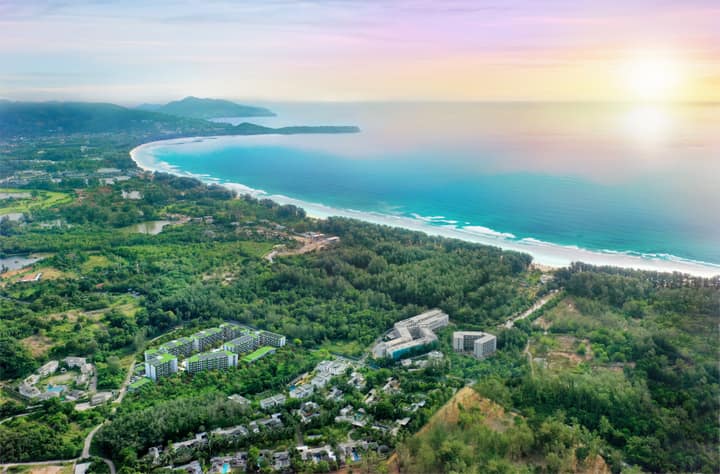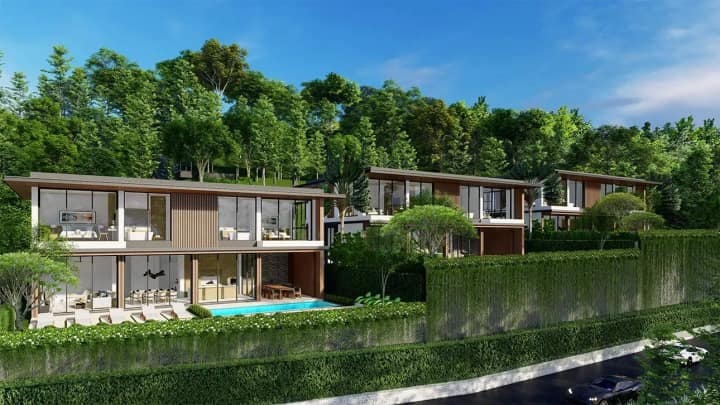
There is no single answer to “how much does a house cost in Thailand”: a single-storey house 20 minutes from the sea and a beachfront villa with a private pool on Phuket’s first line can differ tenfold. Here is what drives the price, what the real numbers look like by region and class, and why for a foreigner a house is not just the price of the building — it is also a separate question about the land.
Contents
1. What makes up the price of a house
Quick answer: an average house in Thailand costs $150,000–400,000 (roughly 5–14 million THB) in 2026. A modest inland house or townhouse starts around $100,000–150,000; a pool villa in Phuket’s coastal areas averages $400,000–900,000; beachfront estates reach $2–5 million. The variables that move the number most are below. The purchase process itself — from picking the ownership route to transferring money — is covered step by step in how foreigners buy a home in Thailand.
A house’s price in Thailand is not a single figure — it is the sum of several variables:
- Land. The closer to the sea and the larger the plot, the higher the cost — land near Layan and Bang Tao beaches is priced far above land 10–15 minutes inland.
- Building size and floors. A single-storey 150 m² house and a two-storey 350 m² villa on the same plot can differ in construction cost by nearly double.
- Finish quality and engineering. Basic tiling and air conditioners versus designer finishes, smart-home systems, a private borehole and a generator.
- Plot infrastructure. Pool, landscaping, a guest house, multi-car parking — each option adds 10–20% to the budget.
- Completion status. A finished house with an operating history is usually priced above a comparable off-plan project — the same mechanics as in buying off-plan.
2. Prices by region in Thailand
Rough market ranges from budget to premium:
| Region | Budget segment | Mid segment | Premium / beachfront |
|---|---|---|---|
| Phuket (west, near beaches) | from $150,000 | $300,000–700,000 | from $1,000,000 |
| Koh Samui | from $130,000 | $250,000–600,000 | from $800,000 |
| Pattaya | from $100,000 | $180,000–400,000 | from $500,000 |
| Bangkok (suburbs) | from $120,000 | $200,000–450,000 | from $700,000 |
| Chiang Mai | from $90,000 | $150,000–300,000 | from $450,000 |
Figures depend heavily on the specific project and distance from the coast or city centre — the table gives an order of magnitude, not a precise valuation. In Phuket, the gap between a house 5 minutes from the beach and one 15 minutes inland can be 2–3x for comparable size.
3. Prices by villa class and size
Within a single region the spread is also wide — here’s a benchmark by class for Phuket:
| Villa class | House size | Typical budget |
|---|---|---|
| Urban townhouse / duplex | 100–150 m² | $100,000–180,000 |
| Compact pool villa, away from the sea | 150–220 m² | $250,000–450,000 |
| Mid-class villa, 10–15 min to the beach | 220–300 m² | $450,000–800,000 |
| Premium beachfront villa with private pool | 300–450 m² | $900,000–2,000,000 |
| Luxury beachfront, exclusive plot | from 450 m² | from $2,500,000 |
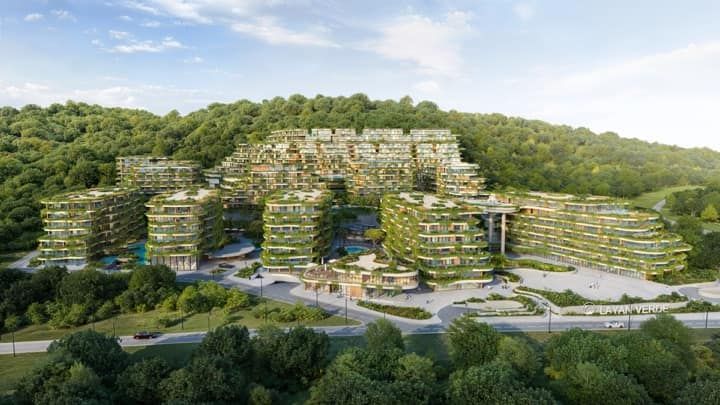
For comparison: the entry threshold for a finished residence with a private pool at Layan Verde starts from $667,050 — noticeably below a standalone premium villa of comparable finish quality, though without a private land plot.
4. Land separate from the house: what a foreigner can do
The key difference between a house and a condo unit is the land. Thai land law prohibits foreigners from owning land outright (with rare exceptions tied to large investments). The building itself, however, can be registered to a foreigner — the structure is legally separate from the plot. In practice, buyers use one of three routes:
- Leasehold (long-term land lease). A 30-year contract with renewal rights, often structured 30+30(+30). The house can be registered to the foreigner separately from the land. Details in freehold vs leasehold.
- Thai company. The land is owned by a Thai company (at least 51% Thai shareholders), with the foreigner controlling it through management and a share class structure. This requires genuine economic substance, not a shell entity — the risks are covered in villa ownership through a Thai company.
- Registration to a Thai spouse. Possible when married to a Thai citizen, with a number of legal nuances around asset division.
None of these routes is simply “easier” than the others — the choice depends on the ownership horizon, willingness to run a company, and what happens to the asset at exit. General principles for foreign buyers are covered in how a foreigner buys property in Thailand.
5. Hidden upkeep costs
The purchase price is only the entry point. A private house (unlike a condo with a management company) comes with ongoing operating costs:
- Pool and garden — chemicals, cleaning, watering, mowing: usually a separate contract with a maintenance crew.
- Security and plot management — especially if the house sits empty part of the year.
- Annual property tax and transfer fees at deal registration.
- House insurance against damage, especially during the rainy season (May–October).
- Legal and accounting support — mandatory under a Thai-company structure: incorporation, annual audit, tax filings.
In complexes run by a management company (like Layan Green Park), most of these line items are already bundled into a single service fee and the rental pool — the owner doesn’t hire a gardener, security, and an accountant separately.
6. House or condo in a rental programme
If the goal is not just personal use but income, it’s worth comparing the two models honestly:
| Parameter | Private house | Unit in a rental pool |
|---|---|---|
| Entry threshold | Higher for comparable finish quality | Lower — from a studio |
| Finding tenants | Your task (or via an agency) | Management company, a single pool |
| Yield | Not guaranteed, depends heavily on season and effort | Benchmark ~8–10% net annual, payback ~12 years |
| Operating costs | Directly on the owner | Bundled into the pool model (owner gets 60% of net profit, the management company 40%) |
| Personal use | Year-round | Usually an agreed number of days per year |
For an exact yield calculation, see how to calculate ROI in Phuket, and run your own numbers in the yield calculator. A direct format comparison is in condo or villa in Phuket.
7. Pitfalls when buying a house
- “Cheap house” without accounting for the land. If a listing doesn’t specify the terms under which the plot is held (leasehold, company, lease), the actual deal structure and its costs can significantly change the final number.
- “5 minutes to the beach” by eye. That phrase sometimes means 5 minutes by car on a mountain road, not on foot.
- Underestimated upkeep budget. Sellers rarely disclose real pool, garden, and security costs — budget for them upfront.
- Nominee shareholders “for show”. Using a Thai company purely to bypass land law, without real business activity, is a legally vulnerable scheme.
- No rental management programme. If the plan is to rent the house out rather than live in it, the lack of a working management model means yield has to be built from scratch on your own.
8. Mini case: two budgets, one goal
An investor with a budget of around $650,000 considered two options on Phuket’s west coast. The first — a mid-class villa 12 minutes from the beach, with its own plot, pool and garden, but no rental management programme: income had to be organised independently, and upkeep (garden, pool, security) ate into the rental rate. The second — a residence with a private pool in a complex near Layan beach, included in a rental pool: the entry threshold was lower than the villa’s price, and income and grounds maintenance were already built into the management model.
Choosing the house makes sense when privacy, a private plot, and year-round living are the priority. If the goal is predictable income with minimal operational hassle, the managed format usually offers clearer economics from the start.
9. Conclusion and next step
A house’s price in Thailand is the sum of land, the building, finish quality, and the ownership structure — not a single figure from a listing. For a foreigner, the key fork isn’t the budget but the form of land ownership: leasehold, a Thai company, or registration to a spouse — and what happens to the asset over a 10–15 year horizon.
If you’re comparing a house against a managed rental unit for your budget, we can match options and run the yield numbers. Leave a request or browse the catalogue on the VillaCarte Group page.
This material is for informational purposes only and does not constitute legal advice or an investment recommendation. House market prices are indicative and may differ from current offers — verify at the time of the deal.