Last week we were wondering whether authorities would clear the promised 117 hotel licences by the end of September. The answer arrived — but not as a “117 of 117” report. It arrived as the first sanctions: five unlicensed hotels were suspended for failing to meet requirements. At the same time, arrivals, which had worryingly slowed the week before, bounced back 5.72% — not because interest in Thailand as a whole picked up, but because a Malaysian public holiday and a Japanese holiday cluster landed in the same week. And the baht kept quietly weakening, crossing past 33.5 per dollar. Here’s what from this week actually matters for an owner or buyer near Layan beach, and what’s just calendar noise.
Contents
- The baht: this week’s numbers
- Arrivals through 19 September: a 5.72% bounce after the slump
- Why it was specifically the short-haul markets: Malaysia Day and Japan’s “Silver Week”
- Phuket’s hotel licences: from approvals to the first sanctions
- A hotel suspension ≠ a problem for a condo buyer: what an owner should check
- Tourist ≠ buyer: how an investor should read the holiday bounce
- Traps of the week
- Mini case: a Singapore buyer asks about “closed hotels”
- What it means for Layan and the rental pool
- Bottom line and next step
1. The baht: this week’s numbers
Per Trading Economics, on 28 September 2026 the USD/THB rate stands at roughly 33.51 — specifically 33.42 on 25 September, rising to 33.51 by 28 September, up about 0.3% in a single session. A week earlier, on 21 September (week-39 digest), it was around 33.27 — the baht eased a further 0.7% over seven days. Over the past month the baht weakened against the dollar by roughly 1.06%, and by 3.97% over the year. Analysts attribute the steady weakening to the interest-rate gap between the US and Thailand, not to any single local event.
| Date | USD/THB |
|---|---|
| 21.09.2026 (for comparison, week 39) | ~33.27 |
| 25.09.2026 | ~33.42 |
| 28.09.2026 (digest date) | ~33.51 |
| One-month change | ≈ −1.06% |
| One-year change | ≈ −3.97% |
The official rate source is the Bank of Thailand, which publishes daily figures on bot.or.th (the Daily Foreign Exchange Rates page) at 18:00 Bangkok time on business days; Trading Economics aggregates this alongside forecasts (analysts expect a pullback to around 33.41 by quarter-end). The practical takeaway for a buyer paying in tranches on a developer’s schedule: the weakening trend has now run for a second straight month without sharp jumps, but each tranche is still worth checking against the live rate on the transfer date rather than a week- or month-old figure.
2. Arrivals through 19 September: a 5.72% bounce after the slump
Per the Ministry of Tourism and Sports, Thailand received 22,183,678 foreign visitors between 1 January and 19 September 2026 — down 3.67% year on year. Tourism revenue over that period reached roughly THB1.083 trillion. For comparison, a week earlier (through 5 September, week-39 digest), the cumulative figure stood at 21.28 million with a 3.12% shortfall — meaning the year-on-year gap widened from 3.12% to 3.67% over the two weeks, even though the more recent of those two weeks turned out to be a growth week.
| Market | Visits, Jan.–19 Sep 2026 | Rank |
|---|---|---|
| China | ~3.73 million | 1 |
| Malaysia | ~2.83 million | 2 |
| India | ~1.64 million | 3 |
| Russia | ~1.23 million | 4 |
| South Korea | ~0.81 million | 5 |
| Nationwide total | 22.18 million (−3.67% YoY) | — |
This time the weekly figure looks far more upbeat than the cumulative one. Between 13 and 19 September, the country received 464,200 foreign visitors — up 5.72% from the previous week, averaging 66,314 arrivals a day. That’s a direct reversal from the slump the week before (472,898 visits, down 3.78% week on week, week-39 digest) — but as the next section shows, the reason for the growth is narrow and calendar-driven, not a sign that the overall trend has turned.
3. Why it was specifically the short-haul markets: Malaysia Day and Japan’s “Silver Week”
Breaking the numbers down by market type explains everything at once. Short-haul markets grew 8.59% for the week of 13–19 September, to 324,816 visits, while long-haul markets barely moved, down a symbolic 0.41%. Within the short-haul segment, two specific drivers stand out:
- Malaysia: 69,255 visits for the week, up 29.12% — the effect of the Malaysia Day national holiday (16 September), which traditionally brings a long weekend and a surge of outbound travel to neighbouring countries, including Thailand.
- Japan: 30,494 visits for the week, up 55.36% — the effect of the approaching Japanese “Silver Week” (19–23 September), a cluster of national holidays (Respect for the Aged Day and the Autumn Equinox) that the Japanese traditionally use for longer trips.
That’s an important nuance for anyone reading the weekly arrivals figure at face value. A 5.72% jump looks like a trend reversal, but breaking it into components makes clear it’s the calendar effect of two specific holidays in two specific countries, not a sign that long-haul markets (Europe, the US, the Middle East) suddenly started travelling more actively. For a Phuket property owner, where most of the yield is built on the November–April peak season and a mix of guests from around the world, a one-off short-haul spike during a holiday week is not a reason to revise an occupancy forecast.
4. Phuket’s hotel licences: from approvals to the first sanctions
In the week-39 digest, we noted that by 12 August 2026 the Ministry of Interior had approved 275 of the 392 hotel-licence applications accumulated since 2018, with the remaining 117 targeted for clearance by the end of September. This week the story took the next logical step: instead of another approvals update, authorities applied sanctions for the first time to those who failed to comply. On 26 September 2026, Deputy Phuket Governor Romdon Haji Awae announced the suspension of five hotels in the province — they had been given 30 days to fix violations (missing licences or structural problems), but the operators failed to make the required changes.
| Metric | Value |
|---|---|
| Approved by 12.08.2026 (of 392 since 2018) | 275 (over 75%) |
| Hotels suspended on 26.09.2026 | 5 |
| Reason for suspension | failed to fix violations within 30 days |
| Hotels on a separate review track | ~40 |
| Deadline to submit missing paperwork | October 2026 |
| Missing documents for part of the 40 | environmental impact assessments, structural safety certificates |
It’s important not to conflate these two processes. Approving 275 of 392 applications is the legalisation of properties that filed paperwork and passed review. Suspending five hotels is an enforcement action against those who either never filed at all or failed to fix identified violations within the given deadline. Separately, roughly 40 more hotels sit on a licence-renewal review track with missing documents and an October deadline — a third, still-unresolved strand of the same process. As of this digest, there’s still no official final report on the fate of the original 117 applications from the old backlog.
5. A hotel suspension ≠ a problem for a condo buyer: what an owner should check
The news about five suspended hotels is easy to misread as an alarm signal for the whole Phuket resort-property market. In practice it applies to a narrow set of properties, and it’s worth separating several distinct situations:
- Operating, licensed condo-hotels — such as Phase 1 of Layan Green Park, running since 2024 with a licence and management company already in place — have nothing to do with this campaign: their paperwork is already in order, and the suspensions concern other properties in the province.
- The five suspended hotels are specific buildings that were formally reviewed, given 30 days to fix issues, and still weren’t cleared to continue operating. Authorities have not published the specific names.
- The roughly 40 hotels on the review track are not suspended, but must submit missing documents (environmental assessments, structural safety certificates) by October; the status of these properties could change either way in the coming weeks.
- Private condominiums without a hotel licence, let short-term via booking platforms outside a licensed programme, remain within the general risk zone of this campaign — it systematically identifies such properties in parallel with reviewing declared hotels.
For how to check a specific property’s licence status before a deal and what to look for in a management agreement, see Phuket rental management programs and due diligence before buying.
6. Tourist ≠ buyer: how an investor should read the holiday bounce
As in the previous digest, it’s important not to conflate the arrivals metric with investment demand — and this week the gap is especially visible. The 5.72% jump was made by two holiday dates in two specific countries, not by a broad improvement in the destination’s appeal to a property buyer. The Ministry of Tourism doesn’t publish — and can’t publish — data on what share of the 22.18 million visitors are considering a condominium purchase; that statistic simply doesn’t exist.
The link between the two metrics is real, but at the level of market mechanics:
- Diversifying guest channels matters more than any single holiday spike. This week’s growth in Malaysia and Japan is a short-lived calendar effect; management companies like the one running Layan Green Park build occupancy on a blend of markets and seasons, not a single source.
- Short-haul markets react to direct flights and convenient dates faster and more sharply than long-haul ones — a structural feature of the region, not a one-off quirk of September 2026, and it explains why neighbouring countries’ holidays and long weekends visibly move the island’s weekly statistics.
- The cumulative 3.67% shortfall matters more for reading the year as a whole than any single growth week: one good week doesn’t offset weaker weeks earlier in the same month.
For broader context on how arrivals and the island’s economy roll up into the property-market picture, see Phuket Real Estate Market 2026, and for how the AREA research centre valued the whole island market at THB705 billion — a figure built on supply and absorption data, not arrivals directly.
7. Traps of the week
- A 5.72% jump in arrivals is not a trend reversal. It’s the effect of two specific holidays (Malaysia Day, Japan’s Silver Week), not a sign that overall interest in Thailand is recovering; long-haul markets grew by only a symbolic fraction of a percent over the same week.
- The year-on-year arrivals shortfall widened, not narrowed. From 3.12% on 5 September to 3.67% on 19 September — a growth week at the end doesn’t cancel out weaker weeks earlier in the same period.
- Five suspended hotels is not a crisis signal for the whole rental market. It’s a targeted sanction against properties that failed to fix specific violations within the deadline; it doesn’t touch licensed projects like Layan Green Park.
- “40 hotels under review” is not the same as “40 hotels at risk of closure.” These properties still have until October to submit paperwork; the status of many of them may well resolve favourably.
- The baht keeps weakening for a second straight week. The move is gradual (~0.3–0.7% per stretch), but the cumulative monthly effect (−1.06%) already shows up when converting large tranches — check the rate right before transferring.
8. Mini case: a Singapore buyer asks about “closed hotels”
A buyer from Singapore looking at a studio in Phase 2 of Layan Green Park messaged the agent right after the news about the five suspended Phuket hotels, asking whether this meant the island’s rental market was entering a troubled phase. The answer relied on the distinction from section 5: the suspended properties are buildings that never filed an application or failed to fix violations within 30 days, while Phase 1 of the same project has been operating since 2024 with a licence and management company already in place, and the suspensions have no bearing on it whatsoever.
Separately, he checked the baht rate before wiring his reservation deposit: as of his calculation date — 28 September, ~33.51 baht per dollar — the deposit amount worked out to the equivalent of 7,424,784 THB ($224,043) per the project price list he checked in the catalogue. He didn’t factor the 5.72% holiday arrivals bounce into his yield forecast as a separate line item: the growth came from Malaysia and Japan during a short holiday week, while his unit’s yield model is built on the entire November–April peak season and a mixed guest base, not a single September week. The yield-calculation method is covered in how to calculate ROI in Phuket.
9. What it means for Layan and the rental pool
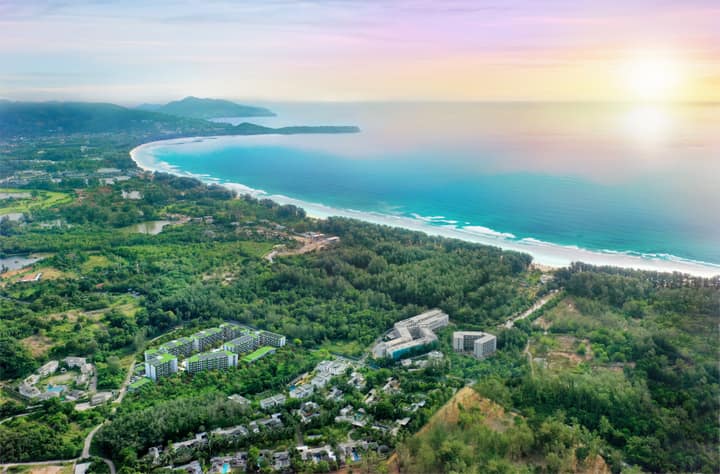
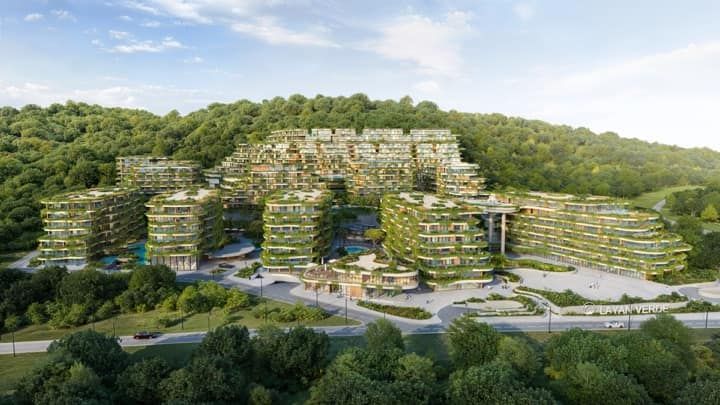
This week’s three storylines add up to a picture familiar from previous digests: headlines live separately from the terms of owning a specific licensed project. Suspending five unlicensed hotels is tighter enforcement that mainly reduces the risk of illegal competition for legal properties, rather than a threat to them. The arrivals bounce on Malaysia and Japan’s holiday week is a pleasant but narrow, calendar-driven effect that doesn’t override the bigger picture: the year-on-year arrivals shortfall keeps widening, not narrowing. The baht keeps gradually weakening for a second straight month, staying within a range familiar to buyers paying in dollars. For the Bang Tao–Layan area, home to most of the coast’s licensed, branded projects — both the operating Layan Green Park and the under-construction Layan Verde — this week doesn’t change an investor’s strategy so much as confirm that tighter enforcement works in favour of legal, transparent properties rather than against them.
10. Bottom line and next step
The headline of this week is three storylines that need sorting by what they actually mean. Arrivals rose 5.72% for the week, but Malaysia Day and Japan’s Silver Week drove that, not a broad recovery in demand — meanwhile the year-on-year gap to 2025 widened from 3.12% to 3.67%. Phuket’s hotel-licence story moved from the approvals phase into the first-sanctions phase: five unlicensed hotels suspended, roughly 40 more on a review track with an October deadline. The baht keeps weakening gradually but steadily — now for a second straight month.
I can send you the current price list, fresh rental-pool occupancy figures, and a yield calculation for your budget at Layan Verde and Layan Green Park — leave a request or see partnership terms on the Layan Real Estate page.
This material is informational only and does not constitute legal, tax or investment advice. Figures are based on sources as of the publication date; verify current rules and figures at the time of your transaction.