“Isn’t it dangerous there?” is almost the first question anyone hears once they say they’re buying property or moving to Phuket. Usually it’s a mix of real risk and urban legend: someone recalls the 2004 tsunami, someone else remembers headlines about the conflict in southern Thailand, and someone just repeats the generic “Southeast Asia is unsafe” line. Let’s go through it properly, without scare tactics and without rose-tinted glasses: what is statistically risky on Phuket, what is overstated, and what genuinely depends on the district and your own decisions. Sources are the UK’s official travel advisory and Thailand’s mainstream press, linked at the end.
Contents
- So how safe is Phuket, really
- Roads and scooters: the biggest risk for tourists and owners
- The sea: rip currents, flags and the rainy season
- Crime: theft, scams — and what is genuinely rare
- Common scams: the bike, the jet ski, the passport deposit
- Healthcare, insurance and emergency contacts
- Phuket’s districts: where it’s calmer, where it’s busier
- How district safety affects property prices and rental demand
- Traps to avoid
- Mini case: Layan vs Patong — and the verdict
1. So how safe is Phuket, really
Start with what Phuket is not. The UK’s official travel advisory for Thailand advises against travel to just four southern provinces bordering Malaysia — Narathiwat, Pattani, Yala and part of Songkhla — because of ongoing terrorist attacks. That is the opposite end of the country: more than 500 km from Phuket in a straight line, different airports, an entirely different logistics picture. Bangkok, Chiang Mai, Phuket and the rest of the mainstream tourist map are listed separately as places where travel is not restricted.
From there, the picture becomes one of real but manageable risks. The official advisory describes Thailand as a country where violent crime against tourists is rare, but flags other, more concrete risks: pickpocketing, bag-snatching from passing scooters, drink-spiking in bars, card fraud, and “grey” job recruiters who promise high-paying work abroad and then illegally traffic victims across the border, confiscating their passports. On transport specifically: Thailand is among the countries with the world’s highest motorcycle fatality rate. And on the sea: people drown in rip currents during the rainy season, and jellyfish stings can be fatal.
Put together, this is neither “dangerous” nor “risk-free” — it’s the ordinary risk profile of a tropical tourist destination: roads rank first, the sea ranks second during a specific season, and everyday crime and scams form a background risk that basic caution largely removes. None of these is a reason to cancel a move or a purchase — but each deserves to be understood concretely rather than treated as an abstract fear. The rest of this guide goes through them one by one.
2. Roads and scooters: the biggest risk for tourists and owners
If you had to pick the single statistically riskiest factor on Phuket, it would not be crime or the sea — it would be road traffic, and almost always that means motorcycles and scooters. Twice a year Thailand runs national road-safety enforcement campaigns, at New Year and at Songkran, and both times Phuket lands near the top of the wrong list.
According to the national “Seven Days of Danger” New Year 2025/2026 campaign (30 December – 2 January), the country recorded 991 accidents, 171 deaths and 956 injuries over four days. Phuket topped the national rankings for both the most accidents (39) and the most injuries (43) during that period — despite not being one of the country’s most populous provinces. The causes were predictable: speeding accounted for 35.29% of incidents, drink-driving for 21.39%, and motorcycles were involved in 72.94% of all crashes.
| New Year “Seven Days of Danger” campaign metric (2025/2026, 4 days) | National figure |
|---|---|
| Accidents | 991 |
| Deaths | 171 |
| Injuries | 956 |
| Share of accidents involving speeding | 35.29% |
| Share of accidents involving a drunk driver | 21.39% |
| Share of accidents involving a motorcycle/scooter | 72.94% |
| Phuket’s national rank by accident count | 1st |
| Phuket’s national rank by injury count | 1st |
Why scooters, and why Phuket specifically. The island runs on bikes: short distances, no metro, locals riding from a young age — and tourists, many of whom get on a motorcycle for the very first time in their lives, often without experience, sometimes without a category-A licence, and almost always without the habit of driving on the left. Add wet asphalt during the rainy season, road markings that are patchy in places, and an evening ride without a helmet after a couple of beers, and the picture writes itself.
The practical takeaway for a property owner and their guests is simple: if you or your tenants plan to ride a scooter, wear a helmet properly (not just for the photo), carry an international category-A licence, and make sure your rental insurance explicitly covers riding a two-wheeler — standard travel insurance often excludes it, which turns any accident into an out-of-pocket expense. For island logistics in general, including alternatives to a scooter, see getting around Phuket.
3. The sea: rip currents, flags and the rainy season
The second most significant risk is the water, and it’s seasonal. Phuket’s southwest coast (Patong, Karon, Kata, Kamala, Surin, Bang Tao) faces the Andaman Sea, and during the rainy season — roughly May to October — powerful rip currents form there: narrow channels of water flowing away from shore that can pull a swimmer dozens of metres out to sea in seconds. The current is often invisible from the beach, and deceptive precisely because the water looks calm.
A documented example of how this plays out: in June 2025, three tourists drowned within two days at three different beaches on the west coast — a 41-year-old woman from Albania at Karon, a 41-year-old man from Kazakhstan at Kata, and another foreign tourist at Bang Tao, where lifeguards attempted CPR on the spot. After a run of similar incidents, authorities installed red warning flags in four languages — Thai, English, Chinese and Russian — stating that even visually calm, shallow water can conceal a powerful current.
The key detail tourists routinely miss: lifeguards are stationed at only five beaches on the island — Patong, Karon, Kata, Bang Tao and Surin — and only during daylight, roughly 8am to 6pm. Every other beach, including the quiet Layan, has no permanent lifeguard at all. That’s not a reason to avoid swimming, but it is a reason to understand that after dark, or outside those five spots, you’re swimming entirely at your own risk.
| Water-safety rule | What it means in practice |
|---|---|
| Red flag | Do not enter the water at all, even knee-deep — a current can start 3–5 m from shore |
| Yellow flag | Extra caution, confident swimmers only |
| Lifeguards exist at only 5 beaches | Patong, Karon, Kata, Bang Tao, Surin — and only 8am–6pm |
| Season of highest risk | May–October (southwest monsoon), waves are unpredictable |
| Night swimming | No lifeguards anywhere — risk rises sharply |
| Caught in a rip current | Don’t fight it: swim parallel to shore, then diagonally back in |
For anyone choosing a home near the water, this is also a practical location criterion. Layan beach and the northern end of Bang Tao are noticeably calmer than the southern beaches during the high season (November–April), but during the rainy season the same caution applies everywhere on the west coast — see the Layan beach guide for more on seasonality, and the Bang Tao beach guide for the northern cluster.
4. Crime: theft, scams — and what is genuinely rare
There are really two separate questions here: “will I be physically attacked” and “will I be scammed out of money.” The answers are different.
On violent crime, the UK FCDO’s official position is calm: such incidents against tourists are rare, and the island’s tourist areas — Phuket included — do not appear on any elevated-risk list. That doesn’t mean zero risk (nowhere in the world is zero), but it does mean the typical holiday or expat scenario doesn’t include physical assault as a meaningful probability.
Property and financial scams are a different story, and it’s more honest to name them directly — they are real and they happen regularly:
- Pickpocketing and bag-snatching — most common in crowded tourist areas and from passing scooters; the FCDO specifically advises against carrying a bag on the side facing the road.
- Drink-spiking in bars and clubs — flagged as its own risk: never leave a drink unattended.
- Card fraud and ATM skimming — a documented problem; the standard precaution is to withdraw cash at ATMs attached to bank branches rather than free-standing machines in tourist zones.
- “Dream job” recruitment scams — recruiters promise high-paying work abroad, after which victims are illegally trafficked into neighbouring countries and have their passports confiscated. This isn’t a Phuket-specific risk as such, but it’s exactly how the FCDO describes an active regional scam vector — worth remembering if a “perfect” remote job suddenly lands in your messages.
A separate category is fraud specific to the real estate and rental market: fake listings, upfront payments for a villa “from an owner” who doesn’t actually exist, deposits on units the seller has no right to sell. This deserves its own deep dive, which we cover in property scams in Thailand — worth reading before wiring any money without a face-to-face meeting and proper due diligence.
The practical takeaway: physical aggression is rare, financial risk is an ordinary tourist-flow hazard that basic caution removes — don’t flash large amounts of cash, don’t leave drinks unattended, withdraw cash at bank-branch ATMs, and verify any property deal legally rather than on trust.
5. Common scams: the bike, the jet ski, the passport deposit
Three specific scams deserve a closer look, because almost every newcomer to the island runs into at least one of them — and all three are avoidable in under a minute at the point of pickup.
The passport-deposit scam. Bike and jet-ski rentals in tourist zones often ask for a passport “as a deposit” instead of cash. The UK FCDO explicitly warns against this: never hand over your passport as a deposit anywhere — it opens a direct path to being charged for “damage” you may not have caused, and getting the document back without paying becomes physically difficult. The correct alternative is a cash deposit (or a card hold) plus a photocopy of your passport, not the original.
The “already scratched” bike. A classic: the rental hands over a bike with an existing scratch or crack the customer doesn’t notice, then demands payment for “new” damage at return. The fix is free and simple — film a short video of the bike from every angle at pickup, with a timestamp visible (for example, a clock app open next to it).
The jet-ski hustle in Patong. A similar trick on the water: the operator claims the tourist damaged the hull or engine and demands a large sum on the spot, relying on the fact that the victim doesn’t know where to turn. The same principle applies — photograph or film the equipment before riding, and where possible, book through a hotel or a vetted operator rather than off the beach.
The common thread in all three scams is that they target tourists who lack the time and local knowledge to push back. For a long-term resident or property owner who already understands the mechanics, none of these usually works twice.
6. Healthcare, insurance and emergency contacts
Safety isn’t only about “what could go wrong” — it’s also about “what to do if it does.” On Phuket, the difference between a good and a bad outcome in an emergency often comes down to where you go and how fast.
The island has well-developed private healthcare — international-standard hospitals operate in Patong, Chalong and the central part of the island, with English-speaking staff and, with some insurers, direct billing without upfront payment. For a detailed breakdown of which clinics are where and how insurance works for a foreigner, see healthcare in Phuket. The key practical point: travel insurance needs to cover the risks that actually apply on the island — riding a motorcycle, water sports, evacuation from remote beaches. A “basic” policy often excludes riding a two-wheeler without a category-A licence — exactly what most tourists do.
For owners in managed developments such as condo-hotels, the situation is structurally easier: round-the-clock security, a concierge desk and medical coordination through the management company remove a chunk of the logistics in an emergency — staff already know the nearest hospital and can arrange transport faster than a tourist searching for a clinic on a map app.
7. Phuket’s districts: where it’s calmer, where it’s busier
The island is far from uniform, and “safety” in practice depends heavily on which district you’re in — not on formal crime statistics broken down by area (these aren’t officially published), but on nightlife density, traffic and the type of tourist flow.
| District | Profile | What it means in practice |
|---|---|---|
| Layan | Quiet, low-density, family-oriented | Minimal nighttime activity; no lifeguards on the beach — swim carefully and in daylight |
| Bang Tao | Resort-style but structured (Laguna, Boat Avenue) | Lifeguards present; calmer traffic than the southern resorts |
| Surin | Upscale, quiet at night | Lifeguards present, but a narrow beach — rip currents are a real seasonal risk |
| Kamala | Medium density, growing infrastructure | Mixed tourist flow, moderate nighttime traffic |
| Patong | Highest bar and nightlife density on the island | Peak risk for drink-spiking, pickpocketing and night-time scooter accidents |
| Rawai / Nai Harn | Quieter south, local character | Lower tourist density, farther from Patong-level hospitals |
Patong isn’t “dangerous” in the sense of violence, but statistically it’s where most of the island’s everyday incidents concentrate: nightlife, alcohol, heavy scooter traffic and tourists new to Asia — a combination that objectively raises the odds of the risks covered in sections 2, 4 and 5. For a deeper, investment-focused look at the district, see Patong for investors.
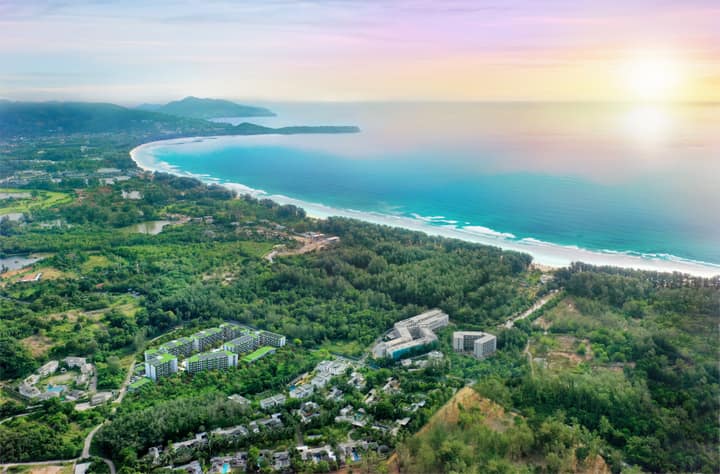
Layan and northern Bang Tao sit at the opposite end: less nighttime activity, fewer bars, calmer traffic — but also less infrastructure close at hand (lifeguards, 24-hour pharmacies, hospitals). For a full district-by-district overview aimed at buyers, see the guide to Phuket’s districts, and for how safety factors into a retirement location specifically, see the best places to retire in Phuket.
8. How district safety affects property prices and rental demand
For an investor, “how safe is it here” isn’t only a question of personal comfort — it directly affects rental liquidity. Families and middle-aged couples — a well-funded and loyal category of long-term tenants — systematically filter Phuket districts by “quiet and calm,” and that shows up directly in low-season demand.
Developments with managed infrastructure have a structural edge over standalone private housing here. Layan Green Park, for example, offers 24-hour security, CCTV across the property, key-card access and guarded parking for 108 vehicles — meaning the security perimeter doesn’t depend on how calm the neighbourhood is outside the gate. Layan Verde is built on the same principle: a gated 7.5-hectare quarter with its own pedestrian environment, which physically reduces residents’ exposure to street-level scooter traffic — one of the main risks from section 2.
The economics are straightforward: a unit near quiet Layan beach, on a gated property with security, is easier to rent to families on a long-term basis than a comparably sized unit in central Patong — even though the latter is nominally the “hotter” tourist location. Entry into this segment starts from $235,995 at the still-under-construction Layan Verde (completion 2028, instalments during construction), or from $142,602 on a resale unit in the already-operating phase 1 of Layan Green Park, where both the rental model and the security setup are proven in practice rather than promised on paper. To factor this into a yield calculation, use the ROI calculator on the homepage.
9. Traps to avoid
- Confusing the “deep south” with Phuket. These are opposite ends of the country; the FCDO’s terrorism warning has nothing to do with Phuket, yet this mix-up is the single biggest reason people get scared off before they even look into the facts.
- Assuming that if a lifeguard exists, the beach is safe at all times. Lifeguards work only 8am–6pm at five beaches — there is no coverage anywhere in the evening or at night.
- Ignoring a red flag “because the water looks calm.” That’s exactly how people drown — the current is often invisible from shore.
- Handing over a passport as a deposit for a bike or jet ski. This is an open door to extortion; the right deposit is cash, not a document.
- Riding a scooter without a category-A licence or a helmet “just for five minutes to the shop.” Short, unhelmeted trips statistically account for a disproportionate share of injuries.
- Skimping on insurance, or not checking whether it covers riding a motorcycle. A cheap policy often excludes exactly the risk most likely to materialise.
- Wiring a deposit on a villa without meeting in person or checking the title. Real-estate fraud is not hypothetical — it’s a working scheme, covered in property scams in Thailand.
- Extrapolating nighttime Patong to the whole island. Incident density varies sharply by district — judging the safety of all of Phuket by one neighbourhood is a mistake.
10. Mini case: Layan vs Patong — and the verdict
A couple with a 7-year-old were planning a winter season on Phuket and weighing an apartment in Patong (cheaper, “everything nearby”) against a studio at Layan Green Park near Layan beach. On paper, Patong won on price per square metre and on walkable infrastructure. Three factors from this article ended up deciding it: first, evening scooter traffic in Patong created a daily risk for their child scooting around outside the hotel; second, the nearest beach to their Patong option wasn’t one of the five with lifeguards, whereas Layan — although technically also without a permanent lifeguard — turned out to be physically quieter and had far fewer people in the water to begin with; third, LGP’s gated property with security and key-card access removed the question of “where can our child go outside alone,” which simply wasn’t an option in Patong’s open-street layout. The family chose Layan, paying a premium for the calm that, by their own account a season later, turned out to be the deciding factor rather than a nice-to-have.
The takeaway is simple and unremarkable: Phuket is neither a high-risk zone nor a risk-free resort utopia — it’s an ordinary tropical tourist destination with its own risk profile, where roads are more dangerous than the sea, and the sea is more dangerous than crime. Every one of these risks is manageable: a helmet and a category-A licence on a scooter, respect for the red flag and knowledge of the five lifeguarded beaches, everyday financial caution in crowded areas, checking documents when renting a vehicle, and legal due diligence when buying property. For anyone choosing a location to live in or invest in, district-level safety deserves the same sober weighting as price per square metre and yield.
We’ll help you match a district and a property to your priorities — from quiet Layan to resort-style Bang Tao — and walk you through how security and management actually work in a given development. Leave a request or reach out directly to Layan Real Estate.
This article is for informational purposes only and is not medical, legal or travel advice, nor does it override the terms of your insurance policy. Statistics and recommendations reflect the sources listed above as of the publication date — check current conditions and official travel advisories before you travel.