Food is the most flexible line item in a Phuket budget after housing: the spread between street food and a beachfront tourist restaurant can hit 10–15x for essentially the same dish. Yet the island isn’t neatly split into “cheap” and “expensive” — markets and food courts operate a few steps from pricey restaurants even in resort clusters. Here’s the real breakdown of what markets, supermarkets, cafés, restaurants and delivery actually cost, and how to build a budget around your own eating style.
Contents
- What a food budget is made of
- Markets and street food: the cheapest option
- Supermarkets: local chains vs premium
- Thai cafés and food courts
- Restaurants: local prices vs beachfront tourist prices
- Food delivery: Grab, foodpanda, Line Man
- On-site restaurants in complexes
- Three food budget scenarios
- Pitfalls
- Case study and takeaway
1. What a food budget is made of
Food spending in Phuket usually breaks into five categories:
- markets and street food — fresh produce and ready meals at the island’s lowest prices;
- supermarkets — from local chains to premium stores with imported goods;
- Thai cafés and food courts — ready meals without cooking, mid-range pricing;
- restaurants — from local eateries inland to tourist spots on the beachfront;
- delivery — Grab, foodpanda, Line Man — convenience layered on top of the dish price.
The final budget depends less on where you live and more on your eating style. For the full picture across all expense categories, see cost of living in Thailand and cost of living in Phuket vs Bangkok.
2. Markets and street food: the cheapest option
Morning and evening markets exist in every district of the island, including resort clusters near Layan and Bang Tao. They sell fresh fruit, vegetables, seafood and ready meals straight from local vendors.
| Item | Price | Comment |
|---|---|---|
| Street food portion (noodles, rice with meat) | $1.5–3 | The cheapest full meal on the island |
| Fresh fruit (kg) | $1–3 | Mango, pineapple, papaya — seasonal is cheaper |
| Market seafood (kg) | $5–15 | Noticeably cheaper than the same dish plated at a restaurant |
| Coconut water / fresh juice | $0.7–1.5 | Sold on nearly every corner |
Eating from markets and street stalls is the base case for a minimal budget — see the full breakdown by scenario in budget for a single person and family budget with kids.
3. Supermarkets: local chains vs premium
Local chains (Big C, Tesco Lotus, Makro) keep prices close to market rates for Thai staples, rice, local produce and meat. Premium stores (Villa Market, Rimping, hypermarkets with imported ranges) target expats and tourists and price in a markup for imported goods.
- local staples (rice, Thai vegetables, local meat and fish) — barely differ in price between chains;
- imported dairy, cheese, wine, ready-made meals — 2–4 times pricier than local equivalents;
- alcohol — imported wine and spirits carry heavy excise duties, while local beer (Chang, Singha, Leo) stays affordable.
The gap is sharper in Phuket than on the mainland — the island depends on shipping logistics, which pushes import prices up more than in Bangkok. More on the city comparison in Phuket vs Bangkok: cost of living.
4. Thai cafés and food courts
Between the market and the restaurant sits a wide segment of Thai cafés and food courts — a plated meal without cooking, without tourist-restaurant pricing.
- Thai café away from the beach — $3–6 per meal;
- shopping-mall food court — $2.5–5 per dish, often air-conditioned with a wide selection;
- coffee locally — $1–2 per cup at a Thai coffee stand versus $3–5 at a Western-style specialty café.
This segment is the mainstay for anyone living on the island year-round who doesn’t cook every day: it pairs a reasonable price with convenience and is available within walking distance of housing almost everywhere.
5. Restaurants: local prices vs beachfront tourist prices
The gap in price for the same dish between a restaurant inland and one on the beachfront in a resort cluster is the most noticeable trap in a food budget.
| Venue type | Main dish price | Example location |
|---|---|---|
| Thai restaurant away from the beach | $3–7 | Areas outside resort clusters |
| Thai restaurant near the beach | $8–15 | Restaurants 5–10 minutes from the shore |
| Beachfront restaurant with a sea view | $15–30+ | Restaurants on the Layan, Bang Tao, Surin waterfronts |
| Western / international restaurant | $10–25 per person | Anywhere on the island |
The difference comes down to beachfront rent and pricing aimed at tourist and expat demand, not product quality. Markets and food courts still operate in tourist areas — just off the beachfront strip, as covered in the pitfalls section below.
6. Food delivery: Grab, foodpanda, Line Man
Three main delivery services — Grab, foodpanda and Line Man — cover nearly the entire island, including resort areas. The pricing mechanics are simple:
- dish price — close to in-restaurant pricing, sometimes with a small app markup;
- delivery fee — usually $1–3 depending on distance;
- service fee — a small percentage of the order total, added automatically.
For a one-off order, delivery is convenient and saves time. But used daily, the markup over a market run or home cooking becomes a noticeable line item — especially for anyone working remotely from home; see Phuket for remote workers.
7. On-site restaurants in complexes
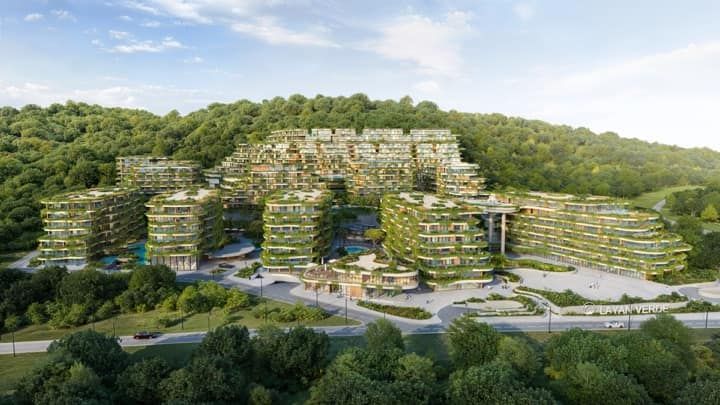
Some newer Phuket projects run their own network of cafés and restaurants on-site — this changes the budget logic for residents and owners who rent units out. A case in point is Layan Green Park: the property runs COMUNA restaurant, LOOM restaurant, JOMO bar and LIV wellness café on-site, meaning full dining is available without leaving the complex.
For tenants, that’s convenience comparable to a hotel service; for an owner in the rental pool, it’s an added argument for occupancy — guests need fewer taxi rides to a restaurant, which tends to show up in reviews and repeat bookings. The methodology for factoring this into yield is covered in how to calculate ROI in Phuket and the yield calculator.
8. Three food budget scenarios
Here’s how eating style maps onto a monthly budget:
| Scenario | Eating style | Food budget/month |
|---|---|---|
| Single, local | Markets, street food, Thai cafés | $150–250 |
| Single, Western style | Supermarket with imports, restaurants, delivery | $400–700 |
| Couple, mixed style | Home cooking + Thai food out | $350–550 |
| Family with kids, Thai style | Home cooking, Thai cafés, markets | $500–800 |
| Family with kids, Western style | Imported groceries, restaurants, delivery | $1000–1800 |
Living together lowers the per-person budget: a couple doesn’t spend twice what a single person does on food, but roughly 60–80% more — thanks to shared portions and joint restaurant trips.
9. Pitfalls
- Defaulting to the beachfront restaurant. The same Thai soup 300 meters back from the beach can cost 2–3 times less — it’s worth one walk down the nearby streets to check.
- Imported goods in the daily basket. Swapping familiar Western brands for Thai equivalents cuts a supermarket bill nearly in half with no real drop in quality.
- Daily delivery instead of occasional. A service fee and app markup, multiplied by 30 days a month, turns into a significant sum compared to a market run or home cooking.
- Alcohol at tourist bars. Imported spirits and cocktails by the sea are among the priciest budget items; local beer at the same venues costs a fraction as much.
- Ignoring the seasonality of fruit and seafood. An out-of-season fruit or fish can cost twice as much as the seasonal equivalent of the same quality.
10. Case study and takeaway
A couple who relocated to Phuket and rented an apartment in the Bang Tao cluster spent their first month eating mostly at waterfront restaurants and shopping at a premium supermarket — the food bill came to $950. After scouting local markets 10 minutes from home and switching to Thai cafés several times a week instead of a restaurant every day, the budget dropped to $480 with the same quality and variety of meals.
The takeaway is simple: food in Phuket can cost anywhere from $150 to $1800 a month — the difference comes down to eating style and willingness to walk a few streets back from the tourist waterfront, not where you live. Markets, food courts and Thai cafés operate even in pricey resort clusters like Layan and Bang Tao, and projects with their own dining infrastructure, like Layan Green Park, remove part of that choice by offering ready-made venues on-site.
I’ll put together a food budget tailored to your neighborhood and lifestyle, and help you find property near markets, cafés and the school cluster — leave a request or check out the Layan Real Estate page.
This material is for informational purposes only. Prices are approximate ranges for 2026; actual costs depend on neighborhood, season and exchange rates, and this is not financial advice.