Thai property marketing almost never mentions the ferry timetable. Yet it is the ferry timetable that decides how much it costs to get an air conditioner onto site, whether a buyer can view a villa on a convenient day, and what happens to a construction schedule when the Gulf of Thailand storms for a week straight. Here is the real difference between Thailand’s “true” islands — Samui, Phangan, Tao, Chang, Lanta, Phi Phi, Koh Yao — and the territories linked to the mainland by a bridge or by land, Phuket included. Foreign ownership law is the same everywhere; logistics, risk and eventual yield are not.
Contents
- Two kinds of remoteness: islands and bridge territories
- Who already has a bridge, who is still on the ferry
- Construction: what logistics cost the owner
- Monsoon season and transport disruptions
- Foreign quota and ownership structure: one law, different practice
- Rental, yield and management model
- Emergency care, insurance and daily life
- Resale liquidity
- Comparison table and pitfalls
- Case study and conclusion
1. Two kinds of remoteness: islands and bridge territories
The first mistake when choosing a location is splitting Thailand into “islands” and “mainland” purely by looking at a map. Geographically, Phuket is an island, but in terms of ownership logistics it has long behaved as an extension of the mainland: the Sarasin Bridge has connected it to Phang Nga province since 1967, a modern dual-lane twin was built alongside it in 2010, and a third bridge across the strait opened in 2023. A truck loaded with construction materials, an ambulance, a delivery van with furniture — all of it travels by road, with no ferry crossing at all.
A completely different story applies to islands reachable by boat only: Samui and Phangan (ferry from Surat Thani or Don Sak), Tao (a ferry further out into the gulf), Chang (a ferry on the eastern coast), Phi Phi (boat only — there are no cars on the island at all), and Koh Lanta, where part of the route is already closed by a short bridge between Lanta Noi and Lanta Yai, while the crossing from mainland Krabi is still by ferry. The difference between these two kinds of territory has nothing to do with scenery or tourist numbers — it is about how many steps and weather risks stand between your property and the outside world.
It is also worth keeping a third, intermediate case in mind — islands with their own international or regional airport (Samui, and Phuket too before the bridges). Flights solve part of the problem for people, but not for cargo: nobody flies in cement, roof tiles or air conditioners by plane.
2. Who already has a bridge, who is still on the ferry
| Territory | Mainland connection today | What is changing |
|---|---|---|
| Phuket | 3 bridges across the strait (since 1967, 2010, 2023) | Already functions as mainland logistically |
| Koh Lanta (Lanta Noi ↔ Krabi) | Ferry, ~30 minutes | Krabi–Koh Lanta bridge: contract signed, opening within a few years (Bangkok Post) |
| Koh Chang | Ferry only | Laem Ngob–Ban Dan Kao bridge: cabinet approval targeted for 2029, opening around 2035 (Khaosod English) |
| Samui | Ferry (Surat Thani / Don Sak) + own airport | No bridge planned; relies on ferries and air links |
| Phangan | Ferry (via Samui or direct) | No bridge planned |
| Tao | Ferry, the furthest of the Samui–Phangan–Tao trio | No bridge planned |
| Phi Phi | Boat only, no cars on the island | Not under consideration — part of the area is protected land |
| Koh Yao Noi / Yai | Ferry from Phuket or Krabi | No bridge planned |
The table reveals a systemic pattern: bridge projects appear where an island is geometrically close to the mainland (Lanta is roughly 2 km at the narrowest point) or where traffic and tourism volume justify an expensive infrastructure project (Chang, an estimated 15 billion baht per Khaosod English). For Samui, Phangan and Tao, the bet is on the ferry fleet and air links rather than a bridge — the distance to the mainland and the depth of the strait make a bridge project an order of magnitude more expensive, and it does not appear to be under serious consideration by the relevant authorities.
3. Construction: what logistics cost the owner
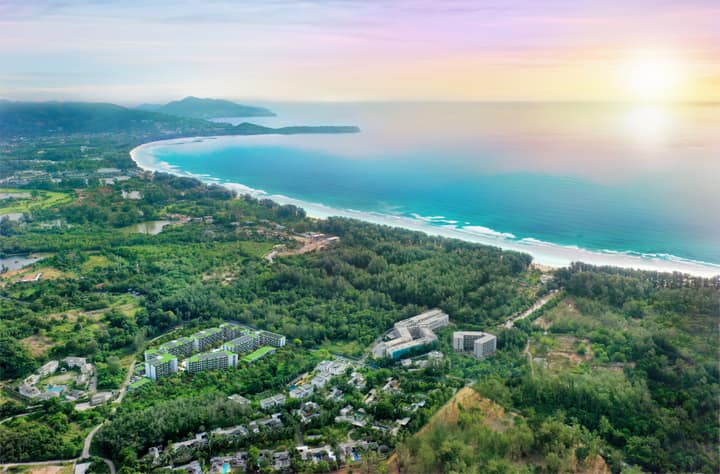
On bridge territories, construction logistics are no different from any mainland project: concrete, rebar, air conditioners, elevator equipment — everything arrives by truck on an ordinary schedule, with no dependence on sea conditions. That is exactly how construction runs at Layan Verde and Layan Green Park near Layan beach — materials and equipment travel by road rather than by ferry timetable, which directly affects how predictable the handover date is.
On ferry-only islands, at least one extra link is added to the chain: cargo too large for a car ferry goes by barge, and barge schedules depend on tides, wind and pier congestion. Developers budget for this as a separate logistics line, and any one- or two-day barge delay translates into a delay in installation work. Many islands also have fewer local contractors and specialist crews, meaning some labour and equipment has to be brought in too — adding further load onto the same crossing.
| Construction factor | Bridge territory (Phuket & mainland) | Ferry-only island (Samui, Phangan, Chang, etc.) |
|---|---|---|
| Bulky material delivery | Truck by road, on schedule | Barge, weather- and tide-dependent |
| Local contractors and equipment | Developed market, competitive | Thinner, some equipment brought from the mainland |
| Risk of handover delay from logistics | Lower | Higher, especially during monsoon season |
| Typical developer | Large developers with district-scale infrastructure (VillaCarte Group and peers) | More often local or regional companies, a younger market |
This does not mean building on an island is impossible or pointless — the Samui and Phangan markets are currently growing faster than many mainland destinations. But when comparing handover timelines for an off-plan project on an island versus a bridge territory, it is worth budgeting a wider buffer and asking the developer more pointed questions about the actual logistics experience of previous phases — an approach we cover in our article on construction timelines in Thailand.
4. Monsoon season and transport disruptions
Monsoon season is not an abstract seasonality note from a tourist brochure — it is a concrete scheduling risk. Bangkok Post has repeatedly reported full suspensions of ferry service between Surat Thani and Samui, Phangan and Tao amid storms in the Gulf of Thailand, with authorities halting sailings on safety grounds for anywhere from a day to several days running. During these windows, neither passenger nor cargo ferries operate: a tourist can get stranded just as easily as a shipment of building materials or furniture waiting on-site.
For bridge territories like Phuket, a storm at sea certainly affects coastal activity and boat excursions, but it does not cut off the road link to the mainland: an ambulance, a delivery truck and an airport taxi all still travel across the bridge in nearly any weather, barring the rare extreme case of a road closure from flooding — which happens far less often than a gulf storm.
The practical takeaway for an owner on a ferry-only island is to plan not only around high and low tourist season, but around the real chance of a multi-day logistics pause at monsoon peak (typically October–December on the Andaman coast and November for the Gulf of Thailand islands). This affects the timing of site visits, the planning of renovations or tenant move-ins, and how realistic a promise of “delivered and installed within a week” actually is.
5. Foreign quota and ownership structure: one law, different practice
It is important to separate law from practice here. The foreign quota on condominiums — no more than 49% of a building’s floor area held by foreigners — is set by national law and applies the same way on Phuket, on Samui, and in mainland Bangkok. Land under a villa is accessible to a foreigner everywhere only via leasehold or a permitted ownership structure — see freehold vs leasehold for the details. The island itself grants neither extra privileges nor extra restrictions beyond nationwide rules.
The practical difference lies in market maturity and the number of proven developers. Over decades, Phuket has built a dense ecosystem of large developers, lawyers and agencies that have handled hundreds of foreign-quota transactions and know the pitfalls of specific land plots. In younger island markets like Phangan, some developers are local companies without that track record, and Nation Thailand notes the growing popularity of leasehold structures there specifically — not a sign of weaker law, but a sign of a market where ownership practice is still forming. The practical conclusion: project- and title-level due diligence matters more in a young market — not because “the rules are different,” but because there is less proven practice to lean on. What exactly to check is covered in our due diligence in Phuket guide, and the method applies to any island.
6. Rental, yield and management model
Phuket has built a mature income model over recent years — the rental pool, where identical unit types are pooled with a transparent profit-sharing formula. At Layan Green Park, for example, the owner receives 60% of net pool profit — a benchmark of roughly 8–10% net a year — and phase 1 has been operating since 2024, proving the model in practice rather than on paper. Layan Verde, due for handover in 2028, follows a similar structure.
Islands like Samui and Phangan, meanwhile, are seeing explosive investment growth — per Nation Thailand, in Q1 2026 the two islands had 154 projects on sale comprising around 2,860 units with a combined investment value of 61.14 billion baht, and Colliers Thailand’s director of research, Phattarachai Taweewong, compared the current growth trajectory to how Phuket’s market looked roughly five years ago. That signals an actively forming rental market, but large public rental pools at the scale of Phuket’s mature projects remain rare — management is often self-run or handled by a local operator without a unified income-sharing policy across the whole complex.
For an investor, these are two different risk-and-yield profiles: a mature rental pool on a bridge territory offers more predictable, if more “industrial,” income; a young island market offers potentially higher capital-growth upside on entry — as Samui and Phangan’s trajectory suggests — but with less rental-management transparency today.
7. Emergency care, insurance and daily life
Ownership logistics are not just about construction — they show up in daily life and become critical in an emergency. Phuket has a network of international-standard private and public hospitals, including Bangkok Hospital Phuket, reachable by road at any hour. On ferry-only islands, a serious emergency evacuation often requires a boat or helicopter to a mainland hospital, and in a storm that option narrows or disappears entirely.
This is worth factoring into insurance choices — some medical and expat/second-home insurance policies price risk differently depending on emergency-care accessibility, and evacuation costs are usually budgeted separately. The same applies to everyday practicalities: getting a spare part for a broken air conditioner, calling a pool technician, an urgent roof repair after a storm — on a bridge territory this is a same-day matter; on a remote island during bad weather, it can take a week.
This is not an argument that “islands are worse” — some owners deliberately choose seclusion and reduced accessibility as part of the lifestyle. But these factors need to be built into the ownership budget and the personal-use plan upfront, not discovered after the fact.
8. Resale liquidity
Liquidity is not just about price — it is about how quickly a buyer can be found. On a bridge territory like Phuket, a buyer can show up for a viewing on any day without working around a ferry timetable, and a mature market of agencies and lawyers shortens the transaction timeline. That is exactly why Phuket’s secondary market is so active — see our detailed article on reselling property in Phuket.
On ferry-access islands, the buyer pool is objectively narrower: some buyers treat a trip to the island as a separate journey rather than a stop “along the way.” Amid rising demand, as on Samui and Phangan right now, this is temporarily offset by overall market growth — but when the cycle turns, limited accessibility is usually the first thing to hit sale timelines and buyer willingness to negotiate. For a broader look at regional price dynamics, see Thailand property prices by region.
A separate liquidity factor is the upcoming bridges. A property on Koh Lanta bought today theoretically stands to benefit once the ferry barrier is removed at bridge opening, but given the timeline (several years, per Bangkok Post), that is a horizon for a patient investor rather than a quick upside. For Koh Chang, the horizon is even longer — 2035 under EXAT’s current plans.
9. Comparison table and pitfalls
| Parameter | Bridge territory (Phuket) | Ferry-only island (Samui, Phangan, Chang, Lanta) |
|---|---|---|
| Access for construction and equipment | Road, no ferry | Ferry/barge, weather-dependent |
| Risk of monsoon-related delay | Low | High, especially Oct–Dec and November in the gulf |
| Foreign quota (law) | Uniform national standard, 49% | Same uniform standard |
| Rental-pool maturity | High (60/40, reporting since 2024 at LGP) | Forming, often self-managed |
| Emergency care | Road access to an international-standard hospital | Boat/helicopter for serious cases |
| Resale liquidity | Higher, wider buyer pool | Narrower, offset by market growth pace |
| Investment momentum (Q1 2026) | Mature, established market | 61.14bn baht, 154 projects — rapid growth (Nation Thailand) |
Common pitfalls when choosing between an island and the mainland:
- Confusing an airport with solved cargo logistics. Samui has its own airport, but cement and furniture do not fly in — construction still depends on the ferry.
- Assuming ownership law is “looser” on a remote island. The quota and registration rules are the same nationwide; the difference is local developer and legal experience, not the law itself.
- Ignoring ferry seasonality when planning site visits. A multi-day storm suspension can land exactly on a planned trip for handover inspection.
- Extrapolating today’s Samui and Phangan growth indefinitely. Fast growth often means new developers entering fast without a long track record — due diligence matters even more here; see developer red flags.
- Treating a bridge opening 5–10 years from now as an already-settled fact in a business plan. The Koh Lanta and Koh Chang dates are planning targets, not guarantees; infrastructure projects in Thailand, as everywhere, regularly slip.
10. Case study and conclusion
An investor was comparing two options with a similar budget of around $230,000: a seaview villa on Koh Phangan and a studio in an under-construction quarter near Layan beach on Phuket. The Phangan villa won on land price and view — the island’s market is still forming, and entry pricing is lower than a comparable Phuket property. But a closer look at logistics revealed the developer was planning to bring in part of the mechanical equipment by barge from the mainland, with a possible delay during monsoon season; there was no management company with a transparent rental-income model for the complex; and the investor’s own site visits to monitor construction would require budgeting a full day of travel including a ferry connection through Surat Thani.
The Phuket studio, by contrast, was being built within a project with already-proven bridge-based delivery logistics, construction-period instalments, and a clear 60/40 rental-pool model — a neighbouring project by the same developer already had reporting going back to 2024. The investor chose Phuket — not because Phangan is “worse” as a place, but because for the goal of “predictable handover and managed income without frequent personal site visits,” bridge-territory logistics turned out to be the deciding factor.
Bottom line. Islands versus the mainland in Thailand is not a question of remoteness for its own sake — it is a question of concrete operational risk: material delivery, weather dependency, emergency-care access, and the width of the future buyer pool. Foreign ownership law is identical everywhere; what differs is infrastructure, rental-market maturity, and the predictability of timelines. Samui and Phangan are currently growing faster than many mainland destinations — a real opportunity for those prepared for island-style logistics. Phuket and other bridge territories offer a more predictable operating model today, with a proven rental-pool system and no ferry risk.
I can help compare specific options — on Phuket and beyond — against your budget, horizon and tolerance for logistics risk, with a yield calculation in the ROI calculator — or let’s discuss strategy through Layan Real Estate.
Get matched to the right logistics profile
By submitting this form, you agree to our privacy policy.