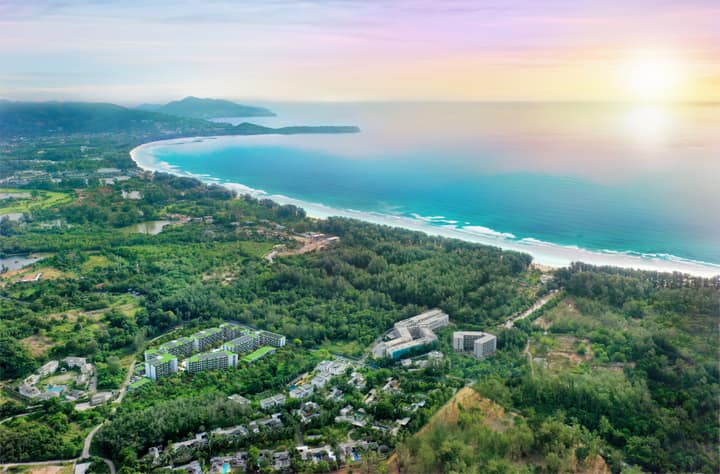
This week’s three numbers pull in different directions, and that’s exactly what makes them worth reading closely. The baht kept quietly weakening — no sharp move, just week after week of drift. Arrivals in the first week of September slowed more noticeably than in previous summer weeks — not because the island got less appealing, but because summer holidays in China and Taiwan ended. And on Phuket, the deadline the authorities set for themselves to clear a years-long hotel-licensing backlog is approaching fast, with no confirmation yet that they’ll make it. Here’s what actually deserves attention from a Layan-area property owner or buyer, and what’s just background noise.
Contents
- The baht: this week’s numbers
- Arrivals through 5 September: 21.28M, the slowdown continues
- Why the pace slowed: summer holidays end in China and Taiwan
- Phuket’s hotel licences: the countdown to month-end
- A hotel licence ≠ legal rental: what an owner should check
- Tourist ≠ buyer: how an investor should read these numbers
- Traps of the week
- Mini case: three numbers before wiring a deposit
- What it means for Layan and the rental pool
- Bottom line and next step
1. The baht: this week’s numbers
Per Trading Economics, on 21 September 2026 the USD/THB rate stood at roughly 33.27. A week earlier, on 11 September (week-38 digest), it was around 33.06 — the baht eased about 0.6% over ten days. The range within the week was wider than the net move: a low of 33.05 on 12 September and a high of 33.42 on 17 September. Over the past month the baht eased against the dollar by roughly 1.7%, and by 4.6–4.8% over the year.
| Date | USD/THB |
|---|---|
| 11.09.2026 (for comparison, week 38) | ~33.06 |
| 12.09.2026 (weekly low) | ~33.05 |
| 17.09.2026 (weekly high) | ~33.42 |
| 21.09.2026 (digest date) | ~33.27 |
The official rate source is the Bank of Thailand, which publishes daily figures on bot.or.th (the Daily Foreign Exchange Rates page) at 18:00 Bangkok time on business days; Trading Economics aggregates this alongside other market quotes into an easier format to track. The practical takeaway for a buyer paying in tranches on a developer’s schedule doesn’t change week to week: check the rate right before wiring funds through the FET form rather than anchoring to your reservation date or this digest’s date — the spread within a single week (33.05–33.42) already exceeds the net weekly move.
🔗 Live snapshot of the index, type medians and every weekly digest on one permanent page: Phuket property market hub →
2. Arrivals through 5 September: 21.28M, the slowdown continues
Per the Ministry of Tourism and Sports, Thailand received 21,280,409 foreign visitors between 1 January and 5 September 2026 — down 3.12% year on year. Tourism revenue over that period reached roughly THB1.04 trillion. For comparison, a week earlier (through 31 August, week-38 digest), the cumulative figure stood at 20.93 million with a 3.08% shortfall — meaning the first five days of September added about 350,000 visits, while the year-on-year gap widened slightly rather than closing.
| Market | Visits, Jan.–5 Sep 2026 | Rank |
|---|---|---|
| China | ~3.60 million | 1 |
| Malaysia | ~2.71 million | 2 |
| India | ~1.57 million | 3 |
| Russia | ~1.19 million | 4 |
| South Korea | ~0.78 million | 5 |
| Nationwide total | 21.28 million (−3.12% YoY) | — |
The more telling number is the weekly, not the cumulative, figure. Between 30 August and 5 September, the country received 472,898 foreign visitors — down 3.78% from the previous week, averaging 67,557 arrivals a day. That’s a sharper move than the weekly swings of previous months, and it deserves its own explanation, which is where the next section comes in.
3. Why the pace slowed: summer holidays end in China and Taiwan
Tourism and Sports Minister Surasak Phancharoenworakul addressed the weekly figures directly: the slowdown is linked to the end of summer holidays in China and Taiwan — two markets whose outbound peak falls in July and August. Once the school year restarts in these countries (typically in the first half of September), family travel volumes decline as a matter of course, regardless of what’s happening with prices, flight connectivity or exchange rates in Thailand itself.
That’s an important nuance for anyone reading arrivals headlines literally. A 3.78% weekly drop looks alarming in isolation, but set against the school-calendar of the largest outbound markets, it reads as an expected seasonal effect rather than a signal that tourists are souring on Thailand. The same pattern — a sharp July–August rise followed by an equally sharp early-September cool-down — repeats every year and isn’t unique to China and Taiwan; it’s typical of most markets where arrivals track the school calendar.
The practical takeaway for a Phuket property owner: judging the health of the coming peak season (November–April) by September’s weekly figures is a methodological mistake. The real test of resort-rental demand is still ahead, not in the handover weeks between the summer and winter tourism peaks.
4. Phuket’s hotel licences: the countdown to month-end
In the week-37 digest, we noted that the Ministry of Interior, on the Prime Minister Anutin Charnvirakul’s direct order, had accelerated clearance of Phuket’s years-long hotel-licensing backlog: by 12 August 2026, 275 of the 392 applications accumulated since 2018 had been approved — over 75% of the backlog. The remaining 117 applications were targeted for clearance by the end of September 2026, meaning the usual processing rate (previously 30–40 applications a year province-wide) needed to multiply several times over within two months.
| Metric | Value |
|---|---|
| Total applications in the backlog (since 2018) | 392 |
| Approved by 12.08.2026 | 275 (over 75%) |
| Remaining as of this digest | 117 |
| Target clearance date | end of September 2026 |
| Previous provincial processing rate | 30–40 applications a year |
As of this digest, fewer than ten days remain until the stated deadline, and no official report confirming full clearance of the remaining 117 applications has been published yet. That’s not a reason for alarm — the clearance rate is running many times faster than the historical norm — but it’s also not a guarantee that “117” turns into “0” precisely on 30 September: administrative campaigns of this scale often run several weeks past their target.
5. A hotel licence ≠ legal rental: what an owner should check
This story doesn’t apply evenly across the board, and it’s worth separating two questions that are easy to conflate. A hotel licence under the Hotel Act is a permit for a specific building or complex to offer short-term stays to guests. A foreigner’s right to buy a condominium within the freehold quota and own it is a separate legal regime that has nothing to do with a building’s hotel licence.
The practical implications for a buyer looking at rental income:
- Operating condo-hotels with a licence already in place — such as Phase 1 of Layan Green Park, running since 2024 — rent out units through a legal rental pool regardless of how the province-wide backlog clears: their paperwork is already in order.
- Private condominiums without a hotel licence let short-term via booking platforms outside a licensed programme are exactly the segment this crackdown targets: authorities are systematically identifying such properties in parallel with processing legitimate applications.
- Clearing the backlog legalises existing applications — it doesn’t authorise unlicensed short-term rental where no application was ever filed.
For how to check a specific property’s status before a deal and what to look for in a management agreement, see Phuket rental management programs and due diligence before buying.
6. Tourist ≠ buyer: how an investor should read these numbers
It’s important not to conflate the arrivals metric with investment demand. Arrivals reflect flight connectivity, visa policy, exchange rates, the school calendar of major outbound markets, and general destination appeal. Demand for buying property is a separate story, driven by yield, transaction transparency, and specific projects and locations. The Ministry of Tourism doesn’t publish — and can’t publish — data on what share of the 21.28 million visitors are considering a condominium purchase; that statistic simply doesn’t exist.
The link between the two metrics is real, but at the level of market mechanics rather than stated intent:
- Peak-season rental-pool occupancy depends directly on overall arrivals to the island — and therefore on the actual yield an owner sees on a unit placed in a rental pool.
- The “tourist to buyer” funnel remains a standard sales channel for resort real estate: some future owners first learn about a project during their own holiday.
- Diversifying guest sources matters more than the swing in any single market. The early-September slowdown specifically in Chinese and Taiwanese arrivals is a seasonal effect, not a structural decline; management companies like the one running Layan Green Park hedge this by blending channels (OTAs, direct bookings, tour operators from multiple countries) rather than betting on one source.
For broader context on how arrivals and the island’s economy roll up into the property-market picture, see Phuket Real Estate Market 2026, and for how the AREA research centre valued the whole island market at THB705 billion — a figure built on supply and absorption data, not arrivals directly.
7. Traps of the week
- A 3.78% weekly drop in arrivals is not a downturn signal. It’s the seasonal effect of summer holidays ending in China and Taiwan, not a sign the island is losing appeal to guests or investors.
- The hotel-licence deadline is not a guarantee it will be met. The remaining 117 applications could clear later than the end of September; assuming “everything is legalised right after 30 September” is premature without official confirmation.
- A building’s hotel licence and a foreigner’s ownership rights are separate regimes. Clearing the backlog doesn’t change the terms of buying a condominium in the freehold quota, nor does it touch already-licensed operating projects like Layan Green Park.
- The baht remains in a calm range. This week’s spread (33.05–33.42) is wider than the net weekly move (~0.6%) — check the rate right before transferring funds, not from a week-old digest.
- Nationwide statistics don’t break down to a specific beach. Figures for China, Malaysia or Russia don’t directly speak to demand for Layan or Bang Tao specifically — local conclusions need local data, such as CBRE or AREA reports for the province.
8. Mini case: three numbers before wiring a deposit
A buyer from Germany had a reservation deposit to wire for a studio in Phase 2 of Layan Green Park within the week, and decided to check three headline numbers before sending the transfer. The baht ranged from 33.05 to 33.42 over the week — the difference in converting a THB200,000 deposit between those two extremes was about $37, well within his budget’s margin of error; he chose to transfer near the lower end of the range, checking the live rate on bot.or.th right before the FET-form transaction.
The news about 117 unresolved hotel licences didn’t apply to him directly: Phase 2 is being built by the same developer as the operating Phase 1, launched in 2024, whose licence and management company are already in place and running — the backlog clearance concerns other, previously unlicensed properties on the island, not this project. He also didn’t factor the weekly arrivals slowdown into his yield forecast: there’s enough time before Phase 2’s 2026 handover for September’s seasonal dip to be irrelevant to the calculation. At a rate of ~33.27 baht per dollar, the deposit amount worked out to the equivalent of 7,424,784 THB ($224,043) per the project price list he checked in the catalogue before transferring. The yield-calculation method is covered in how to calculate ROI in Phuket.
9. What it means for Layan and the rental pool
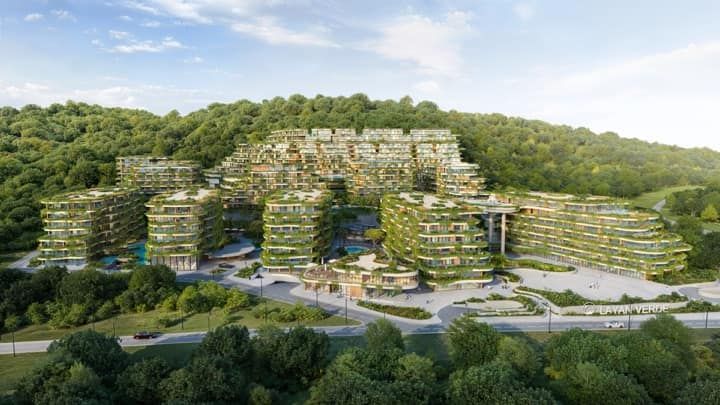
This week’s three storylines add up to a calm, if uneven, picture for an owner near Layan beach. The early-September arrivals slowdown is a predictable seasonal effect that says nothing new about demand for the peak season ahead. The hotel-licensing countdown concerns legalising the island’s existing properties as a whole and doesn’t directly touch already-operating licensed projects with a transparent rental-pool model — but it’s a reminder that rental legality is worth checking as its own due-diligence item, not assumed as an automatic consequence of ownership. The baht keeps behaving predictably, staying within a range familiar to buyers paying in dollars. For the Bang Tao–Layan area, home to most of the coast’s branded, licensed projects with a transparent rental-pool model — both the operating Layan Green Park and the under-construction Layan Verde — this week doesn’t change an investor’s strategy so much as confirm the backdrop stays steady.
10. Bottom line and next step
The headline of this week isn’t one loud story but three quiet numbers that need reading correctly. Arrivals through 5 September were down 3.12% year on year, and the weekly pace slowed 3.78% — but that’s the seasonal effect of summer holidays ending in China and Taiwan, not a signal the island’s outlook is worsening. Phuket’s hotel-licence backlog is close to fully cleared (275 of 392), but the end-of-September target hasn’t been officially confirmed yet. The baht keeps moving inside a narrow, familiar range without sharp swings.
I can send you the current price list, fresh rental-pool occupancy figures, and a yield calculation for your budget at Layan Verde and Layan Green Park — leave a request or see partnership terms on the Layan Real Estate page.
This material is informational only and does not constitute legal, tax or investment advice. Figures are based on sources as of the publication date; verify current rules and figures at the time of your transaction.