On 11 September 2026, Thailand’s Real Estate Information Center (REIC), part of the Government Housing Bank, published its report on condominium transfers to foreign buyers for Q2 2026. The most important fact for Russian-speaking investors isn’t in the headline — it’s buried in the country-by-country table: Russia has moved into second place by transaction value among all foreign condo buyers in Thailand, overtaking Myanmar, with its share almost doubling year-on-year. Here’s what the report shows, what’s behind the growth, and why REIC’s statistics aren’t the same thing as the yield on any specific unit.
Contents
1. The Q2 2026 numbers
According to REIC, foreign buyers were transferred 3,292 condominiums across Thailand in Q2 2026 — up 1.4% year-on-year. Total transaction value came to 14.803 billion baht, up 20.2% year-on-year, with combined floor area of 145,140 sqm (+8.1%).
The gap between unit growth (+1.4%) and value growth (+20.2%) says the same thing it said about Russian demand on Phuket this summer: foreigners didn’t so much buy more units as buy pricier ones on average. At the same time, the foreign share of the overall condominium market actually shrank — 10.2% of all units transferred and 20.0% of total value, both lower than a year earlier when the overall market was smaller.
2. The full half-year: a tale of two quarters
To see whether this is a one-off or a trend, it helps to compare the quarters directly:
| Metric | Q1 2026 | Q2 2026 |
|---|---|---|
| Units transferred | 3,241 (−17.3% YoY) | 3,292 (+1.4% YoY) |
| Value | 13.464bn baht (−17.9% YoY) | 14.803bn baht (+20.2% YoY) |
| Area | 141,644 sqm (−13.8% YoY) | 145,140 sqm (+8.1% YoY) |
| Foreign share (units / value) | 13.6% / 23.9% | 10.2% / 20.0% |
Q1 was genuinely weak — double-digit declines across nearly every metric. Q2 reversed the trend in both unit count and, more sharply, in value — but the half-year as a whole is still negative: 6,533 units transferred between January and June 2026 (−8.8% YoY), total value 28.267 billion baht (−1.5% YoY), average price around 98,566 baht per sqm. REIC explicitly links the weak Q1 to a “global economic slowdown” that pushed foreign buyers to delay decisions.
3. Russia — second place by value
The most notable change in the report is a reshuffle at the top of the nationality-by-value ranking for H1 2026:
| Rank | Country | H1 2026 transaction value | YoY change |
|---|---|---|---|
| 1 | China | 6,874m baht | −27.7% |
| 2 | Russia | 3,603m baht | +75.9% |
| 3 | Myanmar | 2,457m baht | −16.2% |
Back in Q1 2026, Russia held a more modest position — 383 units (+33% YoY) and 1.665 billion baht (+68.7% YoY). By the end of the half-year, its share of total value had grown enough to overtake Myanmar and lock in second place right behind China — a spot another country held firmly a year earlier. Rounding out the full top-10 by value, alongside the leading three, are the US, Taiwan, France, the UK, Germany, Australia and India.
4. China retreats, Russia grows — what’s behind it
REIC and the Thai business outlets covering the report point to the same factor behind the drop in Chinese demand: China’s broader economic slowdown and buyers’ caution around large overseas investment decisions. The numbers show a sharp move — as early as Q1 2026, the number of Chinese-buyer deals fell 38.8% YoY and their value fell 42.9%; over the full half-year, the value of Chinese transactions was still down 27.7%.
REIC’s report doesn’t offer a separate official explanation for the Russian growth specifically — the center publishes figures without country-by-country commentary. But the timing lines up with a trend flagged earlier by Sunway Estates, Prian.ru and Tranio (cited by Kommersant): part of Russian capital is being redirected to Thailand as the list of alternative destinations narrows and interest in Phuket specifically grows. A detailed breakdown of that data is in “Russian demand for Thai property is up nearly 50%”.
5. REIC’s national data vs the Phuket market
One important caveat: REIC’s report covers all of Thailand, with no province-level breakdown. It doesn’t say directly how much of Russia’s 3,603 million baht landed specifically on Phuket.
Context comes from a separate, recent report by AREA (the Thai Real Estate Research and Valuation Center), which on 12 September 2026 valued the island’s entire residential market for the first time in a while: 90,597 units across 806 projects worth a combined 705.055 billion baht, 85% of which is sold. AREA specifically notes that Russian and CIS buyers remain a notable source of demand on the island for a second year running — consistent with the growth REIC’s national report is showing. For more on Phuket’s market specifically, see “Phuket’s property market valued at 705bn baht”.
6. Limits worth knowing
Growth in REIC’s numbers doesn’t change the structural rules every foreign condo buyer in Thailand still faces:
- The freehold quota. Foreigners can own no more than 49% of the total sellable floor area in any given building — which is exactly why REIC tracks condominium transfers specifically, rather than houses or villas on land.
- Land is a separate matter from condos. The freehold rule applies to condominiums; a villa or house on land is only accessible to a foreigner through long-term land leases or other ownership structures — a different legal regime entirely.
- Ownership isn’t a visa. Buying a condo by itself doesn’t extend your stay beyond the standard visa-exempt entry. For more on how the shorter visa exemption interacts with buying property on Phuket, see “Thailand officially confirms the shorter 30-day visa exemption”. This isn’t legal or visa advice — check the specific route with a qualified lawyer for your situation.
7. Raw transaction volume vs managed yield
REIC’s report counts the fact of a property transfer — how many units, and for how much, changed hands. That’s not the same as the yield that unit will generate for its new owner:
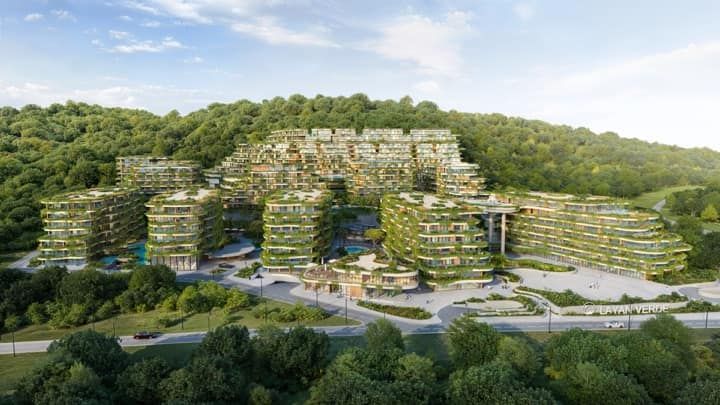
| A plain transaction (what REIC counts) | Rental pool (Layan Verde, Layan Green Park) | |
|---|---|---|
| What the statistic captures | The fact of a title transfer | The same fact — plus a managed rental model afterward |
| Who arranges the income | Not part of REIC’s report — up to the buyer | A management company, a single pool of units |
| Yield | Not tracked by REIC | Benchmark of roughly 8–10% net annual yield (owner gets 60% of the pool’s net profit) |
| Transparency | No data after the deal closes | Regular pool reporting |
In other words, growth in the number and value of deals in REIC’s report is a signal of overall market interest — not a guarantee that any specific unit will generate income. The methodology for calculating your own yield is in “How to calculate ROI on Phuket”; how the pool model works is covered in “How Phuket’s rental management program works”.
8. Pitfalls
- “Russia is #2, so prices everywhere will rise.” A nationwide rise in average transaction value doesn’t mean any specific project or district will get more expensive. Location, developer track record and clean legal structure matter more than the general news cycle.
- Confusing nationwide statistics with the Phuket market. REIC doesn’t break this report down by province — the 3,603 million baht figure covers all of Thailand, not just the island, even though Phuket has historically captured a notable share of Russian demand.
- Treating any transferred property as an income-producing investment. REIC’s report records a title transfer, not the presence of a rental model, reporting, or a management company after the deal — those are different things, and worth keeping separate.
9. Mini case
An investor from Moscow saw the news about rising Russian demand for Thai property in August 2026 and figured that “if the stats are up, almost any move-in-ready resale condo should work.” On closer inspection, it turned out REIC’s report only captures the fact of a transaction — with no data on whether a given unit is actually rented out, or how well it’s occupied. The investor ended up comparing a resale with no income model against a Phase 1 resale at Layan Green Park already plugged into a working rental pool with transparent reporting, and chose the latter — not because REIC’s statistics are good or bad, but because they simply don’t answer the yield question at all.
10. Bottom line and next step
REIC’s Q2 2026 report captures a real, officially documented shift: Russia overtook Myanmar to rank second by value among all foreign condo buyers in Thailand, with transaction value up 75.9% year-on-year. But REIC’s statistics answer the question “where is the money going,” not “what yield will you get on a specific property” — that depends on location, ownership structure, and whether the unit has a managed rental model behind it.
I can walk you through how your budget and goals line up with the numbers and yield at Layan Verde and Layan Green Park in Layan — next to Bang Tao: leave a request or run your own scenario in the yield calculator.
A breakdown of Phuket’s market for your budget and goals
By submitting this form, you agree to our privacy policy.
This article is for informational purposes, based on REIC’s (Real Estate Information Center, Government Housing Bank) report dated 11 September 2026 and publicly available sources as of publication; it is not investment, legal or visa advice and does not guarantee any yield.