Thai law sets the same three routes for foreigners everywhere in the country — a condominium unit in freehold within the 49% quota, a registered lease, or a company. What differs on Phuket is how each project applies them: a Layan condo-hotel sells the same floor in both freehold and leasehold, a Laguna villa comes as a freehold house on leased land, a beachfront resort residence is leasehold only, and a Patong tower may hold most of its stock back from the foreign quota altogether. The island also has its own deal rhythm — reservation sums, instalment plans, which land office you walk into — and that is where buyers who only read the country-level rules get caught.
This guide is the Phuket layer on top of our general guide to buying property in Thailand as a foreigner: which structure each type of Phuket project actually uses, with examples from our catalog and the dates we last checked them, how a deal runs on the island step by step, and what separates Layan and Bang Tao from Patong when it comes to ownership form.
Contents
- The island in one paragraph: who sells what
- Reading the 49% quota project by project
- Villa estates: how the land and the house are split
- The Phuket deal step by step
- Money: FET, instalments and Phuket bank practice
- Which land office registers your deal
- Layan and Bang Tao vs Patong: ownership forms by area
- Foreign-buyer pitfalls specific to Phuket
- Case: two buildings, one project, two different answers
- Choosing the structure for your goal
1. The island in one paragraph: who sells what
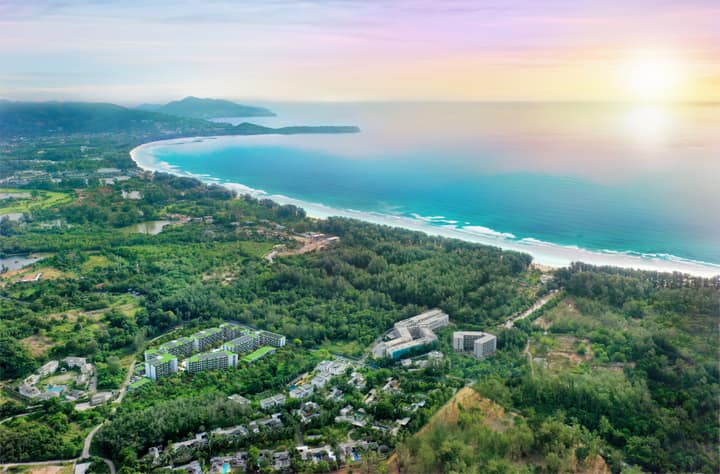
Phuket is an island of roughly 540 km² where almost every residential project aimed at foreigners falls into one of four product types, and each type carries its own default ownership structure:
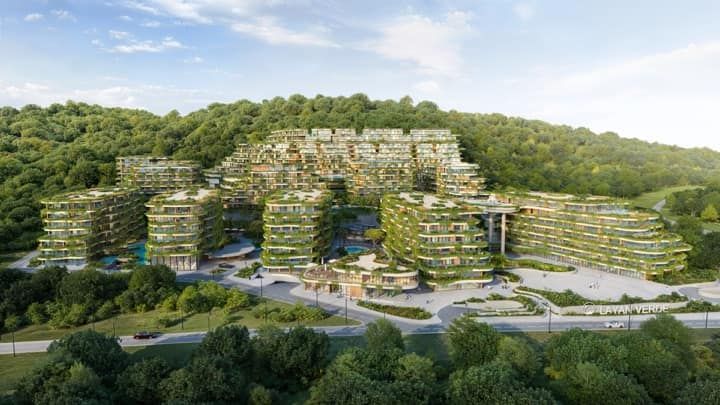
- Condominiums and condo-hotels (Layan Verde, Layan Green Park, Seavale Residences Patong, The Balance Patong) — registered under the Condominium Act, so a foreigner can hold a unit in freehold within the 49% foreign quota of the building, or take the same unit on a registered 30-year lease.
- Resort-branded residences on hotel land (Angsana Beachfront Residences, Angsana Oceanview) — the land belongs to the resort, so the product is leasehold only, however premium the address.
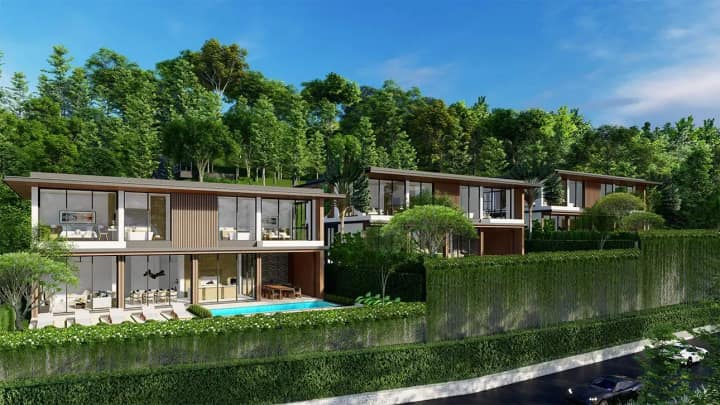
- Villa estates (Botanica, Laguna Homes, Anann Villas, Laguna Fairways) — the land cannot be registered to a foreigner, so the estate sells either a freehold house on leasehold land, a lease with two contractual renewals, or freehold to a Thai company the buyer controls.
- Mixed-use projects (Kiara Reserve, Dandara, Laguna Lakelands) — apartments go into the foreign freehold quota, villas use a lease or a company structure, inside the same master plan.
None of these is “better” in the abstract. The point of this article is that the structure is a property of the project, not a choice the buyer makes freely — and the project card is the first place to read it.
2. Reading the 49% quota project by project
The 49% rule is counted per building, in square metres of saleable area, and it is administered by the condominium’s juristic person once the building is registered — before that, by the developer who holds the land. On Phuket this produces four typical situations, all visible in our catalog. The table shows how the ownership line of a project card reads and when we last verified it.
| Project (catalog) | Area | Type | Ownership as stated in the card | Card updated |
|---|---|---|---|---|
| Layan Verde | Layan | Condo-hotel | Freehold / leasehold — buyer’s choice per unit | 2026-09-02 |
| Layan Green Park | Layan | Condo-hotel | Freehold / leasehold — Phase 1 resales, Phase 2 off-plan | 2026-09-02 |
| 8 Atelier Residence | Bang Tao (Pasak) | Boutique condo, 48 units | Freehold — the developer states quota confirmed for all 48 residences | 2026-07-16 |
| Seavale Residences Patong | Patong | Condo, completed | Freehold within the 49% foreign quota | 2026-10-12 |
| The Balance Patong | Patong | Condo, 202 units | Freehold / leasehold, 49% foreign quota | 2026-07-29 |
| Bluepoint Condominium | Patong | Condo, completed | Freehold (limited) / leasehold — most stock kept as leasehold or Thai ownership | 2026-07-21 |
| Angsana Beachfront Residences | Bang Tao (Laguna) | Resort residences | Leasehold only | 2026-07-16 |
Four lessons from those seven lines:
- “Freehold / leasehold” means the quota exists, not that it is free. At Layan Verde a freehold unit and a leasehold unit sit on the same floor; what remains in the quota on the day you reserve is a question for the sales office, answered in writing. How to request and read that confirmation is in how to check a condo’s foreign quota.
- A small building fills its quota fast. A 48-unit boutique project that advertises freehold for every residence is attractive — and arithmetically tight, because the quota is 49% of area. Treat the statement as a sales position to be confirmed against the current juristic-person or developer letter at reservation.
- “Freehold (limited)” is an honest card. Bluepoint’s developer keeps most units as leasehold or Thai ownership; a foreigner wanting freehold there competes for a handful of units. The price difference between the two forms in such buildings is real and should be asked about directly.
- Leasehold-only is a land fact, not a sales tactic. Angsana Beachfront sits on resort land; no amount of negotiation turns it into freehold. That is not a defect — it is the price of a beachfront address inside Laguna.
Freehold units across the island are gathered in one place: freehold property in Phuket. The legal mechanics of the two forms — what is registered, what is only promised — are in freehold vs leasehold in Thailand.
3. Villa estates: how the land and the house are split
A villa is where Phuket practice diverges most from the textbook. Land cannot be registered to a foreigner, so every estate on the island has engineered a structure around that fact, and the structures are not interchangeable:
| Estate (catalog) | Area | Structure as stated in the card | Card updated |
|---|---|---|---|
| Laguna Homes | Bang Tao (Laguna) | Freehold (house) / leasehold (land under an assignment agreement) | 2026-07-23 |
| Botanica Lakeside II | Layan | Freehold for a Thai company or Thai nationals; leasehold 30+30+30 years for foreigners | 2026-07-22 |
| Anann Villas | Bang Tao | Leasehold — land under a long-term lease, the house under a separate sale-purchase agreement | 2026-10-04 |
| Botanica Foresta | Layan | Freehold (land + house) — i.e. a Thai company or Thai buyer structure | 2026-07-23 |
The 30+30+30 lease. Only the first 30 years are entered on the title deed at the land office. The second and third periods are a contractual promise by the landowner to re-grant the lease. That is why the identity of the lessor matters more than the length of the promise: a developer’s project company that may be wound up in ten years is a weaker counterparty than a landholding entity that will still exist when renewal falls due. The contract should name the renewal mechanism, who pays the registration fee at renewal (1.1% of the lease value at each 30-year registration), and what happens if the land is sold.
The house as a separate asset. Thai law lets the building be owned separately from the land. In the Laguna estates and at Anann the house is transferred under its own sale agreement and registered to the foreign buyer, while the land is leased. The buyer’s position is strengthened further by registering a right of superficies — the right to own a structure on someone else’s land — alongside the lease; we explain it in superficies in Thailand. A lifetime usufruct is a third registrable right used in some private-land deals, less common in estates.
The company route — with the 2026 caveat. Estates that state “freehold (land + house)” are describing a Thai-majority company that owns the plot. This is lawful when the company is real: shareholders who contributed capital, accounts that are filed, a reason for the company to exist beyond holding one villa. Over summer 2026 the authorities announced inspections of nominee structures in resort provinces, and Phuket is the resort province. For a buyer who simply wants a home or a rental asset, a registered lease plus superficies is the structure that does not need defending. Where a company still makes sense and how to set one up properly is in owning a villa through a Thai company. Villas by area are listed in the catalog.
4. The Phuket deal step by step
The sequence below is a Phuket new build; a resale follows the same path with the seller’s documents replacing the developer’s. Figures are taken from the Layan Verde project card (updated 2026-09-02) — other developers set their own reservation sums and plans, and the card for each project states them.
| Step | What happens on Phuket | Typical timing |
|---|---|---|
| 1. Shortlist and structure | Choose the project, then ask the one question that decides everything: freehold quota remaining in this building, or leasehold terms if a villa | 1–2 weeks |
| 2. Reservation | Pay the reservation into the developer company’s account — at Layan Verde 200,000 THB, holding the unit for 3 business days | 1 day |
| 3. Checks | Chanote of the project land, building permit, developer entity in the DBD registry, EIA approval for larger projects | 3–10 days |
| 4. Contract | Sale-purchase agreement (freehold) or lease agreement (leasehold); signed in person or by power of attorney | Inside the reservation window |
| 5. Down payment | At Layan Verde: 35% or 50% of the price, or 100% within 14 days | Per contract |
| 6. Instalments | Five further payments of 13% (35% plan) or 10% (50% plan) every six months, tied to construction progress | Up to completion (December 2028 for Layan Verde) |
| 7. Handover | Inspection, snag list, meters, keys — see the handover checklist | 1–2 weeks |
| 8. Registration | Transfer of the unit or registration of the lease at the land office for the district; sinking fund and first CAM fee paid around the same time | 1 day at the office |
Three Phuket-specific notes on this table. First, a reservation receipt is not a contract: until step 4 the unit is held, not sold, and the refund terms are whatever the receipt says — read reservation fees and deposits in Thailand before you pay. Second, the checks at step 3 are not optional because the developer is well known; what to request and in what order is in verifying a chanote. Third, the full stage-by-stage walkthrough with standard documents and who prepares them is in the Phuket property buying process; this article deliberately stays at the level of what differs on the island.
5. Money: FET, instalments and Phuket bank practice
For freehold the purchase price must enter Thailand in foreign currency, and the receiving Thai bank issues a Foreign Exchange Transaction form (FET) for each inbound transfer at or above the reporting threshold; for smaller tranches a bank credit advice stating the purpose does the same job. Without this paper trail covering the full price the land office will not register a foreigner’s freehold. For leasehold no FET is required, which is one reason leasehold is a popular entry on Phuket for buyers paying from several accounts or over a long instalment plan.
Island specifics that trip up remote buyers:
- Instalments multiply the paperwork. On a 35% or 50% plan with five further tranches you need the FET or credit advice for each transfer, each with the same purpose text and the same beneficiary — the developer company named in the contract. One tranche routed “the easy way” through a friend’s Thai account breaks the chain.
- Developer accounts and project companies. Phuket developers typically hold each project in a separate company; the beneficiary on the invoice must match the landowner on the chanote or the entity named in the SPA. A DBD extract takes minutes and settles the question.
- Opening a Thai account. Many buyers prefer to pay from their home bank straight into the developer’s account, which is the cleanest route for FET purposes. A local account is convenient for CAM fees and rental income later, but is not needed to complete the purchase.
The full mechanics — purpose codes, what to do if your bank cannot send in USD or EUR, and how the FET works on the way out when you sell — are in FET and bringing currency into Thailand.
6. Which land office registers your deal
Registration is where the deal becomes real: the chanote is endorsed with the new owner’s name, or the lease is written on the back of the title deed. On Phuket that happens at the office responsible for the district where the land sits, not at a single provincial counter:
- Layan, Bang Tao, Cherngtalay, Surin, Nai Thon, Mai Khao — Thalang district, served by the Thalang branch of the Phuket Provincial Land Office;
- Patong, Kamala, Kathu — Kathu district, served by the Kathu branch;
- Phuket Town, Chalong, Rawai, Nai Harn, Kata, Karon, Panwa — Mueang Phuket district, served by the provincial office itself.
Practical consequences: the registration appointment is booked by the developer or the seller’s representative at the correct office; a buyer registering by power of attorney needs the Land Department’s own POA form, not a free-form letter, with the attorney’s and the principal’s identity documents attached; the appraised value used to compute the transfer fee or lease registration fee is set by that office, which is why the figure can differ from the contract price. Transfer fees for freehold are shared with the developer according to the contract; lease registration (1.1%) falls to the lessee at each 30-year registration unless the contract says otherwise. The one-off sinking fund and the first months of CAM fee are usually collected at the same time: at Layan Verde 850 THB/m² and 85 THB/m²/month, at Layan Green Park 650 THB/m² and 75 THB/m²/month, per the project cards.
7. Layan and Bang Tao vs Patong: ownership forms by area
Area choice on Phuket is usually discussed in terms of beach, noise and rental season. It is also, quietly, a choice of which ownership structures you will be offered — because the product mix differs.
Layan and Bang Tao (Layan, Bang Tao) are the island’s low-rise, estate-and-resort coast. The catalog for these two areas is dominated by villa estates and resort-branded products, and the structures follow:
- condo-hotels sold in both forms (Layan Verde, Layan Green Park, Bellevue, Laguna Lakeside);
- Laguna villas — freehold house, leasehold land under assignment (Laguna Homes, Laguna Fairways, Laguna Village, Laguna Park);
- estate villas — leasehold 30+30+30 for foreigners, freehold for Thai companies (Botanica Lakeside II, Clover Residence, Asherah Villas);
- resort land — leasehold only (Angsana Beachfront, Angsana Oceanview).
In other words, a foreign buyer in Layan or Bang Tao should expect to read lease agreements and superficies clauses far more often than chanote transfers, except in the condo-hotel segment.
Patong is the opposite profile: a dense resort town where the foreign-oriented stock is mostly condominium, and the question is quota, not land. Seavale Residences Patong sells freehold within the 49% quota in a completed building; The Balance Patong offers both forms in a 202-unit project; Bluepoint keeps most stock as leasehold or Thai ownership and offers freehold only in a limited number of units. Villas near Patong exist (L’Orchidée Residences lists freehold / leasehold) but are the exception.
For a buyer this translates into two different checklists. In Layan and Bang Tao the central document is the lease (lessor identity, renewal mechanism, superficies, what happens on sale of the land) and the company question if a freehold villa is offered. In Patong the central document is the quota letter and the condominium’s registered status with the land office. Comparing the two coasts on price and yield is a separate topic — see our area pages — but on ownership form the difference is structural, not stylistic.
8. Foreign-buyer pitfalls specific to Phuket
- Reading the project, not the building. The quota is per building. A project of six buildings can have freehold left in building F and none in building A; the sales plan shows unit numbers, not quota.
- Taking “freehold” at face value in a villa estate. On a villa card “freehold” nearly always means a Thai company structure. Ask which entity will be on the chanote before you ask about the pool.
- Signing a lease with a project company that will not outlive the lease. Renewals two and three are promises; check who makes them and whether the land can be sold out from under the promise.
- Paying the reservation to the wrong account. Phuket developers run many project companies; the account must belong to the entity in the contract. Three days of reservation window are enough for a DBD check.
- Mixing payment routes on an instalment plan. One tranche in baht, one from a relative’s account — and the FET set no longer covers the price at registration.
- Assuming the provincial land office handles everything. Thalang, Kathu and Mueang Phuket each register deals for their own districts; a POA prepared for the wrong office costs a trip.
- Treating the sinking fund and CAM fee as afterthoughts. They are due at or around registration and are set per square metre in the project card — budget them with the price.
- Buying off-plan without reading the completion date against the instalment plan. Layan Verde completes in December 2028 with instalments every six months until then; the structure is fine, but the horizon must suit you.
- Assuming a Patong “freehold” building has freehold left. Completed Patong buildings have been selling for years; the quota may be full even where the card says freehold is the form offered.
Red flags on the developer side — stalled permits, mortgaged land, price lists that change weekly — are covered in due diligence on Phuket property.
9. Case: two buildings, one project, two different answers
A European couple chose a one-bedroom unit in a multi-building condo-hotel on the west coast in spring 2026. The sales presentation said “freehold and leasehold available”; the couple assumed freehold was theirs for the asking, reserved, and planned their transfer in EUR to obtain the FET.
Before the contract we requested the developer’s written confirmation of remaining foreign area for the building the unit was in, not for the project. The answer: that building’s quota was down to a handful of square metres — less than the unit’s area — while the neighbouring building, same floor plan, same price list, still had room. The couple had two options: switch to the equivalent unit in the next building and keep freehold, or stay with their first choice as leasehold with a written right to convert if quota reappeared on resale.
They switched buildings. The transfer went through as planned, the FET matched the price, and registration at the Thalang office took one morning. Had they signed first and asked later, the realistic outcome was leasehold at a freehold price, or a renegotiation from a weak position.
Takeaway: on Phuket the quota question is asked per building, in writing, before the SPA — and the answer can change which unit you buy.
10. Choosing the structure for your goal
| Your goal | Structure that fits on Phuket | What to check first |
|---|---|---|
| Rental income from a managed unit, exit in 3–7 years | Condo-hotel unit; leasehold with conversion right, or freehold if quota remains | Remaining quota per building; conversion clause; rental pool terms |
| A family home held for decades | Condo in freehold, or villa with registered lease + superficies | Lessor identity; renewal mechanism; building registered to you |
| Villa with land in your own name | Not available to a foreigner; the house can be yours, the land is leased or held by a real company | Who is on the chanote; company substance if a company is proposed |
| Beachfront address inside a resort | Leasehold residence | Lease term and remaining years; resort management agreement |
| Lowest entry, maximum payment flexibility | Leasehold condo unit | No FET required; conversion right in the contract |
The structures are set by the project; your job is to match the project to the goal, then verify that the promised form is actually available on the day you reserve. The catalog carries an ownership line and an update date on every project card for exactly that reason, and the freehold collection narrows the island to units a foreigner can hold outright. For the general legal framework — the Condominium Act, what leasehold is as a right, the company route in law — start with the country guide; this article is the island-level practice that sits on top of it.
I’ll check the structure and the quota before you pay anything
I support the deal as an authorised VillaCarte Group sales partner and as an agency that works across the island’s catalog: I confirm the remaining freehold quota in the specific building, read the lease and superficies terms on a villa, check the developer entity against the chanote and the DBD registry, and plan the transfers so the FET set matches the price at registration.
Get a structure check for your shortlist
By submitting this form you agree to the privacy policy.
This material is informational and not legal advice; ownership structures and registration requirements are confirmed with a licensed Thai lawyer at the time of the deal. Project data is taken from our catalog cards on the dates shown and is re-verified before any reservation.