Thailand and Dubai are the two most-discussed destinations for an investor looking at property outside their home country with an eye on rental income and holding capital in hard currency. Both markets run on foreign capital and tourism, both market themselves aggressively at international property expos, and both have seen foreign transaction volumes rise in recent years. That is where the similarity ends: Dubai is a metropolis with a freehold title, escrow-protected transactions and a visa-through-investment route; Phuket is a resort island with a foreign quota on condo freehold, flexible leasehold and developer rental pools. We compare both markets using one method — from entry price to exit strategy — so the decision rests on numbers rather than a brochure sunset behind skyscrapers or palm trees.
Contents
- Two markets, different nature
- Entry price and the typical product
- Ownership structure for a foreigner
- Yield and rental management models
- Taxes, fees and ownership costs
- Visas and residency through property
- Regulatory environment and risks, 2025–2026
- Infrastructure, logistics and quality of life
- Pitfalls
- Case study: choosing between Thailand and Dubai
1. Two markets, different nature
Thailand and the UAE are countries with very different market scale and cycle logic.
- Dubai. A metropolis of 3.5+ million people with a property market counted in hundreds of thousands of units and tens of thousands of transactions a year. A single regulator — the Dubai Land Department (DLD), together with the Real Estate Regulatory Agency (RERA) — keeps the transaction registry, licenses brokers and developers, and publishes open market data. Dubai’s cycle reacts to global interest rates, capital inflows from India, the CIS, Europe and the Middle East, and new visa-programme decisions.
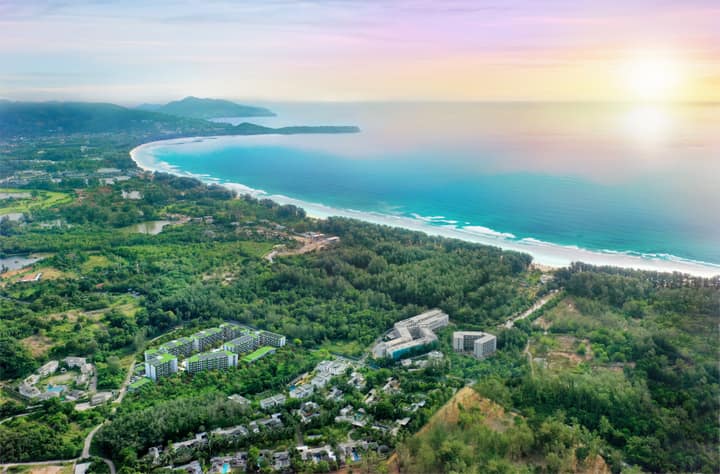
- Phuket (Thailand). A resort island where property is part of the tourism industry: demand is shaped by visitor arrivals, flight connectivity and Thailand’s visa policy, not by pure global capital flows. The Department of Lands is also a single national title registrar, but the market structure differs — not thousands of near-identical towers, but resort condo-hotels and villas clustered around specific beaches.
It matters not to confuse “country” with “market.” Dubai is effectively the entire relevant UAE market for a foreign investor — Abu Dhabi and the other emirates run under somewhat different rules. Phuket is one of several Thai resort destinations alongside Koh Samui, Hua Hin and Pattaya; for a comparison of destinations within Thailand itself, see Thailand property prices by region, and for a broader three-way comparison, see Phuket, Bali or Dubai.
2. Entry price and the typical product
The base product on the two markets differs, and the right comparison is not an abstract price per square metre but what an investor with a given budget actually buys.
| Parameter | Thailand (Phuket) | Dubai |
|---|---|---|
| Typical format | Condo-hotel / residence in a rental pool | Apartment in a high-rise tower or a townhouse |
| Starting entry | Studio from $235,995 (construction-period instalments) | Studio/1BR in areas farther from the centre — the lower market segment |
| Ready asset | Layan Green Park studio resale — $142,602, full payment, immediately in the pool | Ready units in prime districts (Dubai Marina, JVC, Downtown) — noticeably above Phuket entry levels |
| Developer instalment plan | Available on under-construction projects (35% / 50% upfront) | Widely used: a small down payment with a long schedule running before and after handover |
| Market density | Resort condo-hotels around specific beaches | Tens of thousands of near-identical units across competing towers |
Phuket sells a finished resort product: a unit in a building with its own infrastructure, where construction and handover are controlled by the developer and income by the management company. Dubai sells urban property in a competitive environment: location quality and developer reputation matter more than on a resort market, because the supply of comparable units in neighbouring towers is almost always large.
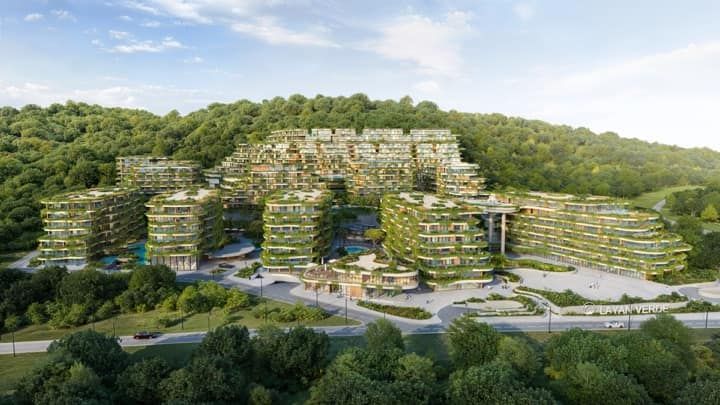
Cash flow timing is worth a separate note. Dubai developers often offer a minimal down payment with a long schedule stretching before and after handover, so a nominally high unit price doesn’t translate into a heavy upfront burden. On Phuket, instalments are usually capped by the construction period: Layan Verde runs 35% or 50% down-payment schemes with the balance due by the 2028 handover. Compare not just the final price but how much money is due, and when.
3. Ownership structure for a foreigner
This is where the two markets diverge most fundamentally, and it’s worth understanding before viewing specific units.
Dubai. Since 2002, a foreigner can hold full freehold — ownership with no time limit, registered in the DLD registry under their own name — but only in designated zones: Dubai Marina, Downtown Dubai, Palm Jumeirah, Jumeirah Village Circle, Business Bay and a number of other government-designated districts. Outside these zones, freehold is simply not available to a foreigner — it remains reserved for UAE and Gulf Cooperation Council nationals.
Thailand. A foreigner can own a condominium unit under freehold within a quota — up to 49% of a building’s floor area may be held directly by foreign owners, registered through the Department of Lands anywhere in the country, not just in specific districts. Once the quota is used up, or for a villa on land, leasehold applies instead: a registrable 30-year land lease with renewal options. See the detailed breakdown in leasehold vs freehold in Thailand.
| Criterion | Thailand | Dubai |
|---|---|---|
| Freehold equivalent for a foreigner | Condo within the 49% quota, nationwide | Freehold only in designated zones |
| Base alternative | Leasehold, 30 years + renewals | Outside designated zones, purchase by a foreigner is effectively unavailable |
| Local company required | No, for freehold condos | No, for freehold in designated zones |
| Single national registry | Yes, Department of Lands | Yes, Dubai Land Department (Dubai emirate only) |
| Geographic reach of the ownership form | Nationwide | Specific districts of one emirate only |
Bottom line: Dubai’s freehold is the legally cleanest title among the forms compared here, but it’s geographically confined to specific zones. Thailand’s system is broader geographically — the freehold quota applies to any condo project nationwide, and leasehold covers villas on land — but it introduces the concept of a “quota,” which simply doesn’t exist in Dubai.
4. Yield and rental management models
The way income is generated differs between the two markets, which affects not just the yield number but the amount of work the owner has to put in.
Thailand. The core tool on flagship projects is the rental pool: identical units are pooled together, the management company lets them and distributes net profit under a formula, usually 60% to the owner / 40% to the management company. At Layan Verde and Layan Green Park that targets ~8–10% net per year — a programme target confirmed by the working operation of Layan Green Park’s completed phase 1 since 2024. See the methodology in how to calculate ROI on Phuket.
Dubai. There’s no standard industry-wide rental pool with a fixed distribution formula on the mass market — management typically runs through a local management company charging a commission on turnover, or through short-term rental under a separate licence. Market consultants, including CBRE, typically quote gross rental yields in popular Dubai rental districts in the range of about 6–8% per year — but that’s income before service charges, management commission and vacancy costs, not a net figure to the owner. Comparing that gross rate directly with Thailand’s ~8–10% net figure is methodologically wrong — both numbers first need to be brought to the same basis: income after all costs.
| Parameter | Thailand (flagship pool) | Dubai (typical unit) |
|---|---|---|
| Management model | Developer’s management-company rental pool | Local management company or self-managed |
| Distribution formula | 60% owner / 40% management company | Turnover-based commission, terms vary by operator |
| Stated target | ~8–10% net | ~6–8% gross (before costs), per market estimates |
| Reporting transparency | Management-company reporting, verifiable pool track record | Depends on the specific operator |
| Owner workload | Minimal — the pool handles everything | Higher: choosing an operator, monitoring the service charge |
The practical takeaway: on Phuket, yield is typically a ready-made formula in the contract with the developer’s management company, backed by a verifiable payout history. In Dubai, it’s a market estimate that needs checking against the specific building and operator, and the final net figure depends heavily on management quality and occupancy.
5. Taxes, fees and ownership costs
Dubai. An individual owner pays no income tax and no capital gains tax on a property sale — one of the emirate’s main selling points. At registration, a Dubai Land Department fee applies, and after purchase there’s an annual service charge for building upkeep and shared infrastructure, set individually per building and potentially significant in premium projects with pools, gyms and concierge. Off-plan property in Dubai is protected by escrow-account law: buyers’ payments sit in an account supervised by the regulator and are released in construction stages.
Thailand. A transfer fee at the Land Department applies to a sale (split by negotiation), rental income is typically withheld at source for a non-resident, and there’s capital gains tax plus a specific business tax if sold within five years of ownership. At completed projects there’s a monthly CAM fee for common areas (Layan Verde: 85 THB/sqm per month; Layan Green Park: 75 THB/sqm per month) and a one-off sinking fund (850 and 650 THB/sqm respectively). See the detailed breakdown in property taxes in Thailand and sinking fund and CAM fee.
| Cost item | Thailand (Phuket) | Dubai |
|---|---|---|
| Registration fee | Land Department transfer fee | Dubai Land Department (DLD) fee |
| Personal income tax | No standalone income tax, but rental tax withheld at source | None |
| Capital gains tax | Applies on sale, including specific business tax within 5 years | None |
| Common areas / sinking fund | CAM fee + sinking fund (known upfront from the price list) | Annual service charge (set per building) |
| Protection of off-plan payments | Escrow is optional practice | Escrow is legally mandatory, supervised by RERA/DLD |
Both markets require building costs into the model upfront rather than pricing off a gross rate. The difference is that Thailand’s cost structure is standardised at the project level and known from the price list before the deal, while Dubai’s service charge is set per building individually and can change year to year at the building management company’s discretion.
6. Visas and residency through property
This is where the two markets diverge most, and for many buyers it matters as much as yield.
Dubai. A property investment meeting the threshold set by UAE rules — a single property or a portfolio worth AED 2,000,000 (roughly $545,000 at the dirham’s dollar-pegged rate) — opens the path to a long-term Golden Visa for 10 years, renewable, without the right to work for a third-party employer without separate authorisation. This is one of Dubai’s main non-market selling points: the visa is processed almost in parallel with the transaction.
Thailand. Buying a condo or villa does not by itself grant a visa. Instead, a separate set of tools is used: the LTR — a visa for wealthy residents, retirees and remote professionals with tax benefits on foreign income (see the LTR visa overview); the DTV — a 5-year digital-nomad visa; and the classic Non-O/O-A retirement visa. None of these is issued automatically upon a property purchase — they’re processed separately, although owning property helps demonstrate ties to the country when filing.
| Parameter | Dubai: Golden Visa | Thailand: LTR |
|---|---|---|
| Best for | Investor meeting the property investment threshold | Wealthy residents, retirees, remote professionals |
| Financial threshold | From AED 2,000,000 (≈$545,000) in property | Depends on LTR category, usually not tied to a specific property |
| Term | 10 years, renewable | Renewable long-term status |
| Link to property | Direct — visa is granted for the property investment | Not required |
| Tax benefit | The visa itself gives no separate tax break | Exemption from tax on foreign income, subject to conditions |
Practical takeaway: if residency through the purchase itself is the priority, Dubai gives a direct and predictable path. If flexibility and tax benefits on foreign income matter more, Thailand’s visa line-up (the LTR in particular) handles that separately from the property itself.
7. Regulatory environment and risks, 2025–2026
Both markets are currently going through tighter regulation — in different areas.
Dubai. The regulator (Dubai Land Department together with RERA) continues to fine-tune escrow-account rules for off-plan sales and broker licensing — the market is already one of the more heavily regulated in the region on protecting off-plan buyers. The main market risk is cyclicality: capital inflows and new project launches come in waves, and in an oversupply phase, competition between near-identical towers grows faster than demand.
Thailand. The Ministry of Commerce and related agencies are tightening controls on nominee ownership structures — Thai companies formally owned by Thai nationals but effectively controlled by a foreigner in circumvention of land law. The key takeaway for a buyer: the crackdown targets company-based ownership schemes, not freehold condos within the 49% quota or direct leasehold to a foreigner — those forms are unaffected.
| Risk factor | Thailand | Dubai |
|---|---|---|
| Regulator’s current focus | Nominee Thai companies | Fine-tuning escrow rules and broker licensing |
| Affects freehold condos in the quota | No | Freehold in designated zones is already protected by separate law |
| Protection of buyer funds on off-plan | Escrow is optional practice | Escrow is legally mandatory |
| Main market risk | Baht currency volatility, dependence on tourist arrivals | Demand cyclicality and volume of new supply |
8. Infrastructure, logistics and quality of life
- Airports and flights. Phuket has an international airport (HKT) with direct flights to Europe, Asia and the Middle East, 15–25 minutes from the west coast, including the Layan and Bang Tao districts. Dubai is one of the world’s largest aviation hubs, with direct flights to nearly anywhere from Dubai International Airport (DXB).
- Healthcare and schools. Phuket has a network of international-standard private clinics (Bangkok Hospital Phuket) and international schools within 20–25 minutes of most resort districts. Dubai has a dense urban network of private clinics and world-class international schools, but at a noticeably higher cost for both tuition and healthcare.
- Climate. Phuket is tropical with dry and rainy seasons; the swimming season on the west coast coincides with the high tourist season. Dubai’s winters are comfortable for outdoor life, while summer months (May–September) are spent largely in air-conditioned spaces.
- Cost of everyday life. Phuket is noticeably cheaper than Dubai for day-to-day costs — housing rent outside the investment property, dining out, transport; for a family with children in private school, the gap compounds over a longer horizon.
- Environment. Phuket combines resort infrastructure with a growing residential environment: supermarkets, restaurants and retail clusters like Boat Avenue near Bang Tao. Dubai offers a fully urban “everything within reach of the tower” format, with no nature on the doorstep but a rich business and social scene.
9. Pitfalls
- Confusing “an investment zone” with “any district in Dubai.” Freehold for a foreigner is only available in designated zones — verify the status of a specific building before booking rather than taking a broker’s word for it.
- Comparing Dubai’s gross yield with Phuket’s net yield. 6–8% gross on a Dubai unit and ~8–10% net on a Thai pool are different measures; bring both to an “after all costs” basis before comparing.
- Not budgeting for the service charge. In Dubai this fee is set per building and can rise year to year — check the payment history over 2–3 years, not just the current rate.
- Trusting a “guaranteed yield” with no source. The 60/40 formula at Thailand’s flagship pools is part of a contract with a verifiable track record; numbers without a contract and reporting are marketing on either market.
- Underestimating nominee schemes in Thailand. Owning a villa through a Thai company “for show” is under heightened regulatory scrutiny since 2025–2026; freehold condos within the quota and direct leasehold don’t create that problem in the first place.
- Not checking the real down payment in Dubai. A long payment schedule with a small down payment doesn’t make the property cheaper — it just stretches the cost over time, while the final price stays the same.
- Ignoring the difference between visa goals and the purchase itself. The Golden Visa is tied to a specific property investment amount; Thailand’s LTR and DTV are separate categories not tied to a specific property, and should be timed to their own schedule rather than “around the deal.”
10. Case study: choosing between Thailand and Dubai
An investor with a budget of around $230,000 was weighing an apartment in an up-and-coming Dubai district near a new metro line against a studio in a working condo-hotel on Phuket. The Dubai option won on formal title cleanliness — a full freehold in a designated zone — and on a potential path to a Golden Visa with a larger investment. But due diligence turned up details: the building’s service charge had risen by nearly a third over the previous two years, the advertised rental yield of “up to 9%” was gross, before that charge and the management company’s commission, and three comparable towers with similar units had been handed over nearby in the same period — competition for tenants turned out higher than at the outset.
The Layan Green Park studio resale near Layan beach, by contrast, went straight into a working rental pool under the 60/40 formula with a target of ~8–10% net, freehold was registered within the quota with no company needed, and the CAM fee and sinking fund were known upfront from the price list. The investor chose Phuket — not because the Dubai asset was bad, but because the goal was predictable passive ownership with a clear net yield and no exposure to a specific building’s rising service charge. For an investor with a different goal — say, prioritising residency through investment, or a larger budget for a premium city-centre freehold — the calculation could well favour Dubai.
Bottom line. Thailand and Dubai aren’t head-to-head competitors — they’re different models of owning overseas property. Dubai suits someone who values a maximally clean freehold title, a large liquid urban market and a path to residency tied to a specific investment amount. Phuket, and Thailand more broadly, suits those who value affordable entry, a ready-made net-income formula in the management-company contract, and a resort quality of life at a noticeably lower everyday cost. For a broader look, see Phuket, Bali or Dubai, which covers the same questions with a third market added, and see owning a villa through a Thai company for the nominee-structure topic in detail.
I can help compare specific Phuket properties against your budget and goal, with a yield calculation in the ROI calculator — or let’s discuss strategy through Layan Real Estate.
Get a shortlist for your strategy
By submitting this form you agree to the privacy policy.