The most common question from an investor who has already chosen a project is not about the area or the floor plan but about timing: “The baht is strong right now — should I wait for it to weaken?” It is a fair question. If you pay in dollars or euros, a few percent of exchange rate on a few hundred thousand dollars is tens of thousands. But there is a flip side that gets discussed less: while you wait for the rate, the price of the unit rises, the best positions are taken, and the instalment plan you counted on may change. This article explains how the USD/THB rate really affects the purchase, the instalments, the rental income and the exit, what you can calculate in advance, what you can only accept as risk, and why the rate matters but is far from the main factor in the decision.
One caveat up front: we do not forecast the exchange rate. It is driven by capital flows, tourism, exports, central bank decisions and geopolitics, and no agency can reliably guess it six months ahead. Everything we cite from market publications is dated and described for what it is — an analyst view on a specific date. Our goal is different: to show the mechanics so that you decide by calculation, not by anxiety.
Contents
- How the rate enters your deal
- What is known about the baht: dated facts
- Price list in baht and dollars: which rate is built in
- Instalments: when the rate works for you and against you
- Rent and yield: income currency vs investor currency
- Moving money: FET, banks and conversion
- Scenario maths: what ±5% of rate means
- Pitfalls: mistakes that cost more than the rate
- Mini-case: wait for the rate or enter now
- Conclusion and next step
1. How the rate enters your deal
The rate affects a Thai property investment at four points, and it is important not to lump them together:
- Purchase. You pay in the currency you hold (USD, EUR, and so on), while the unit is priced in baht. The weaker the baht, the less you pay in your own currency.
- Instalments. If construction-stage payments are spread over years, each tranche is converted at the rate on its payment date. The rate floats between tranches.
- Income. Rent and pool payouts arrive in baht. For an investor counting in dollars, the final yield also depends on the rate at the moment of withdrawal.
- Exit. On sale you receive baht and convert them back. The rate on that day can amplify the price growth of the unit or eat it.
In short, the rate is a multiplier on the whole life of the investment, not a one-off “discount at entry”. Buying at a good rate is nice, but if you exit five years later at a less favourable one, the benefit is cancelled. So the right question is not “on which day should I wire the money” but “what range of the rate can I live with over my holding period”.
A practical note: investors’ base currencies differ. For a dollar-budget owner a weaker baht is a discount. For someone whose budget is in roubles or hryvnia the picture is double: look not only at USD/THB but at how your own currency moves against the dollar. The baht can weaken against the dollar while your currency weakens against the dollar even more — and the purchase has in fact become dearer. Always calculate on the direct pair “your currency — baht” or via a two-step chain, including the real cost of conversion.
2. What is known about the baht: dated facts
We will not quote a “current rate” — it changes daily and an article lives for months. For official live quotes use the Bank of Thailand exchange-rate page. Instead, here are a few dated facts that show the character of the market:
| Date | What happened | Source |
|---|---|---|
| 24.04.2026 | The baht closed at 32.51 per dollar, a two-week low; the analyst range expected for the week was 31.70–32.70 | Nation Thailand, 27.04.2026 |
| April 2026 | Krungthai Global Markets expected about 32.85 by the end of Q2 and about 31.75 by year-end; Bank of Ayudhya expected a 31.50–33.50 range in H2 | Nation Thailand, 27.04.2026 |
| April 2026 | Cited pressure factors: Middle East tension, dividend outflows (about 100 bn baht in late April–early May) and interest-rate uncertainty | Nation Thailand, 27.04.2026 |
| 2025 – early 2026 | The central bank noted that a strong baht hurts exporters and tourism | Bangkok Post |
What follows for an investor? First: analyst forecasts differ even within one month — a range like 31.50–33.50 spans about six percent, and that is ordinary uncertainty. Second: all of them are forecasts. A bank expecting 31.75 by year-end is not a fact and should not drive your payment schedule. Third: the causes of swings are external (geopolitics, capital flows) and have nothing to do with Phuket property as such.
There is also a structural point: in Thailand it is periodically debated that an overly strong baht harms exports and tourism, so regulators and business have an interest in the rate not moving far in one direction. But “interest” is not a guarantee: the central bank can steer the rate only to a limited extent, and the regulator itself has said so publicly.
For the Phuket tourism market the link to the rate is real but indirect: a strong baht makes a holiday dearer for foreigners, a weak one cheaper, while demand also depends on flights, season and the regional situation. How visitor flow relates to rent we covered in Phuket tourism in numbers.
3. Price list in baht and dollars: which rate is built in
Developer price lists show the price in baht and duplicate it in dollars. That is convenient, but remember: the dollars in the list are a conversion at a rate chosen by the developer on the list date, not a quote on the day of your transfer. Here is how it looks on current positions (calculation: baht price divided by dollar price):
| Position | Price in baht | Price in dollars | Implied rate, THB per USD |
|---|---|---|---|
| Layan Verde, studio | 7,833,125 | 235,995 | ≈ 33.19 |
| Layan Green Park, phase 2, studio | 7,424,784 | 224,043 | ≈ 33.14 |
| Layan Green Park, phase 2, 2 bedrooms | 11,564,800 | 348,968 | ≈ 33.14 |
| Layan Green Park, phase 1, resale, studio | 4,800,000 | 142,602 | ≈ 33.66 |
What matters here:
- The implied rates are close but not identical: price lists were compiled on different dates, and a resale lot is run by the owner, who has their own baht price and their own conversion date.
- For the deal, the contract currency is decisive. If the contract states baht, your actual dollar cost depends on the rate on each payment day, not on the figure in the brochure.
- The site’s catalogue cards have a currency switcher that shows one currency per element, so you do not confuse a conversion with the contract price.
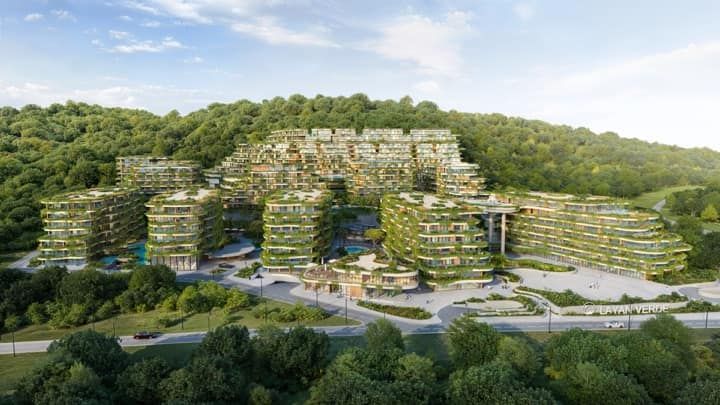
Practical conclusion: before reserving, ask the manager three questions. In which currency is the contract price denominated? In which currency is each instalment? At what rate and on what date is the equivalent calculated if you pay in dollars? These are ordinary questions and there should be a concrete answer. Current prices are on the Layan Verde and Layan Green Park pages: Layan Verde studios are now from $235,995 (7,833,125 THB), phase 2 Layan Green Park studios from $224,043 (7,424,784 THB).
A word on price growth. The exchange gap we argue about is a few percent, while project prices move differently: per the catalogue, Layan Verde studios rose from $224,776 to $235,995 over recent months (in July 2026, on the 01.07.2026 price list, it was $228,838). So waiting for a better rate has a price — the unit itself gets dearer, and entry positions sell out. We discussed this in the piece on the best time to buy Phuket property.
4. Instalments: when the rate works for you and against you
For off-plan projects the main mechanism is a construction-period instalment plan. Layan Verde offers: reservation 200,000 THB; the “35%” scheme — 35% plus five payments of 13% every 6 months; the “50%” scheme — 50% plus five payments of 10% every 6 months; full payment within 14 days. Completion is planned for December 2028.
So payments stretch over roughly two and a half years after the first instalment. The logic is simple:
| Rate at payment | If the payment is fixed in baht | If the payment is fixed in dollars |
|---|---|---|
| Baht weaker than at signing | Cheaper for you in dollars | No change |
| Baht stronger than at signing | Dearer for you in dollars | No change |
| Baht near the previous level | No material change | No change |
The first thing to find out is which currency the schedule is denominated in. If baht, you effectively hold an “open currency position” for the whole instalment period: part of future payments depends on the rate. That is neither good nor bad in itself — it is a risk (and an opportunity) to be aware of. If you earn in dollars and fear baht strengthening, you can shrink the open position: choose a scheme with a larger first payment (50% instead of 35%), or convert part of the funds for future payments in advance.
Second — balancing. Many investors split future tranches into two baskets: the part they are ready to convert immediately (to lock the rate) and the part they leave floating. This needs no financial instruments but lowers the chance of an unpleasant surprise. For the wider arithmetic of ownership costs see How much buying Phuket property costs.
Third — do not confuse instalments with a mortgage. A developer instalment plan is a payment schedule without a bank; mortgages for foreigners in Thailand are a separate and non-trivial subject covered in our article on financing and mortgages for foreigners. The currency risk differs between the two.
Also remember that terms change: in Layan Green Park phase 2 the earlier post-completion instalment has been cancelled, and the whole phase 1 price list consists of resales with full payment. For “ready” positions there is no schedule, and you fix the rate on the day of the deal in a single payment.
5. Rent and yield: income currency vs investor currency
Rental income is formed in baht: guests pay in local or foreign currency, but settlements with owners are in baht. For the rental pool in our projects the benchmark is: 60% of net pool profit goes to the owner, 40% to the management company; the target is roughly 8–10% net per year, with payback usually estimated at around 12 years. These are programme targets, not a guarantee.
Now add currency. Suppose you measure results in dollars. Then annual income in dollars equals baht income divided by the rate on the withdrawal date. If the baht weakens 3% over a year, the same baht sum becomes slightly fewer dollars, and vice versa. A foreign investor therefore has two layers of return:
- Operating — how many baht the unit earned (depends on season, occupancy, rates, fees);
- Currency — how the rate changed between purchase and withdrawal.
The layers add up but differ in nature: the operating one you can improve (project choice, management, occupancy), the currency one you cannot. That is why an honest model shows a base case “rate unchanged” and two boundary cases — “weaker baht” and “stronger baht”. How to build such a model is covered in How to calculate ROI in Phuket, and you can run a quick calculation in the yield calculator.
There is also a natural “hedge”: if you do not plan to withdraw income but spend it in Phuket (stays, travel, upkeep — CAM fee, utilities), part of income and expenses is in one currency and the rate barely touches you. The more you live and spend inside Thailand, the lower your real currency risk. Ongoing owner costs: at Layan Green Park the CAM fee is 75 THB/m² per month and the sinking fund 650 THB/m² one-off; at Layan Verde 85 THB/m² per month and 850 THB/m² one-off. These are baht-denominated, so for an owner with baht pool income the same currency covers them.
Do not forget tax. Rental income is taxed under Thai rules, and your country of residence may have its own obligations — see our pieces on rental income tax and double tax treaties. Tax authorities treat exchange differences differently — consult a tax adviser. This is not legal advice.
6. Moving money: FET, banks and conversion
The rate is not only a “quote” but the real cost of an operation. Between the rate on screen and what you actually receive sit the bank or payment-service spread, SWIFT fees and the receiving bank’s fees. On hundreds of thousands of dollars these costs can match the very rate gain you waited for.
What to clarify before transferring:
- Which rate the bank will apply and how it differs from the interbank rate. The spread is a hidden commission.
- Whether an intermediary bank deducts a fee from the payment (then less arrives than you sent).
- Which currency to send in — dollars directly or converted by the sender. For freehold registration the money must enter the country in foreign currency and the bank issues a FET form; leasehold needs no FET. See FET in Thailand. Currency rules are published by the Bank of Thailand on its Foreign Exchange Regulations page.
- How to word the payment purpose so the bank can issue the proper confirmation.
If you open an account at a Thai bank, mind the non-resident conditions; options are reviewed in internet banks in Phuket. If you pay in parts, each operation is converted separately. Keep a table: date, amount in the sending currency, rate, baht amount, fees. A year later it will save you from arguing with yourself and help compute the real cost of entry.
Last but important: keep the documents proving the currency was brought in. On sale and repatriation the bank may ask for proof the money entered legally. That affects your exit too — which, as shown in exit strategies, also depends on the rate.
7. Scenario maths: what ±5% of rate means
Take an illustrative budget of $250,000 (an illustration, not the price of a specific unit) and see how the picture changes at different rates. The arithmetic carries no forecasts:
| Rate, THB per USD | Baht received for $250,000 | Versus rate 33 |
|---|---|---|
| 31.35 (baht 5% stronger) | 7,837,500 | −5% baht |
| 33.00 (base case) | 8,250,000 | — |
| 34.65 (baht 5% weaker) | 8,662,500 | +5% baht |
The gap between the extremes is 825,000 baht (412,500 either side of the base case). Expressed back in dollars: to buy a unit priced at 8,250,000 baht you need about $263,160 at a rate of 31.35 and about $238,100 at 34.65. The spread is about $25,000 on an object where you invest a quarter of a million. That is significant, but compare it with other cost lines and with the price dynamics of the unit itself.
Now add price growth. Suppose you postpone by six months hoping for a rate “5% better”. If the baht price rises 5% in that time (an illustration, not a forecast), the entire gain is eaten — you end up with the same result but without the unit, without the instalment on previous terms and without the choice of unit. If price does not rise and the rate improves, you won. If the rate worsens and price rises, you lost twice. There is no symmetry: waiting has costs, buying has rate risk, and both must be weighed.
We do not claim waiting is always bad. We claim the decision to wait must be made by numbers: what price growth in your project you are ready to lose, what share of the budget is already converted, which payment terms may change. Price history is visible: Layan Verde prices rise as it is built, and the earlier post-completion instalment in Layan Green Park phase 2 is already cancelled.
A simple way to decide without a forecast is the three-basket rule:
- The part needed for reservation and the first payment — convert at once; it fixes price and terms.
- The part meant for future tranches — convert in stages, for example before each payment, or take the “average” rate over the period.
- A reserve for unexpected costs and taxes — keep in the currency you are used to living in.
That way you do not try to “catch the bottom” — you smooth the risk and keep the plan moving.
8. Pitfalls: mistakes that cost more than the rate
- Waiting for the “perfect rate” and missing the unit. If the best positions sell and prices rise, the rate gain may be smaller than the price loss.
- Treating dollars in a price list as the contract price. The dollar price is a conversion. The contract sum is in the currency stated in the contract.
- Ignoring spread and fees. A “good rate” on screen is not a good rate in your payment. Compare the final amount that reaches the recipient.
- Not fixing the currency of each instalment. If the schedule is in baht and you plan to pay in dollars, write down the conversion rule and rate date.
- Skipping FET on a freehold purchase. Without proof of currency import, registration in a foreigner’s name is at risk, and repatriation on exit becomes harder.
- Confusing rate and yield. A yield of ~8–10% net per year is a baht figure under the pool model. The rate can add to or take from the result in your base currency.
- Building strategy on forecasts. An analyst forecast is not a fact. Model a range and a stress scenario, not one pretty number.
- Buying a weak asset “for the rate”. A 3–5% rate gain does not compensate for a poor location, an unclear rental model or no clear exit. Check the project on merit — for example via off-plan versus ready comparison.
- Forgetting tax. Exchange differences, rental income and sale may have tax effects in different countries. Ask a specialist.
If you remember one item from the list, make it number 1: the most expensive rate mistake is not buying “at the wrong rate” but not buying at all while waiting.
9. Mini-case: wait for the rate or enter now
A typical situation (a generalised example, not a specific client). An investor is ready to put in about $250,000 and eyes a studio or one-bedroom in Layan. The baht feels “too strong” and they want to wait three to four months hoping for a weaker rate. What we do:
- Record the inputs. Budget in currency, holding horizon, goal — cash flow or capital growth.
- Calculate two scenarios. A: buy now at the current list and rate. B: buy in several months at a rate 3–5% “better” but at a price that grew on the list trend. For Layan Verde, where studios rose from $224,776 to $235,995, short-term price growth is comparable with the rate gain the investor dreams of.
- Look at terms. The Layan Verde 35% or 50% scheme lets you convert money in parts rather than the whole budget in one day; for a ready resale in Layan Green Park (phase 1, studios from $142,602, full payment) the rate is fixed on deal day.
- Split the budget into baskets. One part for reservation and first payment now; one for tranches in ~6 months when the rate will be different (better or worse — unknown); a reserve in the base currency.
- Write the decision down so as not to revisit it at every move of the rate.
The outcome is usually this: the investor does not “beat the market” but gets a position in the project at the current price, a payment schedule with clear dates and protection from emotional decisions. If the rate later improves, the extra baht arrive on the later tranches; if it worsens, the blow is spread. It is dull, but that is what managed risk looks like.
To compare formats — construction with instalments versus a ready resale — see our material on off-plan and ready properties: they have different currency profiles because in the first payments are stretched, in the second the rate is fixed in one day.
10. Conclusion and next step
The baht rate matters, but it is one variable, not the main signal to buy. It affects entry price, the cost of instalment tranches, final return in your currency and the exit result. It does not affect how good the location is, whether the developer is reliable, whether the rental model is transparent and whether you have a clear exit. So the order of decisions is: first the project and income model, then payment structure and contract currency, and only then the timing of conversion.
What to do in practice:
- Define your base currency and budget; calculate the cost of entry in three rate scenarios.
- Clarify the contract currency and the currency of each instalment.
- Compare the real cost of transfer (spread and fees) across two or three channels.
- Split the budget into baskets and write down the plan.
- Do not postpone a quality unit for a few percent of rate without calculating the price of waiting.
If you wish, we will calculate your case: market commission, terms at a meeting; you receive the current price list, payment schemes and a calculation under several rate scenarios. Leave a request, look at Layan Verde and Layan Green Park, as well as our agency and the area comparison — Layan and Bang Tao.
This material is informational, is not legal, tax or investment advice and contains no exchange-rate forecast. Market data are dated to their sources; prices and availability are per the developer price list — verify at the time of the deal. A yield of ~8–10% is a programme target, not a guarantee.